Chapter 1 — The City of Little Lights
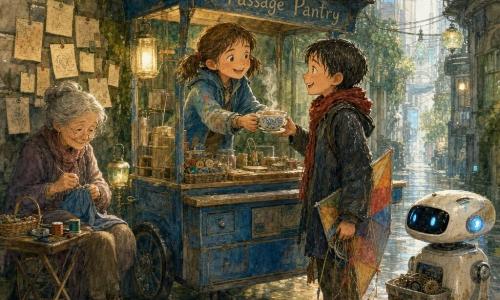
Mira lived in a city that blinked like a jar of fireflies. It was not full of insects, but of lamps so soft they looked like small moons. They hung from trees, floated on the edges of rooftops, and slid along the gutters to follow people in the rain. At night, the city became a gentle ocean of light. Robots hummed quietly on the sidewalks, carrying parcels, watering window gardens, and opening doors for anyone who needed help.
Mira was nine, with a ribbon that never stayed in place and a pair of round glasses that kept slipping down her nose. She loved the city's sounds: the hush of floating buses, the chirp of message-bots, and the faint click of tiny sensors tucked into lamp-posts. The sensors were discreet; you could only see them if you looked for them. They watched for trouble and helped when needed, like small, silent guardians.
One morning in late spring — not long from now, but the kind of future you could imagine with one eye open — Mira woke up to a sound. It was a small, sad creak coming from the door to the little library under her building. That library was special. Its shelves held thin paper books beside glow-tablets. Old maps leaned next to fresh city plans. Mira loved both. She slipped on her shoes, tied her ribbon properly for once, and hurried down the hallway.
At the library door she stopped. The hinge that joined the heavy wooden door to its frame had a loose bolt. Every time the door swung, it made a tired, complaining sound. A small helper-robot named Pipp stood beside the door, blinking polite blue lights. Pipp was the kind of robot built for small kindnesses: it could hand you a cup of tea, find a lost sock, or read a map out loud. Today Pipp looked puzzled.
“Oh,” Mira said. She reached out to the hinge and felt the wobble. “We need to fix that.”
Pipp's lights pulsed. A tiny sensor at the hinge whispered the door's complaint to the building's maintenance grid. The grid answered with calm numbers. Repairs were on their way, it said, but the earliest appointment was tomorrow. Mira's heart sunk. The library closed tonight at dusk for the reading of the Lantern Stories, and she'd promised to bring a new story to read aloud.
She looked at Pipp. “I can try,” she said.
Pipp handed her a small toolkit from under its tray — a loan from the city's lending pool. The tools shone like little promises. Mira sat on the steps and examined the hinge closely. She had watched maintenance robots fix things before, but never done it herself. Her fingers trembled a little.
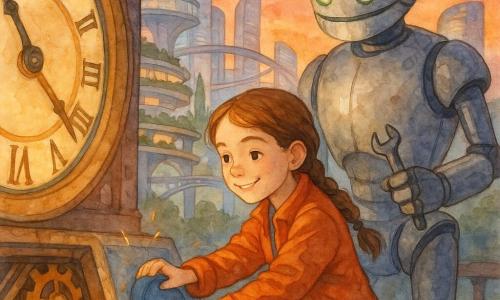
The city of little lights watched. Soft lamps leaned closer to give her more brightness. A sensor near the door offered a gentle diagram through Pipp: angle, bolt size, torque needed. Mira breathed in, the way her mother taught her when tying a tricky knot. Patience, her mother always said, is like a tool. She set the bolt in the hole and turned the screwdriver slowly. The hinge stopped squeaking. Mira smiled, small and proud. The door closed smoothly.
“Thank you,” Pipp hummed.
Mira learned a rule that morning: patience makes a hinge thankful.
Chapter 2 — The Route of Quiet Helpers
After the fix, Mira stepped into the library. The shelves smelled like sun-warmed paper and lemon oil. She found a stool and climbed to the top of a ladder to pluck a paper book that had been balanced on the highest shelf. It was a slim green book with a map of the city inside. She planned to read a passage that night about the first lamps.
“Are you staying for the Lantern Stories?” asked an old librarian robot named Gert, who had a patchwork voice like a radio from long ago. Gert's eyes were two warm amber discs, and he blinked slowly.
“Yes,” Mira said. “I brought a new story.”
Gert hummed with delight. “Good. People like your stories. They are kind and clever.”
Mira accepted the compliment like a small, glowing coin. She did not know her stories were already liked. She felt pleased, but also nervous. A story shared is like releasing a paper boat into a river; you hope it floats.
Later, Mira walked through the city with Pipp by her side. The route to the lantern square took them along a canal that mirrored the lamps. Sensors in the stone whispered about the water's level; they nudged small sluice-gates to keep puddles from making the cobblestones slippery. Robots with long arms trimmed vines that had grown too curiously into the street. Each helper moved quietly, like a thought doing its job.
As they walked, Mira heard a different kind of noise: someone whistling off-key beside a delivery drone. A small robot gardener had its arm stuck in a folding gate, where a hinge — older, rustier than the library's — groaned with every pull. The gardener, a cheerful cylinder named Fenn, tried to free his arm, but it hurt his servo. He winced in a sympathetic beep.
“Hold still,” Mira said quickly. She remembered the slow twist that had steadied the library door. Pipp projected the hinge's measurements and suggested a tiny reverse-torque. Mira asked Fenn to rest his arm on a soft cushion. She took out a cloth, and with the patience she had practiced earlier, she loosened a pin, cleaned the hinge, oiled the joint with her small dropper, and re-secured the pin. Fenn stretched his arm and sighed a happy mechanical sigh. The whistling stopped, replaced by a clear, grateful chime.
“You are a careful hand,” Gert intoned later when Mira recounted it. “A patient hand fixes many things.”
Mira began to notice how many small things needed patient hands. The city had many helpers, but sometimes its helpers needed help too.
Chapter 3 — The Night of Wind and Lamps
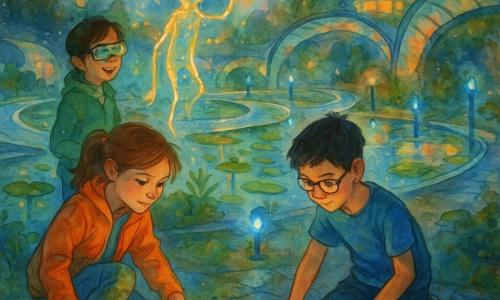
The evening of the Lantern Stories arrived with a wind that carried the scent of rain and toasted bread from the rooftop ovens. The lantern square filled with people under the soft lamps. Children balanced paper lanterns with glitter inside. Robots arranged cushions in a circle. Sensors placed their tiny listening leaves so everyone could hear without shouting.
Mira sat on a cushion at the very front. She gave her paper book a last nervous thumb-through. Above them, the lamps pulsed like guardians winking in the dark. The librarian robot Gert introduced her with a small, rusty flourish. “This is Mira, an explorer of hinges and hearts,” he said.
Mira began to read. Her voice trembled but held. She read of a little city that learned to take care of its small sounds. She read of a girl who repaired a hinge and found patience growing like a vine. The book was about that very library door, and about the gardener's arm, and about a mayoral drone who had once lost its compass but was helped back on course by a boy with a map. The listeners leaned close. Pipp blinked a proud blue.
Halfway through, a gust of wind swept over the square. One of the tall lamps in the corner leaned awkwardly. A panel at its base had sprung a hinge, and the lamp began to sway. It was one of the newer lamps, filled with soft, programmable light. If it fell, it would scatter tiny bulbs into the street and cause a mess.
Gasps rose like a ripple. The maintenance grid buzzed, but the wind had blown a leaf into a sensor and slowed its warning. Above the square, the lamp shuddered.
Mira's hands tightened on the book. She remembered the slow screwdriver turn, the oil drop, the patient cloth. She also remembered how the city's helpers had always been there when she needed them. She rose and stepped into the soft light.
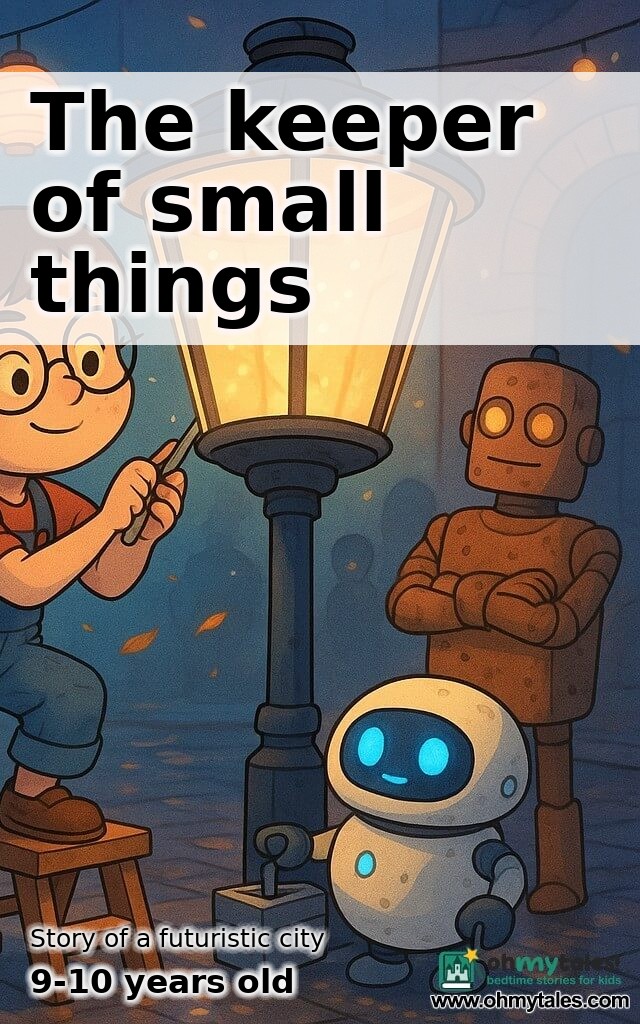
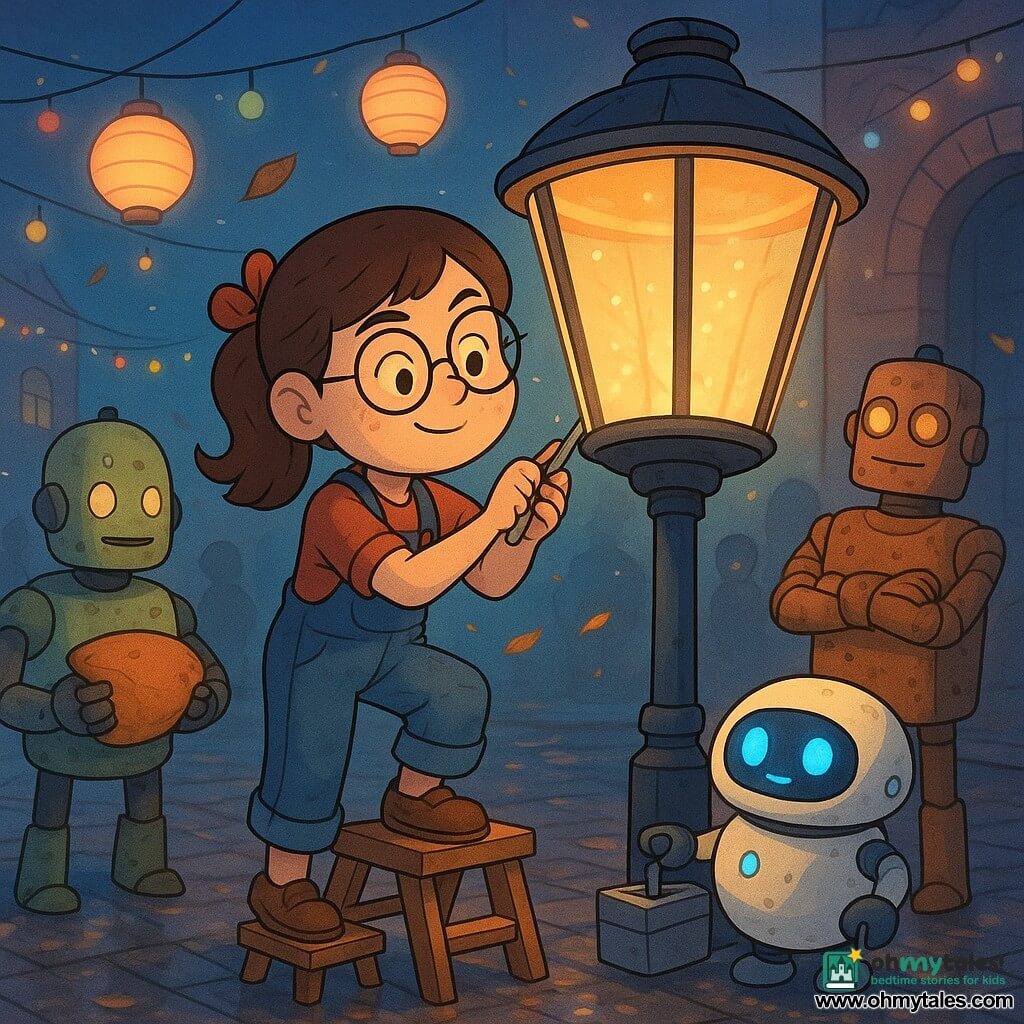
“Stop swaying,” she told the lamp, as if talking to a friend. The lamp's light flickered like surprised eyes. Pipp rolled close and offered a bracket from his tray. Mira climbed a short ladder. The hinge was old at the base, hidden beneath ornamental leaves. The bolt was loose, the same tired wobble she had felt that morning.
Her fingers worked carefully. Children watched, their eyes wide. Robots hushed and held their tools steady. Mira's hands were steady too, but she spoke out what she was doing: “Clean the bolt, tighten this one, a little oil here.” Saying the steps made them feel safer. She breathed slow breaths. The wind tried to dart its fingers between the lamps, but it could not hurry her. Patience kept her hands steady like an anchor.
At last she tightened the final screw. The lamp settled, upright and grateful, its light flushing bright and warm. The square burst into soft applause. Mira climbed down, cheeks pink with excitement. The city's lights seemed to glow a little brighter, as if proud.
Gert handed Mira a small paper with a seal — a library note recording her deed. “You have written yourself into the city's repair book,” he said.
Mira folded the paper and put it in her pocket. She thought about how each small act had kept the city gentle.
Chapter 4 — The Quiet Map
After the ceremony, a man with a silver cap and a bag of maps approached Mira. He was a map-keeper, a person who took old and new maps and stitched them together so the city could remember itself. He had been listening to Mira's reading and watching her fix the lamp.
“You repaired a hinge with care,” he said simply. “Would you mark this place on the Quiet Map?”
The Quiet Map was a soft thing. It recorded little places where patience had been important: benches where people had waited for friends, corners where apologies had ended big fights, wells where dry seasons had been endured. The map did not point to treasure. It pointed to moments that made the city kind.
Mira opened the map case. The keeper handed her a small pen that wrote in light. She placed a dot by the lantern square and wrote three words: “Slow hands heal.” The pen left a glow that would stay as long as someone remembered to look.
“Why does the map care about patience?” Mira asked.
The keeper smiled. “Because a city is only as gentle as the time its people take to listen. Hurrying can break more than metal.” He tapped his cap lightly. “A hinge is small, but it is also a promise that things will swing open again.”
Mira thought of Gert's warm eyes and Pipp's polite blue lights. She thought of the gardener Fenn's grateful chime. She thought of her mother's knot-tying breath. She felt that same steady warmth inside her chest.
“What will I be called on the map?” she asked.
“You will be called a keeper of small things,” the map-keeper said. “That is a fine title.”
Mira folded the Quiet Map and tucked it under her arm. She felt patient in a new way: like a quiet river that keeps flowing, not rushing, carrying small boats safely to shore.
Chapter 5 — The Story That Travels
Spring slid into summer. The lamps hummed gently each night. Mira kept going to the library and reading stories. Sometimes she fixed things — a loose hinge on a music box, a squeaky panel on a playground robot — and always she did the small, careful work with slow hands.
One afternoon, a letter arrived at the library with a pale blue stamp that read: For the Lantern Stories. Inside was an invitation. A little press from across the river wanted to publish the story Mira had read: the one about the city that learned to take care of small sounds. The press was run by people who loved slow things: bakers who kept sourdough, cobblers who knew how to wait for leather to soften, and printers who used old presses that pressed letters into paper like gentle kisses.
Mira's heart leapt. She had never thought her words would leave the square and travel in paper boats to other places. She imagined children in another quarter reading about the lamp that had leaned, and how a girl used patience to fix it.
She worked with the printers. They asked her questions about hinge sizes and oil drops and how she calmed her hands. She answered them simply. They folded her story into neat pages, pressed the cover with a small metal stamp, and tied a ribbon around bundles of books.
On the day the books were ready, the press sent a courier-bot to the library. It arrived under a path of lanterns, carrying a small cart piled with copies. The cover showed a lamp under a moon, and inside, Mira's words flowed like a gentle stream. She held a copy and read a passage aloud to the library's small audience. The words felt the same and also new, like a song you learn all the words to.
Later that week, a postcard came with a drawing on it. A child from another neighborhood had drawn Mira fixing a lamp and had written: Thank you for teaching us patience. Mira's cheeks warmed. She had taught, and yet had learned so much.
That night, the city of little lights seemed to hum in approval. The lamps shone steady. Mira walked home under them, the ribbon in her hair untied but fluttering happily. She thought about hinges and maps and slow hands. She thought about patience like a quiet skill that everyone could learn.
At home, she placed the first published copy on the library's shelf, right next to the green map book she loved. Gert gave her a little bow of his amber eyes.
“Now your story will travel,” he said.
“And people will remember slow hands,” Mira replied.
She slid under her blanket with the sound of lamps and robots murmuring outside. She drifted off thinking about the small, patient fixes she would do tomorrow. The city would keep its soft lamps and discreet sensors and helpful robots. It would keep its quirks and its little creaks. But now it had a new story tucked into its heart — a story that would be read and held, and maybe, if someone needed it, would teach them to slow down and turn the screw gently.
Mira fell asleep smiling, knowing that patience, like a hinge, made things open again.