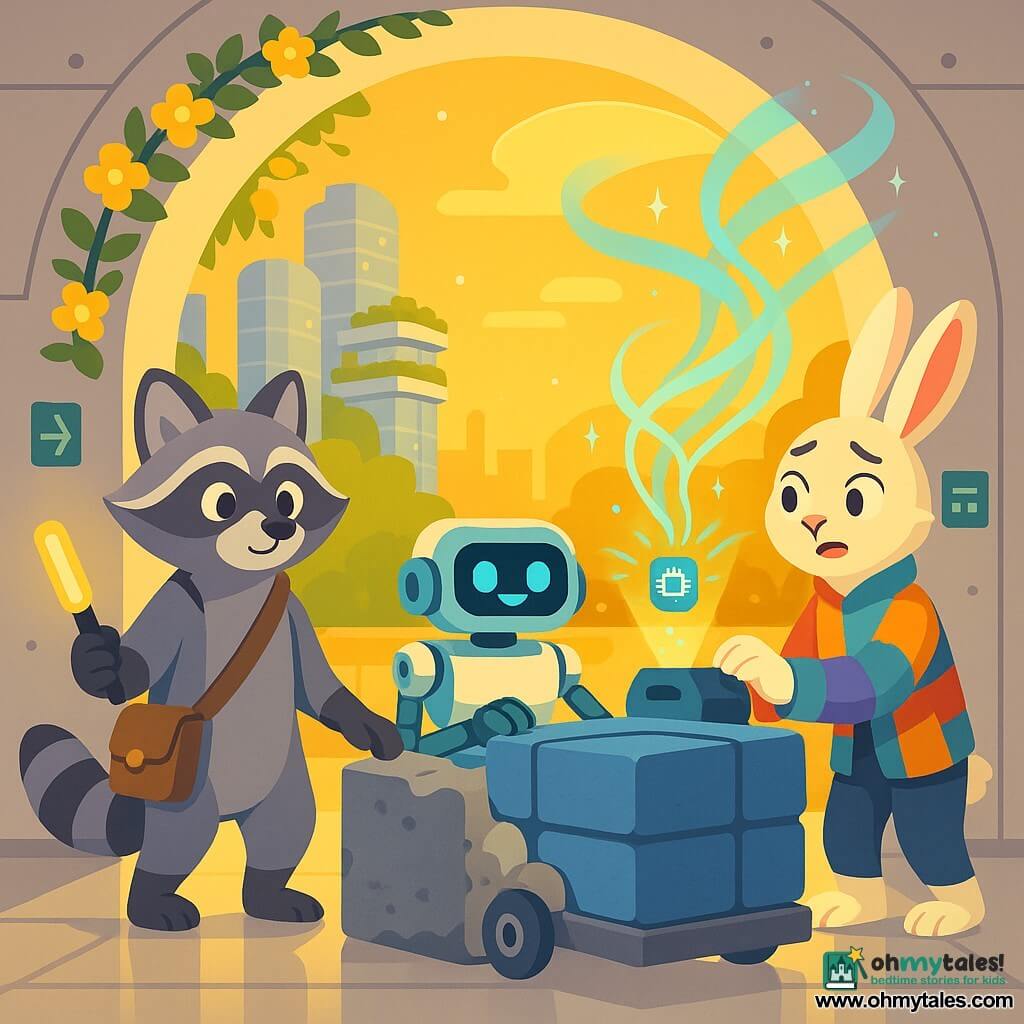
Chapter 1: Sensors in the Morning Mist
Milo the raccoon liked numbers, schedules, and things that worked the way they were supposed to. In Greenrise City, most things did. The towers were wrapped in glass greenhouses, stacked like bright lanterns. Inside them, school gardens climbed upward—rows of beans, strawberries, tiny apple trees, and learning benches that smelled of clean wood.
Milo trotted along the Skywalk Lane with his satchel bouncing at his side. Under the clear floor, he could see the street far below, where delivery bots rolled like patient beetles. Above, soft drones hummed, checking air quality and counting pollen. Everything was watched by discreet sensors—little dots in walls and railings, so small you forgot they were there until they blinked once, like a polite wink.
A helper robot rolled up beside him. Its shell was mint-green, its face a simple screen with calm eyes.
“Good morning, Milo,” it said. “Hydration reminder: sip water.”
“I know,” Milo replied, practical as ever. “I already did. Twice.”
The robot's eyes curved into a smile. “Excellent planning.”
Milo reached the entrance of Glasshouse School Tower Seven. Inside, warm air smelled like basil and sun. Students—young foxes, otters, cats, and squirrels—moved between plant beds and lesson pods. A ceiling of smart glass adjusted to the clouds, turning brighter when the sun hid.
Today's lesson was simple: check the growth charts, collect soil samples, and then join the afternoon tour of the new city tunnel route. The tunnel was important. It carried food carts and emergency helpers, and it kept traffic smooth.
Milo liked smooth.
Right after lunch, the tower gently shivered. Not a scary shake—more like a big building clearing its throat. A soft chime sounded, and a message floated across the hall screens:
“TUNNEL ROUTE TEMPORARILY CLOSED. PLEASE USE ALTERNATE PATHS.”
Milo's whiskers twitched. “Closed?” he muttered. “Why would it close on a clear day?”
A nearby sensor blinked red, then green, then red again, like it couldn't decide what it had seen.
Milo didn't like things that couldn't decide.
Chapter 2: The Blocked Route
After lessons, Milo headed to the tunnel entrance with a small group. The entrance was a wide archway of white stone, planted with climbing flowers that smelled like lemon. A line of helper robots stood in a neat row, gently guiding everyone toward detours.
One robot held up a sign: “ROUTE CLOSED: OBJECT DETECTED.”
Milo stepped closer. “What object?”
The robot's voice remained calm. “Unidentified obstruction. Safety protocol engaged.”
Milo craned his neck. Beyond the arch, the tunnel lights blinked in a slow rhythm. The air smelled faintly metallic, like rain on a railing. Milo spotted something farther in—something dark and lumpy, sitting right in the middle of the path.
It looked like a pile of broken crates.
No, not broken. Melted.
Milo's practical mind clicked through possibilities. “If it's melted, it was heated. If it was heated, something caused it. But there's no fire alarm. And the sensors would—”
A small drone zipped down, hovered, and projected a tiny map in the air. A red circle pulsed where the obstruction lay.
“Detour adds thirty-two minutes,” the drone chirped.
Thirty-two minutes meant late deliveries to the school greenhouses. Late deliveries meant thirsty seedlings. Milo imagined the baby tomato plants drooping like sad ears.
He puffed out his cheeks. “That's not acceptable.”
Beside him, a classmate—a sleek gray cat—shrugged. “Robots will handle it.”
Milo respected robots. They were helpful and kind. But even helpful things could miss details.
Milo slipped to the side, toward a maintenance door marked with a friendly pawprint symbol. It wasn't locked—Greenrise City trusted its citizens, and most doors opened for anyone with a good reason. Milo didn't have a fancy badge, but he did have a very good reason: thirsty tomato plants.
He pressed the door pad. “Maintenance access,” he said, trying his most responsible voice.
The pad flashed yellow, then green. The door sighed open.
A narrow corridor ran alongside the tunnel, lined with cables in tidy bundles. Small sensors dotted the walls like silver freckles. Milo moved quietly, paws soft on the floor.
Up ahead, a glow spilled under a side hatch—shimmering light, not like the tunnel lamps. More like sunlight through soap bubbles.
And someone was humming.
Chapter 3: The Hologram Artist
Milo peered through the hatch window.
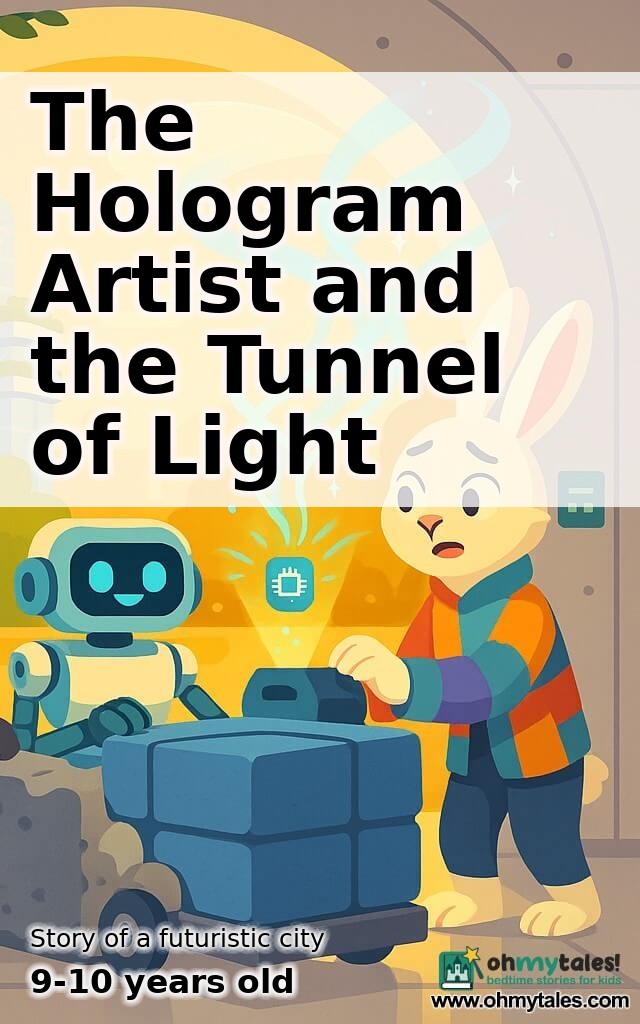
Inside a small service bay stood an arctic hare wearing a vest covered with bright patches. Their ears were tall and expressive, flicking in time with their humming. In front of them, a projector unit sat on a tool table—except the “projector” wasn't making a flat image. It was painting the air with floating shapes: fish made of light, paper kites that fluttered without wind, and a miniature greenhouse tower that opened like a flower.
The hare noticed Milo and didn't startle. They simply tilted their head, curious.
“Hi,” the hare said. “You're not a robot.”
“I'm not,” Milo agreed. “I'm Milo. And the tunnel's blocked.”
The hare's nose wiggled. “I know. I might have… helped with that. By accident.”
Milo stepped in carefully. The holograms drifted around him, cool and bright. One fish swam through his paws without touching.
“I'm Luma,” said the hare. “Hologram artist. I was hired to make the tunnel opening look festive for tomorrow's Greenrise Parade.”
Milo frowned. “Festive doesn't usually mean ‘melted crates.'”
Luma's ears drooped. “I was testing a new light sculpture. It's supposed to be harmless. But the sensors in the tunnel are very sensitive. When my hologram ‘waved' at them, the system thought it was real movement. It sent cleaning bots in a hurry. One bot bumped the supply stack. Then the heat lamp—just a warm-up lamp—fell and softened the crates. Not a big fire, just… a very gooey mess.”
Milo stared. His mind lined up the facts like seeds in rows. “So the sensors reacted to light as if it was solid.”
“Yes,” Luma admitted. “I didn't mean to confuse them. I love this city. I don't want to cause trouble.”
Milo took a slow breath. Luma looked honestly worried, not careless. Milo remembered what his teachers always said in the greenhouse-school: respect living things, respect tools, respect each other—even when mistakes happen.
“What are the crates for?” Milo asked.
“Seed packs,” Luma said softly. “For the school towers. For the winter cycle.”
Milo's stomach sank. “Then we really need the route open.”
Luma nodded quickly. “I've been trying to fix it, but I'm an artist, not a route engineer.”
Milo squared his shoulders. “I'm not an engineer either. But I'm good at simple plans.”
Luma's ears perked. “Simple plans are my favorite kind.”
Chapter 4: A Simple Plan with Bright Light
Milo and Luma crouched by the service bay table. Milo studied the tunnel map on a wall screen. The obstruction sat in a narrow section where the tunnel curved. Cleaning bots couldn't push the gooey crates without spreading the mess. And the safety system had locked down the route until the sensors reported a clear path.
“First,” Milo said, “we stop the sensors from panicking.”
Luma raised a paw. “I can turn off my holograms.”
Milo nodded. “Good. But we also need to tell the sensors what's real and what's light, so they don't overreact next time.”
Luma tapped their vest pocket and pulled out a small, flat chip. “A light-tag. It marks holograms with a special shimmer. Sensors can read it as ‘art' instead of ‘object.' I didn't install it because I wanted the fish to look extra natural.”
Milo gave Luma a look—firm, but not mean. “Natural is nice. Safe is nicer.”
Luma's ears dipped in apology. “You're right. Respect first.”
They attached the chip to the projector. The holograms changed at once: still beautiful, but now each one carried a faint, friendly sparkle, like dew.
“Second,” Milo continued, “we clear the obstruction without smearing it.”
Luma pointed toward a storage rack. “There's a foam sprayer for packaging. It hardens into a light shell. We could coat the goo so it becomes solid again.”
Milo's eyes brightened. “Yes. Make it one piece, then lift it.”
They rolled a small cart toward the tunnel access panel. A helper robot noticed them and glided closer.
“Unauthorized maintenance activity detected,” the robot said, not angry—just careful.
Milo stood up straight. “We're solving the problem. The crates contain seed packs for the school towers. We will be respectful and follow safety steps. Please assist.”
The robot paused, its screen-eyes blinking. Then it nodded. “Request acknowledged. Assistance engaged.”
With the robot's help, they entered the tunnel edge. The tunnel lights reflected on the glossy floor. The obstruction sat ahead: a dark mound with seed labels half-stuck in sticky folds.
Luma handled the foam sprayer with steady paws, coating the mess in a pale blue layer. It puffed softly, like whipped cream, then firmed into a smooth shell.
Milo used a scanner wand from the cart, moving it along the foam. “No heat,” he reported. “Good.”
The helper robot extended lifting arms and raised the hardened bundle carefully. Milo guided it toward a containment bin. Luma walked alongside, projecting a small arrow of light on the floor to show the safest path—sparkling with the new tag so the sensors wouldn't mistake it for a real obstacle.
The tunnel sensors blinked once, then settled into calm green.
Milo let out a breath he didn't know he'd been holding. “See? Simple.”
Luma grinned. “Simple, and kind.”
Chapter 5: The Cleared Road
Back at the tunnel entrance, a gentle chime rang out. The wall screen updated:
“ROUTE CLEAR. THANK YOU FOR YOUR COOPERATION.”
The helper robots rolled forward in an orderly line, checking the path, polishing the floor, and setting the seed crates—now safe and clean—onto a delivery platform.
A small crowd of students gathered, whispering.
The gray cat from earlier blinked at Milo. “You did that?”
Milo shrugged, trying to look as calm as he felt inside. “Luma helped. And the robot.”
Luma stepped forward, ears tall. “I caused the problem, so I wanted to fix it. Milo showed me how to do it the responsible way.”
Milo glanced at Luma. “You also listened. That matters.”
Luma's cheeks warmed under their white fur. “So does your respect. You didn't yell.”
Milo looked at the tunnel—smooth, bright, open again. The delivery platform hummed away, carrying seeds toward the greenhouse-school towers where they would become lettuces, herbs, and winter strawberries. Above, the city's discreet sensors watched silently, not bossy, just careful guardians in the walls.
As evening light turned the glass towers golden, Luma set up their projector near the entrance, this time with the light-tag fully active. Holographic vines curled upward, blooming into floating lantern-flowers. They didn't trick the sensors. They didn't block the road. They simply made the air feel a little more magical.
A helper robot rolled up to Milo with a small card printed on recycled leaf-paper.
“Citizen Milo,” it said, “thank you for practical problem-solving and respectful conduct.”
Milo took the card, surprised. “I just wanted the seedlings on time.”
“Good reasons can build good cities,” the robot replied.
Milo tucked the card into his satchel. Beside him, Luma's lantern-flowers drifted like bright soap bubbles, lighting the cleared route ahead.
Milo looked down the open tunnel, now a clean ribbon leading into Greenrise City's future. “All right,” he said, satisfied. “Road's clear.”
“And tomorrow,” Luma added, “it'll be beautiful—and safe.”
They walked together under the soft hum of helpful machines, toward towers of living green, with a clear path in front of them and a warm, steady feeling that mistakes could be fixed when friends chose respect.