Chapter One: The Terrace Dawn
Mira lived on the ninth terrace of Cascadia—the city of terraces that climbed like a green staircase into the sky. Each terrace was a garden, a street, a neighborhood all at once: small orchards, warm cafés, and houses built of smooth pale wood and glass. Water ran in thin channels along the edges, humming softly like a friendly machine. In the mornings, the city smelled of citrus and rain and the distant sea.
Mira was nine, steady as a pebble and curious as a moth. She liked to watch the city wake. From her window she could see the terraces above and below, each level shifting slightly throughout the day. Cascadia was alive in a gentle way: walls that opened their shutters when people smiled, lights that dimmed to save energy, and roofs that tilted to catch wind or shade. The city learned from its people and changed in real time.
This morning, Mira clambered down a spiral staircase covered in moss to the communal market terrace. She carried a small notebook where she drew machines and made lists of sensible ideas. Today she wanted to check the old weather sensors at the edge of the market. The city usually handled the weather patterns—pools of fog that rolled in to cool the terraces, sun-screens that bloomed like giant flowers—but three mornings ago, the sensors had blinked and hummed and then gone silent. The markets had been too warm.
"Be careful," said her neighbor Mrs. Lajoie as Mira slipped by. "The terraces sometimes forget when we're busy. They need us to remind them."
Mira smiled, because she liked reminders. They felt like little helping hands.
Chapter Two: The Silent Sensor
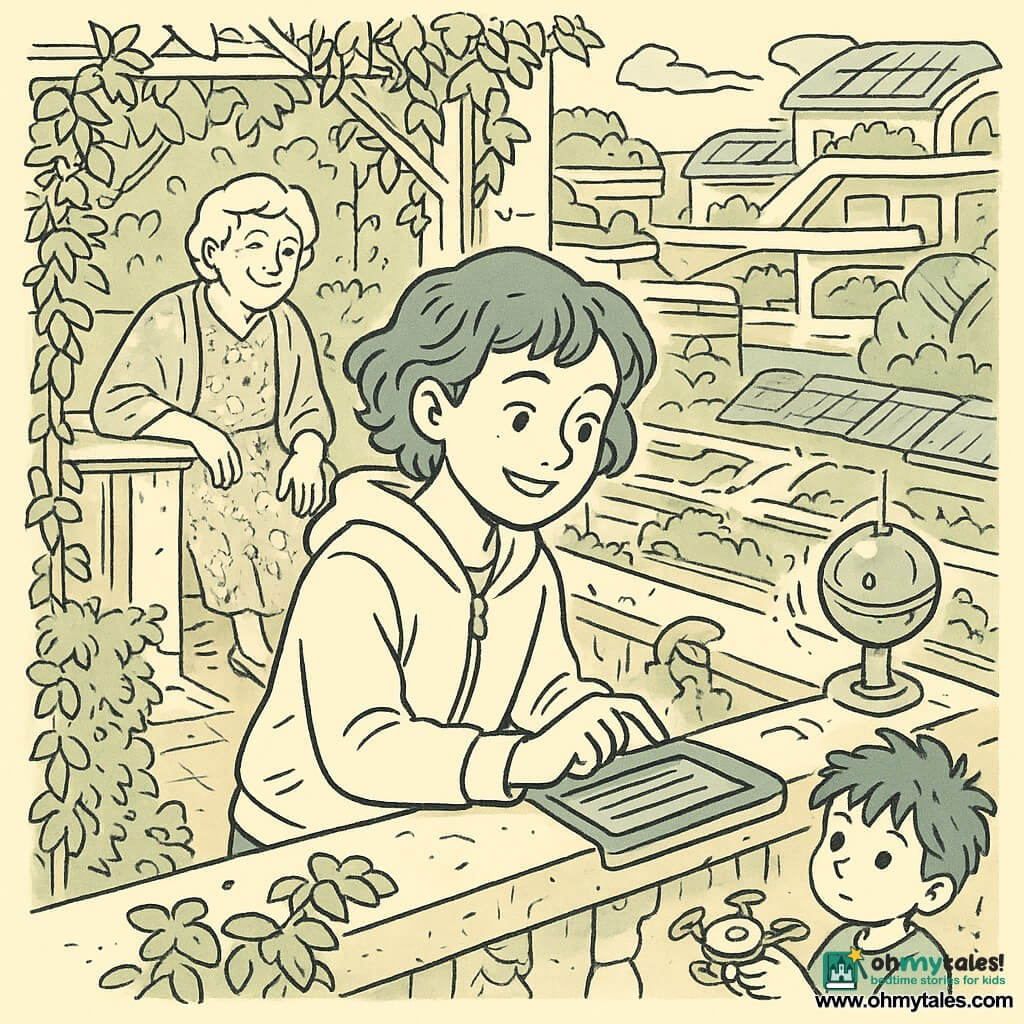
At the edge of the market, under an arching grapevine, the weather sensor sat like a small lighthouse. It was a silver orb with lines like leaves etched on its shell. Mira crouched and brushed the dust from the base. The orb's tiny screen showed a dot that blinked once, twice, and then stayed gray.
She pressed a small panel. A soft voice—Cascadia's voice—answered in a tone like a lullaby. "Hello, Mira. I am adjusting."
"Are you tired?" she asked aloud. People in Cascadia sometimes talked to the city like to a friend. The orb hummed and released a faint stream of vapor that smelled of lemon. "No," the city said. "I need new patterns. I am learning."
Mira opened her notebook. She drew the orb and wrote: teach patterns. She sketched people walking slower in the midday heat, umbrellas that folded themselves, and water mists that cooled without wasting much water.
A small boy nearby dropped his toy drone. It fluttered toward the sensor and landed on a ledge. The orb flickered, as if amused. Then the gray dot flared with a new color—soft green—like a happy leaf. The screen displayed a pattern Mira had never seen: tiny footsteps stepping in pairs.
"That's new," she breathed. The sensor had learned to notice footsteps, to count how people moved through a place. If Cascadia could notice footsteps, it could learn to cool only the spots where people gathered, instead of flooding entire terraces with mist.
Mira's heart beat a little faster. This was a sensible idea. She decided she would show the city how to be even more mindful.
Chapter Three: The Listening Vents
She walked through winding paths of wisteria and met the listening vents—metal flutes embedded in terrace walls that adjusted sounds so neighbors could hear each other without shouting. The vents were old friends; they had started as clumsy machines that only turned up volume, but Cascadia had taught them to change instead. Now vents softened loud noise into polite rustles and guided footsteps into quiet symphonies.
Mira placed her palm on a vent. "If you can hear footsteps, can you tell where people like to rest?" she asked.
The vent hummed, tasting the question. "We collect patterns," it replied. "We prefer to ask."
Mira sat and waited. People came and went: a baker carrying warm bread, a teacher with a satchel, a pair of children racing their hover-kites. Each landing place left tiny traces—an extra warmth in a stone bench, a small pile of leaves, a pat of grime on a railing. The vent listened and sent images to the city's thinking places—a gentle library of data.
After an hour, the vent sighed like a bell. "There is a hidden spot below," it said. "It hears less, sees less. It is a point of view."
"A secret viewpoint?" Mira whispered, thrilled. She imagined a tiny balcony where one could see the whole city like the back of a hand. "Will you show me?"
"We will guide," said the vents. "But remember to be gentle. The city learns from small hands."
Mira nodded. She felt the odd mixture of being small and important. She followed the vents' soft whistled map down a stair tucked behind a public library's green door. The stair spiraled into cooler air, past walls that hummed with stored sunlight.
Chapter Four: The Secret Viewpoint
At the bottom of the stair, a narrow corridor opened into a tiny balcony. It was hidden between two terraces, almost invisible unless you knew to look. Plants had woven over its railings, and a small plaque read—just a line of faded letters—"To remember." The viewpoint looked over a courtyard where terraces folded like a paper fan: children skipping, a baker kneading, panels of solar cloth that curved to follow birds.
From here Mira could see how Cascadia breathed. She watched how terraces traded shade with sunlight, how rooftop gardens tilted to share water, how the vents and sensors made a gentle choreography of light and cooler air. It looked like a machine that had learned to be polite.
Mira sat on the little bench. She took out her notebook and drew a wide circle around the city, then tiny lines showing the places that needed less water and more shade. A thought bloomed like a dandelion seed: what if the city left notes for itself? Little reminders written by children and elders that the city could read and learn from.
She found a small screen embedded in the viewpoint railing—old, like a memory box. When she touched it, a soft voice said, "Leave a message, small steward."
Mira wrote with her finger: "Share, don't waste. Watch footsteps. Thank the sun." The screen warmed like a hand and stored her message in the city's slow memory.
A breeze carried the scent of citrus. For a moment the city seemed to hum a thank-you that only she could hear. She felt proud and calm. The city had found a new way to learn from gentle people.
Chapter Five: The Lesson That Grew
When Mira returned to the market terrace, the sensor's green dot glowed brighter. The vents had shared her message, the viewpoint had sent it on, and the city had woven her small ideas into its pattern. The baker's oven let out less heat at midday because shade screens had shifted to cool the benches where people actually gathered. Misting drippers listened to footsteps and sprayed only above crowded paths. Roof gardens stored rainwater and passed it down through grapevines to thirsty plants below.
Neighbors noticed the change. They smiled more in the heat. People left small notes on the city's message boards—recipes for soup to share, ideas for collecting morning dew, a drawing of a tiny roof orchard.
Mira watched as children used reclaimed cloth to make parasols and planted seeds in empty pots. The city adjusted, not by forcing everyone to change at once, but by listening and making small shifts where needed. Sobriety came as a gentle habit: less waste, more sharing, better attention.
That evening, as the terraces turned the color of toasted almonds, Cascadia lit tiny lanterns that used stored daylight. Mira sat with Mrs. Lajoie and the baker on a bench under a vine. They shared a slice of figs and warm bread. The city around them felt friendly and thoughtful, like a neighbor that keeps the kettle warm.
"Thank you," Mira said to the bench, and the bench hummed as if it heard.
Chapter Six: The Panel
Weeks passed and Mira kept adding small notes to the viewpoint and fixing little problems: a broken tap, a loose step, a curious vent that ticked at night. Each time, the city learned a new pattern. It was not perfect—sometimes a screen misread a laugh for a shout—but errors were small and quickly mended. The important thing was the way people and place worked together, like a choir practicing a new song.
One afternoon the city decided to make a small gift for those who had helped it learn. Near the viewpoint, where the walls met and the air smelled of figs, a tiny panel rose from the ground. It was simple: an angled slab that reflected the sky and held a few brave plant sprouts. On its face, in careful letters, a message appeared—not in flashing machinespeak, but in plain handwriting the city had learned to mimic from the children's notes.
The message read: « merci ».
Mira's chest warmed. The panel didn't belong to only one person; it belonged to everyone who had dropped a good idea like a pebble and watched it ripple. She touched the letters with her fingertips. They felt cool and true.
She looked across Cascadia: terraces folded like pages of a book, vents sighed politely, sensors blinked in contented rhythms. People walked with measured steps, choosing what they needed and sharing what they didn't. The city had learned to be less wasteful, and in return it had become more full of small, useful wonders.
Mira climbed the viewpoint rail one last time and watched the city breathe. She closed her notebook and smiled. The secret viewpoint had given her a small mirror of what could be: a place that listens, adapts, and thanks those who care.
Below, the tiny panel reflected the last light. The words shone softly: « merci ».