Chapter 1: The Boy With the Solar Stitch
In Neon Harbor, the night was never really dark. Billboards poured color onto the streets like spilled paint, and the air smelled like sea salt and warm engine oil. Drones hummed between towers, delivering noodles, medicine, and sometimes—if you were unlucky—a parking ticket.
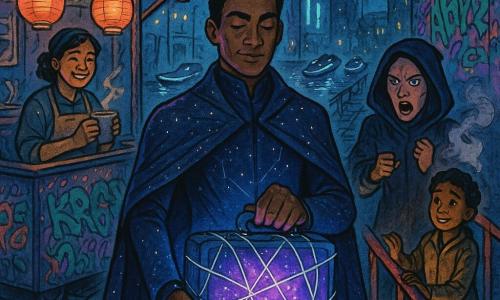
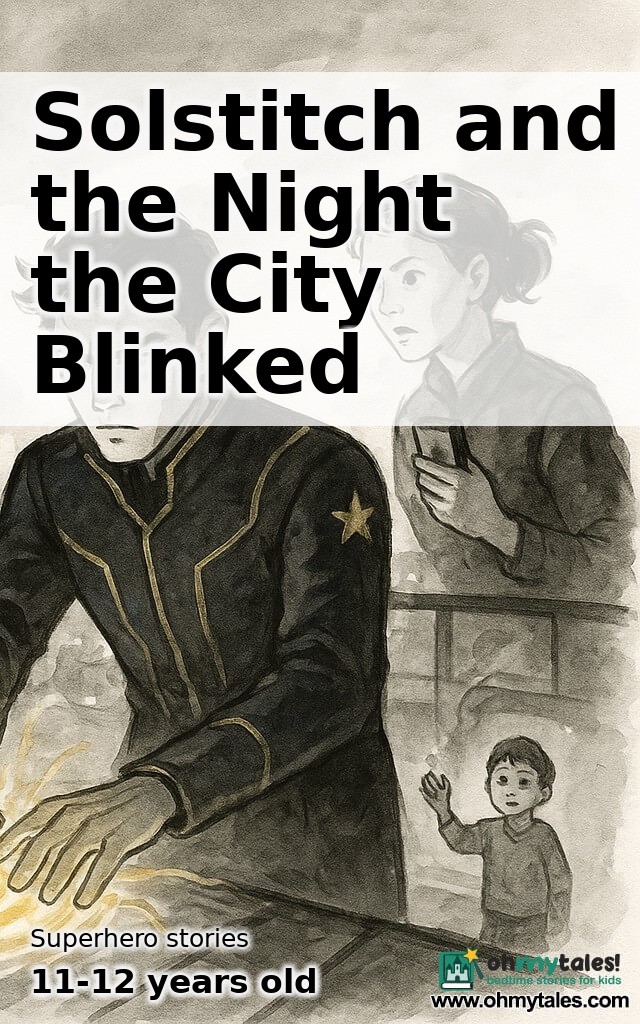
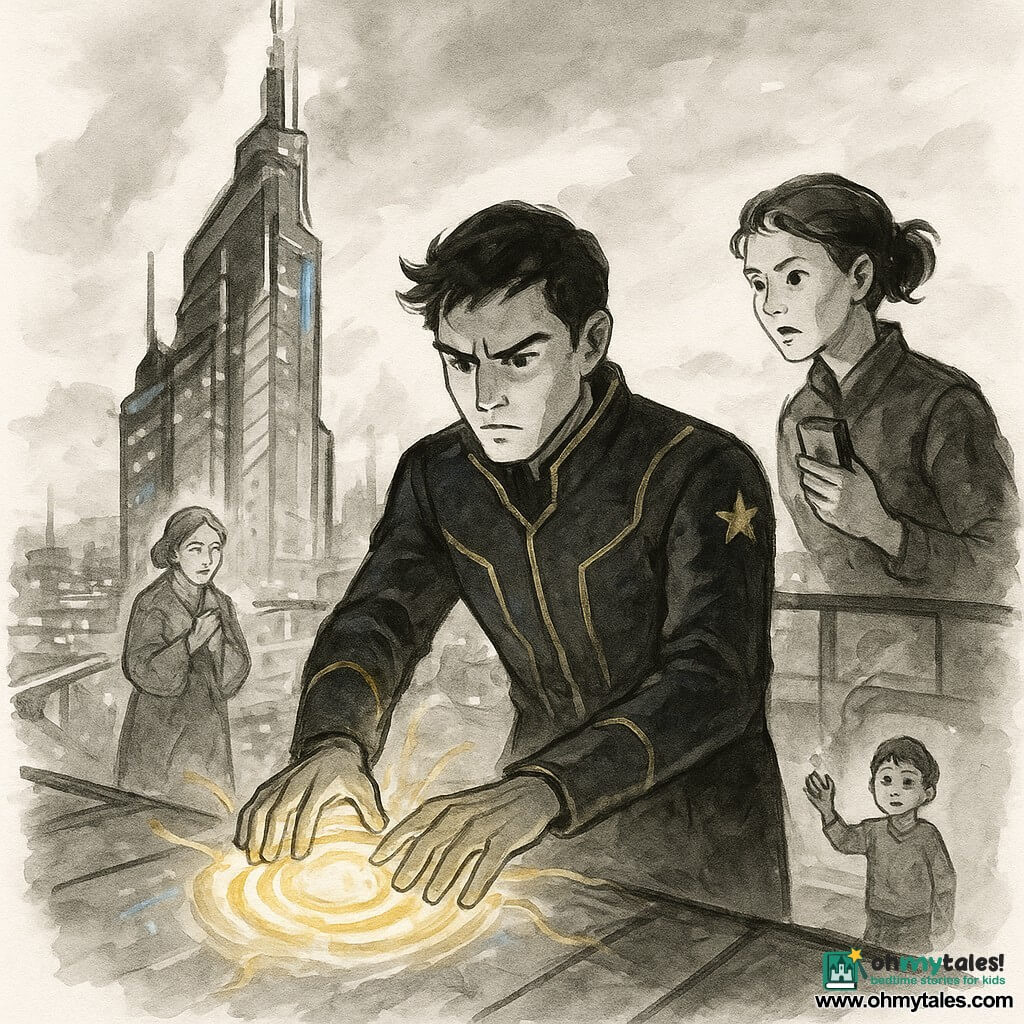
Kellan Voss looked like he belonged in a comic panel that forgot to add the cape. He was tall and wiry, with copper-brown skin, a stubborn curl of black hair that refused to stay flat, and a grin that showed one chipped tooth from an old skateboard crash. His jacket was the loudest thing about him: midnight blue with thin lines that glowed gold when he moved, like sunlight trapped in thread. A small emblem sat on his shoulder—an eight-point star made of stitched light.
Most people knew him as Solstitch.
Right now, he wasn't soaring above the skyline or punching meteors. He was kneeling beside the Harborline Shelter, fixing the old front gate with a portable welder.
“You know,” said Mrs. Dima, the shelter manager, arms crossed, “there are easier ways to be a hero. Like… not getting sparks in your eyebrows.”
Kellan flicked his visor down. “If my eyebrows survive, I'll consider it a victory for science.”
A kid peeked out from behind the gate. He was small, wearing a jacket two sizes too big. “Are you the guy who stopped that runaway delivery truck?”
“I'm the guy who apologized to the delivery truck,” Kellan said. “It was having a stressful day.”
The kid giggled. The giggle mattered. In Neon Harbor, laughs could be rarer than clear skies.
Kellan finished the weld. The metal sealed with a clean, bright line. His jacket pulsed softly, drinking in the heat like a thirsty plant. That was his power: he could store energy—sunlight, heat, kinetic force—and release it as shields, boosts, and bursts of light. His mentor used to call it “borrowing from physics with permission.”
Kellan stood, brushing ash from his hands. “Gate's solid. No more rattling in the wind.”
Mrs. Dima softened. “Thank you. The little ones sleep better when the door doesn't sound like a monster chewing nails.”
Kellan tapped the star on his shoulder. “My promise is simple. I protect the ones who can't run fast enough.”
His wristband chimed—three quick notes, urgent. A message glowed across the small screen:
GRIDKNOT ANOMALY: SKYWAY SECTOR 9. POWER DRAINS. PANIC RISK.
Kellan's smile vanished, replaced by focus so sharp it could cut glass. “Looks like someone's tugging on the city's battery.”
Mrs. Dima raised an eyebrow. “Try not to tug back too hard.”
“No promises,” Kellan said, then corrected himself with a wink. “Okay. One promise. I'll be careful.”
He stepped into the alley, glanced up at the towers, and took a running leap. The golden lines in his jacket flared. Light folded under his boots like invisible stairs, and he rocketed upward, leaving behind a fading streak—like a comet that decided to help with chores first.
Chapter 2: The City Starts to Blink
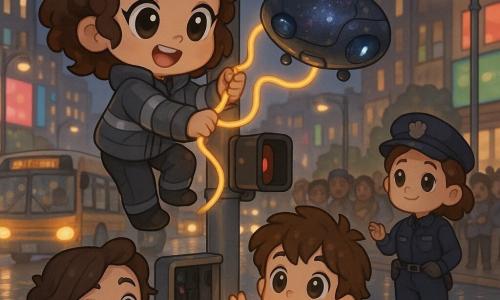
By the time Kellan reached Skyway Sector 9, Neon Harbor was acting strange. Streetlights flickered in perfect rhythm. Traffic signals paused on yellow as if thinking hard about their life choices. Even the huge floating ads—“TRY STARFIZZ! IT'S LIKE SODA BUT LOUDER!”—stuttered and froze mid-sparkle.
Kellan landed on a maintenance platform wrapped around a tower. Wind slapped his face. Far below, the Skyway—an elevated web of pedestrian bridges—glowed with embedded lights, but now those lights were dimming in patches, like a constellation losing stars.
A security drone zipped past him, its camera eye wide. “CITIZEN, PLEASE REMAIN CALM. PLEASE REMAIN CALM. PLEASE—”
“It's okay,” Kellan told it. “Try a new hobby. Like… knitting.”
The drone didn't laugh, because drones had no sense of humor. Tragic, really.
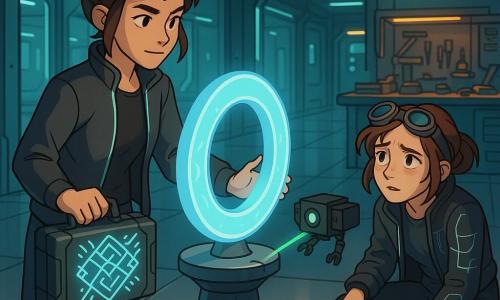
Another ping on his wristband. This one came from Mira Quell, a junior engineer at the city's Energy Bureau and Kellan's favorite person to argue with about science.
MIRA: I'm tracking the drain. It's not random. It's patterned. Like… a braid.
Kellan: A braid made of electricity? That's new.
MIRA: It's pulling from the GridKnot hubs. If it hits the central spine, hospitals go dark. Shelters too.
Kellan's stomach tightened. He pictured the Harborline Shelter, the kids, the rattling gate now quiet. Vulnerable didn't always look dramatic. Sometimes it looked like a nightlight that needed to stay on.
He crouched and pressed his palm to the tower's surface. His jacket's threads brightened as he listened with his power—not with ears, but with stored energy responding to the city's pulse. Beneath the metal, he felt a tugging current, like someone had hooked a fishing line into Neon Harbor's heart and was reeling.
A laugh echoed above him. Not Mira's. Not friendly.
From the shadow of a nearby skybridge support, a figure unfolded like origami.
He wore a sleek suit made of matte gray panels that shimmered with shifting symbols—equations, circuit maps, tiny moving arrows. His helmet had a smooth faceplate with a single glowing line that curved into a smile.
“Well, well,” the figure said, voice crisp and amused. “Solstitch. The walking rechargeable battery.”
Kellan straightened. “And you are… the world's most dramatic calculator?”
The figure's smile-line brightened. “I am Dr. Vant Hex. But you may call me—”
“Let me guess,” Kellan cut in. “The Knotmaster. The Grid Goblin. Sir Sucks-a-Lot?”
A pause. “That last one is appalling.”
Kellan's grin returned briefly. “Good. I was hoping.”
Vant Hex stepped onto the skybridge railing as if it were a sidewalk. “Neon Harbor wastes power. Lights on empty streets. Ads screaming at tired people. I am simply… redistributing. Taking what's ignored.”
“And giving it to who?” Kellan asked.
“To a future that makes sense,” Hex replied. “A city that runs efficiently. Predictably. Under control.”
Kellan pointed down at the dimming Skyway. “People aren't batteries. And control isn't the same as safety.”
Hex tilted his helmet. “Spoken like someone who trusts feelings over facts.”
Kellan's eyes narrowed. “Facts are great. But your ‘facts' are missing a few pieces. Like—what happens to the kids in the shelter when the heat shuts off?”
Hex's smile-line didn't change. “Collateral.”
Kellan's jacket flared gold. “Not today.”
Hex lifted a hand. The air trembled. Threads of pale blue energy laced out from the tower, snaring the Skyway lights and pulling harder. Neon Harbor blinked again—this time, slower, like a tired eyelid.
Kellan launched forward, light stepping under his boots, chasing the drain as it slid across the skyline like a living wire.
Chapter 3: The Web of Skyscrapers
The pattern Mira mentioned became visible when Kellan rose higher: energy threads stretched between skyscrapers, a glowing network that wrapped the district like a giant spiderweb. Each tower's GridKnot hub—a round, humming node—had a pale-blue line attached, draining it.
Kellan zipped from one building edge to another, landing on glass ledges, springing off antenna platforms, sliding down a slanted roof like it was a skateboard ramp. The city below looked like a circuit board, and right now someone was shorting it out on purpose.
His wristband buzzed again.
MIRA: Kellan, the network is converging at the Spindle. The tallest tower. If Hex plugs in there, it's a blackout wave.
Kellan: I'm on it. How do I sever the lines?
MIRA: You can't just cut them. They're phase-locked. If you snap one, it rebounds and fries the hub. Think… untie, not break.
Kellan groaned. “So the villain made a power braid, and I have to unbraid it. I should've paid attention in arts and crafts.”
He reached a junction where three energy strands met around a billboard support. The strands pulsed like veins. Kellan placed both hands near the knot and let his stored solar charge seep out—not as a blast, but as a steady warmth, like sun on a cold bench.
He pictured the shelter's gate weld: clean, precise. He let that same careful focus guide him.
The knot shivered. The strands loosened a fraction, reacting to the gentle counter-frequency. Kellan's jacket threads glowed brighter, synchronizing.
“That's it,” he muttered. “Don't fight it. Understand it.”
A voice drifted from above. “Understanding is my specialty.”
Hex hovered near the side of a tower using a disk of pale energy under his feet. He looked annoyingly relaxed.
Kellan kept his hands steady. “Then understand this: your plan hurts people.”
Hex's helmet tilted. “People are variables. Messy ones.”
Kellan glanced up, sweat forming at his hairline. “Variables keep the world interesting. Like how you didn't expect me to be good at untangling.”
Hex's smile-line sharpened. “I expected you to try. I expected you to fail.”
Hex flicked his fingers. The network tightened. The knot in front of Kellan cinched suddenly, yanking energy harder from the hub. The nearby tower lights dimmed. Far below, car horns blared as an intersection went confused.
Kellan's arms trembled. His stored energy surged—too much at once. If he pushed back with force, Mira was right: it could rebound and damage the hub, making the blackout worse.
“Okay,” Kellan whispered. “Critical thinking time. Don't panic. Don't punch. Think.”
He watched the pulse pattern. Hex was tightening on a rhythm—one-two, pause, one-two. Like someone pulling a rope to a beat.
Kellan matched it, but half a beat off. He introduced a wobble into the rhythm, like nudging a spinning top so it didn't fall, just… changed direction.
The knot loosened again. Not fast. Not flashy. But real.
Hex's voice sharpened. “Stop that.”
Kellan smirked through the strain. “You can't just tell physics to stop.”
With one final careful adjustment, he slid the strands apart—unbraiding instead of breaking. The junction released with a soft flash, and the tower's lights steadied. A few windows brightened. Somewhere, a coffee machine probably sighed with relief.
Hex's smile-line dimmed. “Clever.”
Kellan flexed his fingers. “Thanks. I'm available for birthday parties and emergency power braid removals.”
Hex drifted backward, energy lines still feeding into the network. “You can untie knots all night, Solstitch. But the Spindle is already drinking deep.”
Kellan looked up. The Spindle—Neon Harbor's tallest skyscraper—pierced the clouds like a silver needle. Around it, the pale-blue web tightened, drawing everything toward that point.
Kellan took a breath, filled his jacket with the last of the warmth he had saved, and launched toward the Spindle.
Chapter 4: The Spindle's Hungry Crown
The wind near the Spindle was colder, louder. The building's crown was a ring of rotating antennae and glass fins that caught moonlight and turned it into a sharp gleam. Now, pale-blue energy crawled over the crown like frost.
Kellan landed on a narrow beam and steadied himself. Below, the network of skyscrapers looked like a glowing net thrown over the city. If the net tightened, Neon Harbor would go dark in a wave.
His wristband chimed again—Mira, breathless.
MIRA: I'm at the Bureau. We can reroute some emergency power, but not if Hex locks the spine. Kellan, listen—his lines are phase-locked to the city clock.
Kellan stared at the rotating antennae. “City clock… that's in the Spindle, isn't it?”
MIRA: Yes. The ChronoCore. It times everything—traffic, power cycles, even the wave barriers at the harbor.
Kellan's mind clicked. “If Hex is syncing to the clock, then… he's not just stealing power. He's making the whole city march to his rhythm.”
MIRA: Exactly. If he controls the timing, he controls the flow.
Kellan swallowed. “So how do I break a rhythm without breaking the song?”
“Add a new beat,” Mira said. “A safe one. Something the system accepts.”
Kellan glanced at his jacket's glowing threads. He thought of sunlight. Of warmth. Of steady mornings when Neon Harbor looked almost peaceful.
“I can be the beat,” he said.
A chuckle from behind. “You can be a footnote.”
Hex rose from the crown's far side, arms spread. The pale-blue web tightened around him, feeding into a device on his chest—an angular coil that pulsed like a second heart.
“You're brilliant,” Kellan called over the wind. “But you're skipping the human part.”
Hex's voice carried easily, too calm for the height. “Humans are inefficient. I am offering an upgrade.”
Kellan stepped closer along the beam. “An upgrade that turns off hospitals? Shelters?”
Hex's smile-line flickered. “Those can be managed. Controlled.”
Kellan's jaw set. “You keep saying ‘controlled' like it's a blanket. But it's more like a cage.”
Hex lifted both hands. The air around Kellan thickened, as if invisible cords were wrapping him. Pale-blue strands snapped toward him like hungry vines.
Kellan threw up a shield—golden light curved outward, a shimmering half-dome. The strands slapped it and slid away, sizzling harmlessly into sparks.
“Nice bubble,” Hex said. “How long can you hold it?”
Kellan's arms shook. “Long enough.”
He looked past Hex at the ChronoCore housing—a glass cylinder set into the crown, pulsing with steady white light. If Hex reached it, the city's rhythm would become his.
Kellan lowered his shield slightly, letting a few strands graze it—just enough to feel their timing. One-two, pause. Same pattern as before. Hex loved patterns. Patterns were predictable.
“Hey, Hex!” Kellan shouted. “Quick question. Do you ever get tired of being right?”
Hex paused. “What?”
Kellan grinned. “Because I'm about to be wrong on purpose.”
He dropped the shield completely and dove off the beam.
Hex's strands lunged after him, sure of their catch. But Kellan didn't flee downward—he flipped, caught the underside of a glass fin, and swung himself in a tight arc, like a pendulum. His jacket flared, releasing stored kinetic energy into a sudden boost.
He shot sideways, not along Hex's expected path, but across it—crossing the rhythm.
The strands snapped past where he would have been. They tangled with each other for a heartbeat.
Kellan hit the ChronoCore housing with both hands, palms flat. The white pulse inside thumped steady as a heartbeat.
“Okay,” he whispered. “Here comes the new beat.”
He released his stored solar energy not as a blast, but as a timing signal—tiny pulses, warm and even, matching the ChronoCore's natural cadence. He wasn't overpowering the clock. He was reminding it what it already was.
The ChronoCore brightened. The city's lights below steadied in a ripple.
Hex hissed. “No!”
Hex surged forward, coil on his chest flaring. The pale-blue web tightened, trying to drown the ChronoCore's rhythm.
Kellan clenched his teeth. “Mira,” he spoke into his wristband, “now would be a good time for any helpful miracles.”
Mira's voice crackled back. “Not a miracle. Just math. I'm pushing an override through the Bureau—thirty seconds. Hold the cadence!”
Kellan laughed once, breathless. “Thirty seconds? That's, like, half a villain speech.”
Hex slammed a wave of energy at him. Kellan's shield flickered up instinctively—gold light against blue. The impact shoved him back, boots scraping on the slick crown. He nearly slipped into open air.
He pictured Mrs. Dima's tired smile. The little kid's giggle. The shelter's gate, strong and quiet.
“I promised,” Kellan growled, pushing forward again. “I promised!”
He pressed his palms to the ChronoCore once more and pulsed warmth into the beat—steady, steady, steady.
Below, the web began to loosen. Some of the pale-blue strands dimmed as if confused, like bullies who'd been told “no” in a firm voice.
Mira counted in his ear. “Five… four… three…”
Hex lunged, reaching for the ChronoCore with both hands. “You can't outthink me!”
Kellan didn't try to outthink him. He thought with him.
Hex loved efficiency, patterns, control. So Kellan gave him a pattern—one that trapped his own device.
With a sharp flick of his wrist, Kellan redirected his golden pulse into the coil on Hex's chest, syncing it to the ChronoCore's safe cadence. The coil stuttered, then locked into the city's rhythm—no longer able to pull harder without pulling against the clock itself.
Mira's voice rang out. “Override—NOW!”
The ChronoCore flashed bright white. Across the skyline, the pale-blue web snapped into harmless sparks, dissolving like mist in sunlight. Lights surged back across Neon Harbor—street by street, window by window, bridge by bridge.
Hex staggered, his coil dim. “Impossible…”
Kellan stood between him and the ChronoCore, breathing hard. “Not impossible. Just… tested.”
Chapter 5: A Hero's Promise, Kept
With the web gone, the wind felt less angry. Neon Harbor below glowed steady again, like the city had found its heartbeat.
Hex backed away, clutching the dim coil. His helmet's smile-line flickered uncertainly for the first time.
Kellan didn't charge him. He didn't gloat. He simply kept his stance firm—an unspoken boundary.
“You could still help this city,” Kellan said. “If you actually looked at the people in it.”
Hex's voice was smaller. “People complicate solutions.”
Kellan nodded. “Yeah. That's why we check our work. That's why we ask questions. That's why we don't call harm ‘collateral' and pretend it's just a number.”
For a moment, Hex seemed to hesitate, as if a different choice was standing right next to him, waiting politely. Then his coil sparked weakly, and he triggered a faint smoke screen—more annoying than dangerous.
When the smoke cleared, Hex was gone, leaving only a few drifting symbols in the air that faded like embarrassed fireflies.
Kellan exhaled. “Typical. Villains always leave before the apology.”
Mira's voice came through, relieved. “You did it. The grid's stable. The hospitals confirmed full power.”
Kellan's shoulders loosened. “What about the shelters?”
A brief pause. Then: “All shelters are green. Harborline too.”
Kellan closed his eyes for a second, letting the cold wind wash over him. Then he laughed softly. “Good. Because I just repaired that gate. I'd hate for it to be wasted effort.”
He descended the Spindle with careful light-steps, leaping between skybridges. The city felt brighter now—not because the lights were stronger, but because people were moving again, stepping out onto balconies, pointing up, cheering, waving.
On a mid-level skyway, a group of commuters stared at him as he landed. One man held a bag of groceries like it was precious treasure.
“Are we safe?” the man asked.
Kellan gave a quick salute. “Safe enough to burn your toast again.”
A teenager raised a phone. “Solstitch! Was that, like, an alien?”
“Worse,” Kellan said. “A guy who thinks spreadsheets are a personality.”
They laughed, and the sound echoed between the towers, warm and real.
Kellan didn't linger for praise. He dropped lower, toward the Harborline district, where the shelter's windows glowed gently.
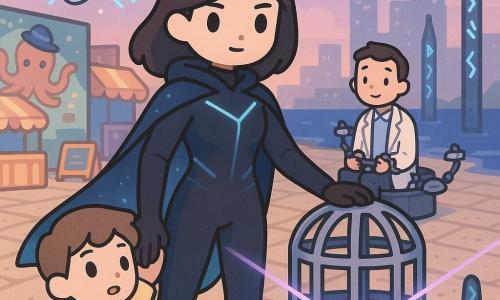
Mrs. Dima met him outside, wrapped in a shawl. “The lights blinked,” she said, eyes sharp. “Then they stopped blinking.”
Kellan rubbed the back of his neck. “Yeah. Someone tried to turn the whole city into a mood lamp.”
She studied him, soot on his jacket, hair wind-tossed, eyes tired but bright. “And you stopped it.”
“I didn't do it alone,” Kellan said. “Mira helped. And the city helped, too. The grid has rules. Patterns. If you pay attention, you can tell when someone's lying with numbers.”
Mrs. Dima huffed. “So. You fought with… critical thinking.”
Kellan grinned. “My most dangerous weapon.”
A small figure stepped forward—the kid from earlier. He held out a paper bracelet made of folded foil and string, shining in the shelter light.
“For you,” the kid said. “It's… solar.”
Kellan took it carefully, like it was something rare. He slipped it onto his wrist beside his tech band. “Perfect,” he said. “Now I'm double-charged.”
The kid beamed. “Will you come back?”
Kellan looked up at Neon Harbor's towers, the network of skyscrapers now just buildings again—tall, proud, and full of ordinary lives. He thought about Hex, about how smart people could still make cruel choices if they stopped asking the right questions.
He looked back at the shelter. “Yeah,” he said, voice steady. “I promised I'd protect the ones who need it most. And I keep my promises.”
Mrs. Dima nodded once, satisfied. “Good. Because your eyebrows still have sparks in them.”
Kellan winced. “So the real villain… is my grooming routine.”
The kid laughed. Mrs. Dima even smiled.
Above them, Neon Harbor shone—bright, steady, and awake—while Solstitch stood at the door he'd repaired, foil bracelet catching the light, promise held like a shield that didn't flicker.