Chapter One — The Keeper and the Shore
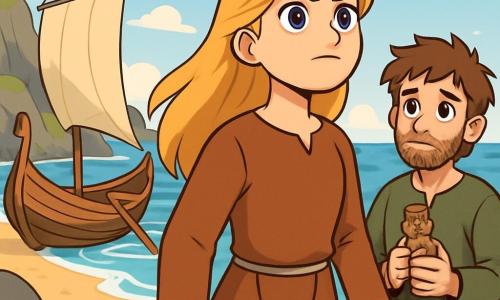
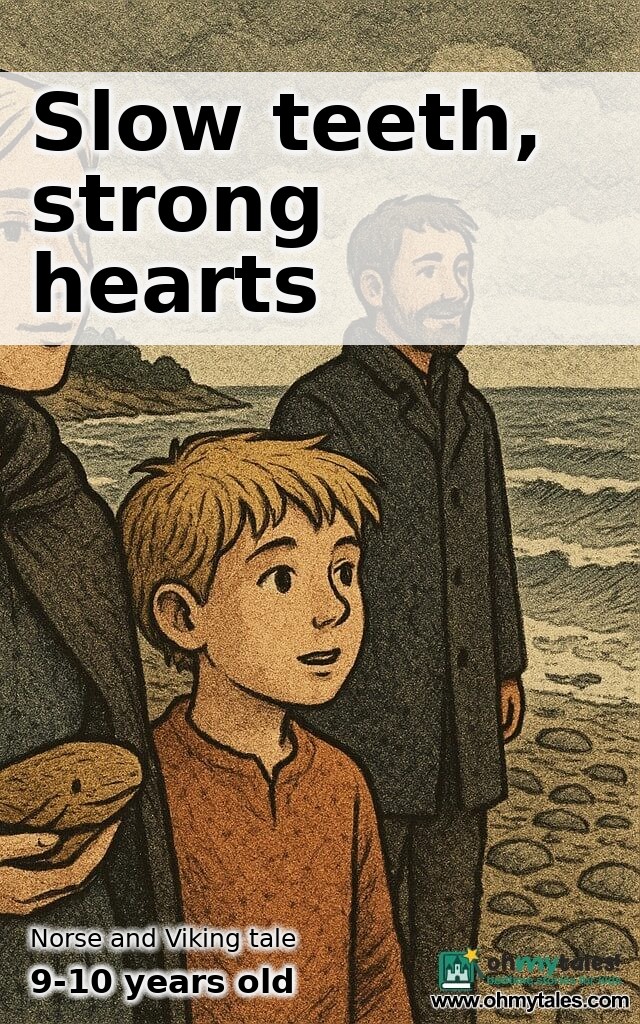
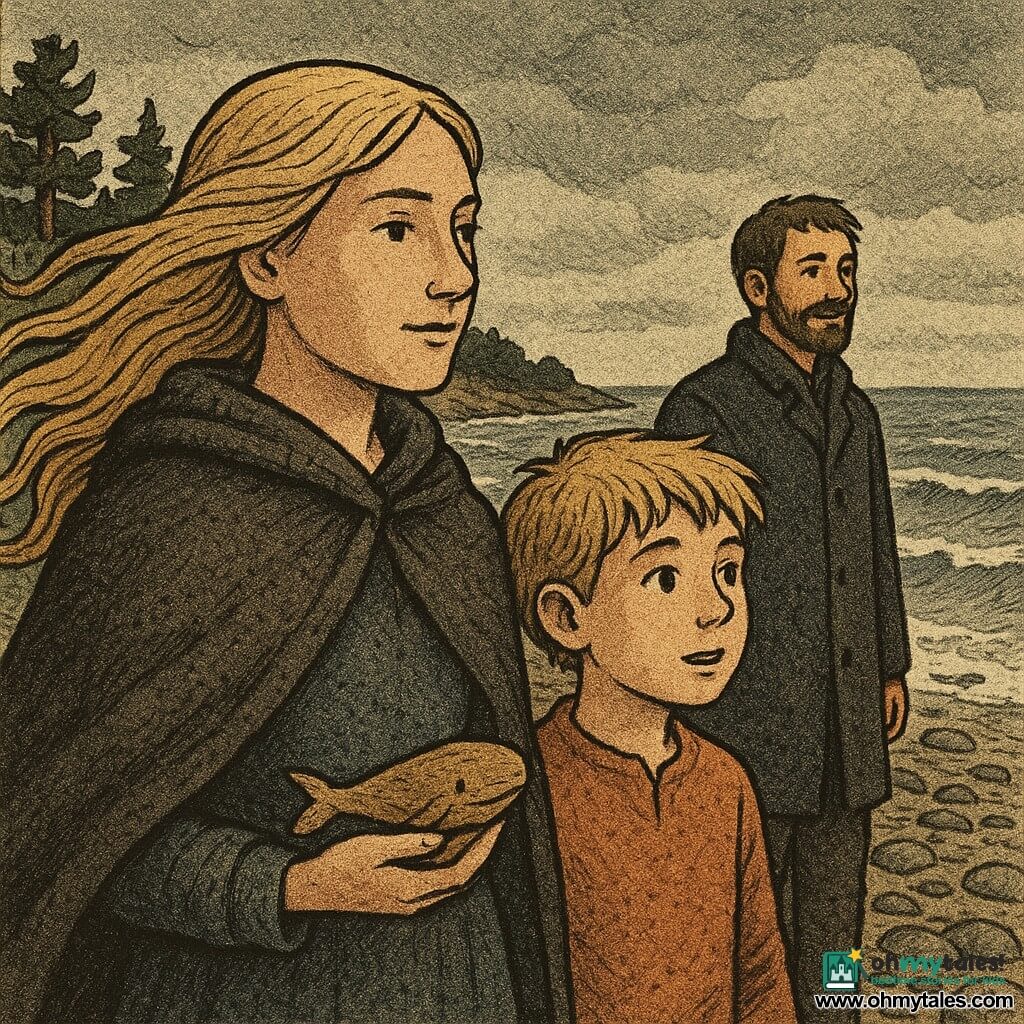
Solveig walked the line where sea met stone as if she were reading the edge of a rune. Her feet made small marks in the sand, and each step was a soft sentence: watch, hold, remember. The village lay behind her like a warm hearth, a smudge of smoke and thatched roofs. In front, the grey ocean breathed in great slow waves, keeping secrets older than the tallest pine.
She was a keeper by calling and choice. Though grown to a woman's height, her hands were used to mending nets and patching a child's pride when a small fishing boat overturned in a sudden wind. People said she had slow teeth — meaning she chewed on things carefully, never rushed into a bite. Her mouth closed first, eyes opened, hands moved last. Slow teeth, strong hearts, they murmured, and Solveig let the phrase become the steady drum of her life.
Leif was two summers younger, a bright quick knot of a boy with hair like driftwood and a laugh that scattered like gulls in flight. He followed her like a hopeful shadow. When he was small, she patched his scraped knees and sewed a wolf into the lining of his coat for courage. As he grew, she taught him knots and which stars steered a boat on a clear night. He learned to carry a lamp without spilling all its light. He learned to come home before dusk. He learned — most of all — to trust the slow way of watching.
One evening in late autumn, when the sea laid a thin mist over the reeds, a man came walking along the strand. He moved like a gull that had learned to land with a sailor's ease: confident, too neat for such weather. His name was Eirik, and he had come from the trade road where many stories were bought and bartered. His cloak was dark and lived-in; but his smile was polished, like a coin too often turned between greedy fingers.
He spoke to the folk of the village at the inn, and they welcomed the warmth of new words. "Stories keep the cold away," he said, pouring barley wine. His voice was a soft stream that made men unlatched. But Solveig listened and was cautious. Her slow teeth warned her of stories that smelled like honey at the mouth but had ash at the end.
Eirik watched Solveig watch the tides. He watched Leif's quick hands braid a rope. He began to ask the kinds of questions that were like a fishing hook — small, precise, and patiently waiting for the twitch. "Such a lively boy," he said to her one night. "Strong as a young pine. He would do well in the north trading towns. There, he'd learn coin and stories and return rich."
Leif blushed at the idea of traveling. His eyes sparkled. Even the sea seemed to lean in to listen. Solveig's jaw tightened, a coastal cliff holding against a storm. "We have bread and sky enough here," she answered. "Leif is my brother. He belongs by the tide."
Eirik's smile did not fall. "The world is wide," he said. "To keep a light is a narrow life. Would you not want him to see more? To know how big he is?"
It was a tempting question. The village was narrow because it had to be—a ring of hands against the cold. But the thought of Leif gone made Solveig's heart a smith's hammer, struck hard and loud. She refused the offer gently, and yet Eirik returned the next week with a shadow in his eyes, and then again after that, each visit a little less polished and a little more sure.
On a night when the first frost glittered like the teeth of small gods across the grass, Eirik knocked on Solveig's door. He was no longer a traveller with a story but a man whose hands had started to want more than words. "Come with me," he urged Leif. "Think of the markets, the strange songs."
Leif looked toward the room where their grandmother's ledger lay, where names were inked like roots into their family. "But why would you take me?" he asked, puzzled.
Sly as a fox that learned kindness only to catch more hens, Eirik grew loud and charming. He told Leif fantastic things: a city where the roofs were metal and sparks fell like small fireflies; ships that carried whales; coins that chimed like little bells. He planted visions in the boy's head, and like seeds in a field, they took.
Solveig saw the change. She could feel it like the shift of the wind before a storm: small, then absolute. That night, after Eirik had left and Leif's breathing had become a thief, stealing sleep from both, Solveig took Leif's hand and whispered, "I will hold you as long as the sea holds the shore."
Leif slept and dreamed of metal roofs. Solveig kept watch at the doorway, tasting the salt of the air and the bitter tang of worry. She could not sleep. Slow teeth chewed over plans as the moon leaned heavy and patient. She would not let a cunning man take her brother like a gull takes a fish.
At dawn she packed a little bag: smoked fish, bread, a small carved whale for luck, and a rope. Leif blinked awake to find their mother's boots at the door and Solveig already fastening the cloak across her chest like a sail. "Where are we going?" he asked, unsure but trusting.
"To keep the light," she replied, and there was no need to say more.
Chapter Two — The Road of Stones
They walked under a sky that looked as if someone had brushed ink across linen. The path they took cut between fields of buried stone and low pines, a way that traded the village for the open world. As they moved, the season changed like a slow hymn: leaves turned and let go; mornings grew sharper; the wind learned new stories.
Eirik's shadow grew longer behind them. He did not hurry like a man in a chase; he moved with the patience of a hunter who knows where prey will drift. He tried to intercept them at crossroads, at the ford where the river spoke in small thunder. Each time Solveig met his words with a plank of truth and a net of silence, and each time Eirik's grin thinned like the last of daylight.
In the third day they reached the Hall of Stones, a place where travelers tied their promises to a tree and left a coin for the road. It was here that a stranger sat and watched them: an old woman with hair like woven silver, eyes as sharp as a whetstone. She leaned on a staff carved with runes that curled like sleepy serpents.
"You carry a light," she told Solveig in a voice that was both a question and an answer. "Why is your brother the one to keep it?"
"Because he is kin," Solveig said, and the words were as plain as bread but as firm as baked clay. "Because I will not let him be borrowed by clever hands."
The old woman nodded slowly. "Some hands are gentle. Some hands know how to mend a broken oar. Others know how to shroud a child in silver promises and lead him to a cliff."
"How do you tell the difference?" Leif asked, his voice small but steady.
The woman smiled like someone who keeps a secret in a pocket. "You ask not what a man says, but what he returns when he has nothing left. You ask him for an old thing, one that cannot be shown for gain. If he takes it, you know the measure of him."
Solveig felt this in her bones—an old wisdom!—and remembered a small carved whale their grandmother had given her when she was a child. It was a small wooden charm that must never be lost. She had it in her pocket still. "Will this prove his measure?" she asked.
The old woman's eyes twinkled. "If he offers to trade the whale, he seeks a thing he cannot earn."
That night in a field lit by the shy moon, Eirik returned like a tide remembers its own curve. He offered Leif a brass flute, jewels braided into a map of the sun. He told him about a harbor where people sang to the moon for coins. Leif's fingers itched with desire.
Solveig sat quiet as a tree till the moment when Eirik reached into the folds of his cloak to make the offer more sumptuous. Then she rose, and all the plainness of her voice rang like a bell. "A question," she said.
Eirik's face opened. "Ask." He thought himself kind and clever enough to answer any small test.
"Would you trade for this?" Solveig held out the carved whale like a small world. "If you cannot give to it your real name, keep it. If you offer me coin for things that swim in stories, I will know the river you cross."
Eirik's smile wavered. To take the whale would have been no more than a gesture, and yet even gestures have weight in the scales of men. He reached and faltered, then said, "Perhaps the child would be better off with me. I have paths and people."
Leif's hands trembled between coin and wood. He looked at his sister and then at the object that had lived in their family for generations. Slowly, as if time itself were watching, he put the flute back into Eirik's hand and pressed the whale into Solveig's palm. His breath was like a small oar cutting the dark.
Eirik's eyes hardened. "A pity," he said, and left as quietly as a shadow that does not stir a sleeping dog. The old woman smiled, and in that smile was a wind that had broken many storms. "You have chosen," she murmured to Leif.
"Did I?" Leif asked, surprise bright on his face.
"You kept more than a charm," she said. "You kept the measure of yourself."
Solveig hugged him in the dim field, and their breath mixed with the mist. That night they slept by a small fire, the carved whale tucked between them, a small island of wood against the sea of night.
Chapter Three — Winter's Trial
Winter came like a slow drum, each day heavier than the last. Snow laid itself over the path and covered the world in the hush of velvet. The trees learned how to hold small moons of frost. They moved more cautiously as the cold taught the river to sleep.
Their progress slowed. Food grew scarce. Eirik's interference had retreated to whispers among barn rafters and the smell of oil in empty cups. The world seemed to narrow and force each heart to look inward. Solveig worked like a woman who braids rope with her mind as well as her hands: she saved food, cut shelter, wrapped Leif in wool and stories.
One morning, while tracking a deer whose breath fogged the clear air, they found a little boy, no older than Leif, crying by a frozen brook. His name was Jorun, and his family was taken by the cold; he had fled like a leaf from a burned piece of sky. Solveig could not close her heart to him. They took him in, and soon his small laughter braided with Leif's, and the three of them made a warmer small world.
Yet the winter pressed its weight. A blight came to the smoked fish stores—a dark rot that spoiled much of their supply. Solveig felt the panic of a village at low tide; her heart thudded like a heavy drum. People began to glance toward the road that Eirik had used, and fear is a hungry thing that eats at trust.
One night, as pale lights loomed over the village — lanterns that were searching — Eirik returned with men who wore his confidence like armor. "The boy of the keeper," he declared, "comes with me. The world needs quick hands like his."
No one rose. The village, made of the same stubborn grain, held its breath. Solveig stepped forward. The snow sang under her boots. "Leif is ours," she said. "You will find no coin in taking a child's breath away."
Eirik laughed like an old bell. "You speak too much for a woman who would clip a bird's wings with worry," he said. "Step aside."
From the crowd, a fisherman called, "We are tired. Our stores are thin. Trade could save us." The words rode the wind like a small sail, and Solveig felt the tugs of a thousand tiny decisions pressing at her shoulders. She thought of the whale and the old woman's voice like a whetstone. Slow teeth, strong hearts.
She drew in a breath as deep as a fjord. "Then trade we shall," she said calmly. "But justice will be our measure, not your silver."
The men laughed and Eirik drew nearer, as if to take what he wanted without weighing it. He reached out to lay a hand on Leif, and the village made a sound like a net cast in one voice. Jorun stood, small as a sparrow, and shouted to the men that had gathered at the edge of the square, "Do you take what is not given?"
That simple truth landed like a stone in still water. The men stalled. Eirik, who had counted on quiet taking, found himself exposed to the sky and the judgment of many eyes. Solveig stepped forward with slow steady feet and spoke not with threat but with the clarity of someone who had set a line in the sea and would not move it for waves.
"If you want using our son as a mean for coin, take from us instead our stores. We will bargain fairly. But if you reach for him with crooked hands, then know that this village keeps its own."
Eirik's plan unravelled like a net slashed by teeth that were neither slow nor hasty but precise. When he saw that the men he had counted upon would not walk into storm without sure gains, he turned and left. The lanterns faded and were carried away like swallowed stars.
Solveig's shoulders slumped, not from victory but from the exhaustion of having held a boundary. Leif ran to her and hugged her hard. "You were strong," he said simply.
"So are you," Solveig answered, and there was no need for more.
Chapter Four — The Spring of Shadows and Light
Spring came with a cautious smile. Snow melted and showed the bones of the earth, and the world exhaled. The village repaired roofs and mended nets. Jorun's family, helped by the neighbors' hands, returned when the ice relented and the river carried news. The carved whale still slept in the pocket of Solveig's cloak, a small guard against forgetfulness.
Eirik did not return for a while, but the wound of his attempt lingered like a bruise. People spoke of justice in different tongues: some wanted to cast him out forever; others wished the law to be heavy and sure. Solveig sought counsel with the old woman of the Hall of Stones and with the village elder, a man whose hair had the silver of long winters.
"What is justice?" Leif asked one dawn as they watched the sun make a slow coin of light on the horizon.
"It is the sea kept from flooding the grain," the elder said. "It is the rope that holds a boat to the dock. It is the rightness that returns a child to his hearth."
The old woman added, "But remember, justice is not only a punishment. It is the mending of harm."
So they decided not to seek revenge but to build something that would lessen the chance of harm. Together they labored: they taught the children how to watch for strangers' tricks, how to ask the questions that measure a man. They made a small council where grievances were aired and a watch that kept the night like a gentle hand. Eirik's cunning had given them a lesson: light and shadow both lived in the world, and you could not banish shadow without also stealing some shape from the light.
Meanwhile Leif grew taller and steadier, his quickness tempered by the steadiness of trust. He learned to balance the eagerness in his chest with the slow wisdom his sister carried. "I wanted to know the world," he admitted to Solveig one evening, "but I am glad I did not go those first days. I would have missed Jorun, and grandmother's ledger, and the smell of baked bread."
Solveig smiled and found a small pride as full as a net. "The world will always be there to welcome you when you are ready," she said. "But home is not only a place. It is what you guard and what guards you."
Eirik returned at last, not as a lion but as a man who had learned the bite of being refused. He came not with force but with a bag of goods and an apology, which sometimes is only words wrapped in rough cloth. He asked for trade, for a place to sell what he carried. He did not ask for Leif. The village was wary. Solveig felt the weight of a decision that was less like a hammer and more like a slow boiling pot: whether to hold onto anger or to let it simmer into something useful.
She met him by the shore where they had first spoken, and the ocean was quiet as a sleeping beast. "You asked for a child once," she said, steady as a pillar. "You wanted to take what you saw as quick and useful. You thought you could trade for a soul."
Eirik's face, under its sunburn, showed a shadow that was not all cunning. "I thought I would give him much," he said. "I thought I could teach him market ways."
"And did you change when you left?" Solveig asked. "Or did you only learn new tricks to make hungry mouths fatter?"
Eirik faltered. The sea, which had been listening all this while, slapped a small wave as if to mark the moment. "I have learned that ease is not the same as kindness," he admitted. "I have been denied and have tasted the bitter root of wanting what I cannot earn."
Solveig considered this. The world is heavy with choices that are not only black and white. She could see the split in him — the old cunning and a possible new care. "You may trade here," she said at last. "But no child leaves without free will and without the blessing of kin. If you ever seek to steal again, we will treat you as a storm at sea — with all the force of a village against you."
Eirik bowed his head, and there was something like relief in the bowing—humility, perhaps, or a map redrawn. He stayed for a season, trading trinkets and buying fish. He learned to respect the watch, and sometimes he helped mend a net. Not all wounds heal, but some scars become maps that remind a person where he has been.
Chapter Five — Of Slow Teeth and Strong Hearts
Years folded like the pages of a well-read book. Leif grew into a man who could split wood and tell good lies from bad truths. Jorun became a fisherman who always remembered to leave the first catch for the sea-spirits. The village kept its watch and taught new children how to ask the old questions that weighed a man's word.
On a spring when the reeds were first green and the gulls were making new nests, Solveig stood at the shore and felt the light like a hand across her shoulder. Her slow teeth had not rusted; her watch had been steady. She looked at Leif, who now had a beard as fine as a fishing net, and felt a softness that was like a warm bread crust.
"Do you regret," he asked, "that you held me too close?"
Solveig took his hand and squeezed, a small map of reassurance. "No," she said. "I would rather have kept you a day too long than lost you at the tide."
Leif smiled, then looked out to sea. "And Eirik?"
"He learned," Solveig answered. "He learned the true weight of giving and the shape of a life that respects others. We taught each other, and the village kept what was ours but opened its hands too. Justice was not only to strike, but to mend."
A small bell rang from the old Hall—a sound like a small bird calling for dawn. The village gathered, and they told tales of seasons as if each story were a fish they had caught together. They praised the slow hands that had kept the flame of the community, and they praised the quick ones that could bring laughter to a hard day.
The old woman from the Hall visited again, stooping under the years but bright as lantern flame. She touched the carved whale in Solveig's pocket and said, "You have kept the measure of things. You have learned that light does not banish shadow; it shares a sky with it. That is wisdom for a keeper."
Solveig looked at her brother, at the village, at the sea that had been their teacher and their test. "Slow teeth," she murmured, "and strong hearts."
The phrase rippled through the crowd like a small song. Children whispered it as they chased each other along the docks. The elders nodded. Eirik, standing by a stack of traded goods, looked up and smiled a small, honest smile.
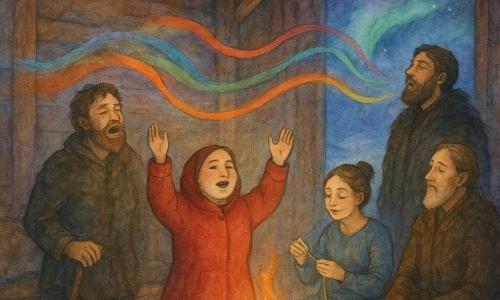
And when the night fell, they lit a great bonfire by the shore. It threw warm gold across the faces of people who had weathered seasons together. Solveig and Leif stood side by side and watched the flames. The light painted them in orange and memory. Leif leaned against his sister and said, "You kept me safe until I could keep myself."
"No," Solveig replied softly. "We kept each other. The sea taught us that nothing stands alone. Even the shore needs the tide and the tide needs the shore."
They watched as sparks rose like tiny ships and drifted into the dark, each carrying a small wish. Leif thought of cities with metal roofs, and now he wanted them for a time but with the knowledge of how to return. He understood that the world was wide and his heart was wide enough to hold both leaving and returning.
In the hush, the village breathed together. Justice had been learned not as a hammer but as a loom that wove the community tighter. Shadows were not chased away but understood, and the people of the shore had made a rule: ask the hard questions, guard the small ones, and let children keep the choice of their journeys.
Solveig's slow teeth had bitten through fear with a patience that was fierce as a storm and tender as a lullaby. Her heart, and the hearts of the village, were weathered and strong. The sea continued to tell its stories, and the shore kept its vow.