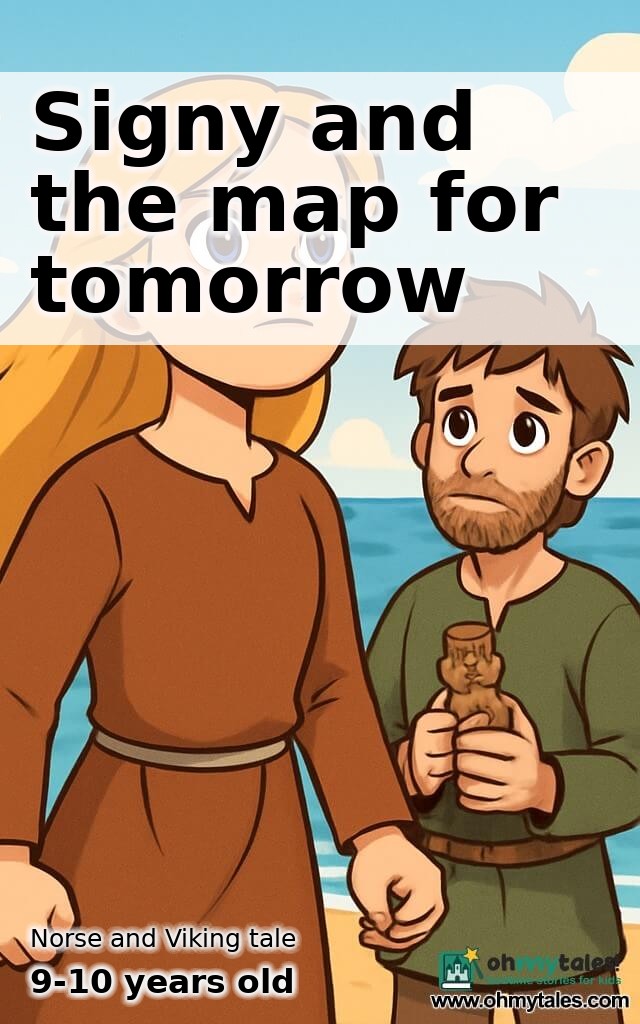
Chapter One: The Nets of Dawn
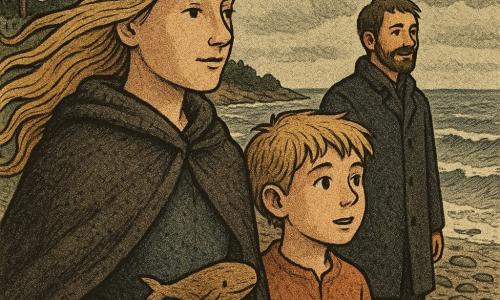
Signy rose before the sun and walked the tide-line with a basket on her arm, the way her mother had, and her mother's mother before that. The pebbles under her boots clicked like small bones. The sea lay quiet and heavy, as if it had chosen to be a blanket that morning and not a drum. She bent for driftwood, for knots of rope, for whatever the sea's pocket had turned inside out.
“Mind the kelp, Signy,” she said to herself. “It holds on like an old story.”
She was practical about the morning, and about most things. A practical woman knows where to place her foot among slipper stones, and how to count waves. She had repaired three fishing nets in the last week, and mended a mast with pine sap and patience. Her hands smelled of tar and wind. She did not expect anything new.
Then she saw him.
At first she thought the pale thing by the wrack was a log. But the log had hair, and the hair had salt in it, and the salt had a heartbeat underneath. Kelp wrapped the figure as snug as an old cloak. A gull stood on a rock and stared at her as if to say, “Well? Don't just stand there.”
“I hear you,” Signy said, and set her basket down.
The man—more a boy, though he was bearded the way a rock is bearded with moss—breathed in ragged sips. His lips were blue as winter shadows. His arms were bare and scored with faint lines where rope had rubbed. A broken length of plank was tied to his waist like a stubborn friend who refused to let go.
Signy stooped and slid the kelp away with her fingers. “Easy,” she said, as if to a skittish colt. “I've untangled nets worse than this.”
His eyes opened. They were seal-dark, full of the shine of water. He tried to rise, but his teeth chattered, and his words came out in a language broken by cold.
“Shh,” Signy said. “You're not a fish, so you don't belong wrapped in seaweed. Come.”
She hauled him up with steady strength. He was heavy like a sack of wet wool. She spoke to him as she worked: “You have a name, I suppose. Everyone does. I'm Signy. My boat's the Storm Gull. My goat is Kelda, who thinks she is a queen. Don't worry. Kelda bites only apples.”
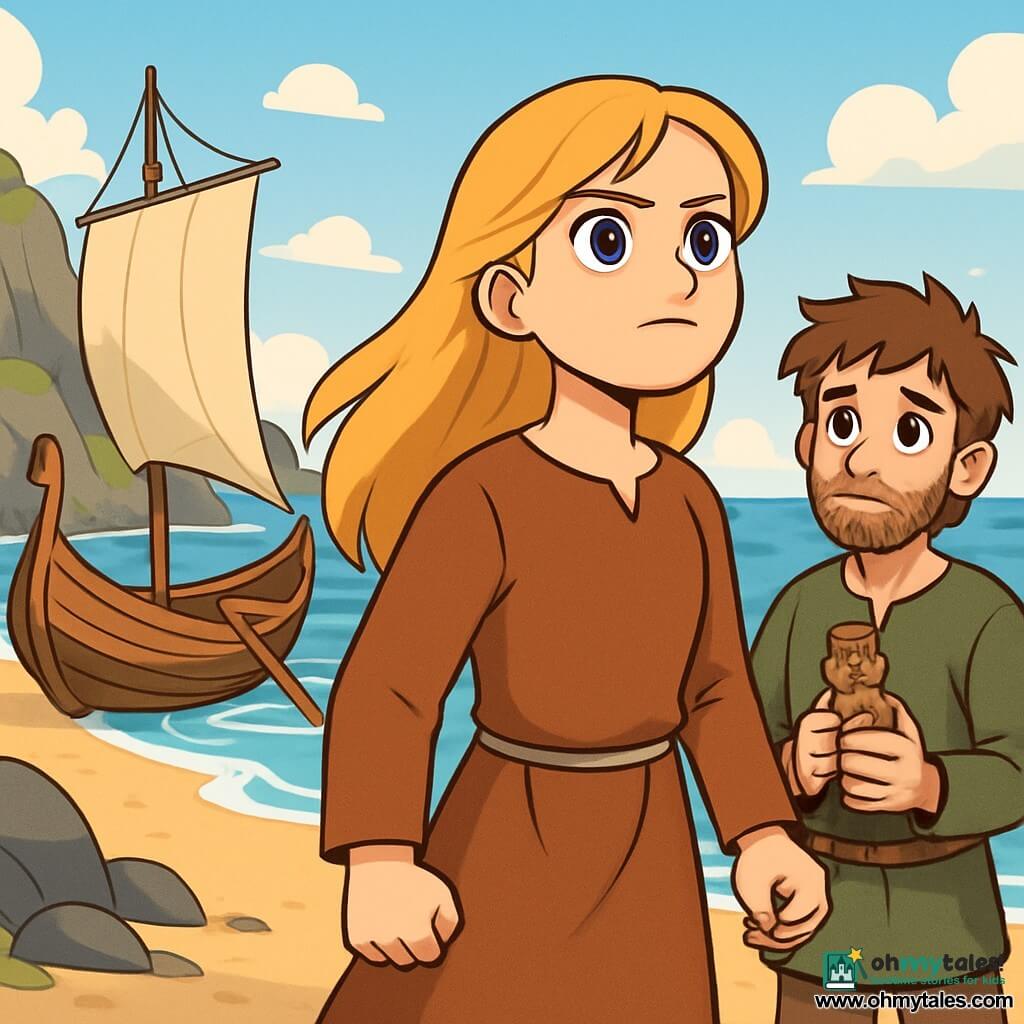
The boy tried a smile and failed. He gurgled a word that sounded like “Ulf,” and then coughed out half the ocean. His skin was cold all the way in. Signy wrapped her cloak over his shoulders, and then, because a cloak was not enough, put her own body between him and the wind.
The weather smelled of change, sharp as new bread. Far off, the clouds gathered themselves as a flock gathers, gray bellies low. Signy's eyes went to the edge of the water where the world thinned. She knew the sign of a storm when she saw it. The storm had the manners of a goat: it would come whether it was asked to or not.
“Come,” she said again, and half-dragged, half-led him to her cottage of stone and turf, where the smoke rose from the turf fire in a quiet line. The hearth was a mouth that knew how to speak warmth. By the door a carved oar leaned, pale and smooth, the handle worn shy by three generations of hands. Spirals and fish were cut along the blade, with small runes that said little and meant much.
Signy set the boy by the fire, wrapped him in blankets, and fed him broth as if the spoon were a ship and his lips a harbor. He said “Ulf” more clearly now, and another word: “Stone-Fawn.” He pointed toward the north, toward the islands that humped on the horizon like sleeping seals when the sky was clear.
“Ah,” Signy said. “You are far from home, Ulf of Stone-Fawn. And I am far from foolish. You have to be returned.”
He nodded, and his eyes watered with more than heat. Outside, a gull cried, and the sound slid like a blade along the coast. Signy looked at the carved oar, and the oar looked back in its quiet way. The ancestors held the long rope of memory, and sometimes they tugged.
“Rest,” she told Ulf. “We will see what tomorrow holds. And if tomorrow is stingy, we will take what it gives and add to it.”
He slept, as deep as dropped anchor. Signy sat by the hearth, her hands around a cup, the warmth moving into her like small animals. The fire sighed. The sea was a great blue lung that took a breath and held it. The oar hummed with the voices of grandmothers.
And the storm walked closer.
Chapter Two: Bread, Salt, and a Promise
Morning came with iron-gray clouds low as a brow over eyes. The wind had turned from a whisper to a busy aunt. It fussed with the thatch, tugged at the hinge, and tried to taste everything. Kelda the goat had wedged herself under the table and stared at the door with a dignified dislike for weather.
Signy put bread and salt on the table, because that was how you welcomed someone who had tasted the sea too closely. “You eat,” she said to Ulf. “Bread for strength, salt for luck.”
Ulf's hands still shook, but his color was better, and his smile this time stuck. “Thank you, Signy,” he said, tasting her name like a new kind of fish. His speech was slow and careful, as if the words were a path of stepping-stones. “Storm took our longboat. I held wood. Waves kept me. I lost day and night. I thought I was a seal. But I am not.”
“No,” Signy agreed. “You are a man, and your people will miss you.”
Ulf reached into the tangle of cord still around his waist and took out a small carved token. It was a pellet of bone with a deer shape etched on it—thin legs, small antlers, the way a child might draw a memory of a deer. “Stone-Fawn,” he said, touching it to his forehead, and then to his heart.
“Keep it,” Signy said. “I have, too.” She showed him the oar by the door, its spiral grooves polished by a hundred boat-mornings. “Grandmother Astrid carved it. When the sea forgot me once, this brought me home. We will take it. We will go while the storm is still choosing where to stamp.”
Ulf looked at the window where the sky was a sheet of pewter. “Today?”
Signy nodded. “Yes. Today, before the sea decides to chew the coast and spit it back.”
She made him drink more broth, and then wrapped him in a seal-wool cloak. “You will do as I tell you and not try to be a hero,” she said. “Heroes drown. That's their habit.”
He laughed a little, surprised, and then sobered. “I will do as you say.”
They went to the strand where the Storm Gull sat on her rollers, bathed and ready. She was not large, but she had a good curve to her hull and a sensible heart. Signy ran her hand along the boards, checking for the small lies boats tell when they want more pitch. She put the carved oar in its place and laid two more oars beside it—plain, square-shouldered. She checked the sail, mended last night with a patch that looked like the island of their bay.
“Come,” she said. “Help me push.”
Ulf put his shoulder to the hull, and together they felt the weight give. The sea took the boat with a sound like a sigh of welcome. The air sharpened their faces, and flakes of rain like cold fish-scales touched their skin.
Before they shoved off, Ulf knelt in the wet sand and drew with a stick. He drew a crescent of islands like small sleeping things. He drew a long beak of rock that jutted from the sea. He drew a cairn. He spoke the names soft and low: “Raven-Maw. Seal-Twins. Fox-Nap. Home.”
Signy watched the marks. “We will keep this in our minds,” she said. Then she bent, picked a flat stone, and pressed its wet face against the map. The sand stuck. She wrapped the stone in a scrap of cloth and tucked it into the boat's forward nook. “A map for our pockets,” she said. “Sand does not always behave, but it remembers the shape of things.”
They pushed off. Kelda bleated as if to say, “You are foolish, but I will stand guard.” Signy waved to the goat and to the sky. “We'll bring him back,” she told both.
The first reach of water was friendly, lapping at the hull as a dog sniffs a new hand. Signy set the sail and took the tiller. The carved oar's edge glimmered with a dull light, as if the old runes hummed with the damp. Waves lifted and set them, as steady as breath.
“Hold tight,” Signy said, and Ulf did.
The storm ahead rumbled like a deep drum. Signy felt the old calm rise in her like a seal rising for air. She was not brave; she was used to work. Work keeps the fear from growing too tall.
“Grandmother Astrid said the sea is a road for whales,” Signy said, half to fill the air, half to let the quiet of the words take root. “She said the right way shows itself if you ask in the old manner. And the old manner is to be watchful and decent.”
Ulf nodded, eyes on the line he had drawn in sand now folded into the boat. “My grandmother said the sea has ears.”
“It does,” Signy said. “So let's speak with respect.”
The Storm Gull nosed toward the north. Rain stitched the sky to the water with silver thread. The wind took their hair and braided it back off their foreheads. Signy set her jaw and counted waves: one in, one out, a third to watch.
By noon the land was a charcoal smudge behind them. Ahead, the weather was making up its mind. Signy made up hers faster. She held the tiller like a handshake and sailed on.
Chapter Three: Fog, Whales, and the Ash Trick
The storm did not fall on them as a wall. It crept in as a fog, soft-footed and careful, wrapped around their boat like a cat. The horizon folded itself away. The sea became a room with no corners.
“Fog,” Ulf said, as if naming it would make it polite.
“Fog,” Signy agreed. She loosened the sail a hand's width and felt the change in the pull. The world shrank to the size of a song.
What did you do in fog? You did not hurry. You remembered that the sea has its own teeth and that you have only one boat. You listened.
Signy listened. The fog made everything close. She could hear the tap of water on wood, the small talk the waves made with the hull. Far off, a sound low and round as a drum rolled over the wet air. Then another. Not thunder. Not rock. Something alive.
“Whales,” Ulf whispered, and sat very still.
Whale backs rose like smooth hills in the gray nearby, four of them, then five. Each great body lifted, breathed a tower of white, and slid under again. Their presence felt like another set of grandparents coming into the room. Signy's hands found the carved oar and held it in a brief salute.
“Ask right,” she murmured. “We keep to our side. You keep to yours.”
One whale surfaced closer. Its eye, dark and old as winter, rolled in their direction. Signy bowed her head. “We carry a man home,” she said, not too loud. “We have bread and salt between us. We do not take more than our share.”
The whale's breath rose again, warm and smelling of sweet rot. Then the whales turned together, as if they had been listening and had agreed, and swam into the fog, where their backs became a moving fence the boat could follow without seeing. Ulf watched, mouth open, until he remembered to close it when a thin spray of whisper-rain touched his tongue.
“My grandmother sang a song for whales,” he said, and sang a piece, a tune low and simple, that followed the whales' backs like a shadow.
“Good,” Signy said softly. “Sing it.”
He did. The fog felt less like a thief and more like an old blanket.
By afternoon the song faded and the whales were gone. The fog thinned to a veil. Black teeth of rock stood up from the sea ahead, where the current braided itself. Ulf leaned forward, anxious. “Raven-Maw,” he said, pointing. “Rocks there, and there. A fast river under.”
Signy nodded. “I see it. The sea's mouth is full of stones there. It chews hard.”
Her grandmother's voice sat in her ear as clearly as if Astrid were in the boat, dripping like a seal, her hair braided with sea grass. “When you don't trust your eyes, trust the pull,” Astrid had said. “Ask the current to show you its veins.”
Signy reached for the small pot near the mast, where she kept ash from her hearth wrapped in oiled cloth. Ulf frowned. “Fire ash?”
“Yes,” Signy said. “When ash touches water, the water tells you which way it's running.” She took a pinch and let it sift from her fingers over the side. The ash made gray snakes, some curling forward, some whipped aside. She watched how they slid. The current went this way, then that. There was a small way through. Not wide, not shouting, but present.
“There,” she said. “Hold tight.”
She shipped one oar and took the carved one in both hands. The runes bit her palms in a friendly way. With small strong strokes, she guided the nose of the Storm Gull into the slack the ash had shown. Water shouldered them, testing, but did not knock. A hidden rock brushed their keel with the light touch of a cat. Signy kept her eyes on nothing and everything, feeling the pull, adjusting by inches.
Ulf held his breath, as if his lungs might startle the sea. “You know how to read the water,” he whispered.
“I know how to ask it to read itself,” Signy said.
They slid through the Raven-Maw. The sea opened again, calm as if it had never been otherwise. A strip of sun found them and laid an arm of warmth across Signy's shoulders. She let go of her breath in a long thread.
Ulf laughed, a sound that shook, then steadied. “You have good tricks.”
“Not tricks,” Signy answered. “Just old ways. Someone showed me. Someone showed her. The ways are a rope into tomorrow.” She glanced at the ash on her fingers and flicked it into the sea. “And a little ash helps.”
By the time the fog burned off, the day had edged toward evening. The clouds broke their huddle and moved away in sulky scraps. To the west lay dark shapes low on the water.
“Seal-Twins,” Ulf said, pointing.
Signy shook her head. “No. Those are the Sleepers. The Seal-Twins are smaller, like two fists. We'll need to stop before dark.”
“Where?” Ulf asked.
“Old Cove,” Signy said. “Between the Sleepers and the coast are stones the people raised before my grandmother's grandmother was born. They stay in place even when the sea is in a mood. We will tie up there.”
He looked at her with trust. It sat awkwardly on him, but it stayed.
The Storm Gull slid toward the Old Cove. The land rose, and the stones rose above it, tall and serious, like elders standing in a circle, talking with their hands tucked in their sleeves. The air had that smell that comes just before night, when the world seems to hold its breath to listen.
Chapter Four: The Hall of Echoes
They tied up the Storm Gull in the Old Cove where the water was thick with reflected stone. The tide crept in and out with the slow patience of old people getting up from chairs. The standing stones watched them without watching. There were marks on them, lines and spirals, the kind of writing a glacier might do with a thumb.
Ulf looked small among the stones. “It is like a hall,” he said. His voice came back to him twice, once soft, once softer.
“A hall that remembers more than it says,” Signy replied. She set a small fire from driftwood under an overhang, where the smoke could rise and not bother the stones. She set the pot and poured water, and put in a handful of barley and a pinch of salt. She dropped in a piece of dried fish and one of dried apple. “For sweetness,” she said to Ulf. “Even stew deserves a treat.”
He laughed and sat close, his hands around his knees. “My mother puts in berries if the sea gives no fish.”
“Wise,” Signy said. The fire took hold and the pot began to murmur. The evening came down like a shawl.
The stones held old voices the way a shell holds the sea. If you put your ear close, you could hear the wind's stories from long ago. Signy listened. She thought of the carved oar back in the boat, her grandmother's hands on it. She told herself, like someone humming a lullaby, “Remembering is also moving forward. We are a braid. One strand does not make a rope.”
Footsteps sounded on the pebbles, soft and certain. A small figure appeared by the nearest stone, wrapped in a seal-skin cloak. Her hair was a white puff, and her face was creased like drift wood, but her eyes were sharp. She looked at Signy as if counting her fingers, then at Ulf as if counting his bones.
“Runa,” Signy said, rising. “I thought you slept above the south headland.”
“People think a great many things,” the old woman said, and smiled as if at a private joke. “I sleep where the wind puts me. I saw your sail and came down. You're Astrid's granddaughter.”
“I am,” Signy said. The warmth that moved through her then was not from the fire.
Runa clicked her tongue and tapped the carved oar with her staff. “That one's seen a deal of weather. You're going north in this?” She squinted at the sky, which had opened to show a few shy stars. “It will be fair by midnight, if the north wind does not change its coat again.”
“We must be quick,” Signy said. She pointed to Ulf. “He fell from the storm. He belongs to the Stone-Fawn islanders.”
Runa nodded. “The Stone-Fawns have a way of putting their boys in the water and then calling them back. I expect they have their hands to their mouths now, shouting his name into their bowls.”
Ulf spoke softly. “They will be watching the rise of the flame by the cairn. If I do not come, they will put out the light and sing my name into the night.”
Runa's eyes softened. “Then we will put you under their light. But go by the Fox-Nap, not the Seal-Twins. The current has teeth near the Twins now, and they like new things to chew. The Fox-Nap will be sleeping, as it says.”
Signy listened and filed the words. Runa could tell the sea which shoal would be in a mood simply by smelling the wind at dusk. There was a string of blue beads around her neck, worn smooth by worry and rain.
“Eat with us,” Signy said.
Runa did. She ate stew with both hands around the bowl, the way a child holds a treasure. When she was done, she reached into her cloak and pulled out a small bone needle and a twist of sinew thread. “For your sail,” she said. “The patch you set is good, but the edge will fray. This thread goes through canvas like a fish through water.”
“Thank you,” Signy said. She took the needle with careful fingers, as if taking a bird. “I will sew by lamplight and be done before the tide turns north.”
Runa tilted her head at Ulf. “Sing your star song, boy.”
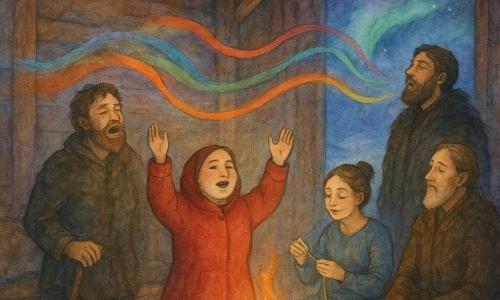
Ulf, shy, sang low the rhyme his grandmother sang, the one that named the north star and its helpers, how the seven bright points are a ladle, how the two from the cup point to the nail that holds the night's tent. Runa nodded along, pleased. The stars above them pricked through the dusk, one by one, as if they were listening and wanted to be counted too.
“My grandmother said the stars are holes poked in the sky by ancestors with sharp sticks,” Ulf said, and smiled.
“Mine said they are nails, and the sky is a tent,” Signy answered. “Either way, they hold.”
When the stew pot was empty and the last light went from the west, Signy took the bone needle and mended the sail's fraying edge with neat, practical stitches. The sinew pulled tight, clean as a promise. Runa sat with them and told three short stories, because three stories can warm a night: one about a fox who stole the moon's reflection, one about a girl who taught a river to braid, and one about a stone that listened.
When the tide began to swell in the cove's throat, Runa stood. “Go now,” she said. “The wind wears its north coat and will keep it till morning. Follow the Fox-Nap. When you see the cairn light, keep it on your starboard side. Do not call the sea by ugly names, and it will not take offense.” She reached out and patted Signy's cheek, then Ulf's shoulder with her small old hands. “Tell Astrid's oar to behave.”
“It will,” Signy said, her throat tight with the way kindness can make a person feel like a small child again. “Thank you.”
Runa grunted. “When you come back, bring me a story the stones do not know.” Then she slipped into the dark, which wrapped around her as if she were one of its own.
Signy and Ulf pushed off under the stars that looked like rimmed bowls full of light. They followed the Fox-Nap, which was a low, easy island that lay like a sleepy animal. The wind steadied them. The stars kept their place. The carved oar hummed with the bustle of ancestors, but in a helpful way.
Ahead, a new glow rose, a faint, steady fire atop a low cliff.
“The cairn,” Ulf breathed. His voice trembled like a string.
“Home's candle,” Signy said, and held the tiller a little tighter.
Chapter Five: The Light on the Cairn and the Map for Tomorrow
When a fire is lit for you, you feel it in your chest before you see it with your eyes. The cairn's flame shone like a heart in the night, not large, not loud, but insistent. It struck the water in a path, a pale road the boat could travel without touching.
Ulf stood and sat and stood again, unable to hold his joy down. “They kept it lit,” he said. “They kept it lit.” He put his hands to his mouth and called his own name, once, twice. The sound went to the cliff and touched it and came back.
Figures gathered on the low headland—small shapes first, then faces as the boat angled in. Hands lifted. Voices, too many at first, then one voice, older, shaking, that said “Ulf!” in a way that was both a sob and a laugh.
“Sit,” Signy said, practical even with joy shouting in her ears. “Sit, and when I say jump, you jump.”
He did as told. When the Storm Gull kissed the ledge where the people had laid kelp to keep boats from biting themselves, Signy eased the sail, poised, counted a set of waves, and said, “Now.” Ulf jumped, and hands caught him as if they had always been there. He folded into his people like a bird folding into a thicket.
The Stone-Fawn folk were cliff and sea in their faces. A woman with hair the color of iron pressed Ulf's cheeks and then Signy's hands. “You brought him,” she said. “May your boat never go hungry.”
“My boat eats pitch and praise,” Signy said, deadpan, and the woman laughed in sheer relief.
An old man with a scar above his eye leaned on a staff. “I saw your sail. It has a patch shaped like our bay,” he said.
“It does,” Signy replied. “It was empty cloth this morning. Now it is a story.” The old man grinned and patted the oar, as if greeting a cousin.
They drew Signy and Ulf up the path that climbed the cliff, set with worn steps where generations had walked. At the top, the cairn fire burned in its ring of stone. Beside it stood a bowl of water, where the fire looked back at itself without blinking. A girl brought bread and dried fish. A boy brought a cup of hot broth so fragrant Signy could feel it in her fingers before she tasted it.
“You will sit,” the iron-haired woman said with command and welcome mixed. “You will eat at our fire. Then you will sleep in our house and wake as a friend.”
Signy hesitated. The Storm Gull tugged at her mind like a well-trained dog checking if it was needed. But the night was gentle in that moment, and the boat sat snug below, and she could see the carved oar's pale line where it lay. “One bowl,” she said. “Two, if the goat does not mind I am late.” She did not try to explain Kelda to them.
They ate. They talked around the fire. Ulf told, in his careful words, of the longboat broken by the storm, of the days of floating, of kelp and cold and Signy's hand pulling him like a rope from the dark water. He held up the small carved deer, and his mother kissed it, then kissed his forehead, then kissed Signy's hands again.
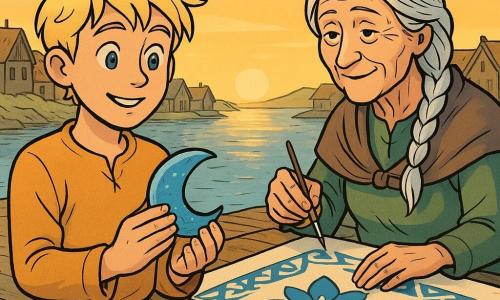
“You have our thanks, and more than thanks,” the old man said. He motioned, and a young woman brought a flat piece of birch bark, smooth and pale as new snow. On it, lines had been painted with soot and fish glue. Small colors marked places: red for danger, green for haven, blue dots for fresh water. Shell beads stitched by holes marked the cairns. Tiny fish bones pointed north. “Our chart,” he said. “We keep the ways on bark, so the children may learn to read the sea like a page. Take this. It will bring you home by the easiest spine of the water.”
Signy took the bark in both hands. The birch was light but felt heavy with care. “This is more than I brought,” she said.
“We trade memory for memory,” the iron-haired woman replied. “You carried ours back to us. We give you the road we keep in our heads and mark for our children's hands.”
For a time they sat in a circle of warmth, the fire writing its own map on their faces. The stars above were bright nails holding up the sky. The old man told a short history of the Stone-Fawn: how they had found a place in the rocks where the currents gentled, how they had piled the stones of the cairn so the light would show far out. Signy matched his story with one of her own: her grandmother Astrid rowing in a fog so thick even gulls were confused, how Astrid had spoken polite words to the sea, how the sea had grunted and moved its furniture to let her pass.
Later, as the fire settled into red thought, Ulf came to sit next to Signy with a cup of water. “I thought I was gone,” he said, plain as bread. “Then you were there.”
“You were there first,” Signy said. “You kept breathing. You kept your hand on the wood. Many forget which end of a rope to hold. You remembered.”
He nodded, watched the water in his cup quiver with the small wind. “Will you sleep here?”
“I will do better,” Signy said. “I will go now, while the wind is still in a good mood, and the sky remembers its stars. Morning's wind might forget its manners. Kelda will be unbearable if I do not feed her. And the tide will carry me easy now.”
Ulf's mouth opened as if to say a dozen things. He settled on, “I will not forget your hand.”
“Good,” Signy said. “Do not. Remembering is a kind of work. It keeps the rope strong.”
They walked down together. At the ledge, Ulf put his hand on the carved oar and bowed his head, a small, shy thanks. He tucked something in the boat's forward nook: a twist of wool with a tiny bead threaded on it, a fawn carved of shell. “My sisters made it,” he said. “For luck.”
“I accept luck whenever it is offered,” Signy said. She pushed off, stepped into the Storm Gull with the grace of a person who knows what boats ask of feet, and found her place at the tiller and the oar.
The sea had changed its coat again, but only to a lighter one. The stars hummed. The birch-bark map lay in the nook, its shell beads cool under her fingers. She glanced at it, at the curve of the Fox-Nap, at the small red strokes where the Seal-Twins gnawed. She set her course.
The route home was not the same path they had taken. That is often true, and you do not fight it. The currents bore her as if happy with the trade: a boy returned, a map gained. The carved oar whispered against the water, and in the whisper Signy heard her grandmother's tone: satisfied, a touch smug.
“You old fish,” Signy said, smiling into the dark. “You did well.”
She reached the Old Cove before midnight and did not stop, because the tide was still a helpful friend and she had a goat to appease. The stones watched her pass and said nothing; they approved in their polite way. Farther south, the Sleepers lay easy and big. Signy counted constellations and kept to their advice. The wind hummed a lullaby without words.
When the black melted toward blue, when the far edge of the world blushed as if remembering something it loved, Signy saw her bay. The smoke from her hearth rose fast, a straight ribbon in the cool. Kelda's bleat carried across the water like scolding. “Yes, yes,” Signy called. “You tyrant.”
She brought the Storm Gull up on her rollers and set her tidy. She hung the sail to dry and laid the carved oar in its place by the door. She fed Kelda, who forgave her at once and pretended she had not been worried.
Inside, the cottage was as she had left it: fire banked, cup on the table, a coil of rope by the stool. Signy set the birch-bark map on the table. The dawn widened, laying white light on the bark. The lines and beads shone. It was a map of safe ways and told dangers, a gift made of memory and care.
Signy took a small oil and rubbed the bark to keep it from cracking, the way you rub a friend's hands in winter. Then she took a coal from the fire and warmed the end of a bone pin. On a clear space near the bottom, she made a tiny mark like a gull's foot and beside it a small spiral, the shape her grandmother liked to carve, and beneath, in her neat hand, she wrote a line: “Ulf returned by Fox-Nap under the cairn's fire—wind north, tide kind.”
She sat back, the room fresh with morning. She felt tired and full. Outside, the sea breathed in and out. The boat waited, mended, fed. The oar leaned and hummed in its wood-voice. The ancestors sat in their quiet chairs and approved with their quiet hearts.
Signy poured herself water, drank, and smiled at the map on her table. It lay there like a promise. It was a map of where she had been and a map for tomorrow, because tomorrow always asks for a road and a memory to walk it. She put her hand flat on the bark and closed her eyes for a breath, and under her palm she felt the faint pulse of all the feet that would walk the road after her, and the faint echo of the hands before.
“Good,” she said into the new day. “We will use this. We will remember.” Then she rose to work, as practical as ever, and the sea, which has ears, listened and was pleased.