Chapter 1: The Empty Casks
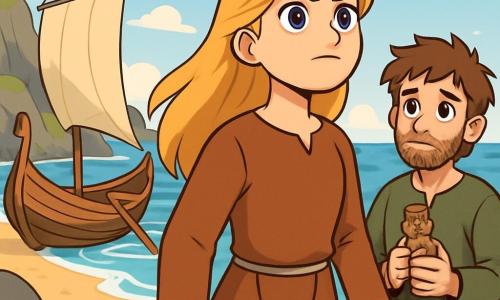
In the time when longhouses breathed smoke into the sky and the sea spoke in gray syllables, a young woman named Astrid lived at the edge of a fjord. Her village lay where pines stood like old guards, and stones wore moss like green beards.
Winter had come early. The streams had tightened into ice, and the well near the hall had gone silent, as if it were holding its breath. Inside the storehouse, the water casks sounded hollow when knocked—like drums that had forgotten their songs.
Astrid was patient by nature. Her patience was not sleepy; it was steady, like a lamp that keeps burning even when the wind tries to whisper it out. Still, a deep wanting stirred in her—simple as thirst, strong as oath: she wanted to bring water.
Not for herself alone. For the children with dry lips. For the elders whose stories needed warm broth to carry them. For the dogs, who licked ice as if it were a joke.
That evening, while the fire cracked and the roof beams creaked like tired knees, Astrid listened to the old ones speak. They did not speak loudly. In the North, words are coins; you spend them carefully.
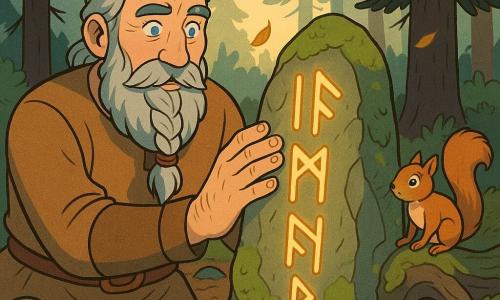
Her grandmother, Signe, traced a finger along a carved post where small runes slept in the wood. “Our ancestors walked when roads were only guesses,” she said. “They remembered the land, and the land remembered them.”
Astrid leaned closer. The carving showed a river, a bridge, and a line of tiny feet. The runes looked like little hooks meant to catch memory before it fell into darkness.
Outside, the moon rose pale and round. It hung above the fjord like a shield left out to cool. Astrid made her choice in the quiet way brave people do—without shouting.
In the morning, she would go to the old spring beyond the ridge, the one the elders called Ancestor's Eye. They said it never froze, because it was warmed by stories.
Chapter 2: The Ridge of Listening Stones
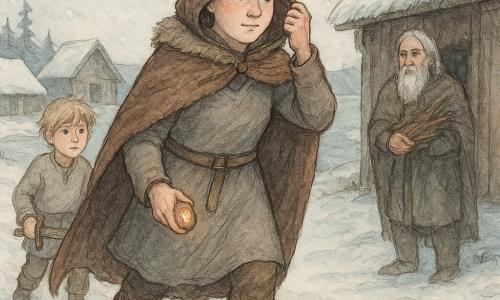
At dawn, Astrid wrapped herself in a wool cloak and tied her hair back with a strip of leather. She packed a small axe, a coil of rope, and two empty skins that flopped sadly like sleepy fish.
The men of the hall were mending nets and sharpening tools. One of them called, not unkindly, “Going to wrestle the winter, Astrid?”
“I'm only going to ask it for water,” she answered. Her voice held a hint of humor, like a smile hidden under a scarf.
She walked north, where the wind tasted of salt and pine sap. Snow lay over the ground in smooth sheets, as if the world had been tucked into bed. Her boots made a firm rhythm: crunch, crunch—like a simple drumbeat for a long song.
Soon she reached the ridge. There, the stones were piled in a line, each one dark and tall. The elders said they were Listening Stones. If you spoke near them, they carried your words along the mountain, delivering them to whoever needed them—gods, ancestors, or stubborn goats.
Astrid did not speak. She listened instead.
The ridge was not silent. It had the quiet hum of the North: wind sifting through needles, a raven's wing cutting the air, the far-off groan of ice on the fjord. And beneath it all, the feeling of many footsteps, as if the ground remembered every traveler who had ever trusted it.
Astrid placed her palm on a stone. Cold met her skin, sharp and honest. In her mind, she saw her great-grandfather, who had once crossed this ridge with a sled of iron. She saw her aunt, who had carried a new baby in a storm. None of them had been in a hurry. They had walked with the patient courage of people who know that the world will not be bullied.
Astrid breathed out. “Show me,” she whispered, though she did not know to whom.
A gust answered, spinning a small drift into the air. When it settled, a narrow path appeared—barely more than a suggestion, but it curved toward the valley where Ancestor's Eye waited. Astrid smiled, because even winter, it seemed, could be persuaded with calm manners.
Chapter 3: Ancestor's Eye
By midday the sky had turned the color of tin. Astrid descended into the valley, where the trees grew close together, shoulder to shoulder like warriors at rest. The air smelled different there—less sharp, more secret.
She found the spring beneath a leaning birch. It was a dark circle in the snow, open and breathing. Water moved within it, slow and sure, like a thought that would not be stopped.
Astrid knelt. The surface reflected her face, and for a moment she looked older, as if the water were borrowing years from the future. Then the reflection shifted. She saw a row of women behind her—many faces, many braids, all watching with eyes as steady as stones.
Her throat tightened, not with fear, but with the feeling of being held in a wide net of time.
Astrid dipped a cup. The water was so clear it seemed to have no color at all, only light. She tasted it. It was cold, yes, but it carried a strange warmth too, like bread remembered.
She filled one skin, then the other. The skins grew heavy and round, like two small moons. She tied them tight. The rope bit her fingers, but she did not complain. In sagas, heroes do not complain to the wind; the wind has its own troubles.
As she stood, she noticed something odd: a narrow stream flowed from the spring toward the cliff's edge—then disappeared under the snow, as if the earth were hiding it. Astrid followed it a few steps and found a crack in the ground where the water slipped away.
It was a thirsty crack. A hungry mouth.
She thought of the village well, silent and locked in ice. She thought of the hollow casks. If the spring's water was escaping, then even Ancestor's Eye could weaken over time.
Astrid crouched and cleared snow from the crack. The stone beneath was smooth, worn by ages of flowing water. She pressed her ear close. Deep below, the earth seemed to sigh.
She could not seal the crack alone—not today. But she could remember it. She could carry the knowledge home like a third skin, invisible but important.
A raven landed on a branch above her and tilted its head, as if judging her.
Astrid looked up. “Yes,” she told it softly. “I'll bring water. And I'll bring the story of where it tries to run away.”
The raven fluffed its feathers, which might have been approval, or might have been the raven simply being a raven.
Chapter 4: The Storm That Tested Patience
On the way back, the weather turned. A storm rose from the sea, swift as an angry rumor. Snow began to fall sideways, and the wind pushed at Astrid's cloak like a child tugging a sleeve.
The ridge that had been friendly now looked stern. The Listening Stones loomed, half-hidden, and the path tried to vanish again, as if it were shy.
Astrid did not panic. Panic is a fast horse with no reins. She chose instead to be patient, the way her ancestors had been patient—one step, then the next, then the next.
But the skins were heavy, and the wind was rude.
A sudden gust knocked her sideways. She stumbled, and one skin swung hard against her hip. For a heartbeat she imagined the water spilling out, pouring into the snow where no one would drink it. The thought felt like watching a candle fall.
Astrid planted her feet and leaned into the storm. “You may push,” she muttered, “but you will not steal.”
Her voice sounded small in the wind, but small things can be stubborn. A needle can hold a whole cloak together.
She reached the largest Listening Stone and sheltered behind it. The stone blocked the worst of the wind, and Astrid took a moment to breathe. Her eyelashes had gathered ice. She laughed once—short and surprised—because she must have looked like a frosted cake.
From behind the stone, she remembered her grandmother's finger tracing the runes. Memory of ancestors, she realized, was not only about names and dates. It was a way of walking. A way of standing when the world leaned on you.
Astrid took out her small axe and chopped at a drift that was trying to swallow the path. She worked slowly and steadily, not wasting strength. When she finished, the path showed itself again, a dark line of promise.
The storm eased, as storms sometimes do when they grow bored. The sky opened a crack, and a thin ray of light fell across the snow like a golden thread.
Astrid followed that thread home.
Chapter 5: The Ice Bridge Sealed
The village appeared at dusk, huddled close to the fjord. Smoke rose from the roofs, and the scent of stew met Astrid like an old friend. Children ran toward her, then stopped when they saw the heavy skins.
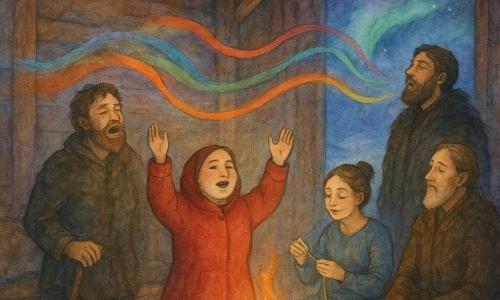
Astrid entered the hall. The firelight made the carved posts glow. Faces turned. The room grew quiet in the way a sea grows quiet before a good tale.
She untied the first skin and poured water into a bowl. The sound was bright and clean, like a bell made of liquid. People leaned in as if the water carried news.
They drank carefully. Even the dogs waited their turn, though one of them did lick the floor afterward, just in case the wood had learned the taste.
Astrid told them about Ancestor's Eye, and about the crack where water slipped away into the earth. She did not make the story large. She made it true, because truth is strong enough.
The elders nodded. Her grandmother's eyes shone. “You did not only bring water,” Signe said. “You brought memory. The old path, the old spring, the old lesson: patience is a boat that does not tip.”
The next day, the village went with Astrid to the valley. They brought stones, clay, and woven mats. They found the crack and worked together, pressing and packing, sealing the thirsty mouth so the spring could keep its promise.
Then came the last task.
Between the valley and the ridge ran a narrow gorge, usually crossed by a shaky wooden plank. In winter it was dangerous, because ice formed in odd teeth along the edges. The elders decided they would make something better—something that would last as long as the cold did.
They hauled water from the spring and poured it in careful layers across the gorge, letting each layer freeze before adding the next. It was slow work. It was patient work. It was work that felt like telling the same good story again and again until it settled into everyone's bones.
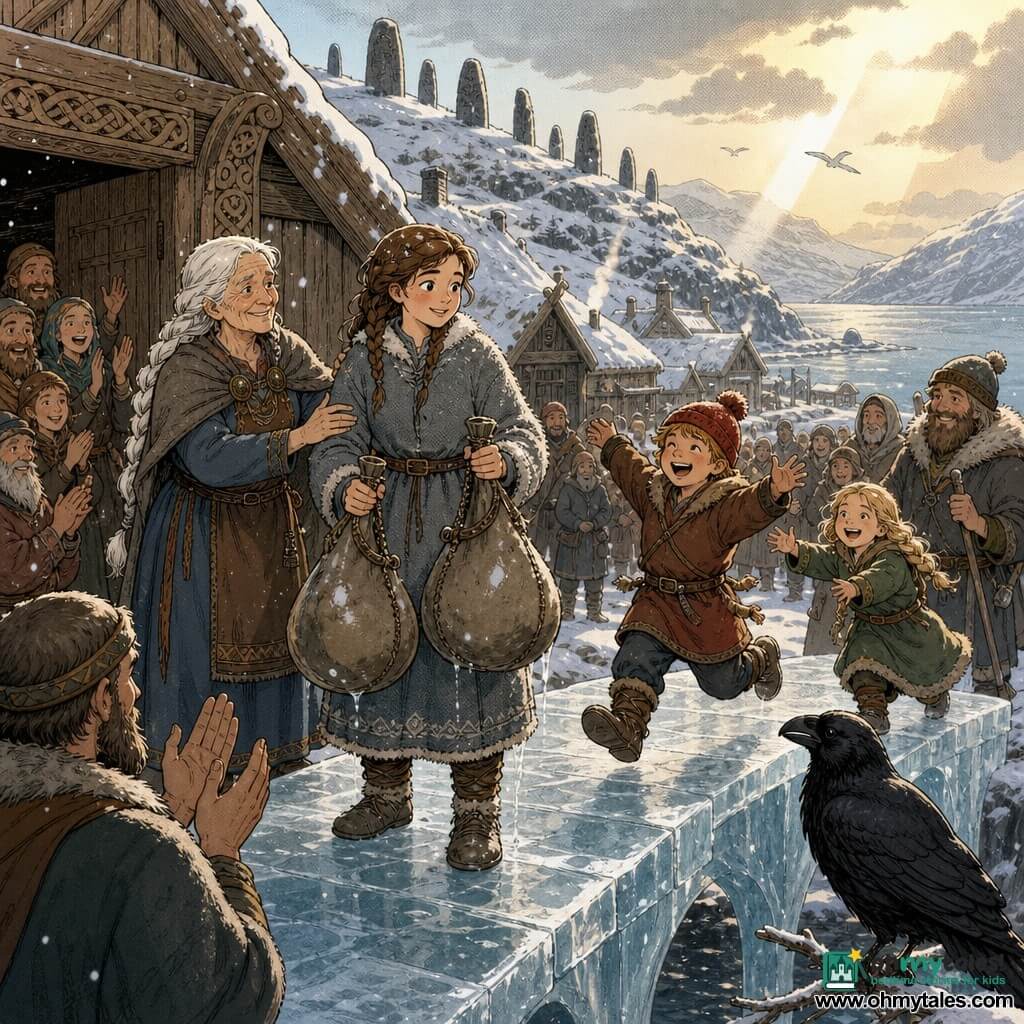
At last the bridge stood firm: an arch of ice, pale blue, with tiny trapped bubbles like sleeping stars. They carved simple runes along its sides—marks for protection, and marks for remembrance.
When the final rune was cut, Astrid placed her palm on the bridge. The cold did not sting. It felt steady, like a handclasp.
Her grandmother spoke softly, and the hall grew still even out in the open air. “Let this be sealed,” Signe said, “as our memories are sealed—kept safe, carried forward. Water will cross here. People will cross here. And stories will cross here too.”
Astrid looked through the clear ice and saw the dark gorge beneath, tamed but not erased. That felt right. The North does not pretend danger is not there; it simply learns how to meet it.
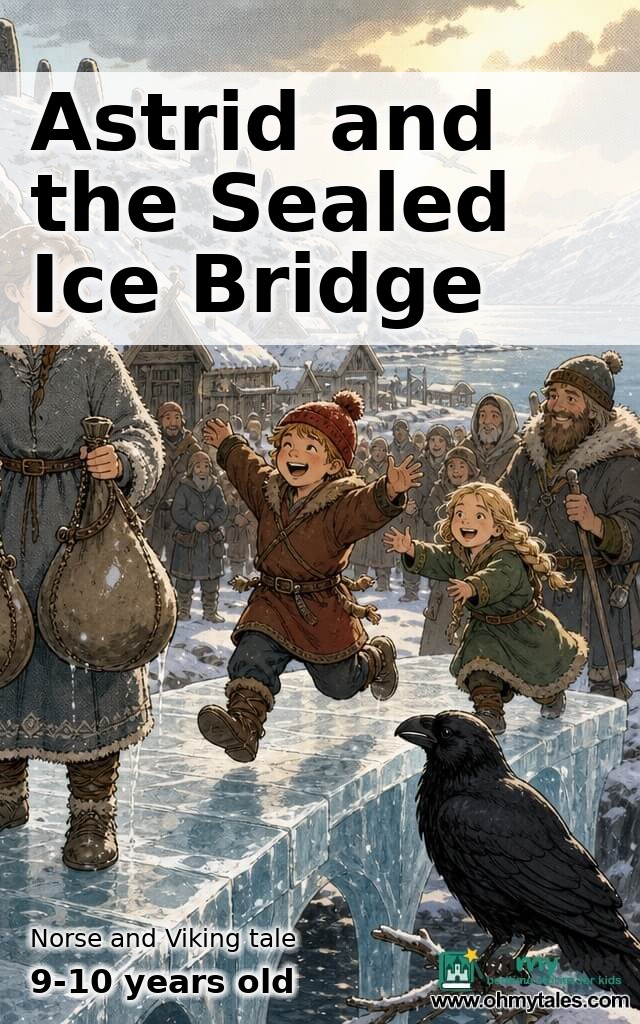
The children ran across the new bridge, their boots tapping a quick rhythm. Their laughter rang bright, and it seemed to Astrid that the Listening Stones on the ridge were listening, pleased.
She lifted a skin of water and held it up. In the pale winter light it looked like a captured piece of the spring's heart.
Astrid had wanted to bring water, and she had. But she had brought something else as well: a path remembered, a lesson repeated, a link between old footsteps and new ones.
And beneath the wide, calm sky, the sealed ice bridge shone like a promise that had learned to stand.