1. Night of Small Stars
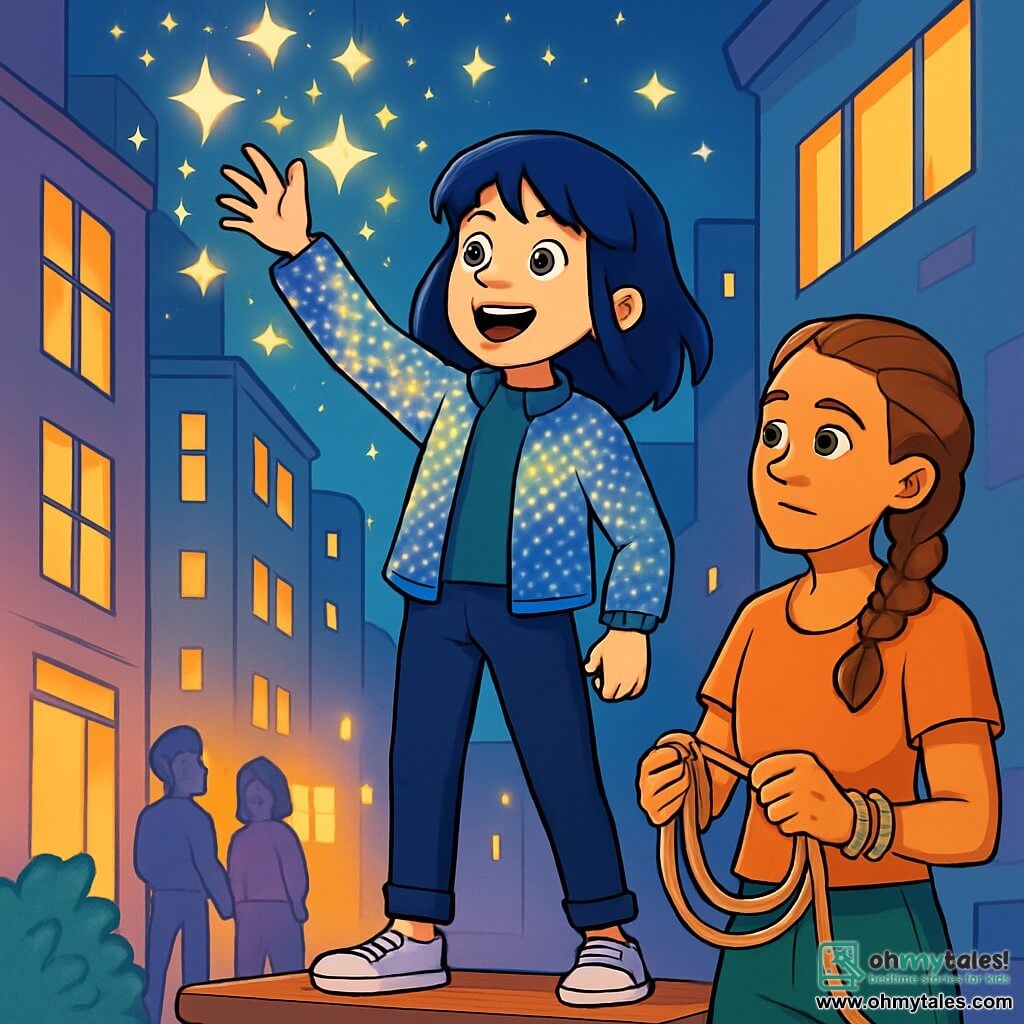
Nova Calder moved through Astra City's scaffolding of light like someone at home in a sky. Her hair was the dark blue of midnight between towers; her jacket carried tiny reflective threads that blinked when she laughed. Everyone in the neighborhood knew Nova not only by the name sewn on her satchel but by the way she left a faint trail of little stars behind her—tiny, living sparks she could light with a twist of her fingers. They were not real stars, but they caught dust, traced breath in cold air, and shone on things the city thought were hiding.
That evening, the city hummed with its usual orchestra: sky-rails whooshing, delivery drones blinking in rows like metallic fireflies, and the neon gardens that hung from the high terraces, drip-fed by the municipal canals. Nova liked to walk the older alleys, where brick remembered the hands that built it. A bench she loved sat beneath an elm near Harborlight Rescue Center, its wood worn smooth by stories and teenagers and quiet afternoons. Tonight the bench felt odd—untethered, somehow, like a memory erased and waiting to be put back.
She lit a star and held it close to her eye. The spark buzzed and painted shadows in silver. Beneath one glow, a message fizzed along the alley wall: twisted lines, rerouted directions, arrows pointing where alleys did not exist. The GuideNet—Astra City's invisible map of paths and signs—was hacked. People down below were following directions into dead ends, into closed bridges, into crowds. The stars around Nova nibbled at the edges of the interference and showed threads others could not see: fine filament lines, like the cords of a tailor who had learned to string up a whole neighborhood.
"Someone's playing with the city's seams," she said to the starlight, half amused and half alarmed. It was the kind of mischief that started small—an unmanned tram looping twice, a park gate swinging open when it should be closed—and then it ballooned into confusion: missed appointments, a night market collapsing as vendors were led away by false routes. Nova felt responsibility settle in her chest like a weight and a promise. She was not a city official, and yet the city listened when she lit her stars.
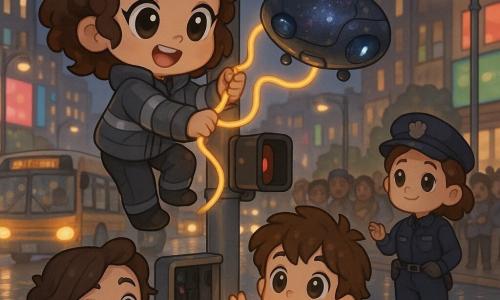
A call came through her personal beacon—a quick, urgent ping from Harborlight Rescue Center. The beacon showed small, jittering icons of lost pedestrians and a patchwork web where the center's coordinates should have been. Nova pocketed the star, snapped the micro-graplin to her belt, and headed toward flashing red on the skyline. The micro-graplin was a neat thing: a palm-sized gadget that fired a tiny grappling hook, fast enough to swing a person from a ledge or snag a loose cable. It was the kind of tool that belonged in the hands of someone who liked to untangle knots both literal and otherwise.
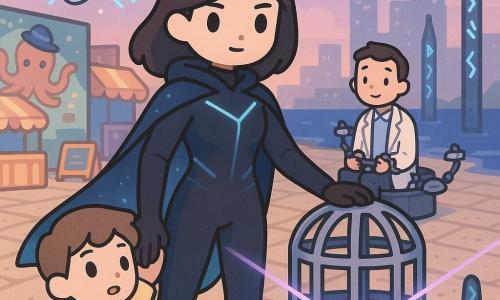
At the rescue center, lights were half-masked by drifting holograms. People queued at doors that shimmered where windows should be. A small boy clung to a nurse's sleeve, eyes wide.
"Where's my mum?" he whispered.
Nova knelt, set a small star in his palm. It glowed and showed a reflected map overlay, a stripe of truth across waving images. The star pointed down a safe corridor, where signs had been left unknotted by honest hands. Nova realized the trick wasn't just about wires and tech; it was about trust. When directions were stolen, so was the city's ability to keep its people calm. She straightened, ready to find who had cut those lines and why.
2. Knots in the Grid
The rescue center smelled of antiseptic and citrus cleaner, a bright smell that tried to steady the nerves. Inside, Harborlight's coordinator—a woman with steady hands and a last name that meant 'shore'—explained the mess. Virtual waymarkers had been braided into illusions: real paths hidden by shimmering wrong-answers, ambulance routes redirected to fountains, even distress signals rerouted into loops that went nowhere.
"This mischief has a pattern," she said, tapping her tablet. Her face was tired but not defeated. "Someone's threading chaos into our signals. We need it found and stopped before someone gets hurt."
"Who would tangle a city?" Nova asked. She fished out another tiny star and let it float above the tablet. The star's light subsumed the screen and wrote in delicate strokes: knot glyphs. Symbols of tying and binding and misdirection. They looked almost decorative, except they solved nothing.
At the far corner, a rescue tech muttered about string theory and neighborhood cats, but Nova's instincts told her this was deliberate. The knot glyphs were the signature of someone who loved to bind as much as to bewilder. A dozen small incidents all led back to a pattern: fixtures found tied up, public art arranged into impossible loops, and the strings of the GuideNet pulled into new shapes.
"Could be a prankster," the coordinator suggested. "But these knots are… too precise."
"Her name is Cora Tangle," Nova said quietly. The name arrived like a gust of memory. She'd seen posters once in the old market—an artist with hands like a spider, a woman who taught knotwork and macramé and called herself a 'master of knots' with a twinkle. Nova had met her briefly at a festival; Cora's eyes liked ropes the way Nova's eyes liked stars. Whimsy was one thing. Manipulating an entire city's route system was another.
"Then we call her," the coordinator said.
They found Cora in a studio that smelled of tea and tarred rope, where lanterns swung like tiny moons. She was not what Nova expected; not sneering, not monstrous, but intensely curious, surrounded by skeins and loops, wrists decorated with bands of braided cord. Cora smiled, patient as a tide. "I make patterns," she said. "Knots hold stories. Sometimes the city needs stories to remember itself."
"Twisting people's routes isn't storytelling, it's endangering them," Nova replied. Her voice was calm but firm. She was a superhero in a jacket, but she could be gentle in the same breath. The rescue tech watched Cora's hands. "Why the GuideNet?"
Cora tilted her head, as if trying to read a hidden card. "Because maps can blind us. Because when everyone follows one path, no one looks. I wanted to make people notice. To make them see again."
The coordinator shook her head. "With this kind of misdirection, people are getting lost. We lost a volunteer for three hours because her path kept leading her back to the same bench."
Nova's jaw tightened. "Which bench?"
"That bench by the elm," the coordinator said. "Parents used to meet there. It means something to the neighborhood."
Nova pictured the bench as more than wood; a place where a city collected stories. Responsibility nudged her forward. "Cora," she said slowly, "if you have ways to make people notice, help us untie the knots. Help us put back what's been lost."
Cora's fingers stilled. For a long beat, the studio filled with the sound of rope rubbing rope. Then she bowed her head. "I didn't want to hurt anyone," she whispered. "I wanted them to wake up. I didn't expect the technology to turn my art into traps."
Nova thought of the micro-graplin on her belt, thought of tiny stars picking apart holographic seams. "Then show me the loom," she said. "Show us how to untangle it."
3. Threads and Truths
Cora led them to the city's undergrid: a network of maintenance tunnels that smelled of warm metal and old rain. Here the city's nervous system pulsed—fiber optic lines flashing messages like the synapses of a giant machine. Cora moved through the tunnel with the ease of someone who knew where every knot began. Above the steady hum, she explained how art had met appliance; her macramé patterns had been repurposed by a vendor of optical filters who stitched them into the city's signage update stream. The result was a series of looped illusions—mirrors of routes that mimicked but did not match reality.
"This tech vendor," Nova said, "made a filter. You used it to show people other paths."
Cora's hands trembled. "I thought it would be harmless. But once the filter touched the GuideNet, it grew. The city amplified it." She looked smaller under the grid lights, suddenly like an artist who had accidentally painted the sky purple. "I didn't mean for it to keep going."
Nova set a tiny star into the tunnel's wall. It shivered and showed them an image: the pattern writ large above the city, a holographic mirage that looked like a ribboned sky. Nova could see how the lines had lied. The starlight revealed the mirror of truth: faint echoes where directions should have been, ghosts that snagged people's trust.
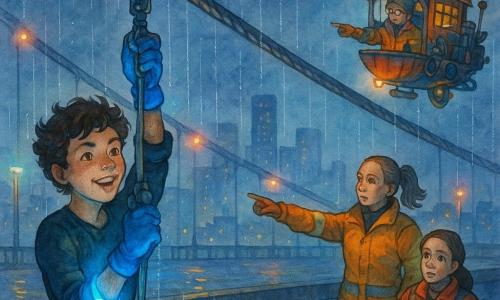
"Then we have to cut the loops at their source," Nova said. She clipped the micro-graplin and fired it up the maintenance ladder, its hook glinting and snagging a support beam. The device whistled softly as it reeled her upward; from up high she could see across neighborhoods, the illusion like a second sky sagging over rooftops.
As Nova climbed, she called down, "Cora, which way does it start?"
Cora passed her a length of braided rope, its end feeding into a panel with a tangle of wires. "There," she said. "The filter's node is here. It needs a pattern to amplify. My loops gave it rhythm. If we replace the pattern with truth threads—small, honest anchors—the amplification dies."
Nova drew the rope like a promise. Stars swarmed her hands, small and steadfast. She threaded them through the braids, watching as the micro-stars' light sewed into the code. The stars didn't just shine; they recorded the real routes where people could walk without being led astray. Each light pinned a corner of the city's map back to where it belonged.
Down below, the rescue center technicians watched on Cora's borrowed tablet. The mirage flickered and waned where Nova's starlight sewed truth into the code. But the larger illusion held like a held breath. Nova realized that untying the knot mechanically was not enough; she had to show the city why the knot mattered.
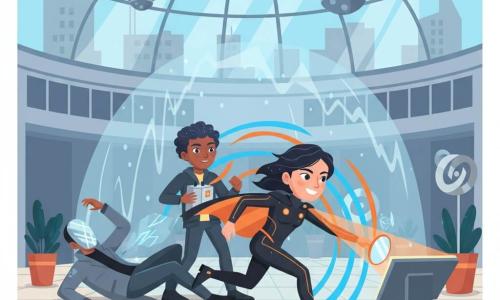
She leaped from the beam, using the micro-graplin to swing along the skyline toward a plaza where the mirage's center softly pulsed. On her way she shouted to a group of volunteers below, "Trust the lights that tell the truth! Follow the little stars!"
A dozen small lights appeared at street level—people Nova had taught to carry tiny star beacons. Like fireflies, they guided confusion into clarity, lighting the way of practical kindness. The volunteers cheered. The city slowly, stubbornly, began to remember how to walk straight again.
4. Mirage Dissipates
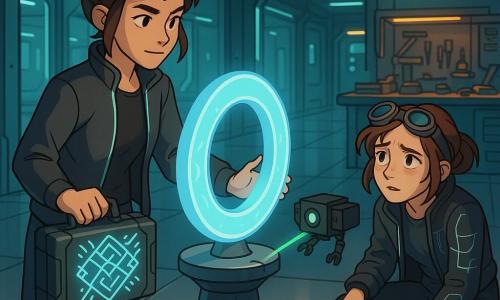
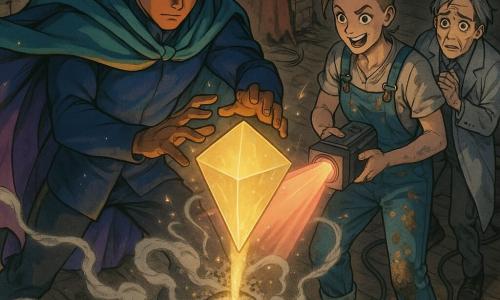
At the heart of the illusion, Nova found the vendor's device: a sleek box of glass and brass with a humming core. It purred like something alive. Cora stood beside it, guilt in every bowed braid of her hair. "I can't undo what I didn't know I broke," she said.
Nova reached out. Her fingers brushed the glass. The micro-graplin snatched a loose strand and anchored her; she hung between the mirage and the real city below. She felt the city's heartbeat under her boots and answered it with a steady breath. "Then we'll fix it together."
She set a trail of stars along the device's circuits. Each star revealed a memory embedded in the code: routes where people walked to get to work, places kids played tag, a little bench by an elm where a grandfather had once proposed. The machine responded to stories. Nova told it aloud what the city meant, not with grandeur but with specifics: "This bench is a meeting place. This alley leads to Mrs. Anaya's bakery at dawn. This plaza holds the winter lanterns." She named places and people as if threading them into a quilt.
The stars glowed, and the device blinked back. Its core unwound illusions into plain signals. The mirage shimmered, then shivered. For a startling moment the city held its breath. Holograms flickered like moths and dissolved into honest street signs and true-lit crosswalks. People cheered in small, relieved noises—laughs, claps, a child's shout.
But at the last second, the filter tried to reweave itself. It spun a new loop, urgent and bright. Nova felt the pull of the city toward that false path. She could have fought it with more force, but responsibility whispered a different lesson. She steadied her stance and looked at Cora.
"You didn't mean harm," Nova said, not condemning. "But making people lose their way carries consequences. You taught us an art that needed a guardrail. Will you help us watch it? Be its keeper?"
Cora's throat tightened. "I will," she said. Her hands, once all knots, were now tools of repair. She threaded fresh cords into the filter's casing—this time simple lines that could not be amplified, small physical markers that would stop the network from leaning on art alone. Nova's stars braided into those cords, and the mirage sighed once, like a tired animal, and lay down.
"They called the vendor to account," the coordinator later said, when the center's lights returned to steady white. "We'll audit filters. We'll include artists in our safety reviews."
Nova thought of the bench as she helped cut the final tie. The city's map, once scattered, now lay honest and whole. She felt the truth of it under her feet: responsibility was not punishment, but care—for tools, for people, for choices.
5. The Bench Returned
When the last illusion dissipated, people came out of doors blinking into real night. The market's lanterns swung steady. The rescue center's volunteers stacked chairs and laughed about their odd detours. The small boy from the first night ran up the alley, found his mother where the star had shown, and hugged her like a knot made of two lives.
Nova returned to the elm by Harborlight. The bench was there, as if it had never been misplaced: its wood cupped with old names carved into initials, a fresh strip where someone had sanded it clean. A neighborhood elder sat on it, her hair silver and eyes bright. She patted the space beside her.
"Thank you for the lights," the elder said. "You made us look again."
Nova sat and felt the bench give under her, a gentle, honest weight. Around them, people shared small stories aloud—about missed buses that became impromptu picnics, about a dog that stopped chasing its tail and found a new friend instead, about Cora teaching knotwork at the rescue center in exchange for helping to safeguard the filters. The city hummed, not perfectly, but livably, stitched back together by hands that accepted responsibility.
Cora approached with a rope bracelet in each hand. "For the bench," she said, offering one. The bracelet was simple, a tiny knot engraved into a bead—a promise. Nova took it and looped it once around her wrist.
"Keep your art," Nova told her. "Just remember that some tools need rules. The city needs both the wonder and the warning."
"Will you keep lighting the stars?" Cora asked.
Nova looked up at the skyline where tiny star trails still floated from roofs and balconies—little beacons people had learned to carry. "I will," she said. "But not for me alone. We'll teach others to light what matters."
The rescue coordinator came by and invited them to a new committee—citizens, artists, technicians—who would watch over public systems together. It was the sort of grown-up thing that felt oddly exciting: not a parade, but civic courage made routine.
As the night folded into softer dark, Nova closed her hand around the little star she always kept. She thought of responsibility as a kind of light—something you could carry, and share, and teach. She thought too of the bench, its worn armrests, its initials. A city sat upon it, for better and for worse. She was a guardian, yes, but also a neighbor.
"One small light can point the way," she murmured to no one and to everyone, and under the elm, strangers and friends agreed.
They spent the rest of the evening telling stories by the bench: about little troubles unknotted, about a mirage that had taught them to look twice, about Cora's new classes at the Harborlight Rescue Center, where volunteers learned to mend ropes and routes together. People left with clean maps and small star-beacons tied to their bags.
When Nova finally stood to leave, she looked back once. The bench caught the streetlamp's glow and turned it into something warmer. She felt the city's heartbeat steady beneath her boots. Responsibility was not a burden to be carried alone; it was a bench to be shared. She lit one more tiny star and set it to float above the elm, a small, steady promise that would show the way for the next time the city forgot its paths.
"Goodnight," she said to the little star, and to the city that would always need her light.