Part One — The Little Carrier
Mira lived on the ninth floor of a building that hummed like a friendly machine. The windows caught the city light and made tiny suns against her ceiling. Down below the streets walked like ribbons. Buses breathed steam. Neon signs winked. Magic lived in the cracks of the pavement and in the glossy puddles. It smelled faintly of orange peel and rain.
Mira was six. She kept her brave inside a small wooden box under her bed, along with a pencil stub and a stone that remembered the sound of her father's laugh. She liked to press her ear to the window and listen for names. Big names came first: the river, the bridge, the market. Small names were hidden. Sometimes a lamppost hummed a word. A stray cat could cough up a syllable like a secret.
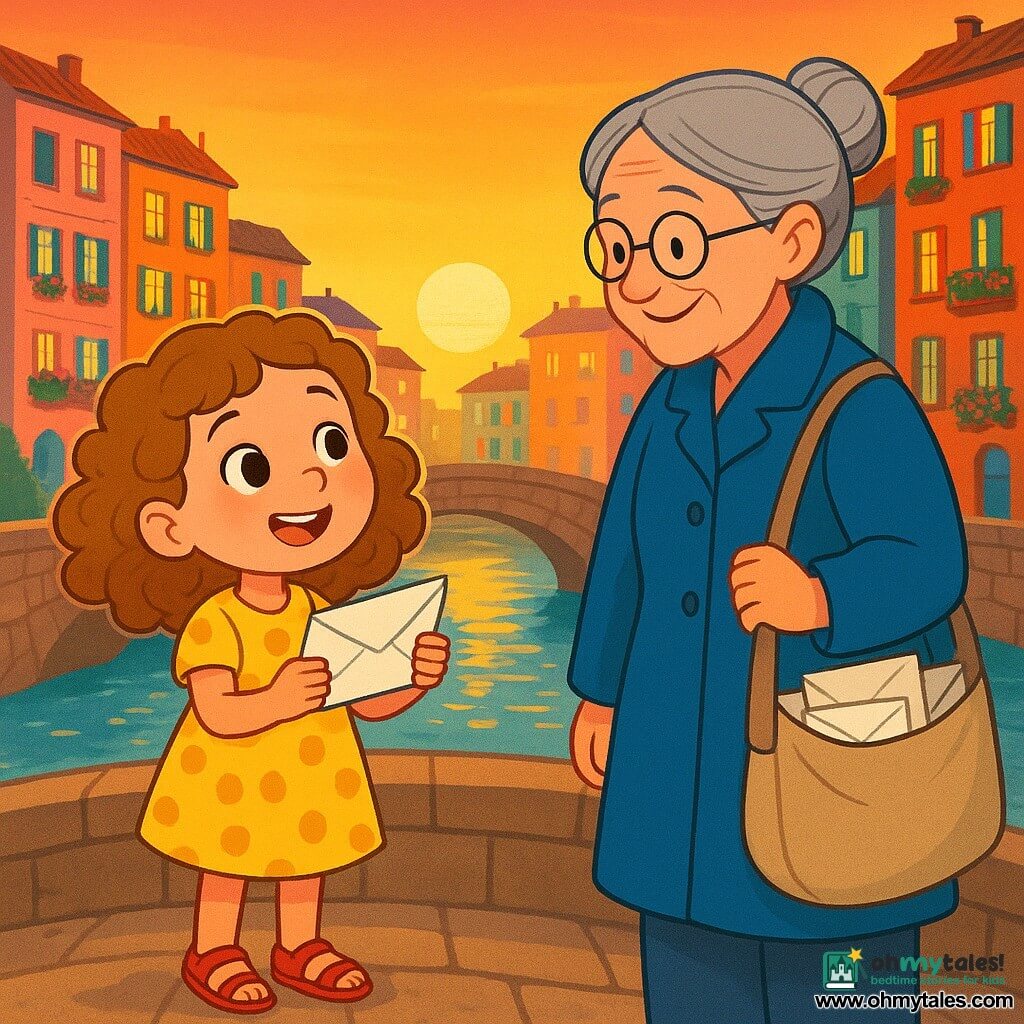
One morning the postwoman left a folded paper on Mira's doormat. It was soft as cloud. On it, in careful ink, was a tiny map and a request. "Between the two rives of the Greywater," the map said, "a message waits. Carry it."
The Greywater slithered through the city like a ribbon of smoke. People crossed it on bridges and ferries. They shied away from a stretch that the maps called only a blank. Old maps showed a note: "Do not name." Where the city forgot to write, the river hummed a low warning.
Mira held the paper close. Her heart tapped a small drum. A task felt like an adventure. To carry a message between rives was serious and secret and bright. She folded the paper into the tiny box with her stone and promised to be careful.
But the map also carried a small, stern warning: the blank stretch had a true name. No one remembered it. Without the true name, the place would change the way one walks. It might make feet sink into fog or turn a voice into a bird that never came back.
Mira placed her hand over the box. She was small, but she knew how to be steady. She believed in lists. She made one in her head: find the true name. Carry the message. Keep the city smiling.
She set out with a paper bag and her good shoes. The city opened for her like a book. Streetlights leaned close to listen. A ferry bell sang a note that tasted of lemon.
Part Two — The City of Lost Syllables
The dangerous place lived where the water ran slow and the buildings leaned in like curious neighbors. It hollowed out names. Children said it smelled of old stories. It was called the Silent Bend by anyone who did not dare speak.
Mira began at the market where old words sometimes hid in fruit stalls. The stallholders spoke with hands and thick scarves. A basket of persimmons had a little tag stitched with a word that tasted like pink sunsets. Mira pressed her ear to the tag. Names fluttered there like tiny birds. She learned the sound of patience.
Next she visited the tram depot, where the rails sang of journeys. The trams had been riding forever. One tram, painted sea-green, kept a secret hum. Mira leaned into its side and listened. The secret was not one sound but a pattern, like footsteps counting up a story. She took the pattern and tucked it in her pocket.
She walked under a bridge that people avoided. The bridge had teeth of graffiti and a loneliness like an old sweater. A gull pinned a ribbon to the railing. Mira took it. The ribbon had tiny knots that spelled a soft word when the wind tugged them just so. She learned the feel of waiting.
At the corner of an alley a lamppost blinked twice and then once. Old lampposts held memory. This one remembered a name from when the river used to be a lane where children dropped candles. Mira asked it to give a piece of its memory. The lamppost gleamed and let go of a single syllable, warm and dusty as attic air.
All day she collected pieces. Some were sounds like the flip of a pancake. Some were colors, like the exact green of a leaf in summer. Some were small acts — a man who parked a bike and tipped his hat to a puddle, a woman who hummed without words. Mira stitched them together like a patchwork.
At the library she found a book with a blank spine. The librarian moved like slow rain. She handed Mira a collar of paper with holes in it. The holes made letters only when light slipped through. Mira watched the sunlight cross the paper. A name unfurled, thin as a ribbon. It was almost the true name. Almost.
By dusk she had a handful of syllables, a pattern, a color, and the taste of persimmon on her tongue. She felt close. Her small hands were tired, but a bright thing shivered inside them. It was hope. She walked home with the city making soft music around her.
Night had a different voice. Neon turned into constellations. The Greywater shimmered like an imagined silver rope. Mira sat by the railing and listened to the river. It made a sound like deep breathing. The blank stretch yawned like a mouth that swallowed words. She pressed the pieces she had gathered to her chest as if they were a map of her own ribs.
Then, as shadow slid smooth over the water, a paper boat floated by. It had a name written in tiny stars. The boat bobbed to her feet and did the smallest nod, like a friend. No one else saw it. Mira reached down. The boat smelled like campfire and milk. Inside it was a single, neat syllable on folded onion paper.
She laid all the pieces out on the railing. The syllables hummed together. The tram's pattern fit around the lamppost's syllable. The ribbon's knot tied into the book's light. When she tried them in different orders, the city seemed to breathe.
There was one order that felt right. It ran through her fingers like a ribbon. Mira did not speak. She was small, and the world wanted her to trust what felt right.
She whispered the name in the quiet that held the city, not loud enough for the cars or the pigeons, just a sound small as a shell pressed to an ear. The name unfolded. It was not a sharp word. It was round like the moon. It tasted of persimmon and old books and the first page of a new story.
When the name finished, the blank stretch blinked. It was as if someone had turned a lamp on inside a room that had been kept dark too long. The river sighed. The dangerous place softened.
Mira felt the name rest on her like a coat. She put the coat in her box with the stone that remembered laughter.
Part Three — Between the Two Rives
Morning arrived with a city cleaned and bright. Mira set out again. Her paper bag held the message and the box with the new coat of name. People on the street looked like paper dolls made lively. A baker offered her a muffin and winked like he had always known she was brave.
The stretch of river waited. It was not scary now. It had the hush of an old friend at the foot of a bed. The water no longer nudged words away. It curled around the bridge like a hand wrapping a small animal.
Mira stood at the edge. She held the message carefully. It was a folded thing, but light. Inside were simple shapes and a sentence that read like a song. It was an invitation. It was a thank-you. It was a promise. She had to carry it from one rive to the other. Many had tried and turned back. The true name made a path.
She walked. The city watched her. Shadows leaned into lamplight and smiled. The path across the blank stretch shimmered like a row of stepping stones of glass. Each stone held a small picture. Her feet made no splash. If the place wanted to test her, it gave only gentle riddles. A puff of fog tried to tangle her shoelace. She smiled and remembered the tram's pattern. She tapped it with her toe. The fog loosened.
A wind tried to lift the message out of her hands. She cupped the paper as one keeps a sleeping bird. The ribbon she had taken from the gulled bridge fluttered and wrapped itself around the message like an extra hand.
Halfway across the river the world turned thin and very bright. For a moment the city looked like the inside of a lantern. She could see the faces of people who lived on both rives, like warm coins behind glass. They were small, and they looked up. On one side a woman hummed and on the other a child made a paper hat. Mira felt the sound like a hand.
She set the message down in the good place, where two children kept a shelf of wishes. The paper fit in like it had been waiting. When she let go, the message opened like a flower. A room in the city filled with light. People on both sides turned and laughed with one small shared sound. The sound was like opening a window after a long rain.
Mira crossed back. The path of glass sealed itself into the river, but it left a single thread hanging above the water — a bright stitch. It would remember how to be crossed by anyone who carried a true message and had found a name with care.
When Mira reached her side, the city seemed to glow. Neighbors appeared with mugs and scarves. The baker gave her an extra muffin with a smile that said silent thank-you. The postwoman who had started her on this trip kissed the forehead of her wooden box and called her small hero without words.
Inside her box, the stone that remembered laughter hummed. The name she had found curled around the stone like a lullaby. Mira sat on the staircase by her door and watched the city breathe. The Greywater twinkled under the bridge. Somewhere a tram sang its pattern. The lamppost blinked twice then once, as if to say, very quietly, "Well done."
That night Mira tucked the message under her pillow. She did not need to read it again. She had carried the song of the city in her hands. Joy lived now in a tiny thread between two rives, a secret made safe by a small girl who listened.
Outside the window, the big city sang on. It was full of secrets and kindness. It had pockets of fear like closed rooms, but Mira had learned how to find the light-switch. She had found a name and carried a message. She was six, and she knew how much grown things could learn from small hands.
When she fell asleep, the last thing she heard was the river's soft word of thanks, a sound like a bell hidden in the pocket of a coat. It promised the city would always have room for new names, for small brave feet, and for messages that travel between rives. Joy settled like a blanket over the city and over Mira, and everything felt gentle and right.