Part 1: The Theater Street That Hummed
Milo was five, and he lived on a street where the lamplights never felt lonely.
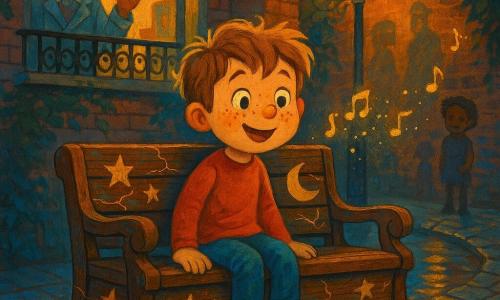
The neighborhood was called Curtain Row, because old theaters stood shoulder to shoulder like friendly giants. Their doors were painted red and blue and gold. Their signs flickered with letters that sometimes rearranged themselves just for fun. At night, the theaters sighed out warm music, even when no one played.
Some people said the theaters were haunted.
Milo thought that meant they had extra company.
When he walked to the corner bakery with his dad, a pale ballerina in a feathered hat would glide beside the posters, humming without a mouth. A gentleman in a top hat would tip his hat to passing buses. The ghosts on Curtain Row were gentle, like bedtime stories that had learned to walk.
Milo liked to gather things.
Not just toy blocks or shiny buttons—though he liked those too. He gathered feelings. He gathered lost moments. When someone looked left out, Milo seemed to notice first.
“You can stand with me,” he would say, patting the space beside him on a bench.
And somehow, that made room in the world.
On a rainy evening, Milo stood under the awning of the Moonlit Marquee Theater. Raindrops tapped the glass like tiny impatient fingers. The street smelled like wet stone and popcorn.
A thin woman in a silver coat—Milo called her Mrs. Rill, because her laugh sounded like water—held an umbrella that never got wet.
“Listen,” Mrs. Rill whispered, leaning down. “Do you hear that?”
Milo listened.
At first he heard the usual city sounds: tires hissing, far-away sirens, a saxophone playing from someone's window. Then, under it all, he heard something else.
A low, rolling sound. A deep, sleepy rumble.
Like a train dreaming.
“It's under the street,” Milo said, eyes wide.
Mrs. Rill nodded. “The subway is talking.”
Milo had ridden the subway before. It was bright and busy and smelled like metal and gum. It carried grown-ups to work and kids to museums and everyone to somewhere else.
But this sound was different.
This sound was lonely.
Mrs. Rill pointed to a small door in the side of the theater, half hidden behind a poster for a show called THE STARS ARE LISTENING.
“That door isn't on maps,” she said softly. “Only on nights like this.”
Milo's heart did a little hop. “Can we go in?”
“You can,” Mrs. Rill said. “You're good at giving everyone a part to play.”
Milo did not fully understand, but he liked the way it sounded. Like being handed a flashlight in a dark hallway.
He reached for the doorknob.
The metal was cold, but not mean-cold. It felt like a spoon in a glass of milk.
Milo turned it.
The door opened onto stairs that went down, down, down, deeper than any theater basement should go. Little lights floated in the air like fireflies that had learned to behave.
Milo took one step, then another.
Behind him, the rain kept tapping. Ahead of him, the subway kept dreaming.
Part 2: The Lost Ghost Train
At the bottom of the stairs was a platform.
It looked like a normal subway platform, but softer. The tiles shimmered as if they were made of moonlight mixed with soap bubbles. The benches were carved from old stage wood. Posters on the walls showed places that didn't exist—The Museum of Small Brave Things, The Garden of Forget-Me-Nots, The Station of Second Chances.
Milo stood very still.
In the tunnel, a white glow grew brighter.
A subway train slid in without any squeal at all. It was pale and see-through, like a drawing made with chalk. Its windows were dark, but in each one Milo saw a tiny moving shadow, as if someone inside was waving.
The train stopped.
Its doors opened with a hush that sounded like “sorry.”
A conductor stepped out.
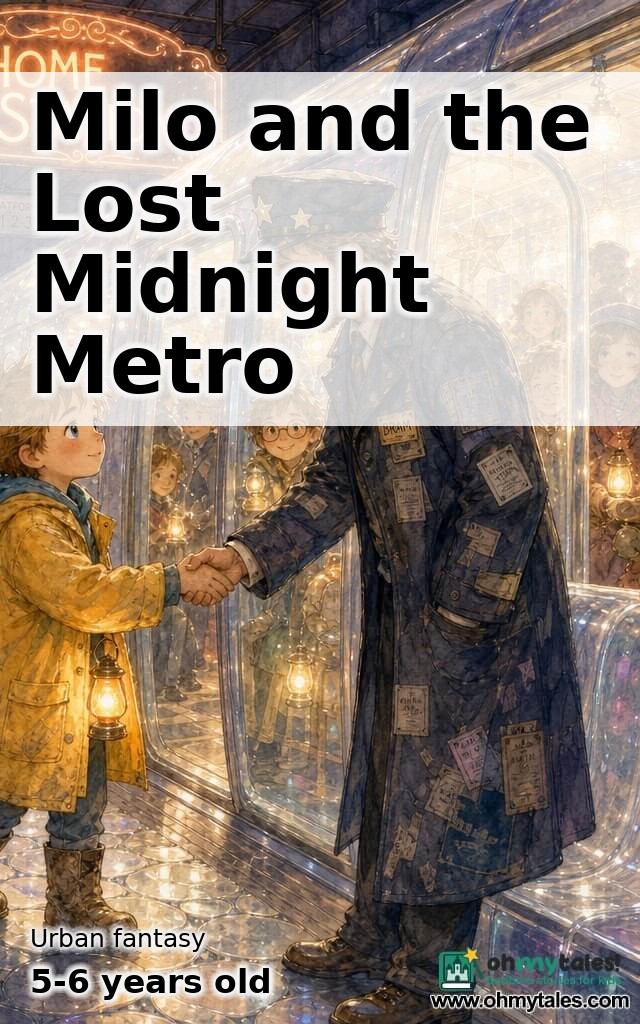
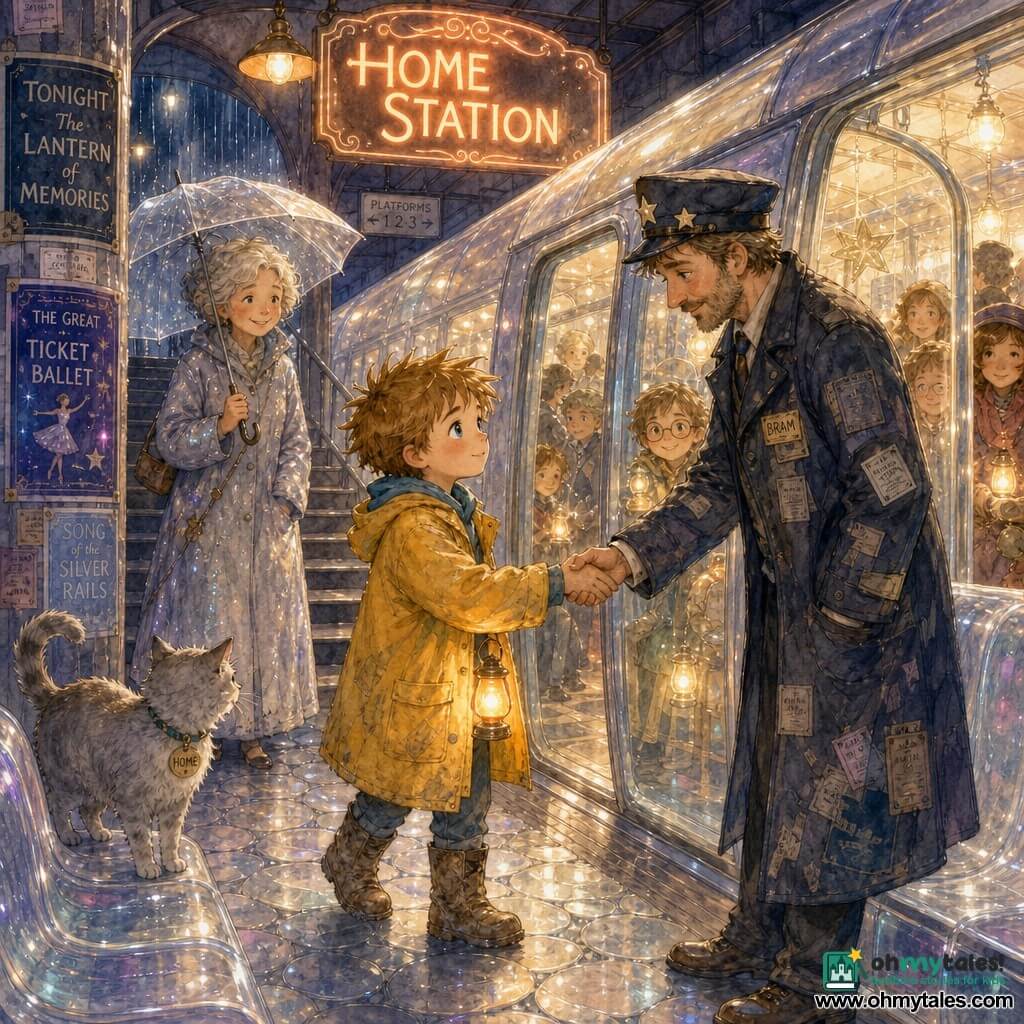
He was tall, with a coat stitched from old tickets. His cap had a shiny button shaped like a star. His face was kind and worried at the same time, like someone trying to remember where they put something important.
“Oh,” the conductor said, and his voice was the sound of paper turning. “Oh dear. This isn't my station.”
Milo blinked. “Hello.”
The conductor bowed. “Hello, small sir. I am Conductor Bram. And this”—he spread his arms toward the train—“is the Midnight Metro.”
Milo looked at the ghost train. “Why are you here?”
Conductor Bram wrung his gloved hands. “We got… misplaced. The city changed its mind. A new tunnel was dug. A new sign was hung. My train followed the old song, and now we're not in the right story anymore.”
“The right story?” Milo repeated.
Bram nodded. “Trains need stories. So do people. So do ghosts.”
Milo's chest felt tight, the way it did when he saw a kid cry at the playground.
“Are you scared?” Milo asked.
The conductor's eyes shone like tiny lamps. “I'm not scared for me. I'm scared for them.”
He pointed to the windows. Milo walked closer. He pressed his hand to the cold, misty glass.
Inside were passengers, but not like normal passengers.
A gray cat with a collar tag that read HOME sat on a seat, tail curled neatly. A little woman made of fog held a shopping bag full of glowing oranges. A boy with a backpack too big for him swung his legs, looking down at his shoes. A tired office worker with transparent hair leaned against a pole, eyes closed, as if napping between worlds.
They all looked… waiting.
“They're lost too,” Milo whispered.
“Yes,” Bram said. “And if a ghost train stays lost for too long, it becomes a bad dream. The doors stop opening. The lights go out. Everyone forgets why they got on.”
Milo did not like that. Not one bit.
He turned to Bram. “We can help. We can make a new story.”
Bram's shoulders lifted a little. “Can we?”
Milo nodded, even though he had no plan yet. Sometimes nodding was the first step of a plan.
He looked around the platform. There was no map. No loudspeaker. No busy crowd to follow.
Only quiet, shining tiles and the soft breathing of the city overhead.
Milo said, “First, everyone needs a job.”
“A job?” Bram asked.
Milo pointed at the gray cat inside. “That cat can be a Lookout. Cats see things.”
Bram's worried mouth made a small smile. “True.”
Milo pointed at the fog woman with oranges. “She can be a Light-Bringer. Oranges are sunny.”
Bram chuckled, a rustle of tickets. “They are.”
Milo pointed at the boy with the big backpack. “He can be a Map-Holder. He looks like he carries important things.”
Bram leaned closer to the window, thoughtful. “He does.”
Milo pointed at the tired office worker. “He can be a Time-Keeper. Grown-ups know about time.”
Bram nodded, slow and respectful. “They do.”
Milo felt a warm glow in his belly, the kind he got when he shared his crayons and someone's face brightened.
He put his hands on his hips, very serious for five years old. “And you, Conductor Bram, you drive. That's your job.”
Bram looked down at Milo as if Milo had handed him a missing piece. “Yes,” he whispered. “That is my part.”
Milo looked at the train again. “Now we need a place to go.”
Bram's smile wobbled. “That is the hard bit.”
Milo listened.
The tunnel was quiet, but not empty. Far away, under the city, the rails made a faint singing. The city's underground wasn't silent. It was full of secret directions.
Milo closed his eyes.
He thought of Curtain Row. He thought of friendly ghosts and warm theater lights. He thought of seats and stages and people who needed somewhere to belong.
When he opened his eyes, he saw something on the wall beside the platform: a blank sign, like a spot where a station name should be.
Milo stepped up to it.
The sign waited.
Milo lifted his finger and drew, very slowly, the letters he knew best.
H-O-M-E.
The sign swallowed the letters and then glowed softly, as if it had always been waiting to be called that.
HOME STATION, it now read.
Conductor Bram sucked in a breath. “That's… that's a real station now.”
Milo nodded. “Because we need it.”
Bram looked at the ghost train, then at Milo, then at the glowing sign.
“Ladies and gentleghosts,” Bram called, voice suddenly stronger, “we have a destination!”
Inside the windows, shapes stirred. Faces turned. The gray cat lifted its head. The fog woman hugged her bright oranges. The boy with the backpack sat up straighter. The office worker opened one sleepy eye.
The train doors stayed open, waiting.
Bram held out his hand to Milo. “Would you… would you help me guide it?”
Milo slipped his small hand into Bram's gloved one.
“Yes,” Milo said. “Let's go.”
Part 3: The City Under the City
Milo climbed aboard.
The inside of the Midnight Metro smelled like old books and rain. The seats were velvet, like theater chairs. The poles were silver, like moonbeams made solid. Above the doors, instead of ads, there were tiny framed scenes: a street with dancing shadows, a pond in a park that reflected stars even in daytime, a little doorway behind a poster.
The passengers looked at Milo.
Not in a scary way.
In a hopeful way.
Milo felt his cheeks grow warm. He waved.
The gray cat hopped down and walked along the aisle, tail high. It paused at each window, staring out as if taking notes. Lookout, Milo thought. Good job.
The fog woman opened her bag and took out an orange. It glowed like a small sun. The light spread gently, filling the car with a cozy gold. The other oranges glimmered too, like lanterns learning to shine.
The boy with the backpack dug inside and pulled out a crumpled paper. It wasn't a normal map. It looked like a drawing a child might make—scribbles and stars and arrows—but the lines shifted as he watched, settling into a path.
The office worker tapped an invisible watch, then nodded once, like a person who knows when it's time to begin.
Conductor Bram stepped into the front car. Milo followed, careful not to trip on the edge of the world.
The driver's panel was strange. Buttons were made of pearl. Levers were shaped like commas. There was a small brass bell that looked like it belonged in a theater orchestra pit.
Bram touched the bell.
Ding.
The sound rolled down the train like a wink.
Milo looked out the front window.
The tunnel ahead was dark, but not empty-dark. It was velvet-dark, like backstage curtains before a show.
Bram swallowed. “We must follow the right song,” he murmured.
“What song?” Milo asked.
Bram tilted his head, listening. “Every line has one. The city sings them in pipes and wires. But this one… it's faint.”
Milo pressed his ear to the glass.
At first, he heard nothing.
Then he heard it: a tiny humming, like someone humming to a baby. It came from everywhere and nowhere. It curled around the tracks.
Milo thought of how the theaters hummed, even when the doors were closed.
He thought of the streetlamps keeping each other company.
He thought of people trying to find their stop, their home, their part.
He started to hum back.
It was not a fancy song. It was just a soft, steady hum, the kind he made when he built towers and didn't want them to fall.
The humming in the tunnel answered him, growing clearer, warmer.
Conductor Bram stared at Milo. “You can hear it.”
Milo kept humming. “It's like a bedtime song.”
Bram's eyes shone. “Yes. Exactly.”
Bram pulled the main lever, slow and careful.
The ghost train moved.
It slid forward like a thought.
They passed through tunnels where old posters floated like jellyfish. They passed a station where the tiles were made of bottle-green glass and the name on the wall read NOT YET. They passed a place where a whole orchestra of rats played tiny violins, and when Milo waved, the rats played a happier tune.
At one point, the lights flickered.
The train shivered.
The fog woman's oranges dimmed a little.
Bram's hands tightened. “The bad dream is trying to find us.”
Milo's stomach did a small flop.
In the front window, the tunnel looked different. The velvet-dark became ink-dark. Shapes like smudges pressed close, as if the tunnel walls wanted to lean in.
A whisper slid through the car: Lost… lost… lost…
The boy with the backpack clutched his map. The office worker sat up straight. The gray cat arched its back and hissed at the darkness, brave as a lion.
Milo's hum wobbled.
He remembered times he had felt lost—like when he couldn't find his dad's hand in a crowd for one scary second. The world had felt too big then.
Milo looked back through the cars at the passengers.
They were not just ghosts.
They were beings who needed kindness.
Milo took a deep breath. He tried something else.
He spoke to the whisper like it was a sad kid on the playground.
“We are not lost,” Milo said, clear and gentle. “We are going home.”
The whisper paused.
Milo kept going. “You can come too, if you want. You can have a job.”
The ink-dark shapes hesitated, like they were surprised to be invited.
Conductor Bram mouthed, “Milo…”
Milo nodded at Bram, then looked at the darkness again. “You can be a Tunnel-Guard. You can help keep trains safe. That's important.”
For a moment, nothing happened.
Then the smudges slowly pulled back from the window, as if the tunnel itself was taking a step away to give the train space.
The whisper softened, turning into a sigh.
The lights steadied.
The oranges brightened again.
The ghost train's wheels hummed more smoothly, like a cat purring.
Bram let out a long breath. “You gave even the darkness a part,” he whispered, amazed.
Milo shrugged, a little shy. “No one likes being left out.”
The tunnel ahead began to glow with a pale dawn-color, like sunrise trapped underground.
The map in the boy's hands stopped shifting. It settled.
HOME STATION was close.
Part 4: A Stop Called Home
The Midnight Metro slid into a station that looked like a theater lobby and a subway stop had decided to be friends.
The columns were wrapped in posters, but the posters showed everyday kindness: someone sharing an umbrella, someone helping carry groceries, someone waiting with patience. The floor was tiled with tiny stars. The air smelled like cocoa and clean rain.
On the wall, the sign glowed:
HOME STATION.
The train doors opened with a happy sigh.
The passengers stood.
The gray cat trotted out first, tail swishing, and sat by the station bench like it had always belonged there. Lookout, on duty.
The fog woman handed out oranges, one to each passenger, and the oranges became gentle lights that floated above their heads. Light-Bringer, smiling.
The boy with the backpack pinned his living map onto a board on the wall. It became a real map, with bright lines and clear names, and a little dot that said YOU ARE HERE. Map-Holder, proud.
The office worker tapped his invisible watch again, then opened a small door marked LOST & FOUND. Inside, shelves waited to be filled with missing things. Time-Keeper, ready.
Conductor Bram stepped onto the platform last.
He turned to Milo and knelt so they were eye to eye. “You guided us,” he said. “You gave us a station when there wasn't one.”
Milo rubbed his nose. “I just listened.”
“Yes,” Bram said softly. “That's what guiding is.”
Milo looked around. People—ghosts and not-ghosts—were arriving now. A woman in a bright coat came down the stairs, looking tired, then smiled when she saw the warm lights. A man holding a violin case paused, surprised, and then his shoulders relaxed. A small dog made of shadow wagged its tail and trotted in, as if it had been searching for this place all night.
Even the tunnel felt calmer, like it had unclenched.
Milo felt something inside him settle too.
Bram stood and lifted his cap. “The Midnight Metro will run again,” he announced, voice ringing kindly through the station. “Not to frighten. Not to steal. Only to carry the misplaced to where they can be found.”
The passengers murmured in approval, like a soft applause.
Bram looked down at Milo. “Would you like to be our Helper Conductor?”
Milo's eyes grew wide. “Me?”
“You,” Bram said. “You have the gift of roles. You see what someone can be.”
Milo thought of his bed upstairs in Curtain Row. He thought of his dad waiting, probably wondering where Milo had wandered. He thought of the friendly theaters humming their sleepy songs.
“I can help,” Milo said. “But I have to go back too.”
“Of course,” Bram said, and he sounded glad, not sad. “Helpers must rest. Even brave ones.”
Bram reached into his coat and pulled out a small ticket, pale as moonlight. He placed it in Milo's palm.
It was warm.
On it, in neat letters, it read:
HELPER CONDUCTOR — ANYTIME.
Milo held it carefully, like a promise that wouldn't break.
Mrs. Rill appeared at the bottom of the stairs, silver coat shining. “There you are,” she said, as if Milo had only been gone a minute.
Milo waved at Bram, at the cat, at the glowing oranges, at the map, at the door marked LOST & FOUND.
“Bye,” Milo said. “Good job, everyone.”
And because Milo said it like he meant it, everyone stood a little taller, even the ones made of fog.
He climbed the stairs with Mrs. Rill.
With each step up, the air changed—less cocoa, more rain. Less starlight, more streetlight.
The secret door opened back into the theater alley. The rain had stopped. Curtain Row gleamed, puddles reflecting neon signs and the gentle faces of theater ghosts.
The ballerina ghost spun once, and her feathered hat dipped to Milo.
The top-hat gentleman bowed.
Milo tucked the warm ticket into his pocket.
Above the city, everything looked ordinary: buses, tall buildings, bright screens, people hurrying home.
But Milo could hear it now, if he listened.
Under the sidewalks and crosswalks and candy shops, the city hummed its hidden song.
And somewhere below, a ghost train rolled along a safe track, no longer lost, carrying kindness like a lantern through the dark.
Milo took his dad's hand when he got home, squeezing tight.
“You're warm,” his dad said. “Like you've been near a heater.”
Milo smiled, sleepy and pleased. “I helped someone find their stop.”
His dad kissed his hair. “That's a good thing to do.”
In bed, Milo listened to the theaters breathing their soft music through the windows. He closed his eyes and imagined HOME STATION shining gently under the city.
He thought of the whispering darkness that had been invited to help instead of being chased away.
He felt proud, but not big-proud. More like quiet-proud. Like a small light that knows it can keep glowing.
And in the present of that strange, bright city, where magic fit into cracks between modern days, Milo fell asleep with empathy in his pocket, warm as a ticket that could take you anywhere you needed to go.