Chapter 1
There was a small boy who loved to read the marks on walls. His name was Milo. He was five years old and lived in a part of the city where the rooftops hummed and clock hands ticked like quiet birds. The streets were full of little shops with brass bells and glass windows. Many of the shops were clockmaker workshops. Tiny gears and springs winked like stars behind dusty glass.
Milo could not read big books yet, but he read walls. He would press his ear to the bricks and listen to the scratches and stains. To him, they were letters and songs. Some marks were happy loops. Some were secret arrows that pointed to small wonders. When Milo read a wall, the city felt like a story being told.
One evening, when the sky was the color of old paper, Milo found a new mark. It was a deep line on a stone by the river. The line pulsed like a heartbeat. Milo knelt. The stone seemed to breathe. He could hear a low grumble inside it. The mark said, "I am angry." Milo puckered his lips. He had never met an angry stone before.
"Hello," Milo said, because he always spoke kindly to things. "Why are you angry?"
The stone made another rumble. When Milo touched it, his fingers felt like twigs and warm tea. A small voice, like wind through gears, whispered, "I am a colère de pierre. I was put here to guard a forgotten factory. I was given anger so no one would break the locks. Now my anger grows heavy."
Milo's eyes shone. He knew the word — colère — from a clockmaker's rhyme about time and grumpy things. The stone's anger was a guard. That meant someone might get hurt. Milo decided he would help. He did not know how to read big books, but he could read walls. He could learn the marks that might soothe the stone.
"Will you let me try?" he asked.
The stone rumbled, a little softer. "If you can find the quiet mark, touch it, and sing three soft words, my anger will sleep."
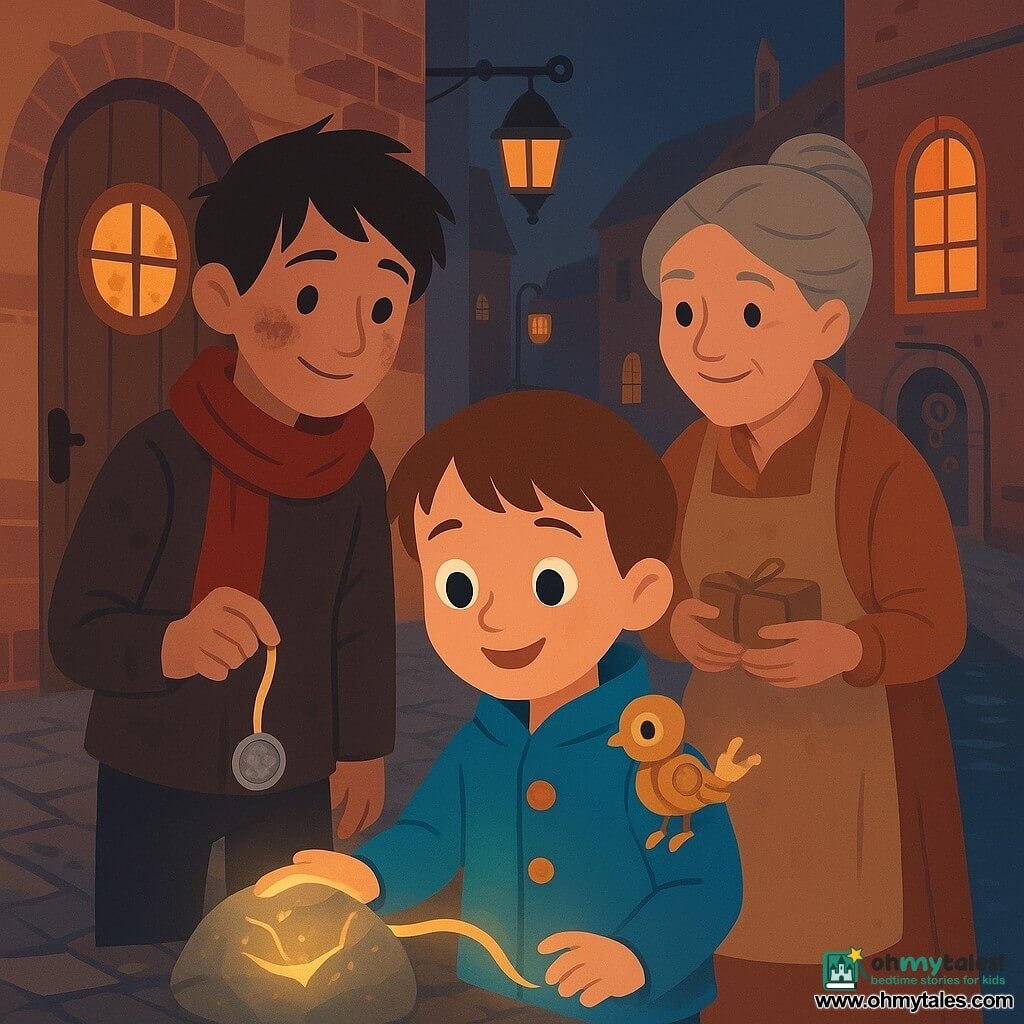
Milo nodded. He stood up. A tiny clockwork bird landed on his shoulder. "Hello," it chirped. It was made of brass and paper, and it belonged to Tessa, the kind clockmaker who lived two doors down. Tessa saw Milo and smiled from her doorway. She had hands that could fix any ticking thing.
"Where are you going, little reader?" she asked.
"To find the quiet mark," Milo said. "The stone is angry."
Tessa's eyes grew gentle. "A colère de pierre? Then take my bird. It remembers marks." She tied the bird to Milo's sleeve. "And take my lantern. The city hides soft paths after dark."
Milo's heart felt warm. He hugged her, and she smelled of oil and ginger cookies. He stepped into the night where neon and lamplight braided like ribbons, and the city hummed the way a lullaby does when the world is almost asleep.
Chapter 2
Milo read the walls as he walked. A streak of paint that looked like a smile pointed toward an alley. A small chalk spiral on a post said, "This way for whisper." The clockmakers' workshops shook tiny clocks when their doors opened, like the city taking breaths. Milo followed the marks that said quiet. The brass bird leaned forward and chirped when the marks were true.
At the corner where three chimneys met, Milo met a boy with a coal-stained face. His name was Jonah. He was six and tall as a stick, and he kept a satchel full of ribbons and bits of mirror. Jonah had seen the city change when the factories hummed less and the glass towers sang more. He was brave in a soft way.
"Are you going to the stone?" Jonah asked. "I saw it grumble today."
Milo nodded. "It wants the quiet mark."
"A quiet mark?" Jonah blinked. "My grandmother calls them hush-songs. She says they hide inside small things."
They walked together, reading the marks like secret sentences. They found a little door behind a clockmaker's shop. The door was tiny and round, like the face of a pocket watch. On it was a silver scrape shaped like a teardrop. The scrape whispered, "Soft." Milo pressed his palm. The door sighed and opened. Inside was a narrow path of keys and tiny lamps that glowed like fireflies. The path smelled of oil and orange peel.
"Do you think this is the quiet mark?" Jonah asked.
Milo listened. The path hummed a note that felt like a blanket. He followed until the path ended at a wall painted with the color of house cats. On the wall was a small, warm spiral that pulsed slowly. It looked like the mark of sleep.
"This is it," Milo said. He touched the spiral. It trembled and left a powdery trail on his fingers. The bird on his sleeve trilled happily. "Now the three soft words."
"What three words?" Jonah asked.
Milo had learned a song from Tessa — not a song in a book, but one she whispered while oiling a tiny watch. The words were simple: "Calm," "Kind," "Home." He said them slowly. Calm like a quiet clock. Kind like a gentle hand. Home like Tessa's kitchen.
He whispered, "Calm, kind, home."
The wall answered with a tiny bell. The powder on Milo's fingers shivered and became a ribbon of light. Jonah grinned. He plucked a small silver clasp from his satchel and clipped the ribbon to his collar. "For luck," he said.
They hurried back to the river where the stone still hummed. The city seemed to hold its breath. Milo touched the stone with the ribbon of light. It felt like a warm blanket over cold cobblestones. The stone's rumble slowed and softened like tea cooling. The mark on it — the deep line — eased until it looked like a smile.
"Is it sleeping?" Jonah whispered.
The stone sighed. Where its anger had been, a small seed of light remained, gentle as a glowworm. Milo felt proud and small and brave all at once.
But then a new sound slipped from the stone — a tiny clink like a trapped gear. The seed of light pulsed and then split into two. One piece drifted toward the river and turned into a bright pebble. The other floated up and landed on Milo's shoulder like a crown.
"Oh!" Milo laughed. "It's not angry. It's watchful now."
A voice, softer than before, said, "Thank you, little reader. You read my fear and turned it into care."
Milo looked at Jonah. Jonah looked at Milo. Their smiles were like hands reaching out. They had done it together. The city felt warm.
Chapter 3
Word went along the alleys that a stone had been soothed. People peeked from shop doors. Tessa brought Milo ginger cookies shaped like tiny clocks. She pressed a small brass pin into his coat. "For reading marks," she said. Jonah's grandmother sent a ribbon of lavender that smelled like slow afternoons.
But the city had one last secret. The bright pebble that had floated into the river began to sing. It made a small ripple that painted the water with tiny stars. Little boats that had been asleep raised their lanterns. The stone's light reached the clockmakers' windows, where gears turned and faces smiled like moons. The city hummed a new tune — not of anger, but of watching and keeping.
Milo learned that anger can be a guard, but it can also be a seed. When it is read with kindness, it becomes something gentle. He and Jonah walked every evening after that, reading marks and learning hush-songs. They found small worries in alley corners and turned them into lanterns. They found lonely things — a ragged kite, a lost cat — and made them friends.
One night, as they walked past Tessa's shop, Milo saw the wall mark that had first told him the stone was angry. It was faint now, like a crayon after a long day of drawing. Milo put his palm on it and felt the warm ribbon of memory. Jonah put his hand over Milo's.
"You were brave," Jonah said.
"No," Milo said, and he smiled. "We were brave."
They sat by the river and watched the bright pebble bob like a tiny sun. The clockmakers' chimneys blew soft steam that smelled of cinnamon and time. The city was not all magic and not all ordinary. It was a mixture — like a pocket watch and a fairy tale stitched together.
Tessa came out and handed them each a small piece of bread. "For quiet journeys," she said. Milo munched and felt the butter melt like a smile. He felt a warm glow in his chest that he could not read on any wall. It was a feeling called friendship.
When Milo lay in bed that night, he pressed his ear to his own wall. The scratches of the city told him a new mark: the mark of home. He hummed the hush-song he had learned: Calm, kind, home. His room filled with a tiny light, not from a stone but from the seed it had shared. Milo slept with the knowledge that reading marks was a way to care. He dreamed of ticking clocks that walked like people, and stones that guarded gardens instead of fears.
In the morning, the city would wake. The clockmakers would open their doors. Milo and Jonah would be ready with their lanterns and the brass bird and a satchel of small wonders. They would read the marks and, when worry flickered, they would sing three soft words. The city would listen. Friends would listen. And when the world rumbled, small hands and kind words could turn anger into watchful light.
The stone by the river kept its place. It no longer grumbled. Sometimes, when the wind was very gentle, you could hear it hum a lullaby. The city lived between cogs and magic, and the children who read walls learned that the truest marks are the ones that lead you to a friend.