Chapter 1 – The City of Climatic Piazzas
Mira woke up to the soft chime of her room's window-wall. It glowed gentle orange, like a sunrise, even though the real sun was still hidden behind the towers of New Harmonia.
“Good morning, Mira,” said the room in a calm voice. “Today will be warm and windy. Don't forget your hat.”
“I won't,” Mira answered, slipping on her light jacket. “And don't forget my bike. I'm designing an itinerary today.”
“As requested,” the room replied. “Your air-bike is charged and waiting.”
Mira loved her city. New Harmonia, built halfway through the twenty-second century, was famous for its climatic piazzas—large open squares where the air, light, and even the temperature were gently controlled. The piazzas didn't try to fight the weather. They only helped it along, smoothing hot winds into cool breezes, or turning heavy rain into a light mist above the gardens.
Outside, the high towers were slim and pale, with vines climbing their sides. Solar leaves shivered quietly on the roofs. Between the towers, wide walkways curved through the air like ribbons. Down below, old streets and canals wound through ancient brick bridges that had been strengthened with new smart-stone.
Mira hopped onto her air-bike. It was simple: two small fan-wheels, a light frame, and a tiny battery. To save power, it mostly glided on the wind.
“Destination?” the bike asked.
“Piazza del Vento first,” Mira said. “I have a big day.”
She smiled. Today she would design a new sounds-and-lights route for the Evening Stroll, the walk people took every night through the piazzas. Nothing too fancy, she promised herself. Just small, clever things that used very little power. Her father always said, “The smartest invention is the one that wastes nothing.”
Chapter 2 – A Broken Bridge
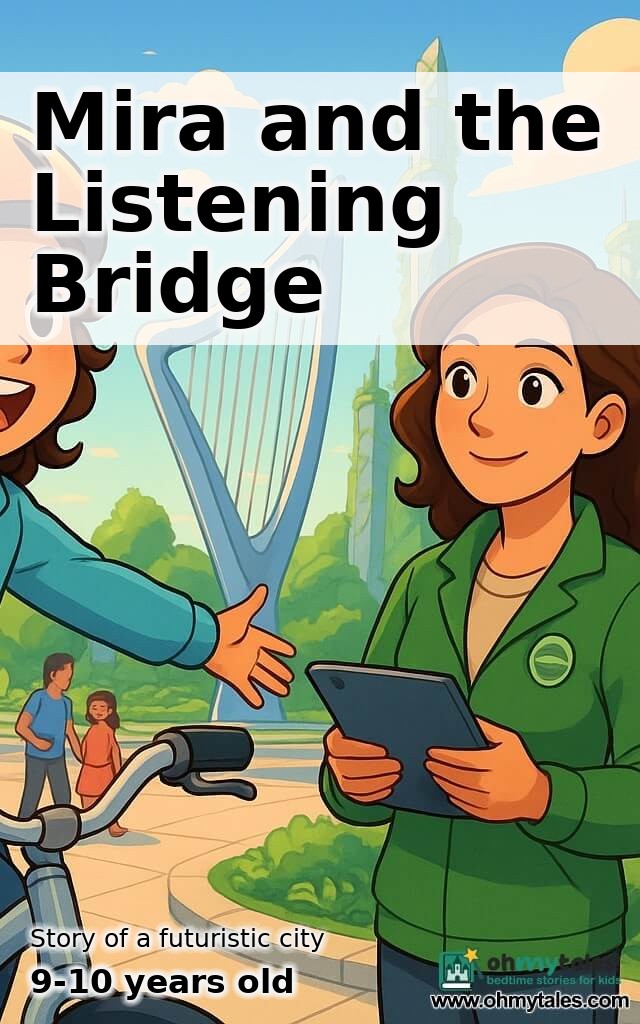
Piazza del Vento was already awake. Children ran under tall, silver wind-harps that sang when the breeze passed through them. The air was cool, even though the day was warming. Thin mist drifted from vents at the base of the towers, then vanished.
Mira parked her bike and listened. She liked to close her eyes and count the layers of sound.
Wind-harps. Footsteps. A distant tram. Someone laughing.
“Too noisy over there… too quiet here…” she murmured. “We can do better.”
She walked to the central control post, a simple gray pillar with a round screen. It showed the map of the connected piazzas: Vento, Ombra, Fontana, and finally the Old Bridge Gate, where the route would end.
Her bracelet buzzed. A message from City Care.
Mira, we've closed the Old Bridge for safety checks. The smart-stone sensors failed last night. The Evening Stroll will have to stop at Piazza Fontana. Please adjust your route. —Lian, City Care
Mira bit her lip. The Old Bridge was important. It joined the newer towers to Little Harbor, the oldest part of the city. People liked to finish their walk there, looking at the dark water and the far-off wind turbines.
“If the bridge is closed, they'll cancel the fireworks,” she whispered. “And the lantern boats. And the final song.”
She read the message again. Sensors failed. That didn't mean the bridge was broken, only that the city couldn't be sure it was safe.
“Still,” she told herself, “we don't force bridges. We fix them.”
She looked at the map of her route. An idea woke up in her mind, like a little light.
“What if...” she said slowly, “we use the itinerary to help repair the bridge, instead of just ending there?”
The thought made her feel calm and certain, like when you finally see the missing piece of a puzzle.
Chapter 3 – Sounds that Listen
Mira moved to a shaded bench and opened her design tablet. It unfolded like a soft book, its pages glowing with diagrams.
She began with Piazza del Vento. Instead of adding new bright lights that used a lot of power, she decided to use what was already there.
“We'll time the wind-harps,” she said, drawing lines on the map. “They'll play in gentle waves, leading people toward the next piazza.”
She set simple rules: the harps would respond to footsteps and voices. When more people crossed the square, the music would grow a little richer, but never loud.
“Sounds that listen,” she murmured. “Not sounds that shout.”
Next was Piazza Ombra, with its tall trees and hanging gardens. It was cooler there, thanks to the shade and the pale stone.
Instead of adding colorful video screens, Mira chose soft, glowing threads. They were already wrapped around the trees to help the gardeners measure humidity and growth.
“We just ask them to glow when someone passes,” she decided. “But only a little. And only on the side they are walking toward.”
She smiled. The path of light would move with the people, like a river made of tiny stars.
She checked the energy use. Very low. Good.
Last came Piazza Fontana, with its ring of thin water jets. The jets already changed height to use the least water on hot days.
“What if the fountain sings?” she whispered.
She didn't mean speakers hidden in the ground. That would be too heavy, too loud. No, she remembered the way bottles sang when you blew across their tops.
She designed narrow tubes beside the jets. When the water rose and fell, air would pass through the tubes and make soft notes. The fountain would become a quiet, ever-changing instrument.
“And then,” she said, tapping the Old Bridge on the map, “the final song checks every stone.”
Chapter 4 – The Bridge that Answered
At midday, Mira glided to the Old Bridge Gate. A red line shimmered across the entrance: CLOSED.
Lian from City Care was already there, wearing a pale green vest and a thoughtful frown.
“Mira,” she said, seeing the girl. “You got my message. I'm sorry about the Evening Stroll.”
“Maybe we don't have to cancel it,” Mira replied. “Maybe we can make it help.”
Lian raised an eyebrow. “I'm listening.”
Mira showed her the route, from wind-harps to glowing threads to singing fountain. Then she pointed to the bridge.
“The sensors failed,” she said. “But the stones are still listening, in a way. When we walk, we press on them. When we talk or sing, tiny vibrations travel through them. What if we use our sounds and steps to test the bridge?”
Lian folded her arms. “Explain.”
Mira went on, her voice steady. “We place simple listening pods under the arches. No power cables, just little coils and magnets. When the crowd walks over the bridge during the Evening Stroll, the pods record the tiniest movements. We compare them to last year's pattern. If the pattern is the same, the bridge is still sound. If something is different, we know where to look more closely tomorrow.”
Lian thought for a long moment. “That's… very elegant,” she said at last. “And low-power. We'd only wake the pods during the stroll.”
“Exactly,” Mira said. “The city doesn't have to push. It just has to notice.”
“Still,” Lian added, “for tonight, we need to be sure.”
Mira nodded and pointed to the far tower. “We can test it before the crowd comes. We walk first. Me on my own, then with you and a few others. The pods will already tell us if anything is wrong.”
Lian's eyes softened. “You'd trust your weight to this bridge before anyone else's?”
Mira patted the old stone. “The bridge wants to work. We just have to listen.”
Chapter 5 – The Evening Stroll
That evening, as the sky turned deep blue and the first stars peeked out, the city gathered at Piazza del Vento.
The wind-harps began their soft waves of music, rising and falling as families stepped into the square. Children laughed, noticing how a burst of running made the tones flutter higher.
“This way,” guides called, but the music was already leading people toward Piazza Ombra.
There, the tree threads glowed gently, never all at once, only along the paths people chose. The lights were dim enough that the real stars still shone above.
“This is like walking inside a quiet comet,” someone whispered.
Mira glided alongside the crowd on her air-bike, checking readings on her bracelet. The energy use was low, just as she had hoped. The city felt alive, but not wasteful.
In Piazza Fontana, the water jets rose and fell. The air in the tubes sang soft notes: a drifting chord that changed as the wind shifted and people moved. Children tried to guess which jet made which sound.
“It's like the city is humming to itself,” an old man said, smiling.
From there, the glowing threads of light led everyone toward the Old Bridge Gate.
Earlier that afternoon, Mira, Lian, and three engineers had walked back and forth across the bridge while the listening pods measured every tiny tremor. The pattern had matched last year's almost exactly. Only a few stones at the far side showed a different rhythm—nothing dangerous, just a seam that needed filling.
“We can fix that tomorrow morning,” Lian had decided. “Tonight, we walk.”
Now, as the crowd reached the gate, the red CLOSED line faded away.
Mira felt a flutter in her chest, then a deep calm. “It's ready,” she told herself.
The first step onto the bridge felt like stepping into a story. Lanterns, powered by small hand-cranked dynamos, glowed along the railings. Volunteers had turned them one by one while waiting for the stroll to begin. No big batteries, just a little work from many hands.
“Look down,” whispered Mira to a boy beside her.
Under the arches, the listening pods blinked faintly, like sleeping fireflies. They were working, but softly, taking only what they needed.
People began to hum, then to sing a simple tune they all knew. Their voices traveled through the stone, and the pods listened carefully, measuring the bridge's answers.
Mira walked with them, one hand resting on the old stone, the other on her bike. She didn't feel like a hero. She felt like a friend, checking that another friend was all right.
Chapter 6 – A Bridge Repaired
The stroll ended at Little Harbor, where small boats glided across the dark water, carrying paper lanterns. No fireworks burst in the sky this time. Instead, children released tiny floating mirrors on the canal. They caught the city's soft lights and stars, making the water sparkle without a single explosion.
“It's quieter,” someone said.
“It's gentler,” someone else replied.
Mira's bracelet buzzed. She stepped aside and opened the report from the listening pods.
Bridge stable. Minor seam at east joint. Recommended: stone dust filler, manual pack. Two hours of work.
Lian joined her, reading over her shoulder. “So simple,” she said. “We don't need new heavy machines. Just stone dust, a trowel, and two careful hands.”
“Four hands,” Mira corrected with a small smile. “I want to help.”
The next morning, they did. While the city woke, Mira and Lian knelt at the east joint of the Old Bridge. They mixed stone dust with a little water and a drop of bonding gel. No roaring engines, no bright sparks. Only the soft scrape of tools and the murmur of the canal.
“This is how the city should be,” Lian said. “Quiet fixes. Small, smart things.”
Mira pressed the filler into a crack, then smoothed it. “Big ideas,” she answered, “built from little steps.”
When they finished, Mira stood up and looked across New Harmonia. Sunlight slid over the towers and down into the climatic piazzas, where the air was already adjusting itself with gentle whispers. Solar leaves opened on the roofs, catching the day.
Her new itinerary—music of wind and water, light that followed footsteps, a bridge that listened and answered—would run again that evening, and many evenings after that. People would walk, talk, and sing, and the city would quietly check its own bones.
Mira touched the stone railing one last time.
“We fixed you,” she murmured. “Together. Without wasting a spark.”
The bridge, warmed by the morning sun and the weight of a small, steady hand, seemed to say thank you in its own deep, silent way.
And in the city of climatic piazzas, the future glowed—not with blinding light, but with a calm, gentle brightness that belonged to everyone.