Part 1: The Canvas Shade
Maya the archaeologist woke up with sand in her shoes and a sleepy smile on her face. The morning sun was already bright, like a big warm lamp.
“Good morning, site!” she said, stretching her arms.
Her team was small but busy. Leo carried water. Anya checked the notebooks. Mr. Sami, who lived nearby, waved from the gate.
Maya rubbed her eyes. “I'm a little tired,” she whispered, “but I'm happy. Today we listen to the ground.”
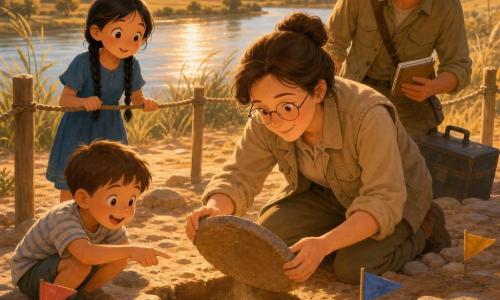
First, Maya and Anya set up a canvas shelter to make shade. The fabric was pale and flapped in the wind like a gentle sail.
“Pull the rope, please,” Maya said.
Anya pulled. The pole wobbled.
“Oh no,” Anya giggled. “It's doing the wiggly dance!”
Maya laughed softly. “That's okay. Archaeology is full of wiggly moments. We try again.”
They pushed the poles deeper, tied the knots tighter, and finally the shelter stood still. Cool shade spread under it.
Maya placed the tools neatly: small trowels, soft brushes, little wooden sticks, and measuring tapes.
“Are we digging for treasure?” Leo asked, eyes shining.
Maya shook her head. “Not treasure like pirates. We are looking for clues. Clues tell stories about people who lived before us. And we must be very gentle, like we are petting a tiny kitten.”
Leo nodded. “Clues, not gold.”
“Exactly,” Maya said. “And we share what we learn, so everyone can understand their past.”
Part 2: The Roman Theater That Changed Clothes
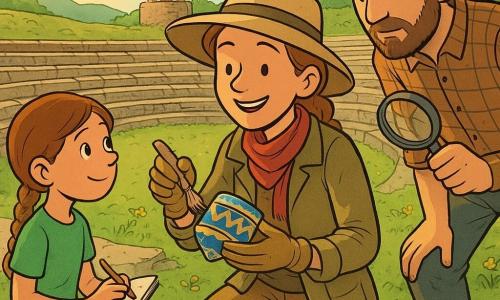
The dig was next to an old Roman theater. Its stone seats curved like a giant gray smile. Birds hopped along the steps. Wild flowers peeked from cracks.
Maya ran her hand over a carved stone. “This place is very old,” she told Leo. “Romans watched plays here. Long ago, people clapped and cheered right where we stand.”
Mr. Sami joined them. “My grandfather said the theater was used again later,” he said. “For markets. For meetings. Even for small concerts.”
Maya's eyes sparkled. “That is called ‘reused.' Places can change clothes over time, like a theater becoming a market. The stones stay, but the life around them changes.”
Leo frowned. “Does that mean we can move the stones to make it nicer?”
“We don't move them unless it is needed for safety,” Maya said. “We protect heritage. That means we care for old places so they can teach many people, for many years.”
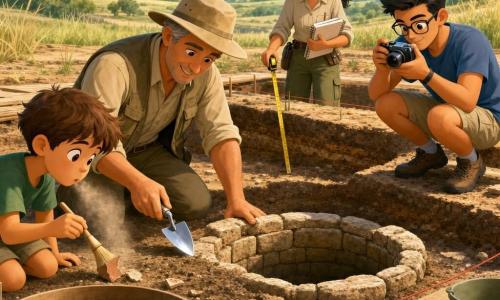
Under the canvas shade, Maya showed the team a simple plan. “We will dig in squares,” she said. “We measure each square. We write everything down. That way, we don't lose the story.”
They worked slowly. Maya used her trowel to scrape thin layers of soil. Anya brushed gently. Leo carried buckets of dirt to a sifter that looked like a big kitchen strainer.
“Look!” Leo cried. “A rock with a bump!”
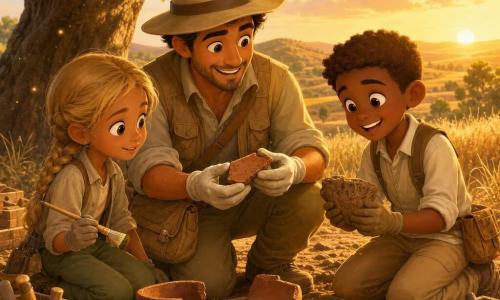
Maya knelt beside him. “Let's see.” She brushed it. The “rock” was a piece of pottery, curved like a smile.
“A bowl?” Leo guessed.
“Maybe,” Maya said. “And we don't guess for long. We check.” She pointed to the notebook. “We record where it was, how deep, and what it looks like. That helps us learn the truth.”
A warm wind blew. The canvas shelter fluttered again. Maya blinked slowly. She was tired, but she kept going, one careful scrape at a time.
Then came a mini surprise.
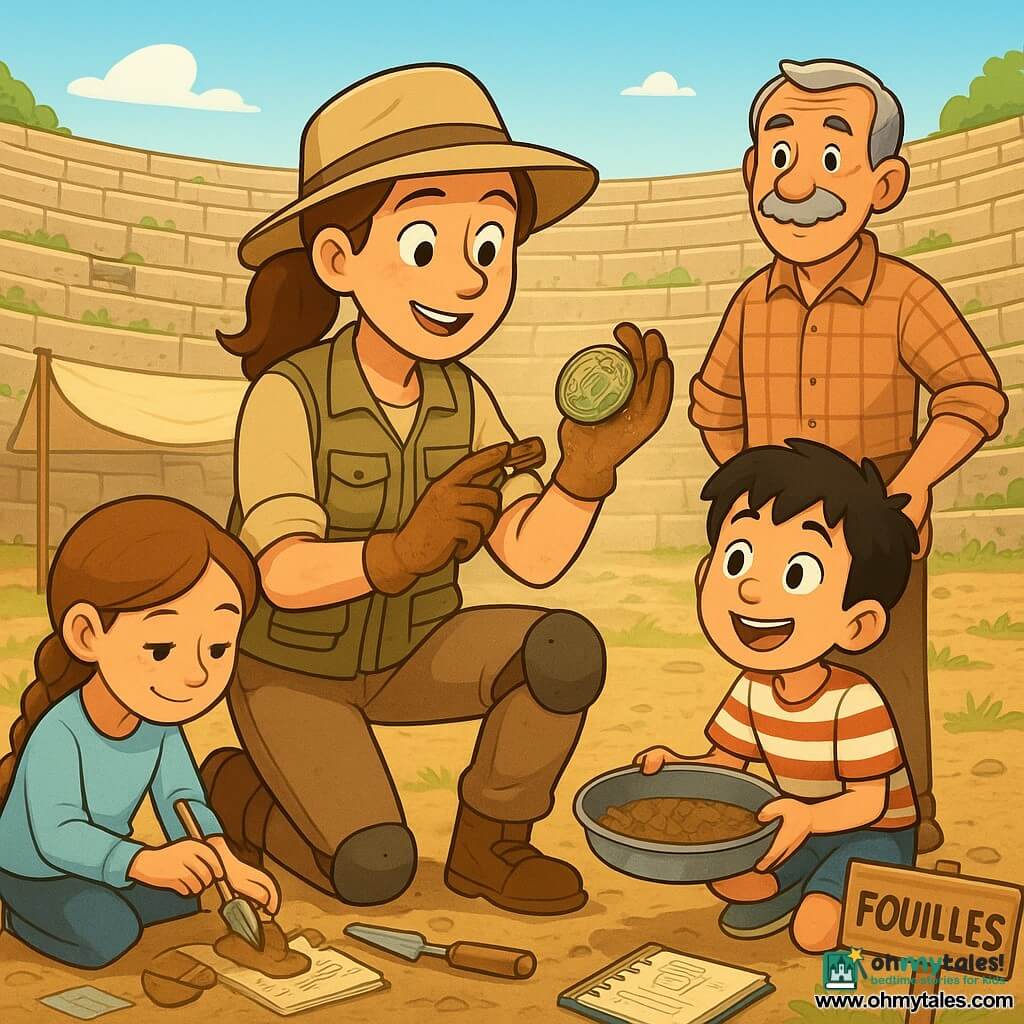
Anya gasped. “Maya! There's something… shiny!”
Everyone leaned in. In the dirt was a small coin, dark and greenish, not bright like a new penny.
Leo whispered, “Treasure?”
Maya smiled. “It is an object from the past. It is special, but it's not for pockets. It belongs to everyone.” She held it on her palm. “See the green? That is from age. We must store it safely and tell the museum.”
Mr. Sami nodded. “So our children can see it too.”
Maya felt proud. “Yes. The past is a guest in our hands. We must be polite.”
Part 3: A Careful Find and a Kind Share
After lunch, the team walked into the theater itself. The stones were warm, but the air in the middle felt cooler, like a quiet bowl.
Maya looked at the curved seats. “Imagine,” she said, “a storyteller on the stage. People laughing. People learning.”
Leo stood on a low step and spoke in a silly voice. “Welcome to the Great Tomato Play!”
Anya giggled. Mr. Sami covered his mouth, smiling.
Maya chuckled, then raised a finger. “One rule: we don't climb on weak stones. We respect the place.”
They found a patch of earth where the theater had been reused long after the Romans. There were bits of charcoal, broken tiles, and animal bones.
“Bones?” Leo asked, a bit worried.
Maya's voice stayed calm. “Bones can tell us what people ate, or how they lived. But we treat them gently. We never joke about people from the past. We learn with kindness.”
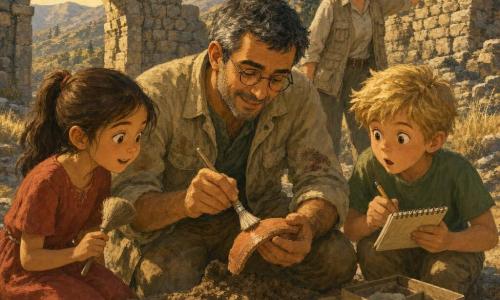
She showed Leo how to use a brush. “Soft strokes,” she said. “Like painting a cloud.”
Leo brushed carefully. “I can do it!”
“Yes,” Maya said. “You are patient. That is the superpower of archaeology.”
But then the brush slipped, and a small piece cracked.
Leo's eyes grew wide. “I broke history!”
Maya placed a hand on his shoulder. “You made a mistake while learning. We can still study it. We write what happened, and we keep going. Perseverance means we don't give up.”
Leo took a deep breath. “Okay. I will try again, slower.”
As the sun lowered, they packed the finds into labeled bags. Maya read the labels out loud: “Square B2, depth 20 centimeters.” Her words sounded like a gentle song.
Before leaving, they invited Mr. Sami and two neighborhood kids to see the work area from a safe spot.
Maya pointed to drawings and photos. “This is how we share discoveries,” she said. “Not with shouting, but with clear facts and open hands.”
The children's eyes went wide. “The theater was a market?” one asked.
“Yes,” Maya said. “And before we know it, you might teach us something too.”
That night, Maya lay in her tent, the world quiet. Her arms felt heavy. Her heart felt light.
She closed her eyes and dreamed of a future dig. In her dream, the canvas shelter was bigger and cooler. There were ramps for wheelchairs, signs in many languages, and a “touch table” with safe copies of pottery for little hands. Neighbors helped map the site. Kids asked questions, and archaeologists listened.
Maya smiled in her sleep. The dream felt warm and real.
Tomorrow would bring more careful scraping, more notes, more teamwork. Slow steps. Strong patience. And the old theater, changing clothes again—this time into a place where everyone could learn, together.