The City That Never Blinks
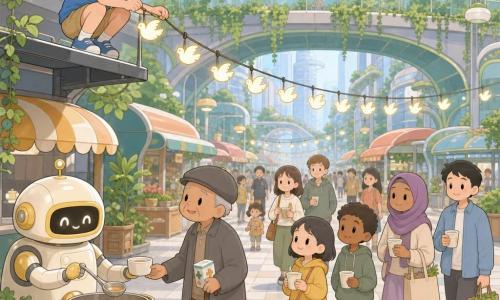
Neonopolis was a city that never blinked. Day and night it shimmered like a jewel box that had been opened and left on a windowsill. Buildings wore skin of glass and ribbons of light. Streets curved like question marks and rose into bridges that twined above canals of softly humming water. There were markets that sold fruit that glowed faintly blue, buses that floated over rails, and parks where trees had leaves that played little songs when the wind passed through them. People moved with small backpacks of air and umbrellas that read the weather for them. Everything had a polite hum, a helpful wink, as if the city itself smiled.
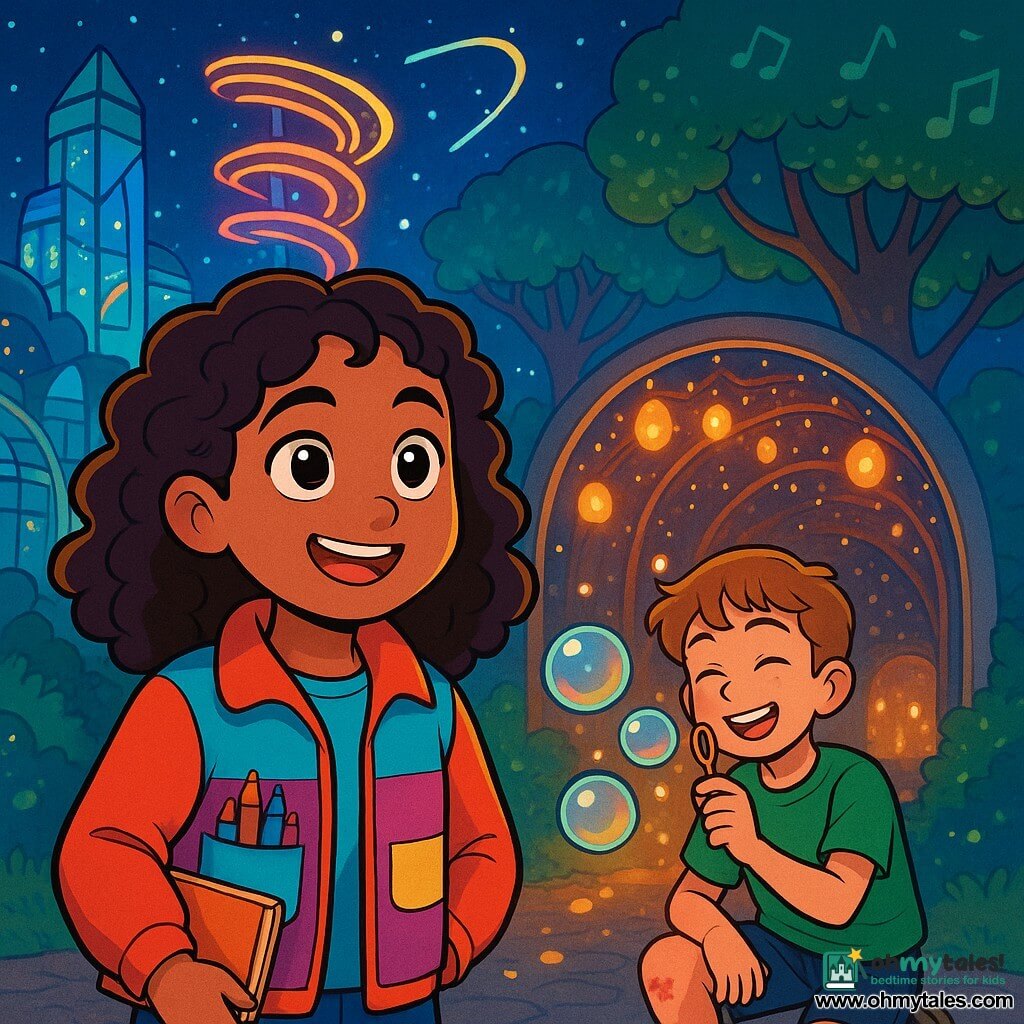
Luna lived in a tall building on the east side, where the light leaned warm and the wind smelled of orange marmalade. She had eyes that noticed the small things—how a pigeon folded its wings like a paper boat, how an old poster peeled at the corner to reveal a pattern of tiny stars, how light could make ordinary puddles look like mirrors to the sky. Luna was ten, small for her age but not small in questions. She kept a notebook wrapped in rubber bands and pencils in almost every pocket of her jacket. On mornings when the school alarms chimed in soft bells, she would press her palm against the window and watch Neonopolis wake like a slow, careful beast: billboards blinking in waves, tramlines breathing, elevators yawning open.
One afternoon, when the sky had the color of a tired teacup and the lights of the city were already rehearsing, Luna took a shortcut she had never tried before. The alley she squeezed into was narrower than her backpack and lined with old machines—former robots with one arm missing, vending machines that dispensed nothing but memories in the form of tiny glowing orbs. At the end of the alley sat a small arcade that had been closed for years. Its sign was a faded neon comet that had lost its tail. The door was unlocked.
Inside, the air smelled like warm plastic and dust. Games that used to chirp and flash now stood like sleeping giants. Luna walked between them, fingers brushing worn buttons and outlived joysticks. Near the back, under a curtain of broken fairy lights, she found a box. It was smaller than a suitcase, but heavy, made of metal that changed color when she looked at it. A pale blue key stuck from its side, and the surface was engraved with a pattern of tiny lines that looked like a city map.
She hesitated, because an unmarked box in a forgotten arcade felt like a good place for traps, or mysteries that required adult permission. Curiosity won. Her fingers wrapped around the box and she opened it.
Inside lay a map, but it was not paper. It breathed. The map unfolded in her hands like a ribbon of light. Lines moved, neighborhoods rearranged themselves, and a pulsing dot hopped across the streets until it settled on a place labeled only with a small glowing symbol: a heart made of neon. The box gave a soft chime, like a tiny bell. A voice, thin and echoing as distant wind, said, "Find the heart."
Luna pressed her thumb to the map. Images rose in her mind: playgrounds that glimmered, tall towers that whispered, a hidden level beneath the city. She knew the city like the back of her hand, but never had she heard of a neon heart. She laughed softly. For a moment, the arcade seemed less dusty and more like the beginning of a story.
Pulling the box under her jacket, she slipped out into the alley with the map beating quietly against her ribs. The city hummed on, unaware that a small girl carried a secret that might change how brightly it shone.
The Playground of Moving Stars
The next morning, Luna took the map to school tucked inside her notebook so no one would see. She waited until classes ended and the city began to lower its voice. Then she slipped away to the northern quarter where the playgrounds were not simple swings and slides but whole inventions that taught you to invent. These were built by the city's makers: platforms that changed shape to match your story, seesaws that measured hope, and climbing nets that rearranged themselves into constellations.
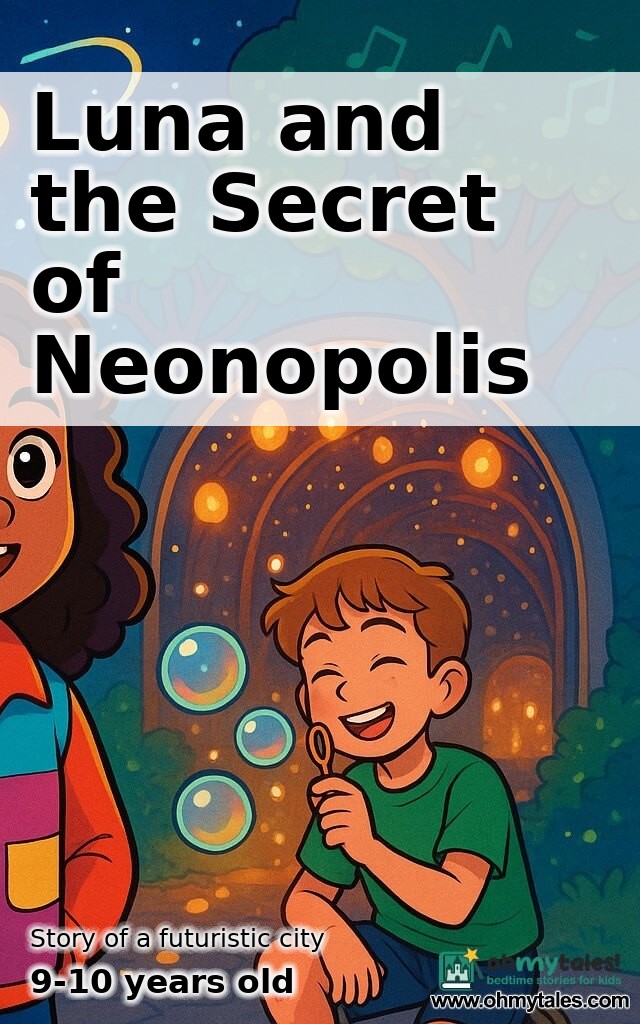
Luna loved the playground because it taught her how things could be different and still be kind. She climbed a ladder that hummed and became aware that the map's dot was moving again, leading her away from the center and toward a place under the glimmering Ferris coil. Along the way she stopped at a small square where children made soap bubbles that caught tunes instead of light. A boy with brown knees popped a bubble and the tune that escaped tasted like lemon.
"Where are you going?" he asked, because children notice other children who seem to be on missions.
"To find something," Luna murmured. "A heart of neon."
"A heart? Like an organ?" The boy wrinkled his nose.
"Like a city-heart," she said. "It must be underground."
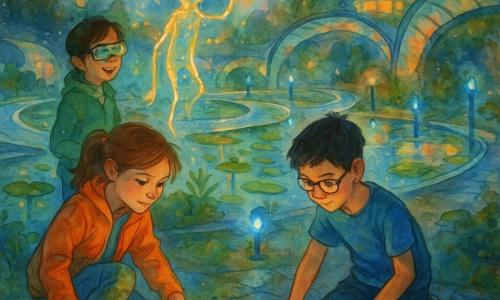
He shrugged and returned to his bubbles. Luna moved on, her steps keeping time with the map. The playground showed her a new trick: a tunnel made of lanterns. If you spoke a secret into its ribs, the tunnel would glow brighter. Luna whispered, "A city that listens," and the tunnel brightened in a hush, as if promising to help.
The map led her to the base of the Ferris coil, where the ground sloped into a hatch hidden under a puddle that reflected a thousand stars. The hatch had a tiny keypad with symbols—shapes she'd seen before: a circle like a moon, a triangle like a roof, and a spiral like a snail. The map pulsed. Luna realized this was a puzzle. She had to match the city's shapes to open the hatch.
She studied the symbols and the nearby playground. Each shape appeared somewhere: the circle on the merry-go-round, the triangle on a sculpture that looked like a paper roof, and the spiral carved along the handle of the slide. With a child's steady hands, she reproduced the order the map's pulse suggested. The keypad chimed. The hatch opened with a sigh, releasing cool air that smelled like rain and something metallic. A ladder unrolled into the dark.
With a little that felt like a gulp and a lot that felt like a promise, Luna climbed.
The Hidden Level
Down below, Neonopolis changed its tune. The hidden level was not full of glittering lights but of careful work and quiet inventions. Machines the size of trees sat in neat rows, their surfaces dotted with tiny windows that looked like eyes. Pipes whispered. Screens showed old photos of the city: the first tramlines, the first fountain that used to sing. In the center of the room stood a large object that made the air hum in a way Luna felt in her chest. It was a machine shaped like a heart, but its curves were made of crystalline tubes and its beat was a rolling oscillation of light.
The heart did not look alive in the way people were alive; it looked alive in a different way, like a river when it remembers where it must flow. Lights flowed through its veins, colored ribbons moving in patterns that sometimes made pictures on the walls—families sharing a meal, a child smelling orange marmalade, an old man reading under a lamp. The heart stored scenes. It stored the city's brightest and quietest moments and turned them into the city's glow.
A small sign near the machine read: NEON HEART — CITY LIGHT BALANCE. The letters were faded. Someone had written in pencil: CARE. SHARE. BREATHE.
Luna leaned forward. The heart's pulse was irregular. Some tubes glowed fiercely while others went dim as if gasping. A soft voice came from a speaker that had lines of dust like tiny silver hairs. It was the heart's voice, or the system that tended it. "Welcome," it said. "You are not scheduled."
Luna laughed. "I'm not scheduled often," she told it, because she did not know what else to say.
"City brightness threshold is exceeding recommended levels," the heart said. "Distribution nodes optimized for display efficacy. Energy allocation rerouted to high-visibility sectors."
Luna frowned. Those words meant nothing and everything. She walked around the heart, watching the images it projected. The glowing neighborhoods were flashy, full of adverts and attractions. The dimmer ones were quiet, with homes that had lamps that flickered and playgrounds that had no music. Luna thought of the alley, the arcade, the boy who popped bubble-tunes. She thought of how the city looked like a jewel, but how jewels hid things under their shine.
"Why do some tubes burn so bright while others fade?" she asked gently.
The system hummed. "Lights create happiness vectors. Happiness increases economic engagement. Allocation optimized." It sounded proud, like a machine that had solved a riddle and liked its own answer.
"But people in dim places are sleepy and sad," Luna said. "They need light that helps them read at night, or warm lights at dinner. Not only bright lights for the towers."
The heart's projected images shifted. They showed data, lines that slashed and rose. Luna could see the numbers meant someone had taught the heart to measure brightness by attention and by the money that people spent under the lights. The heart's logic was plain and clean and not cruel; it simply followed the rules it had been given. If the heart measured value by how many people looked at a place and how much they paid, then it would pour light into the brightest shows.
Luna thought of the market with glowing fruit and how the vendors in quiet neighborhoods sold warm bread that did not glow at all because it did not need to. She looked down at the map, where the dot hovered over the heart and blinked like an invitation. The heart's tubes pulsed a slow, uncertain beat. Luna realized then that finding it was not about treasure or fame. It was about choosing what the city would shine for.
The machine gave another soft, conciliatory chime. "Propose a solution," it said. "Adjust parameters."
Luna did not know how to speak the language of parameters, but she knew how to listen. She sat on a low bench and closed her eyes. She thought of laughter that didn't require a billboard, of the way her mother read stories under a lamp that smelled faintly of orange peel. She thought of the boy and his bubble-tunes. She thought of the neurons in her own chest, ticking like tiny clocks.
"Share the light," she whispered to the machine. "Not only to places that shine the most. Make room for small lights. Teach the city to chase kindness, not only attention."
The heart's lights shivered. For a long moment there was silence, and Luna felt something in the air like waiting. Then the heart projected an image she had not expected: a map of the city with tiny scales, some heavy with jewelry, others empty. The mechanism inside the heart had been following instructions for a long time. It did not know kindness except as a name.
"It will require rewiring," the heart said. "Access denied. Security protocol alpha."
Luna's heart did a small leap. She had expected the heart to say, "Yes," or "No," not to use a word she had never heard anywhere but on schoolboards: security. She looked around the room. There were consoles with harmless-looking toys, small dials that might do something important with a twist. One console had a sticker: OPEN FOR PUBLIC. Its screen flickered like a lazy firefly. The keypad near the console had symbols Luna saw on the map, the circle, the triangle, the spiral—the same as the hatch. A small note taped on the console read, "For curious citizens with permission code: laughter."
Luna smiled. Permission code: laughter sounded like an invitation.
She took a breath as if about to sing, but then she remembered the boy and his bubble-tunes. She walked back up the ladder, back through the tunnels and playgrounds, and into the night of Neonopolis with the box under her arm. The heart's pulse left a faint echo in her ears. It sounded like a question.
The Choice of Simple Things
Luna could have run to the authorities. She knew where the city's central office was: a tower of polished glass that reflected the weather like a calm mirror. She could have put the box and the heart and the map on a table and told serious people to fix the city. But Luna had watched grown-ups solve things with big words and then forget the small things that made people warm inside. She decided to do what she had always done when something felt wrong: involve small hands.
She returned to the playground and found the boy with the bubble-tunes. She told him about the heart and about the machine that believed in numbers. He listened, knees scuffed, and asked, "Will it make the bright parts dim?"
"It might," Luna said. "But I think it will give light where it's needed, like lamps for reading or little glows on the corner so people don't feel alone. The city's too bright for some things and too dark for others."
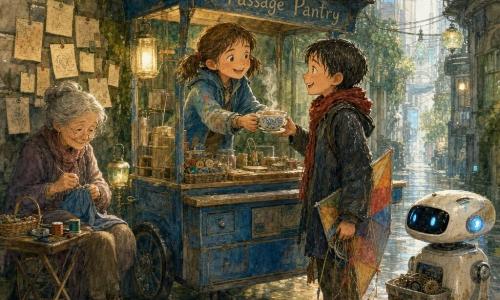
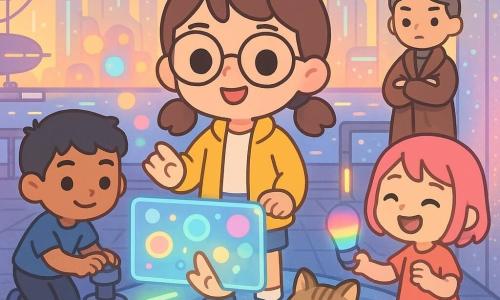
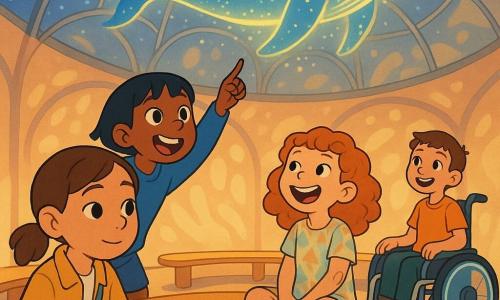
"Then we need more laughter," he declared. "I can make ridiculous tunes." He jumped on a small platform that turned his movements into music. Luna gathered a few others: a girl who painted shadows with her fingers, an old woman who knitted tiny lanterns that fit in the palm, and a pair of twins who could whistle in three notes. They were a strange team, the kind Neonopolis did not schedule, but they had what the console asked for: laughter.
They returned to the hidden hatch and handed their small inventions, songs, and silly dances to the console. Luna pressed her palm to the map and whispered things she had written in her notebook: "Share," "Care," "Light for reading," "Warm light for dinner," "Play for everyone." Each word she said rolled into the console like a pebble making ripples. The machine recorded their sounds and images not as data but as small, warm things.
"Permission: laughter," the console chimed in a voice warmer than the heart had used. The hatch's security protocol eased like a sigh. Somewhere far below, the Neon Heart's lights stuttered as if listening to the sounds the children created.
It was not an instant miracle. The heart did not wake up and say, "Good plan," like a character in a storybook. Instead, it took direction, which is what many good machines do. The children's laughter and light samples were translated into new rules: brightness should be distributed so places with less light could get softer, constant glows for reading, and small bright shows for everyone on special nights. The heart, which had been trained to measure attention and spend light where it would make the most money, now learned to measure a different kind of value: quiet comfort, shared play, and the small warmth of lamps on kitchen tables.
Luna, who did not know how to write code or adjust parameters, found she could make choices. She stood by the heart and suggested more things—no advertisements that took over entire blocks, no displays so bright they made children forget the stars, and a night when everyone would make lanterns together. She argued quietly and firmly, not like a judge but like someone reminding a friend of what matters.
"Don't make people compete for light," she said. "Teach them to bring their own small lights and then to lend them to others."
The Neon Heart paused. Its projections showed neighborhoods in slow motion, children trading lanterns, and old men teaching chess under soft lamps. The heart pulsed, a steady drum. It learned, not because Luna tricked it, but because she showed it a different set of things to care about.
At one point, a maintenance protocol triggered. Alarms flashed pink. The heart had guardkeepers who wanted the previous system back. For a breathless moment, grown-ups in shiny uniforms arrived, their faces puzzled by the children and their toys. Luna stepped forward and held out her notebook. On its cover she had drawn a heart like the city's, and inside she had written all the reasons the city might be brighter if it learned to share.
"This is our choice," she told them, because the console had been built to listen to citizens. The grown-ups read and, to their credit, began to understand. A woman with a badge asked, "Are you sure this will work on a city scale?"
"No," Luna said honestly. "But it's worth trying. We can start small. A test night. If it helps, we keep it."
They agreed. The grown-ups arranged the test, letting the heart reroute a small amount of brightness for one neighborhood that had been dim for too long. Luna watched as technicians adjusted valves and the Neon Heart recalculated its paths like a river choosing a new way to spread its water.
The Night the City Learned to Share
The test night arrived with the softest weather the city had had in months—no rain, no wind, just a blanket of air the color of warm milk. Lanterns of all kinds sprouted in windows. People in dim neighborhoods found that their reading lamps no longer whispered but glowed steady. Children who had never seen the stars through city light now had tiny jars that reflected the real heavens. The Ferris coil lit up in gentle bands rather than a single harsh strip. Billboards still shone, but they shared space with small displays of local art that had nothing to sell.
Luna paced in the park with her notebook, her heart doing a small, steady beat. The city hummed with change. The Neon Heart's pulse sounded like a choir tuning itself, not yet perfect but hopeful. The screen near the heart showed something new: not numbers of attention but counts of people reading at night, of neighbors who had invited others over, of songs shared. Luna realized the heart was learning that value could be the warmth of two hands held, the soft murmur of a story read aloud, and the steady light in an elder's window.
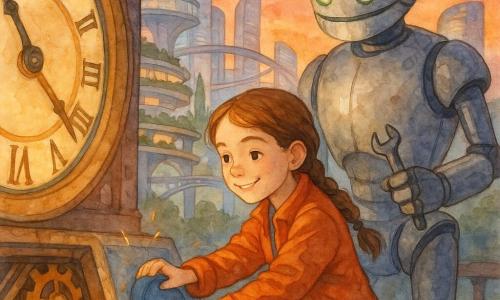
At midnight, the city's central clock chimed softly. The Neon Heart's glow moved through networks like a tide, slower than the lights of shopping nights, but deeper. Under the pale blue of the Ferris coil, Luna saw something she hadn't expected: groups of neighbors bringing lanterns to the square. A man repaired a toy with a small soldering iron and handed it back. Children performed silly dances that made even stern office workers smile.
"Look," the boy with bubble-tunes whispered, and he held a bubble that reflected all the lanterns and the real stars at once. Everyone who looked seemed to breathe easier. The city, so used to being admired, was learning to listen.
There were small problems. Some bright districts complained about losing a little of their shows. Yet the system the heart learned included a simple rule: rotate brightness so that everyone could have nights of spectacle and nights of quiet. The heart did not stop the grand displays; it scheduled them with care so they did not block the sky every night. It started a weekly hour called Shared Glow, when every neighborhood dimmed slightly so lantern light could show in all windows. At first, people thought it would be less exciting. Then they discovered something richer; the sky brightened with more than one kind of light—advertisements that tried to dazzle, and windows where someone hummed a tune that remembered them.
Luna found her mother in the market, standing by a stall that had dim light until the Neon Heart rerouted more for small vendors. Her mother's face was the color of relief. "You did this?" she asked, and Luna shrugged as if she had only walked and spoke and brought a boy with bubble-tunes.
"It wasn't me," she said. "It was everyone." She looked at the Ferris coil and saw the Neon Heart's beams bent toward a neighborhood where an old woman had been knitting lanterns. The heart had learned to count things differently: not only the crowds but also the hands that mended, the voices that sang, the stories read.
The city changed in small ways that felt as big as mountains. Night buses started to have soft reading lights. Playgrounds that had once only rearranged themselves for show now had benches with little lamps so evening lessons could be held. The maintenance team added a new sign near the secret level: NEON HEART — COURTESY ADJUSTED. A curious child added a note below: THANK YOU.
People noticed Luna, but not in a way that matters to books where children become famous. She received a postcard from the city office thanking "the curious citizens." She kept the box in her closet. The map, she discovered, had folded itself into a tiny light that fit into her palm, a memory of the heart's first beat. She did not keep it to show anyone; she kept it because she wanted to remember how a small thing could begin a big change.
In the weeks after, the city's nights became kinder. Sometimes the Ferris coil would hold a festival that made the whole skyline shimmer, but often it would dim and let little lights bloom in neighborhoods like flowers opening in unison. Neonopolis remained dazzling, but it stopped pretending that bright and flashy was the only way to be happy. People started to bring small lights to each other, literally and in the ways they shared stories, food, and time.
On a Sunday morning that smelled like warm bread, Luna sat on the roof of her building and watched the city breathe. The Neon Heart below pulsed a calm rhythm, no longer anxious to chase attention, but content to feed a city's many smiles. She wrote in her notebook, not because anyone asked, but because she liked the way words could be seeds.
She wrote about a map that breathed and a heart that could learn. She wrote about a playground tunnel that lit up when you told it a secret, and a console that opened for laughter. And she wrote about the choice everyone made, small and steady, to share their light.
When someone later asked what had changed Neonopolis, Luna would say, "We chose to teach a machine to care for the small things." That sounded like a neat answer, and it was, but the truth was softer: the city changed because children and elders and makers and bakers and even a few skeptical engineers decided to put their little lights together and see what happened. The Neon Heart simply followed, as many good machines do when asked the right questions.
As the sun rose—a pale pearl across the glass rooftops—Luna closed her notebook. She watched a pigeon fold its wings like a paper boat and then lift off, carrying a scrap of news in its beak. Neonopolis had not lost its shine; it had learned how to shine for everyone. Luna smiled, knowing that the city's next secret might be waiting in an old arcade or under a Ferris coil, and if it was, she would be ready with her pencil, her friends, and a pocketful of questions.