Chapter 1: The Meadow That Whispered
Finn's kayak slid over the calm water where the river met the sea. Beneath him, a green meadow swayed—long, ribbon-like leaves of eelgrass, a seagrass that loved this brackish place where fresh and salty water mixed. Finn was gentle with everything he touched. He drifted, then leaned over with a small net.
“Easy,” he murmured. “Just a few blades for the herbarium.”
He lifted a strip of eelgrass, smoothed it on a damp board, and slipped it into his press—two pieces of cardboard, a layer of paper, straps pulled snug. He liked to keep a record of the meadow. He wrote in his field journal: Day 27: eelgrass thin, some leaves pale, faint muddy smell. Water warmer than last week.
Something was wrong. The water had a milky tint that didn't belong here, and the eelgrass leaves, usually clean and shining, felt dusty, as if the river was carrying a secret down to the sea.
A silver school of fish passed by, then turned away. Finn frowned.
“If the meadow is worried,” he said, “so am I.”
He paddled to the small dock, where Old Mac, the lighthouse keeper, mended a coil of rope.
“You've got the river look,” Old Mac said. “Going upstream?”
“To the source,” Finn answered. “I need to find what's changing the water.”
Old Mac handed him the rope. “Rivers tell the truth if you're patient. Tie in, keep your head, and listen.”
Finn slipped the rope and a warm sandwich into his bag. He checked his thermometer, pH strips, and vials. He took one last look at the green, whispering meadow. Then he pushed off, pointed his kayak upriver, and began to paddle.
Chapter 2: Friends of the Current
The river's water tasted less salty as Finn went upstream, and the air smelled like wet leaves. He ducked under hanging branches, dodged a log, and followed the twisting, brown-green flow.
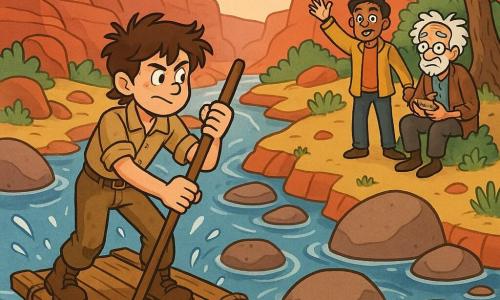
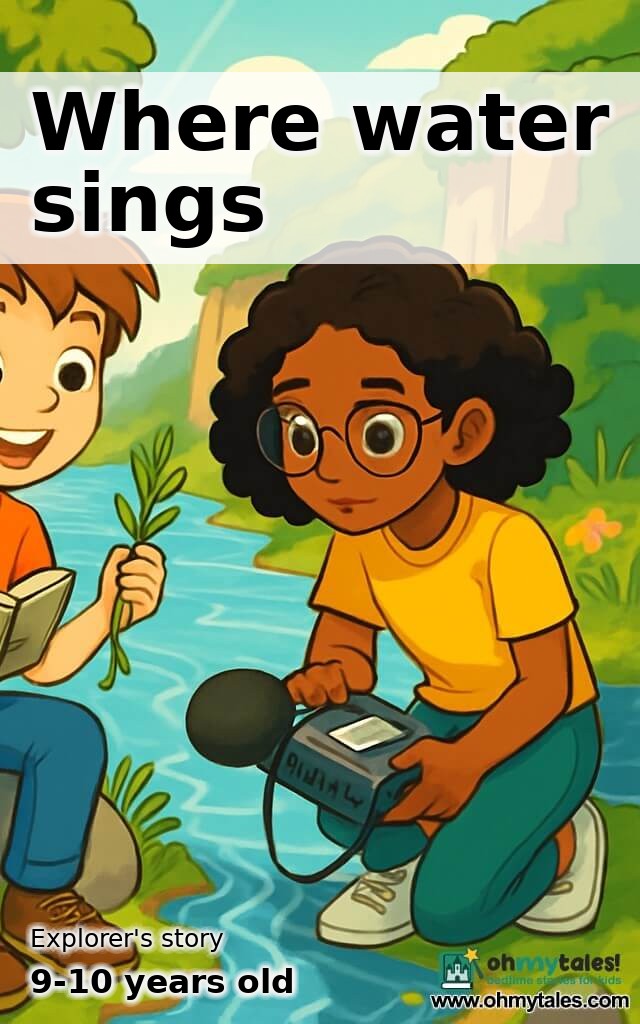
“Hey!” A voice carried over the water. A girl in a reed boat was kneeling by the bank, listening to a little speaker.
“Are you… listening to frogs?” Finn asked, slowing.
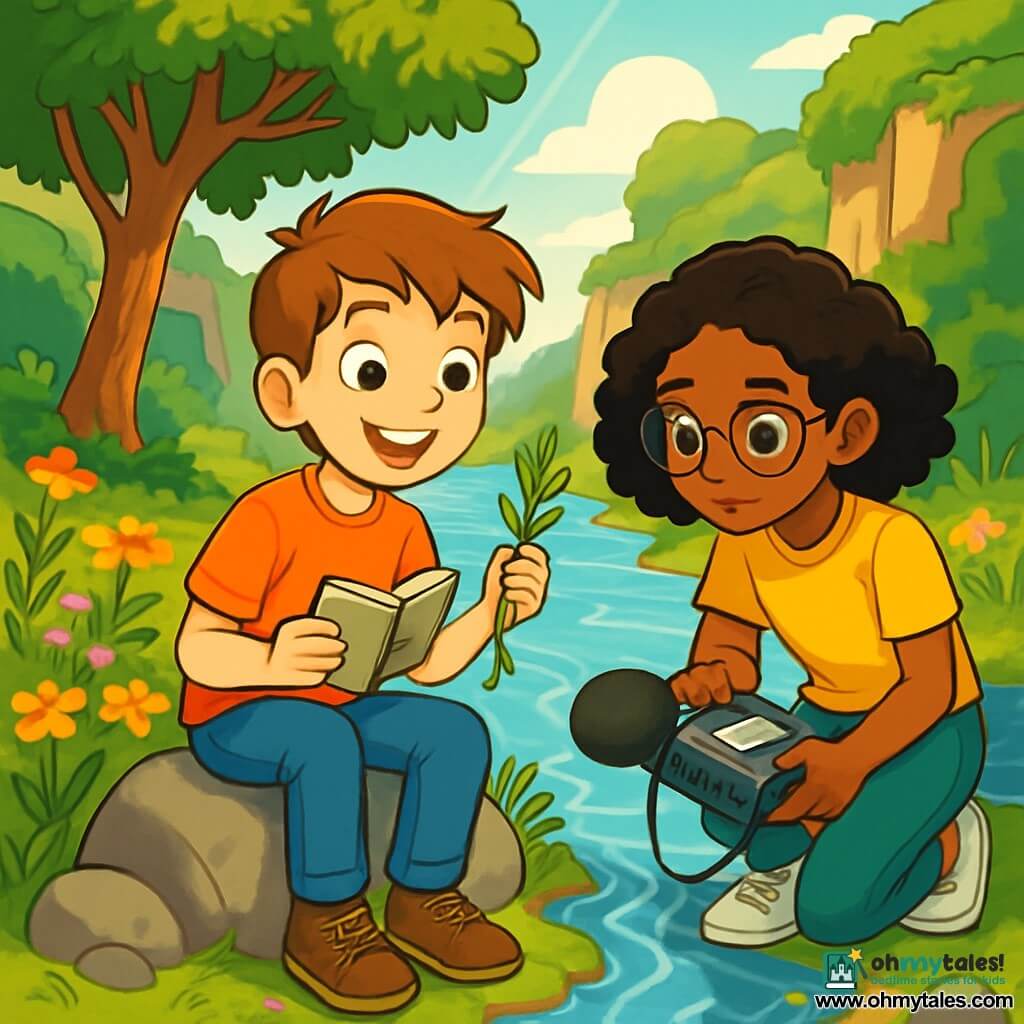
“I'm mapping their songs,” she said. “I'm Asha.” She held up a notebook filled with zigzag lines. “You look like you're mapping something too.”
“Seagrass,” Finn said. “It's not happy. I think the river is sending it trouble.”
“Then we're a good pair,” Asha said, grinning. “Mind if I come?”
They paddled together. Dragonflies zipped past like tiny helicopters. Finn showed Asha how to dip a vial under the surface without catching bubbles. Asha pointed out a kingfisher, a blue flash perched on a snag.
A sudden splash startled them. Something struggled near a tangle of roots—a young beaver caught in a lost net, squeaking, eyes wide.
“Hold steady,” Finn said. He slid close, careful not to tip. The net was tight around a small leg. Finn took out his pocket knife. “It's okay,” he whispered to the beaver, keeping his voice soft. Asha steadied the net with the reed boat's pole.
Finn cut slowly, thread by thread. The beaver kicked free and vanished in a blur of fur and water. For a moment, the river went still.
Then a heavy splash nearby. A bigger beaver surfaced, slapped the water, and dove. Another trail of bubbles appeared. The adults swam ahead, then looked back as if saying, Follow.
“I think they're showing us a safer path,” Asha said.
“Let's trust them,” Finn answered.
They followed. The beavers led them through a hidden side channel, calm and clear. Finn felt a thread of hope, like sunlight under water.
Chapter 3: The Stone That Sang
By afternoon, the river split in two. On the left, the water rushed over rocks, loud and foamy. On the right, a narrow stream slid through tall grass, quiet as a breath.
Asha pointed to something on the bank—flat stones arranged in a circle. Finn paddled over. The stones were carved with simple shapes: a line like a river, a spiral like a spring, and a cluster of little cuts like rain. In the center, a short message had been scratched long ago:
“Follow where water sings, not where it shouts.”
Asha leaned in. “Left is shouting.”
“Right is singing,” Finn said. He dipped his thermometer into each side. “Left is warmer. Right is cooler.”
“Warmer water downstream would make the sea meadow feel odd,” Asha said. “Warmer water holds less oxygen.”
“You know your science,” Finn said, impressed.
“Frog songs and water songs,” Asha replied. “They're cousins.”
They chose the quieter stream. The air grew cooler. Dragonflies gave way to soft moths. Finn noticed tiny bubbles rising from the sandy bottom. “See that? Groundwater coming up. The river might be close to its source.”
He took a water sample, capped it, and labeled it carefully: Fork, right side. He pressed a small river weed in his herbarium press too, a cousin to seagrass, though it lived in fresh water.
As they rounded a bend, a humming sound began—low and steady, like a big cat purring far away.
“Is that the river singing?” Asha whispered.
“Or something behind it,” Finn said. He felt the current tug, faster now, stronger. The humming grew louder. Finn steadied his paddle and grinned. Mystery is a kind of map, he thought. And we're reading it.
Chapter 4: Night Work in the Canyon
The stream narrowed to a canyon with walls of dark stone. The humming grew into a hollow hum-hum as the wind slid through cracks, like a giant bottle being blown. Then they saw the trouble.
A fresh landslide had tumbled boulders and trees across the water, pinching the stream and forcing it through a crooked gap. The squeezed water came out in a froth, carrying clay and warm seepage from the left bank, where the broken wall of an old bathhouse sagged. It smelled like wet bricks.
“So the heat and silt get trapped here,” Asha said, squinting. “Then flushed down.”
“That would bother the meadow,” Finn said. He felt a knot in his stomach. The blockage looked heavy. Too heavy for two kids.
“Call my uncle,” Asha said, already dialing. “He's with the river crew.”
Dusk fell. Moths circled their headlamps. Soon, a truck jolted along the dirt track above, headlights shaking. Asha's uncle and three crew members climbed down with ropes, pulleys, and strong hands. “You brought your own morale,” he said with a nod at Finn. “Good.”
Finn tried to help wherever he could. He tied knots the way Old Mac had taught him. He hauled on a rope line until his shoulders burned. He checked rocks for safe footing. Asha marked the safest path with glow sticks. The beavers showed up again, circling, then settled to chew at a log wedged deep. Everyone worked. Nobody complained. They moved one stubborn boulder at a time, as gentle with the stream as Finn was with eelgrass.
“Water's dropping a little,” Asha said sometime after midnight.
“Keep going,” said her uncle. “Teamwork doesn't watch the clock.”
Finn's hands were cold, his socks were soaked, and tiredness pushed at his eyelids. But he kept breathing with the river and pulling in rhythm. He remembered the meadow's slow sway and held that picture in his mind.
At last, the biggest rock shifted. With a scrape like a giant chair moving, it slid, stopped, and then rolled aside. Water rushed in a clear line around the new channel. The hum softened.
Everyone cheered. Finn sat down hard on a safe rock and laughed, water dripping off his nose. “I think,” he said, panting, “this is the best midnight I've ever had.”
Chapter 5: The Source and the Meadow's Promise
Morning came pale and blue. They followed the now-gentler stream a little further, until the canyon opened into a bowl of moss and ferns. Water bubbled straight from a crack in the stone, cold and glass-clear. Nearby, a rusty pipe jutted from the old bathhouse wall, dripping warm, cloudy water into the same bowl.
“So there's our mix,” Finn said softly. “True spring there, old hot water here.”
A forest ranger hiked down the path, radio on his shoulder. “Got your message,” he said. “We'll seal that pipe. Temporary fix first.”
They worked together. The ranger set a wooden plug, hammered it with a rubber mallet, and sealed the edges with clay from the bank. Asha wove a quick wicker screen from willow twigs and stones to catch any leftover silt. Finn measured the water below the spring—cooler now, clearer. He smiled.
“I'll report the bathhouse to the council,” the ranger said. “They'll make a proper repair.”
Finn knelt by the spring. The water danced in little silver beads over his fingers. He thought of the eelgrass far away, waiting for clean tides. “Thank you,” he whispered to the rocks, to the water, to the friends around him.
By the time they paddled home, the river looked different. They passed the fork, where the quiet stream now sang brighter. They passed the beavers' channel, where a sleek head bobbed and vanished. Asha checked her frog recorder and laughed. “They sound happier,” she said. “Is that a thing?”
“It is today,” Finn replied.
At the estuary, the meadow swayed in slow green waves again. Tiny silver fish darted between the blades. Finn dipped his net and lifted a ribbon of eelgrass. It was smooth and strong. He pressed a fresh sample in his herbarium and wrote: Day 30: water clear, current steady, eelgrass bright. Repairs holding. Team effort.
Old Mac waved from the dock. “River tell you the truth?”
“It sang it,” Finn said.
They climbed out, shoes squishing. Asha wrung a sock and made a face. “I am going to have pruney toes forever.”
“Worth it,” Finn said. He looked back at the meadow, then at the river curling into the distance like a question that had found its answer.
“Let's check it again next week,” Asha said.
“And the week after,” Finn agreed. “Explorers don't stop just because the map has fewer mysteries. We make sure the places we love stay alive.”
The tide turned, and the meadow nodded, like a friend who understands. Finn tucked his herbarium under his arm, felt the weight of pages and pressed leaves, and thought about all the hands—and paws—that had helped. Courage had gotten them here. Brains and stubbornness had kept them going. But it was togetherness that turned a problem into a path.
The river kept singing. And the sea sang back.