Chapter 1: The Cliff with a Secret Eye
Milo Grady liked cliffs the way other people liked roller coasters: from a safe distance, with snacks. But today he was walking right up to one.
The path curled along the sea like a ribbon that had forgotten how to lie flat. Below, waves punched the rocks and sprayed white foam into the air. The wind tugged at Milo's jacket and tried to steal his map.
“Not today,” Milo muttered, pinning the paper down with his elbow.
He was fourteen? No—he was ten. Ten and a half, which felt important when you were an explorer-in-training. His backpack thumped with useful things: a flashlight, a notebook, a pencil, a little compass, a granola bar that had melted and re-frozen into a suspicious brick, and—most important—a small pouch of smooth stones.
Milo's grandfather had taught him the old trail sign of stacked stones. “Cairns,” Grandpa called them. “A polite way to say, ‘Someone made it here. You can, too.' But remember,” he'd added, tapping Milo's forehead, “bravery is not doing silly things. Bravery is doing smart things even when your knees wobble.”
Milo's knees were currently doing a tiny dance.
At the end of the path, the cliff rose into a hump of dark stone, and on top sat the observatory—half building, half giant metal dome—like a watchful eye aimed at the sky. Its windows were dusty. Its door leaned slightly, like it was tired of standing up straight.
Milo stopped and stared. The place looked abandoned, but not empty. Some places held quiet the way a held breath did.
A wooden sign, gray with age, creaked on two chains. The letters were faded, but Milo could read enough:
CLIFFSIDE OBSERVATORY — CLOSED
Closed didn't mean impossible. It meant, “Be careful.”
Milo swallowed, took out his notebook, and wrote: Day 1. Objective: explore the observatory. Leave stacked stones as a sign. Do not become a cliff pancake.
He looked around for a safe spot and stacked three stones near the start of the final steps leading to the door. A small, neat tower. A promise.
Then he climbed.
The steps were slick with sea mist, but Milo used the handrail and took them slowly. Halfway up, a gull landed on the railing and stared at him with the dramatic seriousness of a museum guard.
“Do you work here?” Milo asked.
The gull screamed, which Milo decided meant, “No, but I will judge you.”
At the top, the air smelled of salt and rust. Milo touched the observatory door. Cold. Rough. He pressed gently.
The door groaned and opened a crack.
A thin line of darkness waited inside, smelling of old paper and rain that had no business being indoors.
Milo clicked on his flashlight and stepped in.
Chapter 2: Dust, Echoes, and a Star Map That Wasn't
Inside, the hallway was narrow and lined with framed photographs. Milo swept his flashlight over them: black-and-white pictures of stars, the moon, and people in old coats standing beside huge telescopes. Their faces looked proud and slightly uncomfortable, like someone had told them to “smile naturally” and then waited ten minutes.
His footsteps echoed. Not loudly—more like the building was whispering them back.
A door to the left was half open. Milo pushed it with the back of his hand, the way he'd seen his mom do when she thought there might be spiders.
The room was a tiny office. A desk sat under a window smeared with salt. Papers lay scattered, as if a strong wind had ruffled them and then gotten bored.
On the desk, Milo found a leather-bound book with a clasp. He touched it, and a little puff of dust rose like a ghost sigh.
“Sorry,” Milo whispered, and opened it.
The pages were covered in neat handwriting and careful drawings—charts of stars, notes about weather, and sketches of the dome mechanism. Milo flipped slowly, feeling like he should be wearing white gloves and a serious expression.
Then he found a page that made him freeze.
It was a map, but not of the sky. It showed the observatory and the cliff around it. A winding line led from the main hall to the dome room, then down—down—toward something labeled:
THE GEARWELL
Next to the words was a tiny symbol: three stacked stones.
Milo's heart did a quick, happy hop.
“Grandpa,” he breathed. “You weren't the only one.”
He read the note beneath the map, squinting at the faded ink:
If the dome will not turn, do not force it. The sea takes what the careless give. Follow the stones. Leave your own. And if you find the star-room below, bring light and patience.
Milo sat back in the dusty chair, which protested with a squeak that sounded like a small complaint.
A mystery. A hidden room. Someone long ago had used stacked stones as signs inside an observatory on a cliff.
This was exactly the kind of discovery Milo wanted—except for the part where something might break, or collapse, or contain a very annoyed raccoon.
He considered his choices, because measured boldness meant thinking first.
He checked his flashlight battery by flicking it off and on. Still bright. He took a slow breath and listened. The building creaked, but it didn't sound like it was falling apart right now. The wind thudded against the walls, but the floor felt solid beneath his shoes.
Milo stood and tucked the book into his backpack carefully, as if it were a sleepy cat.
“Okay,” he told the empty room. “We explore smart.”
Back in the hall, he found another door at the end. Above it, a sign read DOME ACCESS.
Milo pushed it open and entered the main chamber.
The dome room was enormous. The ceiling curved overhead like a gray sky inside-out. In the center sat a telescope as long as a canoe, pointed slightly upward, its metal body dotted with bolts. A circular track ran around the floor, and on it the dome could rotate—at least, it was supposed to.
Near the wall, a small pile of stones sat on a ledge: three stones stacked, just like the symbol.
Milo smiled, nervous and thrilled at the same time. He took one of his own smooth stones and added it to the top, making the stack four high.
“I'm here,” he whispered. “And I'm trying.”
Then he followed the map.
He found a narrow stairwell tucked behind the telescope. The air down there was colder. The steps spiraled into darkness, and the sound of the sea grew louder, like the ocean was clearing its throat.
Milo gripped the railing, aimed his flashlight down, and began to descend.
Chapter 3: The Gearwell and the Test of Patience
The stairs ended in a round chamber where the walls sweated with damp. Water dripped steadily from somewhere above, plinking into a shallow puddle.
In the center was a huge circular mechanism—gears the size of bicycle wheels, interlocked and dark with rust. A thick chain hung slack. Beside it, a crank protruded from the wall.
Milo recognized it from the drawings in the book. This was the Gearwell—the heart that turned the dome.
And it looked like it had stopped beating.
A cold draft brushed Milo's cheeks, carrying the smell of seaweed. He shivered and aimed his light around the room.
On the far side, something glittered. Milo stepped closer and found a small glass case built into the wall. Inside, sheltered from the damp, lay an object wrapped in cloth.
Before Milo could touch it, his foot slipped on wet stone. His arms windmilled. His flashlight beam swung wildly across the room, bouncing from gear to wall to puddle.
He caught himself on the railing with a loud clank.
Milo stood still, breathing hard. His heart hammered. The cliff felt suddenly closer, even though he was inside.
“Measured boldness,” he reminded himself, voice shaky. “Which means… not slipping again.”
He backed up and searched the floor carefully. He found a path of drier stone along the wall, and he moved slowly, placing each foot like a chess piece.
Near the crank, he spotted another cairn: three stones stacked neatly on a dry ledge. Next to it was a chalk mark, a simple arrow pointing to the chain.
Milo crouched and studied the chain. It had jumped off a guide wheel and tangled itself slightly, like a shoelace that refused to behave.
“Okay,” Milo said, pretending he was talking to a stubborn pet. “We can fix this. Gently.”
He set down his backpack and took out a small cloth. He'd brought it to wipe his hands, but now it became a safety tool. He wrapped it around the chain and pulled carefully.
The chain resisted. Milo didn't yank. Grandpa's voice floated into his thoughts: Don't force it.
Milo tried a different angle, lifting the chain slightly and guiding it back toward the wheel. He used his flashlight to check the groove. Then he eased the chain into place, link by link, as if he were helping it remember its job.
Finally, it settled with a soft clink.
Milo exhaled like he'd been holding his breath for a week.
“Nice,” he whispered, and grinned at the gears. “We're a team now.”
He stood and looked at the crank. If he turned it, the gears might move. The dome might rotate. Or something might snap and fling a piece of metal at his face, which would be a terrible way to become famous.
Milo checked the room: no loose rubble above the crank, no obvious broken teeth in the gears. He tried turning the crank just a tiny bit.
It moved—stiffly, but it moved.
The gears answered with a deep, slow groan. Dust drifted down like gray snow.
Milo stopped and listened. No cracking. No screaming metal.
He turned again, a little more. The chain tightened, and the gears rotated one careful notch.
Up above, faintly, he heard a sound—a heavy sliding rumble, like a giant chair scraping across the floor.
The dome.
Milo's stomach fluttered with excitement and fear. He stopped turning.
“Just enough,” he told himself. “We fixed it. We don't need to wrestle the whole building.”
He turned the crank one final small notch, then stepped back. The rumbling above faded, and the Gearwell fell quiet again, as if satisfied.
Now Milo looked at the glass case. The cloth-wrapped object seemed to glow softly in his flashlight beam, not from magic, but from the way glass catches light and makes you think it's hiding secrets.
He found a simple latch and opened the case. The air inside smelled dry, like old books. Milo lifted the bundle out gently and unwrapped it.
It was a brass disk, about the size of his hand, with tiny markings around the edge and a small compass needle in the center. On the back was engraved:
FOR THE STAR-ROOM BELOW — WHEN THE SKY IS CLOSED
Milo turned it over. The needle trembled, then pointed firmly toward a narrow corridor leading deeper into the rock—one Milo hadn't noticed before.
Milo's mouth went dry.
The map had mentioned a star-room below.
He held the disk, tucked his notebook into his pocket, and placed two stones at the entrance to the corridor—his own cairn, low and steady.
“If I go in,” he whispered, “I leave a sign. And if I get nervous, I go back.”
Then he stepped into the corridor, following the needle.
Chapter 4: The Star-Room Under the Sea
The corridor sloped down. The air grew colder and wetter, and the sound of the ocean became a constant boom, like a giant heartbeat behind the walls.
Milo's flashlight beam caught scratches on the stone—old marks, like someone had dragged crates here years ago. Then the passage opened into a chamber that made Milo stop so suddenly he almost bumped his nose on the doorframe.
The star-room wasn't filled with stars.
It was filled with them.
The ceiling was a smooth circle of stone, and set into it were hundreds of tiny glass points. As Milo stepped inside, the points began to glow—not bright like a lamp, but soft like fireflies. Pale blue, white, and hints of green. They formed constellations, swirls, and patterns that looked like a night sky trapped underground.
Milo stood with his mouth open.
“Okay,” he whispered. “That's… very unfair to regular rooms.”
In the center of the star-room was a pedestal with a shallow bowl carved into it. The bowl was empty, but the brass disk in Milo's hand warmed slightly, as if it recognized the place.
He approached slowly. The floor here was dry, and the air smelled like stone after rain.
On the wall behind the pedestal, writing had been carved into the rock, neat and careful:
THE OBSERVATORY WATCHES ABOVE.
THE SEA WATCHES BELOW.
TURN THE DOME ONLY WHEN IT IS SAFE.
LEAVE SIGNS FOR THOSE WHO COME AFTER.
CURIOSITY NEEDS COURAGE.
COURAGE NEEDS WISDOM.
Milo read it twice. Then he smiled, because it sounded like something Grandpa would approve of.
He set the brass disk into the bowl. It fit perfectly. The needle spun, then stopped, pointing straight up.
A soft click echoed through the chamber.
The glowing points in the ceiling brightened, and one cluster shifted—no, not shifted. A section of the ceiling opened, silently sliding apart like a secret eyelid.
A round shaft appeared above the pedestal, leading upward. Milo could see a faint circle of gray daylight at the top, and he could hear the wind again.
A hidden exit.
Milo's excitement bubbled up like soda. Then his sensible brain poked it with a finger.
Is it safe?
He walked around the pedestal, searching. On the floor near the wall, he found another cairn—older stones, darker with age, still stacked carefully. Next to it was a small note sealed in wax, tucked into a crack.
Milo hesitated. The wax looked ancient, but it held.
He gently pried the note out and unfolded it. The handwriting was shaky, as if written by someone tired but determined.
If you are reading this, you have found the star-room. Well done.
Do not climb the shaft in high wind or wet weather.
If the sea is angry, wait.
Measured boldness brings you home.
Milo looked up at the shaft. The wind sounded strong today, and the cliff outside had been slick with mist. Climbing now would be risky.
His knees did another tiny dance, this time from disappointment.
“I want to,” he admitted to the glowing ceiling. “But I don't have to.”
Instead, Milo sat on the floor with his back against the wall and ate his granola brick. It was chewy in a way that seemed personal, like it had chosen to be difficult.
While he waited, Milo wrote in his notebook by flashlight:
Found star-room. It glows. Also: granola can be used as building material.
Time passed. The sea's booming rhythm calmed, and the wind softened from a roar to a steady shush. Milo watched the light at the top of the shaft. It stopped wobbling so much.
He stood, stretched, and checked his flashlight. Still good.
“Okay,” he said, feeling braver because he'd waited. “Now we climb smart.”
He took three stones from his pouch and stacked them beneath the shaft as a clear sign. Then he began to climb the iron rungs set into the wall of the shaft, one hand and one foot at a time.
The metal was cold. Milo's arms strained. Halfway up, he paused, breathing hard, and pressed his forehead briefly to the stone.
“You're doing fine,” he told himself, though his voice echoed and made him sound like two Milos.
At last, he reached the top and pushed at a round hatch.
It opened with a squeal of protest, and Milo emerged into daylight.
Chapter 5: The Dome Turns, and the Stones Speak
Milo climbed out onto a flat platform on the far side of the observatory, higher than the front steps and closer to the cliff edge. The sea spread out in every direction, glittering now that the clouds had thinned. The wind was still strong, but not wild. It tugged at Milo's hair and made him feel like a flag that had learned to breathe.
He closed the hatch carefully and looked around.
From here, he could see the dome's seam—where it could rotate. And he could see something else: a line of stacked stones leading along the platform, each cairn small and steady, like a trail of quiet hellos.
Someone had been here before. Many someones.
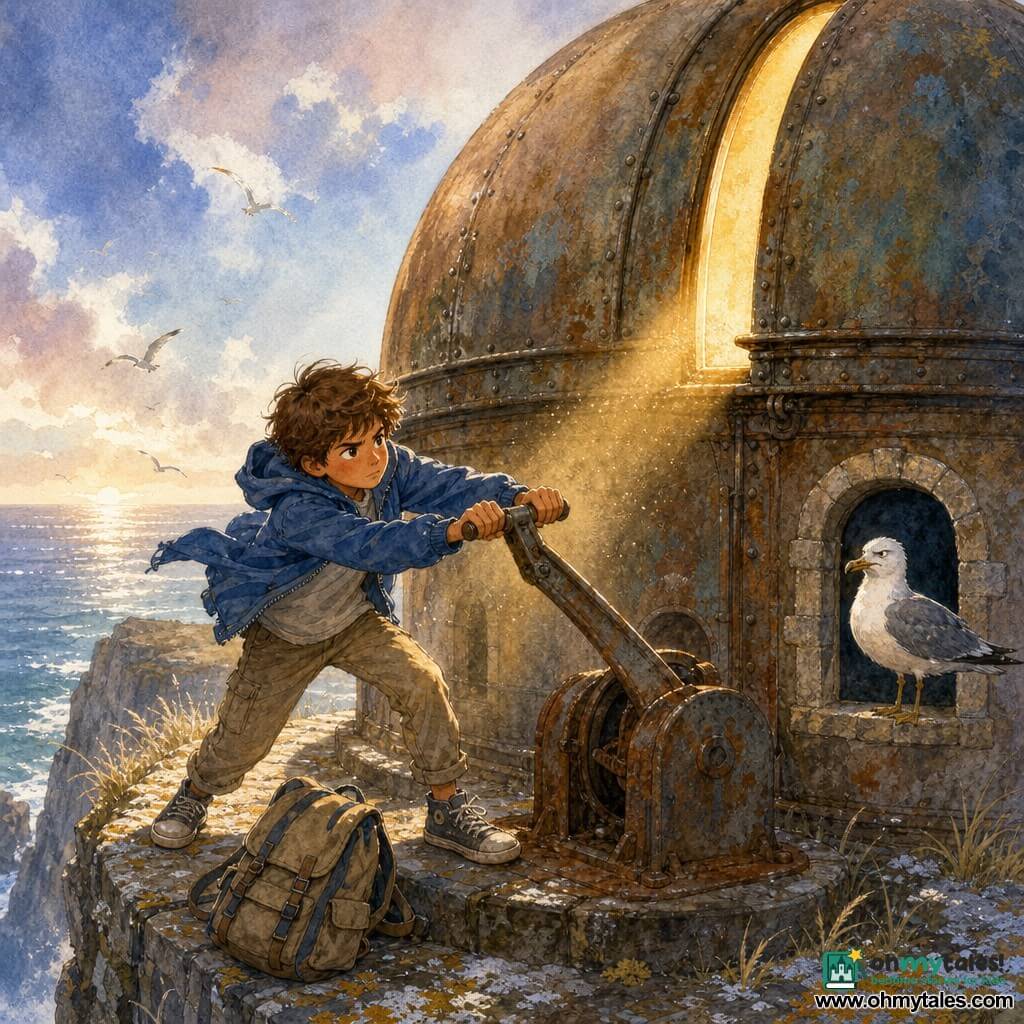
Milo followed the stone signs. They led to a safe spot near the inner wall, away from the cliff edge. There, set into the stone, was a metal lever with a worn handle.
Milo's eyes widened. The lever had a small tag attached:
DOME RELEASE — USE ONLY WHEN GEARWELL IS READY
Milo's mind clicked the pieces together. The chain in the Gearwell. The dome rumbling above. The star-room message about turning only when safe.
He had made the Gearwell ready. Now the lever could do its job—if the weather stayed calm enough.
Milo looked at the sky. The clouds were moving, but slowly. The wind was steady, not sudden. The platform was dry.
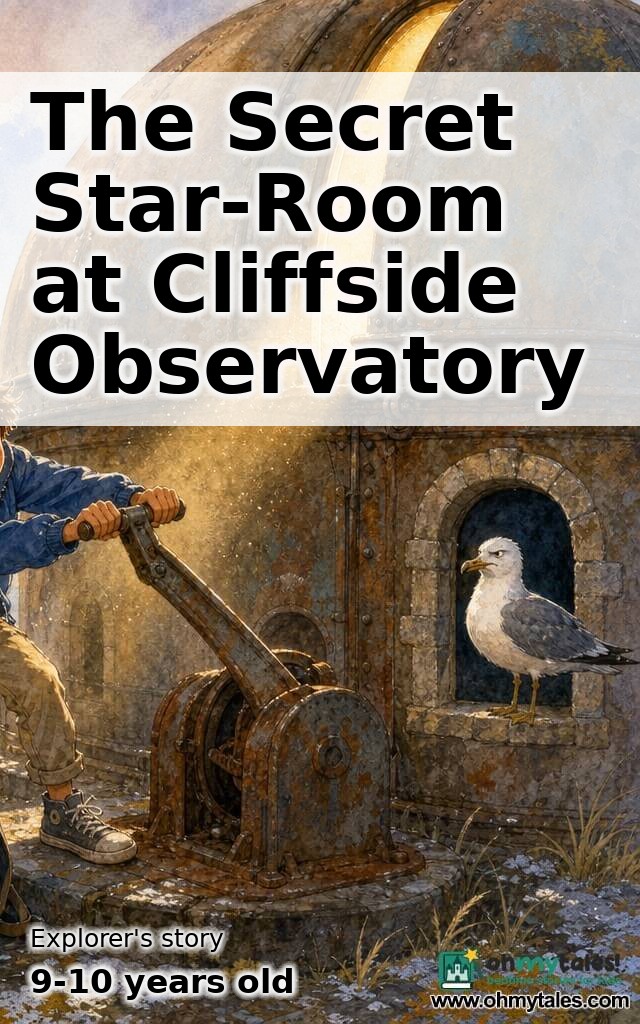
He took a careful stance, feet wide, and put both hands on the lever.
“Okay,” Milo said, and then, because he couldn't help it, he added, “Please don't explode.”
He pulled.
The lever resisted at first, then moved with a heavy clunk. The observatory answered with a long, deep rumble. The dome began to rotate, slow and smooth, like a giant turtle turning its head.
Milo watched, amazed. A narrow slit in the dome aligned with the western sky. Sunlight poured into the opening, a bright golden stripe.
From inside the building came a soft chorus of clicks, as if old parts were waking up and politely clearing their throats.
Milo didn't run to look—he walked quickly but carefully, because running in old buildings was how explorers became stories other people told.
He returned through a side door and hurried into the dome room. The telescope, now lined up with the slit, pointed toward the sky where the first pale star sometimes appeared at dusk.
On a table near the telescope, a small panel lit up—dim, but alive—showing a simple star chart. Not fancy, not modern. Just enough to guide someone who loved the sky.
Milo felt a warm swelling in his chest, like he'd done something bigger than himself.
He looked around the room and spoke aloud, as if the old astronomers could hear him through time.
“It works,” he said. “Your careful notes helped. Your stone signs helped. And I didn't force anything. Mostly.”
The gull from earlier landed on the windowsill, somehow having found its way to the exact spot where it could look most judgmental.
Milo looked at it. “I know. I'm still alive. You're welcome.”
The gull blinked slowly, which Milo decided was high praise.
Milo took out the leather-bound book from his backpack and placed it gently on the office desk again. It belonged here.
Then he wrote one more note on a clean page in his notebook, tore it out, and left it beside the book with a pencil:
I fixed the chain in the Gearwell and used the dome release lever in calm weather. The star-room shaft exit is safest when the wind is quiet. I left stone signs. Please add yours and be careful. — Milo Grady
Before leaving, Milo built one final cairn just outside the observatory door, taller than the first. Five stones, steady and proud.
It wasn't a shout. It was a friendly signal:
Someone came. Someone cared. You can, too—smartly.
As Milo walked back down the cliff path, the sea air felt less like a warning and more like applause. The observatory behind him stood a little straighter in his imagination, its great eye turned again toward the sky.
Milo grinned, his legs tired and his heart full.
He wasn't fearless.
He was something better.
He was brave enough to be careful.