Chapter 1: The Salt Plain and the Map
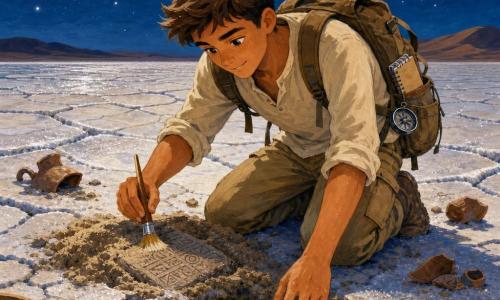
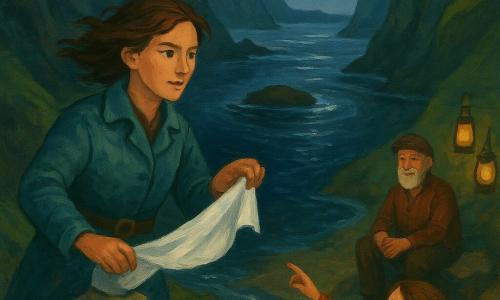
Mira walked out onto the salt steppe with her boots crunching like thin ice. The ground stretched white and bright, so flat the sky seemed to sit on it like a lid. Little crystals glittered at her feet, and every step sent up a sharp, dry scent that made her nose feel awake. Far ahead, a ribbon of darker ground teased her eyes—it might be a mirage, or it might be the lake she had come to find.
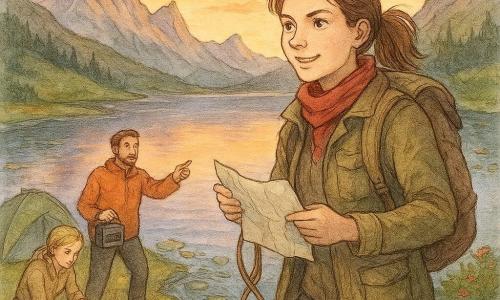
She was small for an explorer and had a laugh that sounded like a bell, but there was a steady calm about her. In her pack were a leather notebook, a brass compass, a folding sextant, a copper water bottle, and a map that looked more like a suggestion than a plan. Her wish was simple and precise: to take down the exact position of the lost lake that lay somewhere in this salt sea, so the villagers could know where to find water again.
Mira opened her notebook and traced the faint lines of the old map. The lake was marked with a tiny circle and the single word: “Home.” The map had been drawn by a grandmother who loved to tell stories, not to measure things. Mira wanted to give the map a true place on the world. She stepped off the beaten track and let the steppe teach her.
A breeze lifted salt into little ghostly waves. The sun swung warm and bright; shadows of distant hills were like soft ink. Mira checked her compass. The needle quivered, then swung wild as a bird. She frowned. Something in the salt made metal behave oddly. She folded the sextant and put the compass away. “We will use the sky tonight,” she murmured, and set her pace toward the mirage.
Chapter 2: The Broken Compass and the Ruins
Around noon the steppe opened into a scatter of broken pillars and stones half-buried in salt, the ruins of a place whose people had once lived by water. Strange carvings leaned from the rocks like teeth. Mira brushed her palm across a carving and felt an echo in her mind—stories about how people had listened to the land to find the lake. The wind carried a sound like far-off laughter, or maybe just the wind in the hollow stones.
She tested her instruments next to a pillar. The compass was useless; the metal in the salt crust warped the needle. The sextant could only help if she knew a precise horizon, but the plain bent the eye with its brightness. She could have turned back. Instead she opened her notebook and drew the ruins carefully, noting the angle of a leaning arch and the line of stones that pointed toward the west.
A sudden gust threw up a sheet of salt-dust. Mira hunched low. Salt stung her eyes and made a taste of iron at the back of her throat. When the air cleared, she found footsteps—small and old—pressed into the crust, leading away from the ruins toward a patch of darker white. The footsteps were tiny, like a child's, and they did not belong to anything now alive. Mira smiled. “Someone walked this land before me,” she said, and followed.
At dusk she climbed a low mound and used the sextant as best she could, measuring the angle of the setting sun against a ruin that pointed like an arrow. Her numbers were rough, but they gave her a line. She marked it on her map with a steady hand and, for the first time, felt the lake move closer.
Chapter 3: The Night of Stars and the Dry Riverbone
Night turned the steppe into a mirror of the sky. Stars pricked so close they seemed like holes in a bowl. Mira laid out her blanket and propped her back against a warm stone. The cold at night was sharp, but it made the sky sing. She pointed her sextant and watched the stars slide across her notes. Without a proper compass, she used the Pole Star and an old trick her grandmother had taught her—counting from the bright hip of Orion to find true north. It took patience, but Mira held the line.
In the moonlight she saw a dry riverbone—a channel etched into the salt like a pale vein. It ran toward a hollow, and hollows often held secrets. She followed it carefully; the edges crumbled like dry bread and the sound of her footsteps was muffled. The air smelled faintly of reeds and something sweet, the scent of water gone but remembered.
Halfway along, the ground shifted and Mira slipped. Her ankle twisted. She breathed out, felt the pain, and sat for a moment. Night surrounded her with soft, honest quiet. Courage, she thought, wasn't always a loud thing. It could be calm and patient, like waiting for a wound to stop bleeding. She wrapped a bandage from her scarf, set stones to make a small rest for her foot, and continued. The lake was not somewhere to rush into; it was a place to earn.
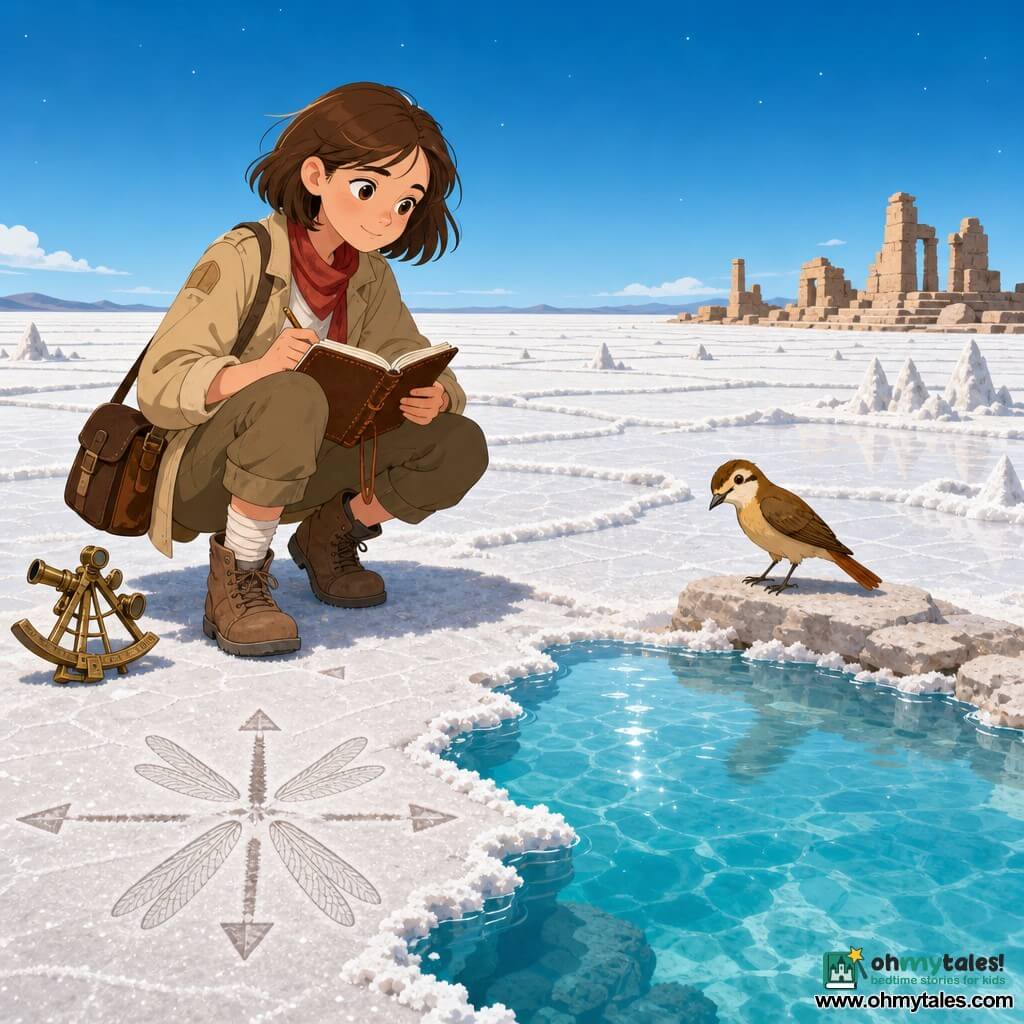
At the hollow she found old steps leading down into a shallow depression. At the bottom lay a circle of stones and, in the center, a blue-gray mud that glimmered faintly. It smelled faintly of algae—an echo of life. Mira knelt and pressed her palm to the mud. It was damp, not dry. Her heart gave a little, and then she noticed another sign: dragonfly wings, caught and fossilized in salt, their patterns pointing toward a narrow channel.
Chapter 4: The Hidden Pool and the Wisdom of the Plain
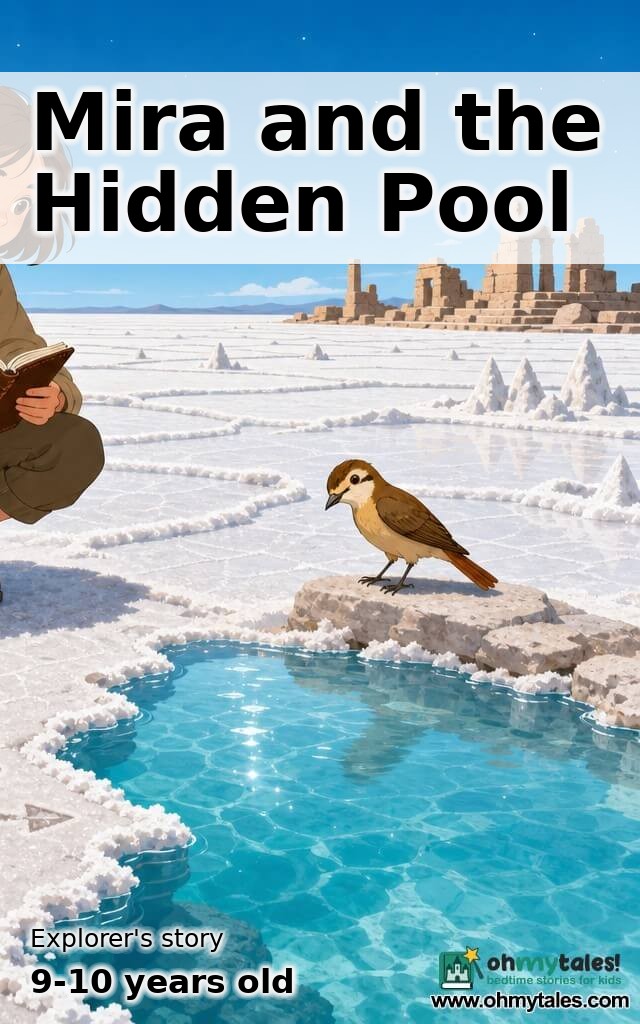
The next morning the sky was a clean sheet. Following the dragonfly marks, Mira walked until the sun made patterns on the salt that looked like scales. The channel narrowed, and there, tucked low between salt ridges, was a cup of water so blue it seemed to have been painted. The lake was not a wide ocean but a secret pool, fed by a buried spring. Its edges were crusted with white lace, and little ripples crossed its face like whispered secrets.
Mira sat at the rim and felt a rush of joy so big it made her eyes blink. She opened her notebook and set to work. First she measured the angle of sun at noon, then the angle of a distant ruin she had noted the day before. She used the sextant and the stars she had marked, juggling numbers until the map on her paper matched the map in the world. Her ankle throbbed, but her hand was steady. When she finished, she wrote the exact position with careful letters and drew the lake as a small blue circle, surrounded by the ruins and the dry riverbone.
A sound startled her. A flock of small birds rose from the reeds, shimmering like living leaves. One landed on a stone near her and cocked its head. “You found it,” Mira whispered, as if the bird had ears for such praise. She dipped the corner of her scarf in the water and tasted it. It was thin and tasted of salt and green memories, but it was water all the same.
Making her way back, she left small marks—tiny stone piles and a pattern of dragonfly wings scratched into soft salt—so others could follow if they needed. She also hid the most obvious path with a sweep of her hand across the ground, because sometimes wisdom meant keeping a good place secret until people were ready.
On the plain she paused and looked back at the little blue pool, bright as a bead. The steppe was vast and could be cruel, but it had taught her more than instruments could. It had taught patience, how to listen to small things, how to trust the slow language of ruins and wind. She sealed her notebook with a small smile and began the long walk home.
When Mira returned to the village, the map she carried felt heavier than before. She showed the elders the coordinates, drew them out carefully, and told them not only where the lake was, but how it had been found: by watching the stars, by following footprints, by reading the ruins, and by moving with quiet courage. The elders nodded, not because the numbers were a surprise, but because Mira had done something softer and truer—she had learned from the plain and carried its wisdom home.
That night, under the same bright stars, the village lit a small lamp near the old map. People came to see the new dot that marked the lake and listened as Mira told the story. Children tilted their heads and imagined the glittering salt and the tiny blue pool. Mira said little, but when she spoke, it was clear: the world is full of hidden places, and the way to them is through patience, careful thought, and the courage to keep going when the compass spins. The villagers smiled, and the lamp burned steady and kind as a promise.