The Girl Who Listened
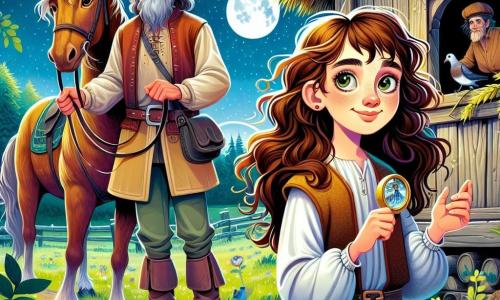
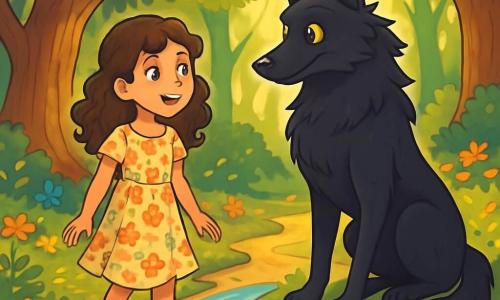
May was eleven years old, with eyes like small lanterns and a stillness that surprised the wind. In a village where everyone talked about chopping wood and baking bread and beating rugs, May had a secret dream that made her heart beat softly and strong: she wanted to learn the sound of a step and a breath. Not words, not songs, but the quiet writing of people's feet and lungs. She thought it might be a kind of reading no book could teach.
She was assiduous. That is to say, she worked at it every day. She sat on the low stoop of the house with the blue door and closed her eyes. She learned the map of her home from the soles up. Father's boots came home heavy at dusk, saying, “Work, work, work,” with each heel. Mother's slippers were careful leaves, brushing the floor, whispering, “Hush-hush-hush.” Her brother Kit, when he remembered, tried to tiptoe, but his ankles laughed at him, and he tripped on the threshold and swore he meant to do it. At night, Kit's breath buzzed like a sleepy bee and sometimes honked like a tired goose. May smiled into the dark.
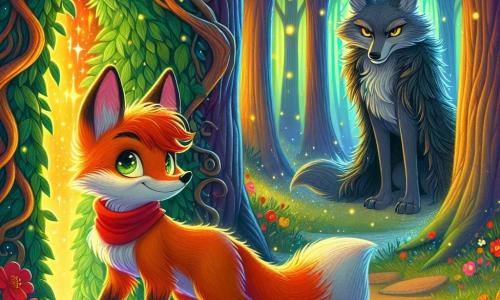
Her village nested at the edge of a great forest, the kind that turned crimson and gold in autumn and black as ink when clouds covered the moon. In the forest, a Big Bad Wolf lived. The elders said he had eyes like wet stones and a breath like a winter window. He was called big and bad because that was what he had become, not what he was born. He did not like company. He did not like songs. He did not like the braided ropes the villagers hung between the cottages or the woven baskets they carried to the well. “He flees solidarity,” the old ones said by the fire. “He runs from togetherness. Alone finds alone.”
May listened when they spoke, and she listened when they stopped. She listened to the forest breathe. When the trees were sleepy, the leaves sighed ksss-ksss. When the river dreamt, it spoke in bubbles, like a child blowing a secret through a straw. Sometimes, after midnight, when the moon put a silver thumbprint on the path, something else breathed there, not like her family, not like the trees. It was cold and measured, as if it pinched each breath between pointed teeth.
May did not tell anyone about that breath. Not yet. She was still learning the alphabet of steps and the grammar of breaths, and she knew secrets are like seeds—they must be held in warm hands until the roots start to tingle.
Footprints and Firelight
At the market, when she carried a flat basket made of willow twigs, May walked behind people with her eyes closed, counting their steps. Mr. Alder, the carpenter, had a rhythm of three short taps and a longer drag—tap-tap-tap—draaaag. Mrs. Fen's toes pointed outward, and her footsteps were small, as if she were afraid to wake the earth.
“Close your eyes again?” Mrs. Fen laughed kindly. “You'll walk into my onions.”
“I'm learning,” May said. “I want to know things even when I can't see them.”
“Oh,” said Mrs. Fen, tapping May's shoulder with a sprig of parsley. “Then listen to this.” She whistled, and her little dog, Pepper, scampered over. Pepper's paws were a patter of rice, quick and light and hungry for attention. May knelt, counted, and smiled.
At night, she added to her collection. Grandfather Bram's pipe sighed, and the ember glowed like a tiny sunset in his beard. “What are you listening for?” he asked, not unkindly.
“Steps and breaths,” said May. “When people come, I want to know them without looking. I want to hear their worries and their joys. I want to hear the difference between a friend and a stranger, and between good trouble and bad trouble.”
“Ah,” Bram said, puffing once. “Then listen to the fire. When it crackles high, there is too much hunger in it. When it hums low, it is content and gives out heat. A fire has a step and a breath too.”
May leaned closer, feeling the warmth on her face. The fire's breath made a gentle O, and its step was a crack, pause, crack, like careful teeth in a crust of bread.
One evening, the elders told a story in their winter voices. “The Wolf will not come to a door where many hands have placed a latch,” one said. “He will not cross a threshold woven with ivy and twine. He cannot stand three hearts beating in one rhythm. He will tear at a loose thread, but he runs from a strong rope.”
May looked down at her basket. It was only thin sticks, yet it held eggs and apples and bread because the sticks were woven together. Separate sticks would not do. She stroked the willow ribs and thought of ribs inside a chest, holding in the breath. She thought of her village like a basket.
She practiced more. At dusk, she stood by the lane and closed her eyes. “Who am I?” Father said, taking three steps.
“Father,” May said without thinking. “You carry stone dust.” She could hear grit from the quarry in the creases of his boots.
“Good ear,” he said. “What's this?” Mother breathed out, a long soft river.
“Mother,” said May, smiling. “You hide a laugh in your breath.”
Kit tried to trick her by walking on his hands. He fell. “I meant to do that,” he groaned, and even the nettles laughed.
May listened and learned and listened again, and in listening her courage grew like a candle wick dipping into wax: slowly, steadily, making light.
The Wolf's Wind
The Wolf returned when the leaves were thin and the moon was fat. The first sign was not a howl, but a silence. The crickets sewn into the grass fell quiet, and the river held its breath. May woke in her narrow bed and sat up, the quilt a small hill around her. She did not move. She listened.
There it was, pressed against the window like frost: a step so careful it might not be a step at all. The weight came down and held itself, as if the ground had to be persuaded to carry it. Then a breath, not rushed, not tired, but as if counting. In, out. In, out. Cold coin against her ear. The Wolf.
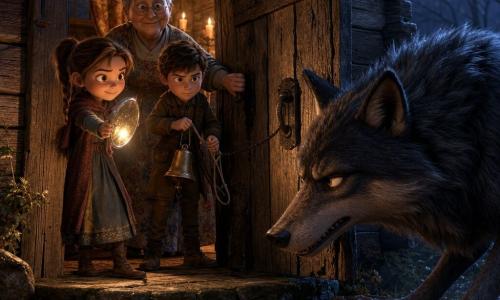
May slid from bed like a shadow slipping off a wall. She did not light a candle. She went to the door and pressed her palm to the wood. The boards did not shake. The latch was fixed with a strip of woven grass and twine, a charm her mother had made. May could hear the difference between the house's breath and the wind's breath. Houses breathe slow and warm, like old cats. The wind has nothing to warm.
Kit stirred and snored: honk-honk-sigh. May almost laughed; then the cold breath on the other side of the door drew the smile out of her mouth and kept it in its pocket for later.
“Go away,” she whispered, not sure if she spoke to the Wolf or to fear.
A voice like dry bark rubbed the door. “Little breath-counter,” it said, almost friendly. “Do you hear me?”
May did not answer. She didn't know how the Wolf had learned of her listening, but she would not give him more.
“I know you,” the voice went on. “You are the one who wants to name me by my walk and catch me by my lungs. But listen: I am nothing alone. I am only strong when you are alone. Come away. Walk in the forest alone. See how your steps are yours again. They do not have to tangle with other feet. No need to move at anyone's pace.”
May thought of her basket and the twist of reeds at the latch. She thought of singing while kneading bread with her mother's hands beside hers. “No,” she said, her own voice surprising her with its steadiness. “No.”
The Wolf breathed once, a sound like ice slipping into water. “I do not like latches,” he said. “And I cannot bear the sound of many people breathing at once. It makes my teeth ache. How strange, that you like it.”
“Not strange,” said May, though her knees trembled. “Safe.”
He sighed, a long winter sigh. “You will have to come out sometime, little listener.”
“Not alone,” May said.
Silence again, and then the softest steps withdrawing, not down the lane, but into the garden, into the hedge, into the path that led to the trees. He was not gone, only waiting where darkness grew like moss.
May sat on the floor and held her knees. She listened to her house. She listened to Kit's ridiculous snore until she smiled again. She waited until dawn rubbed the window with pale hands.
In the morning, she told no one. But her secret now had leaves, and it asked for sunlight.
The Woven Plan
May sat with Grandfather Bram by the fire while the washing steamed on the line and the forest pretended to be harmless. She told him everything, in a voice that kept stumbling but did not fall. When she finished, Bram nodded as if he had expected this.
“He talked?” Bram asked, eyes narrowed.
“He wanted me to walk alone,” May said. “He hates our latches and our songs. He told me he cannot bear many breaths at once.”
“Good,” said Bram. “He told you where he is weakest.”
May felt a small warmth that was not from the fire. “Then we should breathe together.”
Bram looked at his granddaughter as if seeing her again for the first time. “What do you need?”
“People,” said May. The word felt like a hammer striking a bell; it rang clear.
That afternoon, she went to Mr. Alder, to Mrs. Fen, to the twins who mended nets, to the baker whose laugh rose like yeast. She did not frighten them with the voice at the door. She spoke of latches and ropes and baskets and breath. “I want to make a sound he cannot stand,” she said. “Not shouting. Not pots and pans. Just steps, and the kind of breath that belongs to home.”
The baker wiped flour from his hands. “A march?”
“A weaving,” said May. “A braid of footfalls.”
“We can do that,” said Mr. Alder, tapping with his knuckle. “But how will we know when?”
May lifted her basket and turned it over. Inside, she had lined seven little stones she had washed in the river. “We will make a signal,” she said. “Three quick taps on a window with a spoon,” she told Mrs. Fen. “Then pause. Then three slow taps. That is the call. It must be the same in every house.”
“Like a heartbeat,” said Mrs. Fen softly.
May nodded. “If you hear it, you come. As you are. No one walks alone.”
So they practiced, not all at once, but in twos and threes in the lane, in the square, by the well. May walked with her eyes closed, listening, and said, “Again,” and again they moved. They matched their steps to a rhythm, steady as a loom. They learned to breathe on the same counts. In, two, three; out, two, three. The twins laughed and tripped each other and tried again. Kit was allowed to join on the promise not to show off. He showed off anyway and then pretended he hadn't.
“Listen to each other,” May said. “The idea is not to sound like yourself, but like us.”
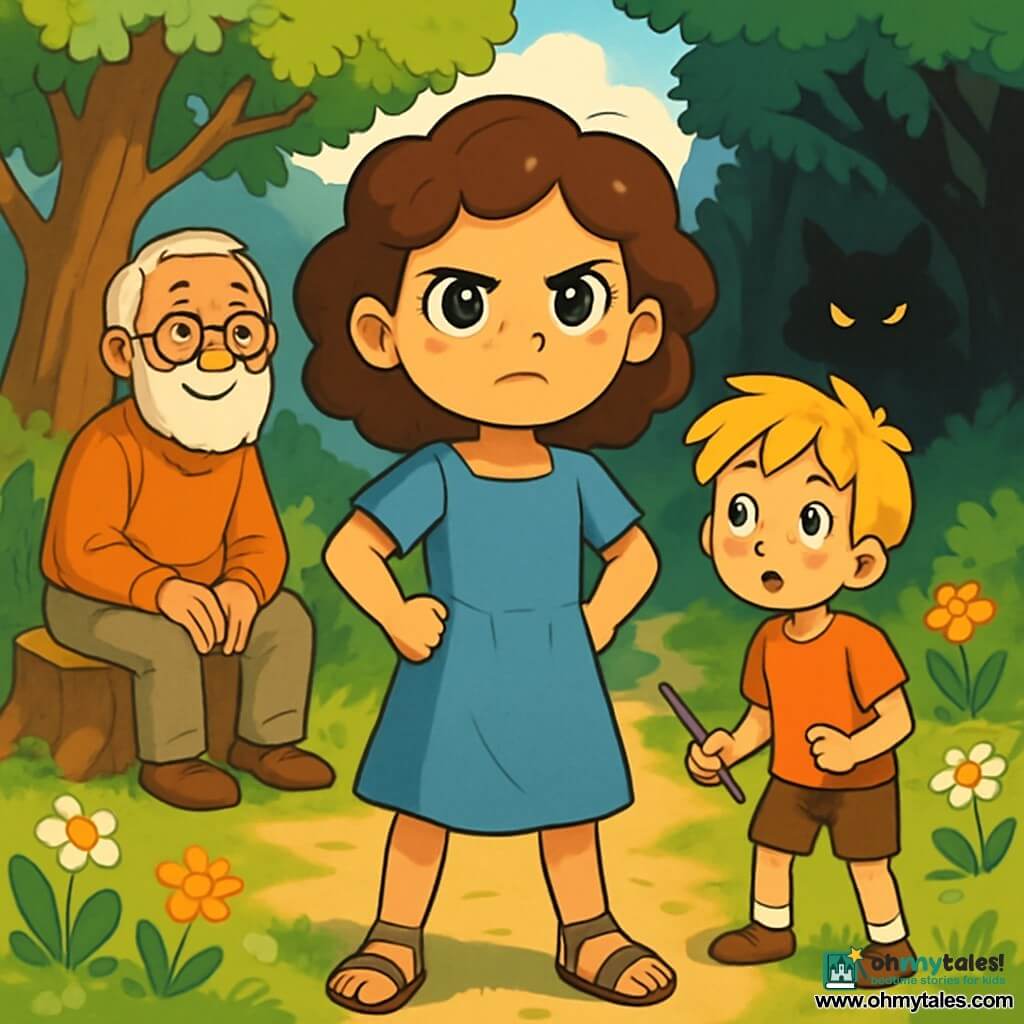
At dusk, she showed them a rope she had made, twining reeds with straw and a bit of her own ribbon. She stretched it across the lane at knee height. “He will not cross this if we stand with it. He will not cross us if we stand with each other.”
“Are we the rope?” Kit asked.
“We are the rope,” May said. She touched the latches on the doors, the ones braided with ivy and twine, and felt their small brave hum.
The Night of Two Breaths
The Wolf came when a frost lay thin as breath on the fields and the stars shivered. He did not come to May's door. He was clever and grew bolder around cow sheds and chicken coops, around the edge, where people were often alone. He moved like a shadow that had learned to walk. His steps were quiet; his breath was a saw cutting slow through winter.
May woke to a faint sound at the window: tap-tap-tap, pause, tap... tap... tap. She reached for the spoon by her bed and answered, three quick, three slow. The rhythm hopped across the village like a cricket, window to window, spoon to spoon. Doors opened, latches clicked and clicked again as hands reached for one another.
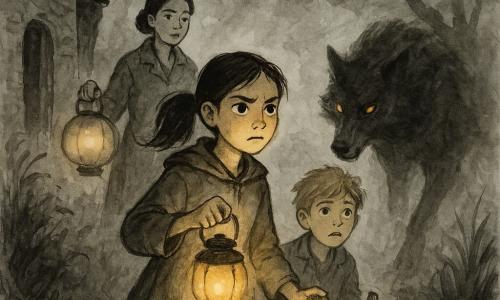
“Do not bring torches,” May said in a whisper, moving into the lane. “Bring your steps. Bring your breath.”
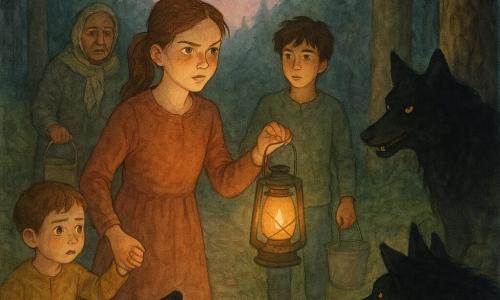
They spread into a wide ring, the rope in their hands. May kept them at the edge of the sheds and the blackberry hedge. The night smelled of damp earth and iron. The Wolf was a darker dark, there, where shadow should have stopped.
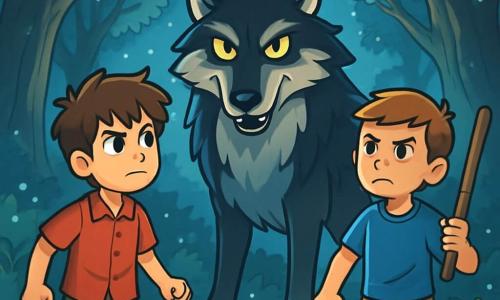
He was larger than some tales said and smaller than others, as dangerous things often are. His coat drank the light. His eyes were the color of old water. May stood at the front with Bram's hand on her shoulder, and Kit just behind, trying not to bounce on his toes.
The Wolf watched. He licked his teeth with a tongue like a knife wet from the river. “You would weave yourselves into a rope,” he said. “You would braid your breath.”
“Yes,” said May, the word a pebble dropped into a still pool.
He moved his paw forward, and then another. The rope quivered, but the hands holding it did not. The villagers began to step, just as they had practiced. Step, step, step. In, two, three; out, two, three. A warm sound rose, not loud, but whole. A house's heartbeat brought outside.
The Wolf flinched, only a twitch, like a muscle learning a new pain.
“It hurts your teeth, doesn't it?” Kit whispered, not unkindly.
The Wolf's lips peeled back. “I will pull one of you loose,” he said. “And then I will pull another. Not all ropes are well-made.”
He turned his steps. He changed his rhythm. He tried to scatter them with speed, then stillness, then speed. He tried to copy the steps of Mr. Alder, three quick taps and a drag, coming up behind him to make him turn. He breathed like Mrs. Fen—a gentle sigh—to trick her ear. For a moment, Mr. Alder faltered. For a heartbeat, Mrs. Fen's hand trembled.
May shut her eyes. Whatever she had learned stretched within her like a string being tuned. She listened deeper, below speed and the copying of her neighbors, to something else. There, beneath the surface—hunger. Cold hunger, old as stones. A breath that wanted only for itself, not for joy or rest, not for bread baked for many or milk shared in mugs. The Wolf could borrow a step, but not a purpose. He could not mimic what he hated.
“That is not Mr. Alder,” May said clearly, eyes still closed. “That is not Mrs. Fen.” She lifted her chin. “Listen to the intent,” she said to her village. “Not the sound—what the sound is for.”
They tightened the circle. They breathed as if they were joined by one set of ribs. Even those who were afraid breathed, and even that breath belonged in the weaving.
The Wolf growled, a rolling thunder in his chest. He lunged at a gap that wasn't a gap; Bram and the twins sealed it with their bodies and with the rope. He tested the rope with one paw. The braided reeds did not break, because their strength was not in the reeds. It was in the hands holding them.
“Do you want to come in?” May asked, surprising herself with the question. “We would have to change you. You would have to bear the sound of many breaths. You would have to carry some weight that is not yours alone.”
The Wolf's ears flattened. “I cannot,” he said, not roaring, not snarling. His voice was flat like a road under snow. “It burns. It burns where my heart might be.”
“Then go,” said May softly. “Go where your breath does not hurt you. Go deeper, where lonely things live. We will not follow. But do not come here, not where the latches are many and the steps are shared.”
He looked at them all, eyes flicking over faces and shoulders, over chests rising and falling in one rhythm, over the rope with its slight shine of moonlight, over May's small hands holding a piece of straw with ribbon threaded in it. He is big and bad, May thought, because he is alone and fears he will always be.
He turned. He ran. Not like a gust of wind, not like a panther, but like a fear skipping away from other fears. He fled the ring as water flees a bowl. The villagers did not chase him. They stood and breathed until the frost wore thin and the stars stopped their shivering.
When the rope fell slack on the ground, the sound of their own breaths made them laugh. It was a quiet laugh that tasted of relief.
“Your spoon woke me,” Mrs. Fen said to May. “I thought, ‘Who's tapping me at this hour?' and it was you, and I was glad.”
“You did well,” Bram murmured. He looked a little taller in the moonlight.
Kit ran up to the rope and then dropped it, embarrassed, as if he had meant to pick something else. “He ran,” Kit said. “He did. He ran away from us!”
May nodded. “He runs from us,” she said. “Not from a person. From us.”
Home Again, Together
Morning put gold on every roof. The frost melted and made the dust call itself a river for a little while. The women gathered the rope and hung it over a fence like washing. The men checked the latches and added new braids of ivy and twine. Children stomped in the soft ground to see if their steps made tiny ponds appear. The village moved through the day with a lightness in its hips.
May made her rounds, not as a captain, but as a listener. She stopped at Mr. Alder's workbench and listened to the way his saw's breath rasped against the wood. She heard, under the rasp, a small, glassy sound—worry. “What is it?” she asked.
“My son is late,” he said, surprised at himself. “He is usually here by now. I pretend I don't mind. I do.”
“We will look together,” May said. She called Kit, who arrived as if his legs had been waiting all morning for an adventure, and Mrs. Fen, who took the onion basket off her arm. They walked to the edge of the pasture, three hearts in one rhythm. The boy was not far. He had slipped in the mud and was hiding because he had broken a button. “You can break a button and still be found,” May told him. They walked him back, one on each side.
May visited the well and listened to its hollow breath. It was low. She told the baker, who told the twins, and by afternoon they had a line of buckets moving in and out like swallows to fill the barrel by the schoolhouse. She listened to the dog Pepper, who had a new limp, and found a thorn in his paw. She listened to the new mother down the lane and heard worry tucked under joy, like a pebble at the bottom of a mug. “You can sleep while we keep watch,” May said, and Mrs. Fen nodded and brought soup.
At sundown, May stood in the doorway of the house with the blue door. She looked at the lane. It was still the lane that had frightened her two nights before, but now it had footsteps pressed into it like writing. She could read the story they had written with their feet.
“Are you done listening?” Kit asked around a mouthful of bread.
“Not yet,” said May. “I think I will never be done.”
That night, she lay in bed with the quilt tucked under her chin. The house breathed slow and warm and safe. The forest breathed its endless breath, too, but now she could hear the difference between threat and distance, between a danger within and a threat passing by like a cloud. She found the Wolf's breath as one finds a far storm. It was beyond the trees, not near the latches, not near the rope where they hung their gloves. He had gone to where lonely things live and where they might one day learn to change.
She thought of the way he had flinched when they breathed together, how he had tried on Mr. Alder's steps and Mrs. Fen's breath like coats that did not fit him. She wondered if a day would come when he could bear a song sung by many, or if he would walk and walk around the edges of it forever.
She turned her face into her pillow. It smelled of soap and sun and the straw ribbon from the rope. She said aloud, to no one and everyone, “Alone is sometimes needed for learning,” and then, with a small smile, “but not for living.”
The house held her like a basket, ribs and rafters, roof and sky. The village's steps had become her lullaby. In her dream, she walked through the forest, and the trees had their own quiet footsteps, and the river breathed with her. In her dream, she met the Wolf at a distance: he did not come closer, and she did not call him, but she wished him a steadier heart all the same.
And in the morning when she woke, she was ordinary May again, eleven and listening, the child whose secret dream folded now into the work of her days: to read the world by step and breath and teach her village to weave itself strong and kind.
For that is the way fear loses its sharpness: not when one brave person stands alone, but when many are brave together, and their breath makes a rope that cannot be pulled apart.