Chapter 1: The House That Stayed Bright
In the village of Alderwick, the woods began where the last garden ended, as if the earth had drawn a dark line and said, Here the stories start.
Mira was eleven and small enough to slip between grown-ups' elbows, but her eyes were sharp as pins. She lived in a narrow cottage with whitewashed walls and windowpanes that caught the sun like thin ice. Every evening, her mother did the same thing—again and again, like a lullaby made of chores.
She lit the lamps.
One lamp in the kitchen. One lamp in the hall. One lamp by the window that faced the trees.
“Too many,” Mira would say, half teasing, half serious.
“Not too many,” Mother answered, tightening the wick. “Just enough. The wolf dislikes bright rooms.”
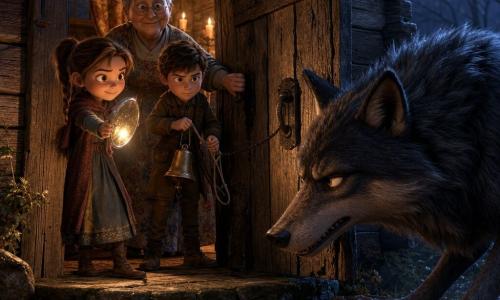
Mira had heard the old tale: the Great Bad Wolf did not prowl where lamps stayed burning. Light was not a sword, not a cage, but it was a warning, the way a bell warns an unseen thief. In Alderwick, people left lamps glowing like small moons—especially on foggy nights, when the forest seemed to lean closer.
Mira liked the lamps, but she did not like how they made everyone whisper.
“Is it true?” she asked her mother one night, when the wind worried the shutters. “That he only comes when it's dark?”
Mother's hands paused over the flame. “Some say he hates light because it shows what he really is.”
“And what is he really?” Mira asked.
Mother looked toward the window, where the trees stood like a crowd in black coats. “A mouth with a plan.”
Mira was careful by nature. She counted steps, checked latches, remembered warnings. Yet she was also bold, the way a match is bold—small, but willing to flare.
Lately a question had scratched at her mind like a bramble: How do you know which secrets to keep and which to tell?
Because secrets were everywhere. Adults folded them into their sleeves. Friends hid them behind laughter. Even Mira held one: she had found a narrow path behind the old mill, a path that slipped into the forest like a stolen ribbon. She hadn't told anyone. She wasn't sure if that made her wise… or foolish.
That night, as the lamps burned and the house hummed with gentle light, a faint sound came from outside.
Tap. Tap.
Not the clumsy tap of a branch, but a careful, patient tapping—like a knuckle against glass.
Mira's spine turned to cold water.
Mother lifted her finger to her lips. “Do not open. Do not answer.”
Tap. Tap.
Mira moved closer to the window, slow as a cat. The lamp beside it made a golden pool on the sill. Beyond the pane was only darkness and fog, thick as wool.
Then a shape slid across the edge of the light—just for a breath, just enough.
A snout. A grin that was not friendly. Eyes that reflected the lamp like two wet coins.
Mira swallowed her fear, because fear, she remembered, could be a candle too—it could show you what mattered.
The tapping stopped.
The night went on, holding its breath.
Chapter 2: A Whisper in the Fog
The next morning, the village looked ordinary again. Chickens scratched. Buckets clanged. The baker's chimney wore a scarf of smoke. But Mira felt as if she had woken from a dream with a message clenched in her fist.
At school, her best friend Rowan slid into the seat beside her. Rowan had hair like straw and a laugh that tried to make everything less scary.
“You look like you ate a cloud,” Rowan whispered. “A stormy one.”
Mira hesitated. If she spoke, would the words invite danger? If she stayed silent, would the danger grow teeth?
“The tapping,” she murmured. “At my window.”
Rowan's smile faded. “The wolf?”
“I saw his eyes,” Mira said. “Like coins. Like he'd pay for something.”
Rowan shivered and pulled their collar up. “My gran says he bargains. He doesn't just bite. He talks.”
Mira stared at the ink stain on her desk, shaped like a little puddle. “What does he want?”
Rowan leaned closer. “Maybe he wants a secret.”
Mira's stomach tightened. She thought of the hidden path behind the old mill. She had kept it like a pebble in her pocket, rubbing it when she was bored, proud that it was hers alone. But now it felt heavy, and sharp.
After lessons, Mira walked home by the long road, the one with neighbors and fences and barking dogs. She avoided the mill. She avoided the forest's edge. Still, as she passed the well, she heard old Mrs. Heddle talking to two men.
“—lamps burning all night,” Mrs. Heddle was saying. “Even then, I heard him. Outside my hens. Sniffing, sniffing.”
One man spat into the dust. “We should turn out the lamps and set traps.”
Mrs. Heddle's eyes bulged. “Turn them out? That's like inviting him in for tea!”
Mira's mother was in the garden when Mira arrived, pulling weeds with steady fingers.
“Mother,” Mira said, and her voice came out smaller than she wanted. “He was at the window.”
Mother's face did not crumple, but it turned hard, like bread crust. “Did you answer?”
“No.”
“Good.” Mother stood and wiped her hands on her apron. “Listen to me, Mira. Wolves are not only teeth. They are questions. They ask and ask until you give them what they want.”
Mira's throat felt tight. “What if I have something he wants?”
Mother searched Mira's face, and Mira felt as if her thoughts were lanterns with no covers.
“If you do,” Mother said softly, “you must be careful. Keep the useful secrets. Tell the dangerous ones.”
Mira frowned. “How do I know the difference?”
Mother looked toward the forest line. “A useful secret protects someone. A dangerous secret protects only the secret itself.”
That afternoon, the sky bruised purple, and the fog returned, crawling low. Mira helped light the lamps earlier than usual. The cottage glowed like a ship on dark water.
And still, deep in the fog, something moved—as silent as a thought you wish you didn't have.
Chapter 3: The Wolf's Bargain
That evening, Mira sat by the window lamp with her book open, though the words wriggled like worms and refused to settle. Outside, the forest breathed. The fog pressed its face to the glass.
Tap. Tap.
Mira did not jump this time. Her fear was still there, but she held it like a leash.
Mother stood behind her with the poker from the hearth in her hand. “Do not speak to it.”
Tap. Tap.
A voice slid through the crack beneath the window frame, smooth as oil.
“Little lamp-girl,” it said. “Little bright-house.”
Mira's mouth went dry. Mother's knuckles whitened on the poker.
“Go away,” Mother called, steady as stone.
A soft chuckle. “Stone can crack. Light can die. Even a brave mother must sleep.”
Mira felt anger spark. The wolf was trying to make fear into a wedge, trying to pry them apart.
“What do you want?” Mira blurted, before her mother could stop her.
Mother's eyes flashed, warning.
Outside, the voice brightened, pleased. “Ah. A question answered with a question. Clever.”
The fog shifted. A shadow pressed close enough that Mira could make out the curve of a cheek, the sharp triangle of an ear.
“I want a secret,” the wolf said. “A good one. A warm one. The kind that sits in a pocket and thinks it owns you.”
Mira's heart hammered. The hidden path. The ribbon-path behind the mill.
“I have no secrets,” Mira lied, and the lie tasted like old pennies.
The wolf laughed again, low and patient. “Everyone has secrets. Even the lamps have secrets. They burn, and they burn, and they pretend they are not afraid of the dark.”
Mother raised the poker. “Leave. Now.”
“And if I do?” the wolf purred. “If I step back into my fog? Will your little girl keep all her secrets locked up tight, even the ones that could save someone?”
Mira's skin prickled. The wolf wasn't just hunting bodies. It was hunting choices.
“I know things,” the wolf continued, voice gentle as a blanket. “I know whose door is unlatched. I know whose lamp is low. I know who walks alone.”
Mira pictured Rowan, who sometimes took the short path near the mill to get home quicker. Mira pictured old Mrs. Heddle with her hens. The village suddenly seemed full of thin places, weak spots where danger could slip in.
“What will you do?” Mira asked, and surprised herself by sounding calm.
The wolf's snout shifted in the fog. “That depends. Give me a secret, and I will give you a warning.”
Mother leaned down to Mira's ear. “He bargains like a thief. He takes more than he gives.”
Mira nodded, but the wolf's words had already burrowed under her ribs. If she gave him the hidden path, he could use it. But if she said nothing, would someone else pay?
The lamp flame trembled, as if it, too, was listening.
Mira took a slow breath. “I won't trade,” she said.
For a moment there was no sound but the wind, rubbing the cottage like hands.
Then the wolf spoke, softer now, almost sad. “Brave. But bravery without wisdom is a lantern without oil.”
The shadow withdrew. The fog swallowed it.
Yet Mira could still feel the wolf's attention, like a finger pressed against the back of her neck.
That night, Mira lay in bed and watched the light under her door. The lamps' glow made a thin river on the floorboards.
Keep the useful secrets, she thought. Tell the dangerous ones.
But which was her path? Useful… or dangerous?
She did not sleep quickly. The darkness beyond the walls seemed to wait, and the wolf, somewhere in it, seemed to smile.
Chapter 4: The Secret Path Behind the Mill
The next day, Mira found Rowan at the well, dropping pebbles in and listening for the plunk.
“I didn't take the mill path,” Rowan said quickly, as if reading Mira's mind. “I walked the long way. Twice as long. Twice as boring.”
Mira forced a small laugh. “Boring is healthy.”
Rowan squinted at her. “You talked to him, didn't you? The wolf.”
Mira hesitated, then nodded.
“What did he say?” Rowan asked, voice tight.
“He wanted a secret,” Mira admitted. The words felt like opening a drawer that had been stuck.
Rowan's eyes widened. “Did you—?”
“No,” Mira said. “But he said… he knows who walks alone. He knows whose lamp is low.”
Rowan's shoulders hunched. “My gran forgot to buy oil. Her lamp's been flickering like a tired firefly.”
Mira's chest tightened. “Then we should help her.”
Rowan blinked. “We?”
“Yes,” Mira said, and surprised herself with how clear it felt. “If the lamps keep him away, then we keep the lamps burning.”
Rowan's mouth quirked. “So we're… lamp-heroes?”
“More like lamp-servants,” Mira said. “Less heroic. More soot.”
They hurried to Rowan's cottage and fetched a small tin of oil, then carried it to Gran's house. The old woman's hands shook as she poured, and her lamp steadied, the flame standing tall again.
“Good children,” Gran murmured. “Light is a kind neighbor.”
Mira felt a warmth that was not from the lamp. Still, her hidden path tugged at her thoughts.
A few streets away, Mira saw men gathered near the smithy. They were speaking in low voices. One of them held a coil of rope.
“Tonight,” one said, “we set the trap near the mill. That's where he comes through.”
Mira's breath caught.
Near the mill.
Her secret path behind the mill wasn't just a curiosity anymore. It was a doorway. And doorways could be used by anyone—by friends, by fools, by wolves.
Mira stepped closer. “A trap?” she asked.
The men turned. One of them was Mr. Durn, broad-shouldered and impatient. “Go home, Mira. This is grown talk.”
But Mira felt her courage rise, not loud and reckless, but steady, like a lamp being filled.
“The wolf asked me for a secret,” she said.
The men went still.
“He came to our window,” Mira continued. “He wanted a secret in exchange for a warning. He said he knows whose lamp is low.”
Mr. Durn's face hardened. “And what secret did he want?”
Mira's tongue stuck for a heartbeat. If she told them about the path, would it make the village safer—or would it paint a target? Yet keeping it now felt like hiding a spark in dry hay.
Mother's words returned: A dangerous secret protects only the secret itself.
Mira swallowed. “There's a narrow path behind the mill,” she said. “It leads into the forest without anyone seeing. I found it. I didn't tell anyone. But if the wolf knows it too, he could use it.”
The men exchanged glances. Rope shifted. Someone muttered a curse.
Mr. Durn exhaled hard. “That is the kind of thing you tell.”
Mira's cheeks burned, part shame, part relief.
Rowan touched Mira's sleeve. “We can show you,” Rowan said.
Mira nodded. “But not to set traps in the dark,” she added quickly. “The lamps—he hides if lamps stay lit. We should bring light. Lots of it.”
Mr. Durn scoffed. “Light doesn't catch a wolf.”
“It keeps him from hiding,” Mira said. “And if you can see him, you can help each other.”
For a moment, the men looked as if they might laugh. Then old Mrs. Heddle appeared behind them, holding a lantern as big as her head.
“I've got oil,” she snapped. “And I've got eyes. And I'm tired of being scared in my own yard.”
The men's laughter died.
That afternoon, the village began to prepare, not with sharpness alone, but with brightness. Lanterns were cleaned. Wicks were trimmed. Neighbors shared oil the way they shared bread.
Mira felt her fear loosen, like a knot being worked free—not gone, but no longer choking.
Still, as the sun lowered, the forest's edge looked darker than ever, as if it had been drinking the light.
Chapter 5: The Lantern Line
Night fell with a slow, heavy grace, like a curtain drawn by invisible hands. Fog seeped between cottages, turning the streets into pale rivers.
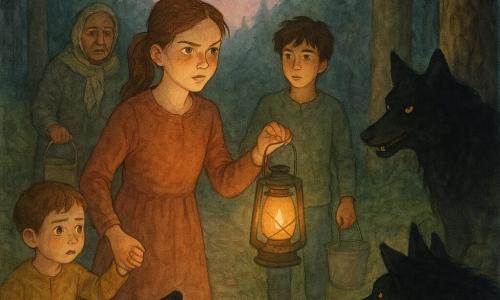
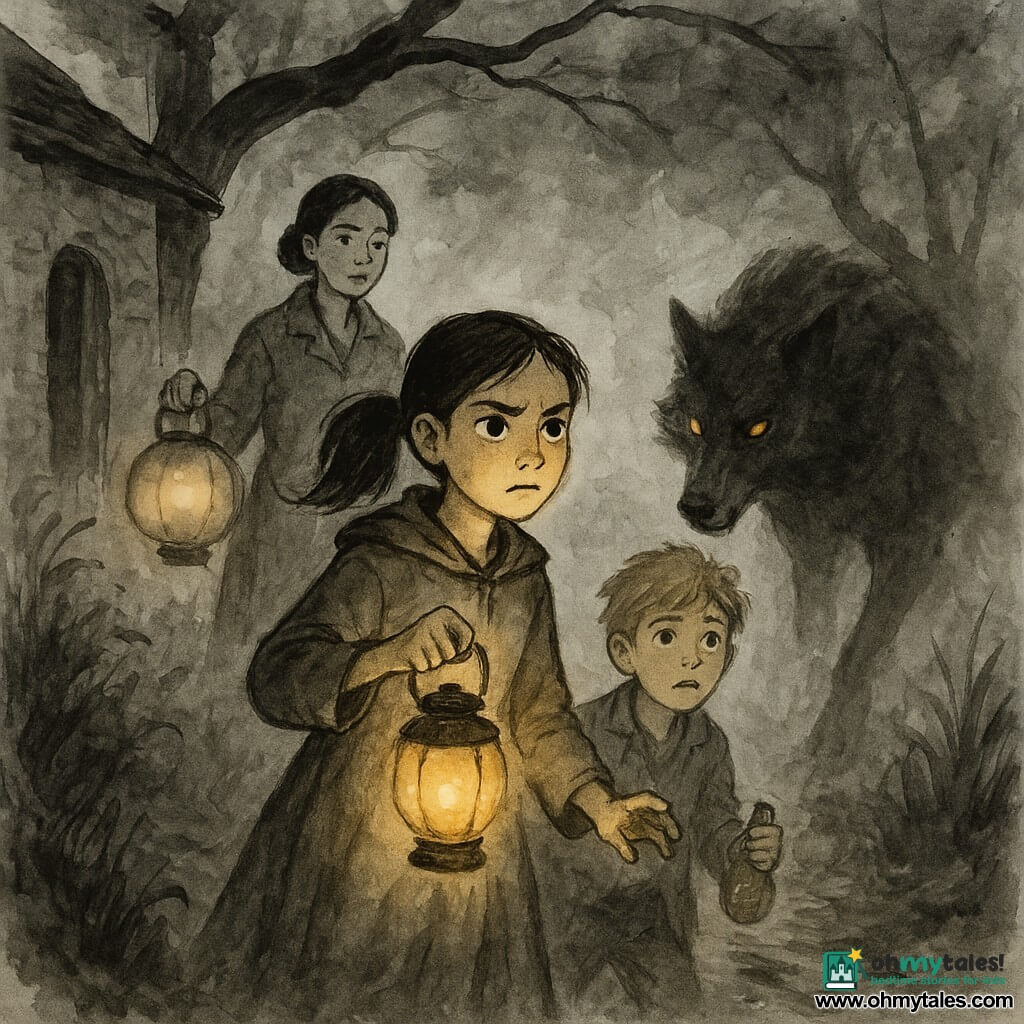
At the mill, a small group gathered: Mr. Durn and two other men, Mrs. Heddle with her big lantern, Mira and Rowan with smaller ones, and Mira's mother, carrying an extra lamp wrapped in cloth.
“Stay close,” Mother told Mira, her voice low. “Close is safe.”
Rowan tried a joke. “If the wolf shows up, we'll read him a bedtime story until he falls asleep.”
Mrs. Heddle snorted. “If you can make a wolf sleep, child, you'll be richer than the mayor.”
They found the hidden path, the one Mira had kept like a private treasure. In lantern light it looked less magical and more real: a thin track through nettles, a gap between two leaning trees, a place where the forest accepted you if you were careful.
“Here,” Mira said, and the word felt like setting down a burden.
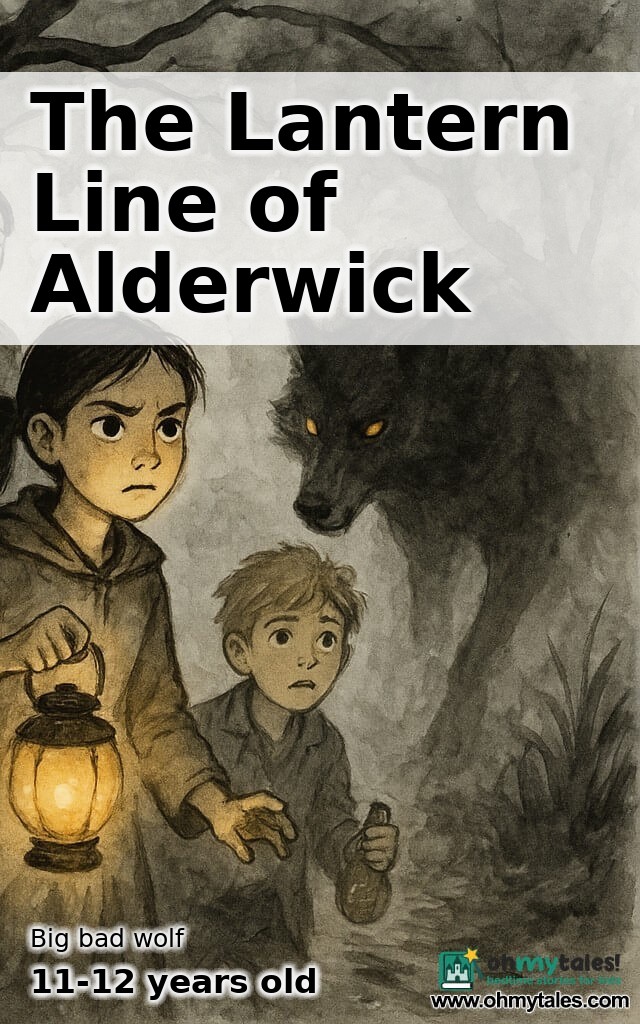
They did not rush in. They did not creep in with only one flame. Instead, they formed a line, lanterns spaced like glowing beads on a string. Light stepped forward with them, and the fog pulled back grudgingly, like a shy animal.
The forest was full of sounds: a twig snapping, an owl's breath, leaves whispering secrets to each other. The lanterns made small circles of certainty, but beyond them the world was still thick with question marks.
“Do you smell that?” Rowan whispered.
Mira smelled damp earth, mushrooms, old bark… and something else, sharp and animal, like wet fur.
Mr. Durn lifted his rope. “He's near.”
A laugh floated from somewhere ahead, soft as a sigh. “So many lights,” the voice purred. “So many little suns. How proud you are.”
The lantern flames trembled.
The wolf stepped into view—not fully, not like a simple beast in a storybook, but like a moving shadow with bones. His coat was blackened gray, as if he had rolled in ashes. His eyes caught every lantern and threw it back brighter, making him look crowned in stolen light.
He stopped where the lantern line began, just beyond the brightest circle.
“Well,” he said, “the secret-keeper has become a secret-teller.”
Mira's knees wanted to wobble, but she locked them. “I told because it was dangerous.”
The wolf tilted his head. “And now you feel safe?”
“No,” Mira said honestly. “But I feel… less alone.”
Mrs. Heddle thrust her lantern forward. “Back, you long-nosed nuisance!”
The wolf's lips pulled back. His teeth were pale, too many, like a row of sharp winter stones. “Old woman,” he murmured, “you shake your light like it's a sword. But light is not a sword. It only shows.”
“Then let it show,” Mira said, surprising even herself. “Let it show you.”
The wolf's gaze slid to her, and for a second Mira felt as if she stood before a deep well—one step wrong and you'd fall forever.
“Brave lamp-girl,” the wolf said. “Tell me—what else do you keep? What else do you hide under your tongue?”
Mira's mind flashed with secrets: Rowan's worry about their gran. The men's plan to set traps. Her own fear of being seen as childish. She realized something with a cold clarity: the wolf didn't only want information. He wanted the habit of giving in.
Mira raised her lantern higher. “I keep the secrets that protect people,” she said. “And I speak the ones that could hurt them.”
The wolf's ears twitched. “Pretty words.”
Mother stepped beside Mira. “Not pretty,” she said. “True.”
The men tightened their grip on the rope, but they did not rush. The lantern line held steady. No one stood alone.
The wolf's eyes narrowed, and his voice turned silky. “Then here is my warning, free of charge. Your lights cannot burn forever. Someone will forget. Someone will grow tired.”
Mira felt a chill, but she also felt the warmth of the people near her.
“Then we will remind each other,” Mira said.
For a moment, the wolf looked almost… annoyed. As if the answer was a locked door.
He took a step back into the fog. The lantern light reached for him, but he retreated, slipping away as if darkness were his blanket.
Yet as he vanished, his voice drifted back, light as ash:
“Remember, lamp-girl. The dark is patient.”
Chapter 6: The Night of Shared Oil
The group returned to the village without triumph. There were no cheers, no victory songs, only a quiet feeling—like standing after a storm and noticing your roof is still there.
At Mira's cottage, Mother set their spare lamp on the table.
“We should give this to someone,” Mira said. “Someone who might forget.”
Mother nodded. “Who?”
Mira thought of old Mr. Sallow, who lived at the far end of the lane and often fell asleep in his chair. She thought of the Griggs family with four little children and never enough anything. She thought of Gran, whose hands shook.
Rowan's voice floated through the open door. “We could make rounds,” Rowan suggested, stepping inside without waiting to be asked, as friends do. “Like… lamp-checkers.”
Mrs. Heddle, who had followed them, huffed. “You'll be busy. Half this village forgets their own names.”
Mr. Durn cleared his throat, looking a little embarrassed. “We can help. The men. We can carry oil. And lanterns.”
Mira blinked. The same men who had wanted traps in the dark were offering to carry light.
So, that night, Alderwick became a village of footsteps and soft knocking.
—“Evening, Mr. Sallow. Your lamp's low.”
—“We brought oil, Mrs. Pike. No trouble.”
—“Here, Gran. Let me fill it.”
People opened doors and blinked at the glow outside, then smiled, then called out to neighbors: “Do you need some too?”
Oil was shared. Wicks were trimmed. Lantern glass was wiped clean. The village did not fight the dark with bravery alone, but with routine—steady, repeated kindness that did not get tired of doing good.
Mira learned something else, too: speaking a dangerous secret did not mean shouting it to everyone. It meant telling the right people, at the right time, for the right reason.
When Rowan started to mention, loudly, that the wolf had been at Mira's window, Mira shook her head.
“Not that,” Mira whispered. “That's… just fear food.”
Rowan nodded slowly. “So we tell what helps. Not what scares.”
“Yes,” Mira said. “Useful secrets stay safe. Dangerous secrets get daylight.”
Later, when Mira lay in bed, the lamps still burned, but the house felt different. Not like a lonely ship now, but like one bright window among many. She could almost picture the village from above: dots of light stitched together like a quilt.
Outside, the fog pressed close, but it did not feel like a hand around her throat. It felt like a closed door.
Tap. Tap.
Mira's heart thumped, but she listened.
Tap. Tap.
This time the tapping came from the front door, not the window.
Mother rose, poker in hand, and Mira followed. They opened the door a crack.
On the step stood Mr. Sallow, blinking in the lantern light, holding an empty oil tin. Behind him, Mrs. Pike and two others hovered, sleepy and worried.
“Our lamps—” Mr. Sallow began. “We ran out. We thought—if you had—”
Mira exhaled. Not the wolf. Just neighbors.
“Come in,” Mother said, setting the poker aside. “We have enough to share.”
Mira helped pour oil. The flames steadied. The neighbors' shoulders dropped, as if someone had taken a stone from them.
When the door closed again, Mira leaned her head against it for a moment.
“See?” Mother whispered. “You are not alone in the dark.”
Mira smiled, small and tired and true. “Neither is the light.”
Chapter 7: What the Wolf Could Not Take
Weeks passed. The fog came and went. The forest stayed, as forests do, keeping its secrets under bark and root. But the village had changed in a way you could feel, like a song learned by heart.
People began leaving small lanterns on porches for anyone who walked late. Children reminded parents: “Oil?” Neighbors called over fences: “Your lamp's flickering!”
And Mira kept learning the shape of secrets.
One afternoon, Rowan arrived breathless. “I heard someone say the wolf moved on,” they said. “That he's hunting in another forest.”
Mira didn't relax. “Wolves don't move on,” she said quietly. “Not completely.”
That evening, as the lamps were lit, Mother watched Mira carefully. “Do you feel afraid?” she asked.
Mira considered. Fear still lived in her, but it had changed. It wasn't a monster under the bed now. It was more like a guard dog—alert, useful, but not in charge.
“I feel… awake,” Mira said. “And I feel responsible.”
Mother nodded. “That is courage's older sister.”
Later, when Mira was almost asleep, she thought she heard a sound far away, from the forest's edge: a long, thin howl, like a thread pulled tight.
The lamps did not go out. The village did not go out.
In her mind, Mira saw the wolf as he truly was: not just teeth, not just shadow, but a test. A question that returned again and again, in different shapes.
Will you keep silent when speaking could save someone?
Will you speak when silence is kinder?
Will you stand alone, or stand together?
Mira turned on her pillow and listened to the soft, friendly noises of the house—Mother's steps, the lamp's tiny hiss, the wind's distant fussing.
The wolf could hide in darkness. He could bargain with fear. He could sniff for lonely places.
But he could not take what the village had learned to do: to share light, to share strength, to share the right words.
And as sleep finally drew its blanket over Mira's eyes, she held the moral close, simple and warm as a lamp in winter:
Keep the secrets that shelter others.
Speak the secrets that could cause harm.
And when the forest feels too big, make a line of lanterns—because courage shines brightest when it is shared.