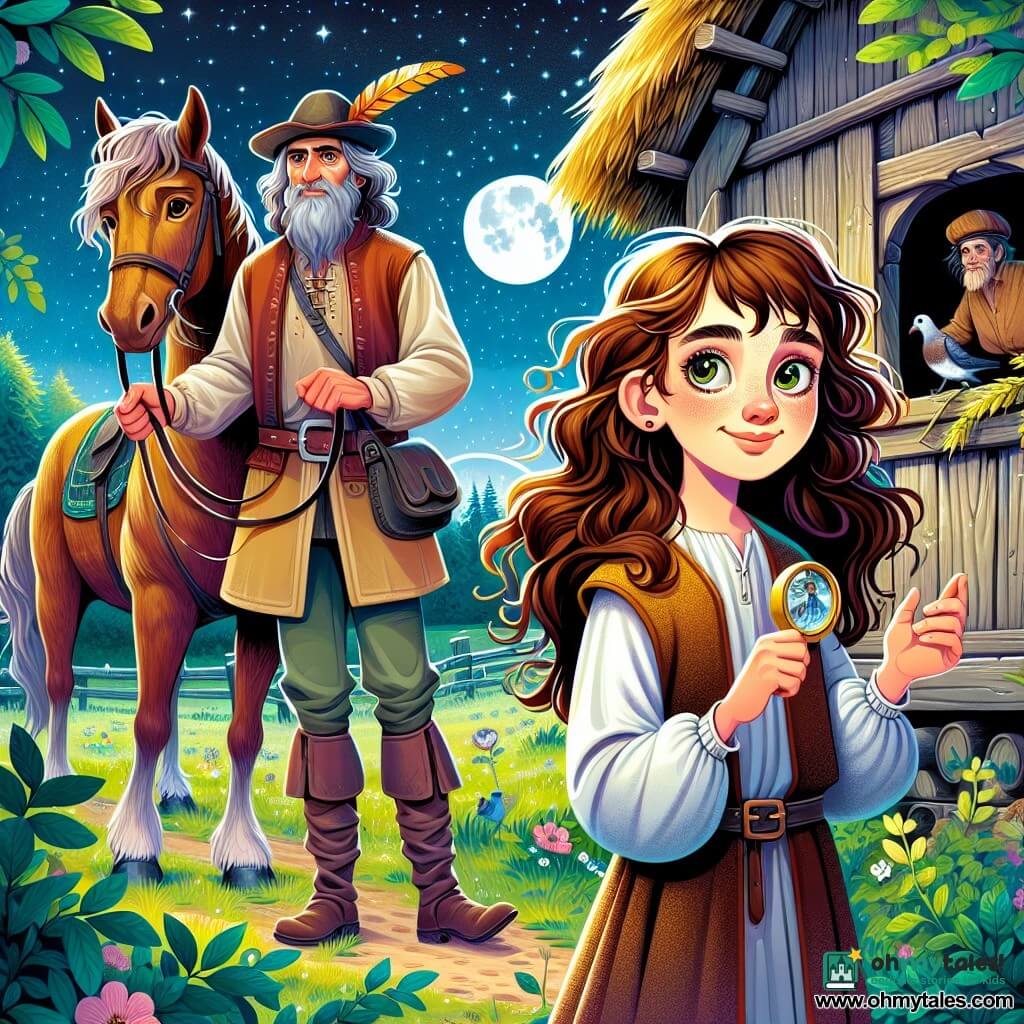
Chapter I — The Quiet of the Old Ways
There was a village folded under the hills like an old page pressed into a book. Roofs clustered together as if for warmth; lanes braided themselves in small, careful patterns; and in the centre a handful of elders sat on worn benches, their hands as map-lines of long roads. They kept the stories as one keeps a lamp: not to hoard light, but to lend it, steady and sure.
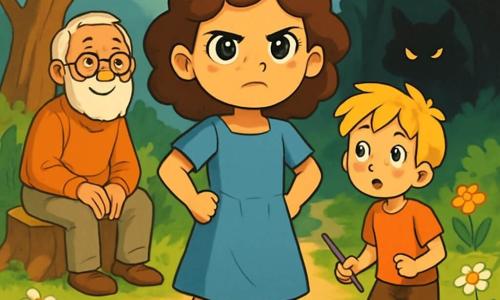
Among them lived a girl of twelve, thin as a reed and steady as a root. She spoke little, and when she spoke it was with the humility of someone who knows the weight of words. The elders called her Elin. She would sit by the baker's steps and listen, her knees dusted with flour and her eyes bright with questions. Whenever a tale came to rest on the bench, she would fold it into her pocket like a seed to be planted and watered in time.
On an evening when the sky was the color of iron and the wind rubbed its palms against the shutters, the oldest of the elders began a tale that made the children lean closer. He lowered his voice until it sounded like a creek under ice.
—There is a wolf that whistles like a blackbird, he said, his voice a whetstone. It sits at your window in the black of night and sings a tune that sounds like spring. It will call what you miss and imitate what you trust. Do not answer its music.
Elin held her breath as if to keep the words from slipping away. The old man's face had the quiet of a field in winter. He wrapped the warning in a small, plain thing: humility before the knowledge of those who had seen roads, he said, is not weakness but a lamp that shows the next step.
That night Elin could not sleep. The white moon lay on her pillow like a coin. She thought of a dovecote by the old mill, empty now, its roof with a hole like a small open mouth. The dovecote had been quiet since the pigeons flew away; people said the hole let in mischief. Elin imagined the hole yawning, and the image stitched itself to the old man's warning. If the world wore a crack, the wind might whisper threats into it. She decided then that fear ought not to be a fire that burns the whole house. Fear could be a coal, kept and used; fear could be turned into prudence.
She rose with the dawn, her feet finding the paths she had walked a hundred times, and she went to the bench where the elders gathered. There she bowed her head and asked if she might go to the dovecote to see to the roof, to mend small things before they grew into storms. The elders watched her like gulls at the shore and one by one, with the slow kindness of gavels, they gave her their lean encouragement.
—Take these words with you, the eldest said. Remember: listen to the roads, they will tell you where the wolves do not go.
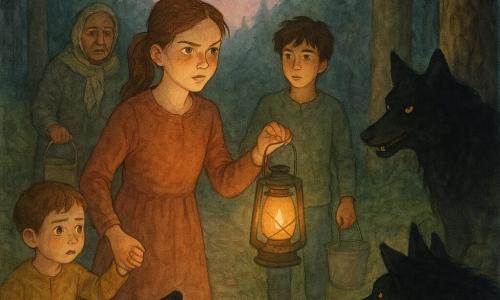
So she set out with a satchel, a length of rope, a lantern and a piece of bread wrapped in linen. Her courage was quiet; her courage was a hand pressed to a chest that keeps rhythm.
Chapter II — The Postillon on the Crossroads
On the lane that led from the village to the mill the world widened. Fields lay like scattered coins; far hedges stood like slow teeth. Halfway along the road a postillon rode, a thin figure on a gelding that knew the ways of country lanes. He wore a hat with a feather that looked like an answer to the wind. He drove a small cart that smelled of leather and old paper. He had the look of someone who had learned to read the maps of weather as well as of land.
He was called Tomas, and his voice had the rattle of road stones. He knew the roads as a baker knows rivers of flour; he could tell at a glance whether the west lane would be muddy, which hedgerow favored the sun, and where a false cry had been heard.
Elin recognised him from the market and bowed.
—You are going to the dovecote, he said. The feather on his hat tipped like a question. Be warned. A whistle has been heard near the mill, sweet as a blackbird, calling lonely things out of hidden places.
Elin's fingers closed on the rope in her satchel. The old man had told of the same whistle. She felt the web of caution tighten.
—Do the roads say where it sings most? she asked.
—Often near roofs that gape, he said. Where a home is unfinished, trouble finds a way to sit. But roads are honest if you listen. They whisper which way to go, and which to avoid. Will you have company? I visit the mill each day, and sometimes I can stand a while where the sound is thin.
They walked together along the lane, the postillon's boots keeping time like a metronome. He spoke sometimes of long journeys and small kindnesses. He told her of horses that stopped at the scent of rain and of a woman in a far valley who baked bread in the shape of moons for children who had no light. Elin listened and learned to see the world as a book where each village is a page and every page has margins where small things hide.
—You seek to mend a roof, Tomas said. The best mending is done with both hands and with those who watch the horizon. If fear is a shadow, make your light move so the shadow shrinks.
When they reached the mill the dovecote stood like a small, hollow house against the sky. It was a white thing with age in its plaster. Its roof had a hole that made the building look like a hat with a missing crown. No pigeons nested there now. The entrance hole of the dovecote was dark as a pupil, and wind came out of it like a thought that had gone wrong.
Elin felt a pull in her stomach like the first tug of a kite's string, and she breathed in the smell of old wood and moss. The postillon smiled at her as if he had known she would be brave.
—We will listen first, he said. The roads taught me that sounds have bones. If the whistle is near, the bones of the sound will tremble.
They set themselves in a place where the sun crossed the roof's shadow, and they waited, the two of them like two pebbles in a stream, still enough to hear the smallest ripple.
Chapter III — The Whistle Like a Blackbird
It was not long before the sound came: a note that slid like oil, bright and common, a melody a child would hum to sleep. It rose from the hedgerow, bright as a coin, then again, and again as if someone were practising a tune at a window.
—Listen, the postillon whispered. He leaned forward like a man catching a thrown feather. The sound was a blackbird's song, sweet in its shape, but too steady, too cunning, like a hand that paints a smile over a closed mouth.
Elin felt the old fear stir, an animal inside her ribs. The whistle tried to call the hollow places in her heart; it sounded like her smallest longings and like the promise of easy light. For a second she felt the temptation to rise and answer, to run toward the melody as if toward a hearth. But the old man's words were a lantern in her mind: do not answer the music that imitates what you trust.
—We must test it, she said, and her voice was softer than a bell. She had learned from the elders that to act from fear was to give fear a throne; to act from prudence was to turn fear into a tool.
The postillon nodded. He took from his pack a small hunting mirror and held it to the sun. It caught a strip of light and threw it like a little bird across the hedgerow. The whistle stilled. For a heartbeat the world waited.
Then the sound returned, but this time it came from a different direction, behind the mill, a dry whistling like a branch scraping a windowpane.
—It moves, said Tomas, and his voice held no alarm. It means the creature knows to follow the voice of its own echo. Clever, very clever.
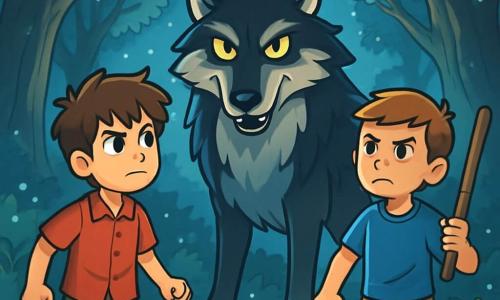
Elin drew nearer to the dovecote and peered inside. The hole in the roof let the sky fall into the building like a bright coin. Dust motes turned in the beam of the lantern and looked like a small galaxy at rest. The inside of the dovecote smelled of old straw and rain-dried feather. She saw, beneath the shadow of the entrance, a set of prints curved like commas. They were not pigeon claws. The pads were wide, the nails long. The truth fit itself into place: the old tale was no simple tale to frighten children. It was a map. The wolf had been at the gate.
—It whistles like a blackbird, she said, more to herself than to Tomas. The sound a wolf makes when it pretends to be otherwise.
—Wolves learn tricks when they must, Tomas said. They are not only teeth and hunger; they are also mirrors that show us our own weaknesses.
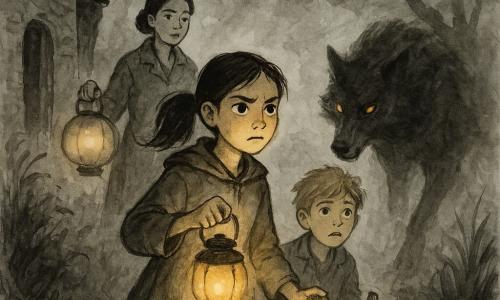
They stayed until the sun had dropped like a coin into a well and the sky turned the colour of old bruises. The whistle came again and again, sometimes from the hedgerow, sometimes from the river. Each time it sounded their hearts tightened like the hems of coats. But Elin did not answer. She did not run away. She wrapped her fear around her like a cloak and stitched over it with small, careful stitches of thought.
—We will not meet its tune, she said finally. Instead we will make it find a different song.
Chapter IV — Ruse and the Soft Courage
Night drew its hair around the mill and the village lights were few and slow. Elin and the postillon had a plan that was small and steady. Elin would not fight the wolf with open arms or with sharp tools. That would be to meet fear with blind force. Instead they would use the world's softer weapons: sound, light and the slow thinking of the road.
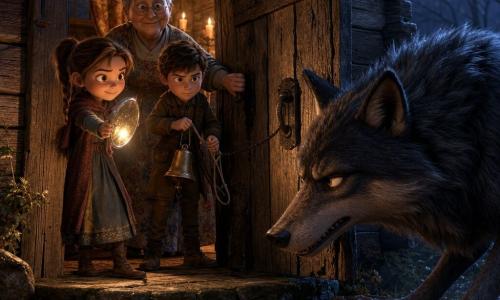
They set a little bell at the mouth of the dovecote, tied to a thread that led to a hollow post. The bell had once been on a goat's collar; it remembered summers. They placed a bowl of bread soaked in milk just beyond the bell, in a place where only a creature cautious enough would go. It was not bait to harm but a test to know what kind of heart lived there.
—If the wolf is truly clever, it will try to take the bread without jingling the bell, Tomas said. —Cleverness for its own sake is trouble. We will force cleverness to choose: a soft noise tells us truth.
They made a second trick. Elin took her mirror and leaned it against the inside of the dovecote so it would catch the moon and sprinkle light around the hole in the roof. If an animal crept inside, the light would flash and it would have to reckon with what it had revealed. Courage that shines a little light is prudence made visible.
The wind moved through the roof-hole like a slow tongue and the night waited.
After a time there was a shifting in the straw. A shadow richer than the darkest coat of a hedgehog slid within. The bell rang once, soft and surprised. Then the whistling began again, high and timid, copied exactly like the song of a small blackbird. The sound tried to charm the bread from its place and tried to charm the bell not to speak. It had the tone of something lonely; it was not the roaring hunger of a winter wolf but the thinness of a creature that had learned to mimic what it missed.
Elin watched the bell and the mirror and felt her breath fall in the rhythm she had practised in the empty hours. When the wolf approached it tapped the bell each time, once, twice. It was a clumsy thing, not a trickster of great skill. The wolf had been learning the world in pieces.
Then it happened: a small, younger wolf—a pup by its gait—stepped into the beam. It was not the size of a great danger but it held the look of an animal that had been living half by cunning and half by fear. Its ears were too large, its ribs a map of the road. It looked at the bowl with the puzzled hunger of a child who cannot read instructions.
Elin felt the sharpness of pity; it pricked her like a thorn and then it eased. She had known softness and it taught her to be brave in new ways.
—It is not evil, she said, whispering as if to the animal. —It is hungry and frightened. It learned the whistle from the hedges and then forgot to be itself.
Tomas did not move. He had seen roads bend people and animals alike; he knew how hunger could teach voice. He simply watched, and in watching he offered a kind of counsel.
The wolf cocked its head and whistled, precisely copying the blackbird's trill. It wanted to lure the bell to stay silent, to pick up the bread and leave like a polite thief. But when the bell rang it startled and flinched, and for a moment the animal was a shadow which then became apparel: ear, eye, mouth.
Elin stepped forward, small as a pebble but no less steady. She made no loud sound. Instead she settled on the ground a little away and unrolled a bit of cloth with a handful of dried meat she had kept. She offered it on her palm: not a trap but a plain hand.
—Come, she said, and her voice was softer than milk. —We are not your enemies. You have been taught to trick the brave by the lonely.
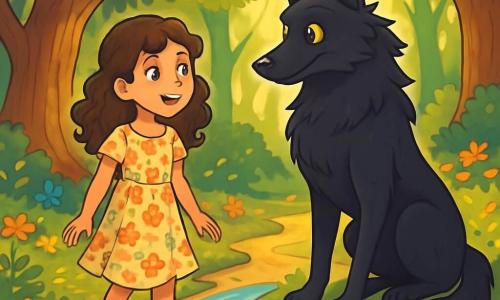
The wolf approached with the shy curiosity of someone who knows the names of things but not their faces. It took the meat from her hand and did not snatch it; its jaws closed like a patient clasp. The postillon let out a small breath as if the road had loosened one of its knots.
But danger is not only in hunger. The wolf's mother had been driven from the valley long before; the hole in the roof had become a place for small storms to pass. This wolf had learned that imitation could be a way to survive. Elin understood then that fear, taught to speak falsely, could be untaught with small, kind words and with the firm edge of prudence. She could teach the animal to seek steadiness rather than steal shallow songs.
Elin and Tomas made a plan to guide the wolf away from the village. They would not send it to a place where it would starve and claw at stones. They would guide it along the roads Tomas knew until the hills opened to a place where the wolves lived with enough to eat and where old packs kept the young from learning tricks of mimicry.
They walked the animal with gentle ropes, letting it follow the scent of the road. The wolf's whistle tried once more to charm; once more it sounded like a small blackbird. But Elin would not answer the tune. She instead called, in her own voice, a new sound: the slow and true speech that had been taught to her by the elders. She told the wolf about the world beyond imitation, about the honest hunger and the honest hunt; she told it that to learn the songs of others was a short way to hunger and to harm. She told it to find its own voice.
The wolf listened as if to a long story. At times its ears twitched like a reed; at times it tried the whistle and found it thin and cold compared to the warmth of the meat and the steadiness of the road. When the moon came up they reached a ridge where Tomas said a pack might meet them. The wolf's eyes held the light of something that might, in time, answer to true hunger and true song rather than mimicry.
—Go with them, Tomas said quietly. Roads know where wolves learn to be wolves without stealing the songs of birds.
The animal slipped into the dark with the gait of someone who had begun to remember its feet. The whistle it gave then was not the imitation of a blackbird but the low note of a wolf finding its place, and the sound was not meant to trick the heart but to belong to itself.
Chapter V — Mending Roofs and Building Year
When they returned to the village dawn was a thin promise on the fields. Elin's hands were quiet with work; dust had settled into the folds of her sleeves. The old men on the benches were awake and when they saw her coming with Tomas beside her they stood as if a small truth had just passed through the lane.
—You met the road and you listened, said the eldest, and his voice was like a bell that has been struck once and then remembered. —You took fear and made it a labour. That is how a village stands.
The dovecote that had once been empty began to be mended, but not by one set of hands. The villagers came with ladders and nail-boxes, with new thatch and boards. The hole in the roof was patched with planks and with a piece of copper to make it bright against the sky. They did it together and in the doing they told the story again of the whistle and of the small, brave girl who had not answered it. The dovecote filled again, not immediately with pigeons but with the sound of hammers and the smell of fresh tar. In time the pigeons came back, cautious as new readers in a strange library, but they came.
Elin taught the children to listen to roads not as a map of danger but as a way to learn prudence. She sat by the bench and told them how the wolf had whistled like a blackbird and how she and the postillon had taught it a different song. The elder who had told her the tale that winter nodded, pleased. He had said that humility before the elder's knowledge was like a lantern; Elin had used that lantern and now lent it.
—Perseverance, the elder told the children as they raised their hands like small trees, —is the quiet foot that keeps coming until the house stands, until the bell rings true, until the wolf finds its path.
The village rebuilt more than a roof that year. They repaired a small bridge that had been weak with water and planted a line of hawthorns to keep the road edges from giving too easily to storms. They made a storehouse for seed and a place where the postillon could leave messages and food for travellers. The repairs were not a single grand sweep; they were stitches and slow stitches, the kind that last.
Elin's humility before the elders remained, but now it had the shape of a lamp she knew how to carry. She had learned that fear is not to be banished like snow from a porch, for it returns, but it can be shaped into something useful: a cautious foot, a prepared hand, a soft courage that tends to the world as if it were a garden.
One evening, as the year turned and the leaves wrote themselves into their autumn pages, the postillon came to the village with a new feather on his hat, bright as a promise. He found Elin by the dovecote, where a pigeon sat on the repaired roof and cooed like steady rain.
—You have mended more than wood, he said. —You made courage into a bridge.
Elin looked at the bird and then at the lane that led away. She felt the smallness of her own beginnings and the stretch of all the days to come.
—Fear taught me the shape of caution, she said, and there was no pride in the words, only the steady tone of someone who knows the work of a season. —And the roads taught me that if we walk them, we can teach others to walk too.
The years that followed brought many winters and many small summers. The wolf that had learned the blackbird's whistle answered less and less to mimicry and more to the low calls of its pack. The postillon carried news from valley to valley, and sometimes he left a loaf at the village door and a note that said only, Keep the lamp.
As for Elin, she grew in the village like a tree planted at an edge where sun and shelter met. She married neither fear nor bravery alone; she kept both in balance like two hands carrying a basket. She became someone to whom both children and elders would turn when the night arrived with strange sounds. She taught that the first thing to do when danger sings a sweet song is to sit very still, listen to the roads and the elders, and then take a small step forward with crafted care.
When the children asked her what it meant to persevere, she would smile and point to the dovecote with its patched copper and to the bell that still hung on the post.
—Perseverance is the steady hand that mends the roof while others speak of storms, she would say. —It is the patience that waits for the truth to be shown and the courage to change your fear into wisdom. It is little by little, like filling a jar with small stones until there is no room for emptiness.
And so the village kept its lamp, the dove returned, and the lane kept its tracks. The whistle of the blackbird could still be heard on some mornings, and sometimes children would try to copy it, but when they did Elin would only laugh, gentle as rain.
—Sing your own song, she would say. The hills are wide enough for many.
They rebuilt more than a place; they rebuilt a way of living that knew to turn fear into prudence, cunning into kindness, and the lonely voice into the true one. It is said, and with truth, that in the heart of the valley the dovecote still stands and the bell still rings when someone wisely tests the night. The story is kept on the elders' bench, folded like a map under the lamp, waiting for the next small ear to listen and to learn how to make fear a lantern instead of a fire.