Beginning
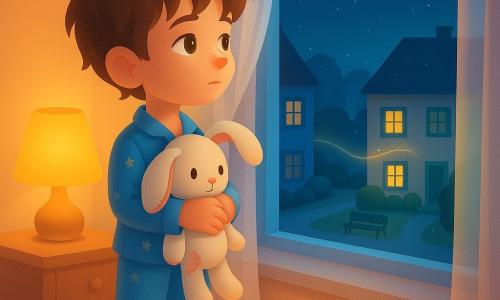
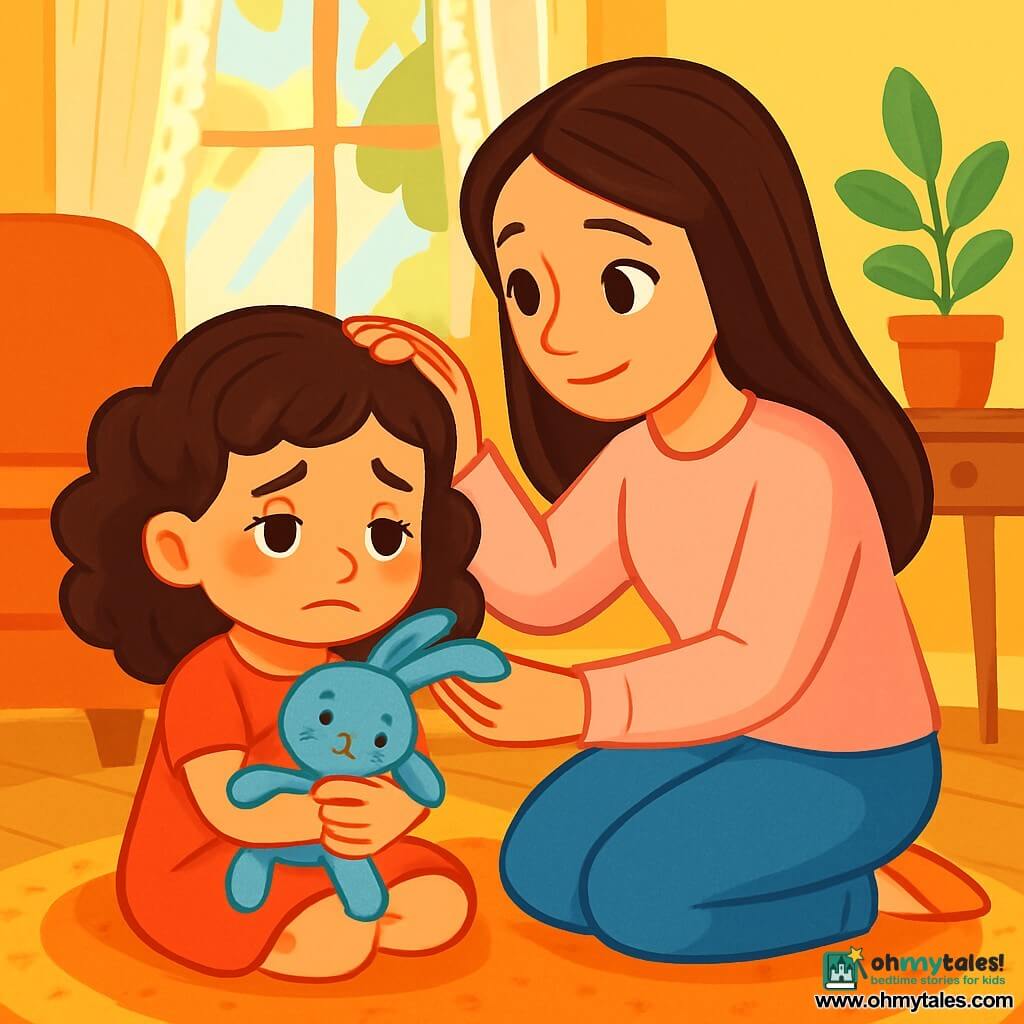
Mia hugged her blue bunny tight. The moon made a silver path on her bedroom floor. She was six and small and wondered a lot of big things. Tonight, her room felt as if it held two hearts—one that wanted to laugh and one that wanted to cry.
“Mia,” her mother said softly at the door. “Can we talk for a minute?”
Mia nodded. Her bunny's ears were worn and soft. She climbed onto the bed and listened.
“We are going to live in two houses now,” her mother said. “But we both love you very much.”
Mia blinked. The words landed like tiny stones. “Does that mean I will lose anyone?” she asked.
Her mother sat on the edge of the bed and stroked Mia's hair. “No. You will have two homes with two people who love you. You can love both of us,” she said. “It's okay to feel many things. Sad, angry, confused, or happy. All feelings are allowed.”
Mia whispered, “Will you still tuck me in?”
“Always,” her mother promised. “I will always tuck you in. We will make a plan so you know where to sleep and when to see each of us.”
Her mother said some words that felt like a warm blanket: “I love you. You are safe. I will listen.”
Mia chewed the edge of a quilt and felt the words settle in her chest. She wanted to hold on to them.
Middle
The next morning, Mia's kitchen table had a new plan on bright paper. Her father had drawn stars for days he would pick her up. Her mother had drawn suns for days Mia would stay with her. There was a little moon for sleepovers. Mia liked the stars and suns. She could count them like birds.
“That way,” her father said, kneeling so he was eye level with Mia, “you will know where you will sleep each night.”
“And when you miss us,” her mother added, “you can call. You can knock on a grown-up's door and say your safe word.”
“Safe word?” Mia looked up.
Her parents smiled together. “A safe word is a special word that means you need comfort,” her father said. “It could be ‘purple star' or ‘cuddle-bunny'. If you say it, we know to come quickly.”
Mia thought. She tapped her lip. “Cuddle-bunny,” she decided.
They made a comfort box together. Inside went Mia's blue bunny, a little picture of the three of them, and a small notebook to draw feelings. They also put in a folded paper with words that help: “I love you,” “I am here,” “You are safe,” “Tell me how you feel.”
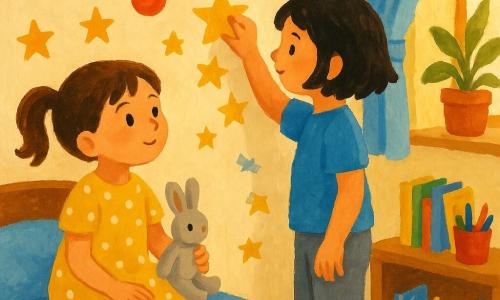
At school, Mia showed her friend Noor the drawing of the suns and stars. Noor hugged her. “It's like having two forts,” Noor said, and that made Mia giggle.
One afternoon, Mia forgot her bunny at her father's house. She realized it when she reached into her bag and felt only a small empty space.
“Oh no,” she whispered. Her chest felt tight. She went to her mother's kitchen and held the comfort box. “My bunny is gone,” she said, tears springing.
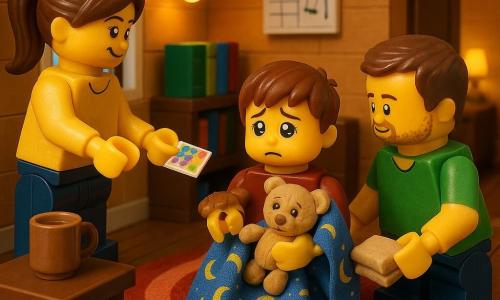
Her mother sat with her and repeated the words from the paper. “I love you. You are safe. We will get your bunny back.” Her voice was steady like a bridge. “Let's call Daddy. We can plan.”
Mia called and her father answered right away. “I think I see blue ears by the pillow,” he said. “I will bring Bunny tomorrow.”
Mia felt relief like a balloon filling. The fear was still there, but smaller.
That night, Mia and her mother drew a feelings map. They put happy stickers for things that made Mia smile: swinging at the park, pancakes on Sundays, storytime. They put cloud stickers for things that made Mia sad: the moving of chairs, saying goodbye, forgetting Bunny. Next to the clouds, they wrote ways to feel better: deep breaths, calling a grown-up, hugging the comfort blanket, saying the safe word.
“Sometimes things change,” her mother said, reading the map with her. “But your feelings are always heard. We will listen.”
Mia practiced saying the words out loud. “I love you. I am here. You are safe. Tell me how you feel.” Her voice was small and brave.
End
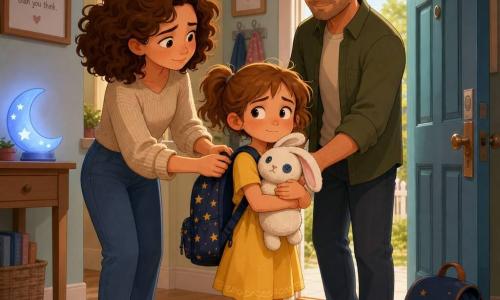
A week later, Mia's father arrived with Bunny in his hand. Bunny smelled like dad's sweater and summer. Mia jumped up and down. “Bunny!” she cried.
They all sat on the living room rug like a small sun. Her parents had tea and stuffed cookies and smiled. Mia hummed a happy tune. She felt two kinds of warmth—like two lamps in the same room.
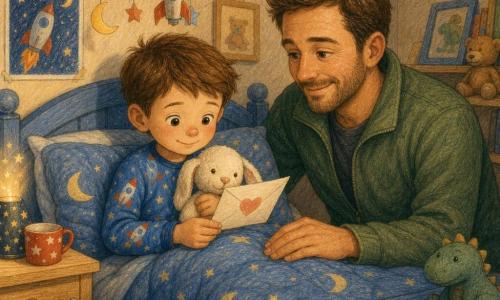
That night, when it was time to sleep, Mia held her bunny and looked at the folded paper with the comforting words. She pretended the words were tiny lanterns lighting a path.
Her mother tucked the blanket, and her father kissed her forehead through the doorway. “Good night, my brave girl,” her father said.
“Good night,” she said back. Then she held up her hand and whispered, “Cuddle-bunny,” just for fun. Her parents laughed softly. Mia felt safe.
Over the next weeks, Mia learned that some days were suns and some days were clouds. Sometimes she was messy with feelings and cried on the kitchen floor; sometimes she danced in socks when the radio played. Each time she felt lost, she used the map, the comfort box, or the safe word. She told her teacher when she felt too big inside. Her teacher listened and gave her a small star sticker.
One evening, Mia looked at the moons and stars on her family calendar and drew a new picture in her notebook—two houses with one big tree between them. She drew herself in the middle, holding hands with her mother and father. She wrote three words next to it, in proud, crooked letters: I AM LOVED.
Mia blew out her little imaginary candle and smiled. She had learned that words could be like warm soup for the heart. She had places to sleep, people to call, and ways to feel safe. Most of all, she knew she could feel anything and be loved anyway.
She hugged Bunny close and whispered the comforting words she had learned: “I love you. I am here. You are safe.” Outside, the moon watched gently. Inside, Mia slept with two lamps on, and her dreams were soft and light.