Chapter 1: The Smudge That Started It
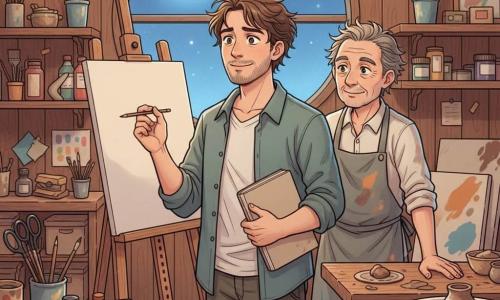
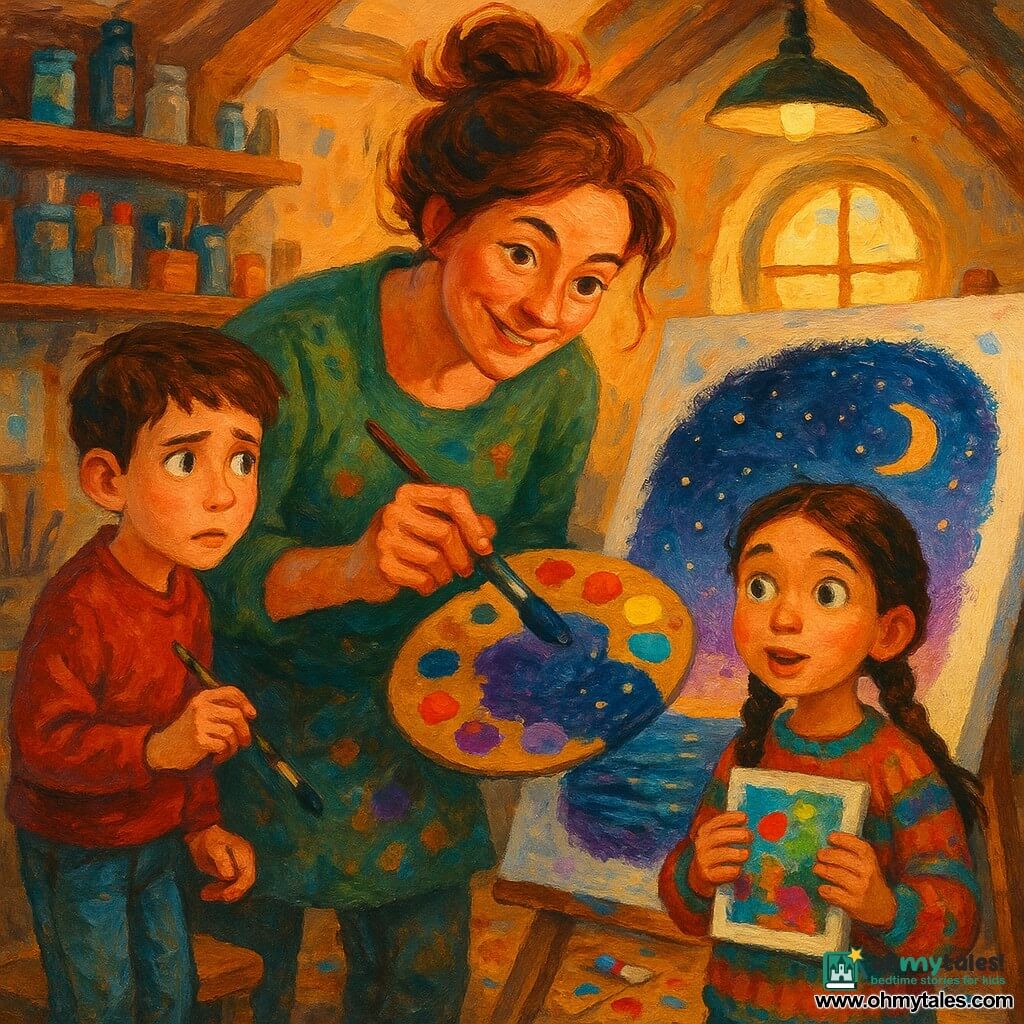
Mara's studio was a small attic room with a slanted ceiling and a round window like a ship's porthole. Moonlight often parked there at night, but right now the late sun was pouring in, warm and sleepy.
On the floor lay a canvas with a very large, very confident mistake.
It was a purple… sort of. More like a sad bruise.
Mara sighed, then laughed at herself. “Well,” she told the paint tubes, “that's what happens when you rush like you're late for your own idea.”
A soft knock came from the hallway. Then another, braver knock.
“Ms. Mara?” a voice asked. “Are you busy?”
Mara opened the door to find her neighbor's twins, Leo and Mina, standing there with wide eyes and backpacks that looked heavier than their bodies.
“We heard you paint,” Mina said, as if painting made noise like fireworks.
“It does,” Mara said. “Mostly in my brain.”
Leo leaned forward. “Our teacher said there's a community art night. People can show work. But we're… not sure we can do it.”
Mara stepped aside. “Come in. Carefully. The floor has opinions.”
They walked in, dodging jars of brushes and a stool with paint footprints on it. Mina's gaze landed on the bruised-purple canvas.
“Oh,” Mina said gently. “Is it… supposed to look like that?”
Mara put a hand to her chest in pretend drama. “That, my friend, is my beginning. Or at least one of them.”
Leo blinked. “Your beginning is a mistake?”
Mara grabbed a cloth and dabbed at the purple. “My beginnings were a whole parade of mistakes. I once painted a sunset that looked like tomato soup. And I tried to draw a cat that came out like a very worried potato.”
Mina giggled. “So you're not always amazing?”
Mara raised an eyebrow. “Who told you I'm amazing? I'm just stubborn. I keep going. That's most of the job.”
She pointed to a small shelf filled with sketchbooks. Some were neat. Others were lumpy, like they'd survived storms.
“Being an artist,” Mara said, “is noticing things. Trying. Listening. And learning to accept comments without letting them crush you like a dropped watermelon.”
Leo frowned. “Comments are the worst.”
“They can be,” Mara agreed. “Or they can be lanterns. Let me show you how I learned to use them.”
Outside, the first evening breeze tapped at the window. Inside, the studio smelled like paper and paint and the quiet thrill of beginning again.
Chapter 2: The Critique That Didn't Bite
Mara pulled two folding chairs from behind a stack of canvases. They squeaked like tiny mice.
“Sit,” she said. “And tell me: what do you think this painting was meant to be?”
Leo stared at the canvas. Mina tilted her head.
“A… storm?” Leo guessed.
“A grape that feels sad,” Mina offered.
Mara nodded as if they'd both named something important. “Good eyes. It was supposed to be a night sky over the sea.”
Mina's face fell. “Oh. Then we were wrong.”
“No,” Mara said quickly. “You were honest. That's useful. There's a big difference between a mean comment and a helpful one.”
Leo crossed his arms. “What's the difference?”
Mara took a marker and drew two simple boxes on a scrap of paper.
“In the first box,” she said, “a mean comment says: ‘This is bad.' It stops there. No help. No kindness.”
“In the second box,” she continued, “a helpful comment says: ‘I'm confused about what I'm seeing. Maybe the colors need more contrast, or the shapes need to be clearer.' That gives you a direction.”
Mina nodded slowly. “So if someone says, ‘I don't get it,' that can be okay.”
“Exactly,” Mara said. “It means they're telling you where your message got lost.”
She sat on a stool and tapped the purple paint with her brush handle. “When I was twelve, I joined an art club. I drew a horse that looked like a sofa with legs. The instructor said, ‘Mara, I can see your energy, but your horse's neck is doing gymnastics.'”
Leo snorted. “Ouch.”
“It stung,” Mara admitted. “I wanted to hide under a table. But then she added, ‘Try looking at a real horse photo. Break the neck into simple shapes.' She wasn't laughing at me. She was handing me a tool.”
Mina looked at the canvas again. “So… what tool do you need here?”
Mara's eyes brightened. “Color mixing. My favorite tool. Because color is like mood. If you mix it carefully, it can tell the truth.”
Leo leaned forward. “Can you teach us?”
Mara stood up, rolled her sleeves, and set out three paint blobs on a palette: red, blue, and yellow. They shone like tiny, bright candies—only less delicious and much less safe to eat.
“Welcome,” she said, “to the place where purple stops being a bruise and starts becoming a sky.”
Chapter 3: The Secret Life of Colors
Mara placed a cup of water beside the palette. The brushes stood in a jar like a bouquet with messy hair.
“First rule,” she said, holding up a finger. “A little paint goes a long way. Second rule: clean your brush when you switch colors, unless you enjoy surprise mud.”
Mina raised her hand as if they were in class. “Is mud always bad?”
Mara smiled. “Great question. Not always. Mud can be perfect for shadows, tree bark, storm clouds. But if you want bright colors, you have to protect them.”
Leo pointed at the three blobs. “So these are the main ones?”
“These are primary colors,” Mara said. “They're like the original ingredients. You can't mix other paints to make them. But you can mix them to make lots of other colors.”
She dipped the brush into yellow. “Sunshine.”
Then into blue. “Deep water.”
She wiped the brush, then gently pushed yellow and blue together on the palette. A ribbon of green appeared, fresh as spring leaves.
Mina leaned closer. “It's like magic.”
“It feels like it,” Mara agreed, “but it's more like cooking. If you add too much of one thing, it changes the flavor.”
Mara made two small green puddles. “Watch. This green is mostly yellow with a little blue. It's bright, like new grass. This one is mostly blue with a little yellow. It's darker, like pine needles.”
Leo's eyes widened. “So you can choose the mood.”
“Yes,” Mara said softly. “Color is a language. Artists use it to whisper or shout.”
She cleaned her brush again and pulled a bit of red into yellow. Orange bloomed—warm and lively.
Mina grinned. “That's like a sunset.”
“And a campfire,” Mara said. “Now red plus blue makes purple.”
Leo glanced at the canvas. “The bruised kind?”
Mara laughed. “If you use too much blue, or if your colors are too dark, yes. If you want a royal purple, start with red and add blue slowly.”
She let Leo try. He dabbed red, then added a tiny speck of blue, stirring carefully. The purple that formed looked richer, like velvet.
“I did it,” he said, surprised.
Mina tried next and made a purple that leaned pink, like a lilac flower.
Mara nodded approvingly. “Different purples, different feelings. Neither is wrong. It depends what story you're telling.”
Mina hesitated. “What if people don't like your story?”
Mara rinsed her brush and spoke in a calm, bedtime voice. “Then you listen. You ask, ‘What didn't work for you?' Sometimes you'll learn something. Sometimes you'll realize they just prefer a different kind of story. Both are okay.”
Leo looked thoughtful. “So criticism isn't a monster.”
“It can roar,” Mara said. “But it doesn't have to bite. You can decide what to keep and what to let go.”
She turned to the canvas. “Now, let's rescue my night sea from the bruise kingdom.”
Chapter 4: Turning a Mistake into a Map
Mara taped fresh paper beside the canvas. “We'll plan first. Artists do that more than people think. It's not just wild splashing.”
She mixed a dark blue with a hint of purple. “For the sky, I want depth. Night isn't flat. It has layers.”
Mina watched Mara's hand move, steady and gentle. “How do you make it look like it's far away?”
“Good observation,” Mara said. “Distance is about softness. I use more water and lighter pressure for things far away. Closer things get sharper edges.”
She painted a wash across the top of the paper, then used a clean, damp brush to soften the lower edge. The color faded like a sigh.
Leo pointed. “It looks like air.”
“Exactly,” Mara said. “Now, the sea needs a different blue—cooler and heavier.”
She mixed blue with a tiny touch of orange—so tiny it was almost a secret. The blue became less bright, more realistic.
Mina's mouth formed a small O. “Orange makes blue… less blue?”
“It calms it down,” Mara said. “Colors can balance each other. Opposites on the color wheel can make each other quieter.”
Leo tried it and added too much orange. His blue turned grayish brown.
He froze. “Uh-oh.”
Mara leaned in. “That's not an uh-oh. That's information. What happened?”
“I added too much,” Leo admitted.
“And now you know,” Mara said. “Fixing is also part of the job. Add more blue, slowly.”
Leo did, and the color returned, deeper and stormier. He let out a breath. “Okay. That felt like saving a video game character at one heart.”
Mina giggled. “Artist mode: survival.”
Mara dipped her brush and began working on the canvas itself. She didn't fight the bruised purple. She used it.
“This is important,” she said. “Sometimes a mistake becomes an underlayer. It can make the final color richer.”
She painted a darker blue over the purple in thin layers. The purple peeked through, like secret shadows in the sky.
Mina stepped closer. “It's prettier now.”
Mara nodded. “Because it has history. Like us.”
Leo pointed to a blank area near the horizon. “Are you going to add stars?”
“Yes,” Mara said, “but not the same white dots everywhere. Real skies have brighter clusters and softer dust.”
She splattered tiny white specks with a toothbrush, shielding parts with her hand. The stars appeared, playful and uneven.
Mina whispered, “It looks like it's breathing.”
Mara set the brush down and leaned back. “Now comes a brave part. At community art night, people might say, ‘The sea feels too flat,' or ‘The sky is beautiful.' We listen to both.”
Leo swallowed. “What if someone says something mean?”
Mara's voice stayed warm. “Then you remember: their words are about their taste, their mood, or their manners. You can choose not to carry their rudeness. But if there's a useful note inside, you can still take it.”
Mina looked at her hands. “I get upset when someone corrects me.”
Mara nodded slowly. “Me too. I still do sometimes. The trick is to pause. Breathe. Ask questions. And remind yourself: being corrected doesn't mean you're a failure. It means you're learning.”
Outside, the sun sank lower, painting the rooftops orange. Inside, Mara's sky grew darker and kinder.
Chapter 5: Community Art Night
The community center smelled like lemonade, floor polish, and nervous excitement. Folding tables lined the walls, covered in crafts and paintings. People chatted in soft bursts, like popcorn.
Mara carried her canvas carefully, as if it were a sleeping animal. Leo and Mina walked beside her, holding their own smaller paintings—simple landscapes with bold, brave colors.
Mina's sky was purple-pink with a bright orange sun. Leo's was deep green with a river that glinted blue.
“These are good,” Mara said. “Not perfect. Real.”
Leo muttered, “My river looks like a worm.”
“It looks like a river that's in a hurry,” Mara said. “That can be a style.”
They set their paintings on a table with name cards. Mara wrote “Mara Ellison” in neat letters. Mina wrote her name with a loop that turned into a tiny heart. Leo wrote his name and then drew a miniature dragon beside it.
People wandered past. Some smiled. Some tilted their heads. Mara watched Leo's shoulders rise and fall like he was trying to breathe quietly.
A tall woman with silver hair stopped at Mara's canvas. She studied it for a long moment.
Mara's stomach tightened. Even after years, that feeling still arrived—like a small fluttering bird trapped in her ribs.
The woman nodded. “The sky is lovely. I like how the purple shadows give it depth.”
Mara let herself smile. “Thank you.”
Then the woman pointed at the sea. “The water feels a bit still. If you added a few sharper highlights, it might sparkle more.”
Mara felt the sting—there it was—but she didn't swat at it. She held it gently.
“That's helpful,” Mara said. “Do you mean like brighter streaks where the moonlight hits?”
“Yes,” the woman said. “Exactly.”
Mara nodded. “I'll try that.”
When the woman moved on, Mina whispered, “You didn't get mad.”
Mara whispered back, “Because she told me what she noticed and how I could improve. That's a gift.”
Leo glanced at his own painting as a boy about their age stopped to look.
The boy squinted. “Your river is weird.”
Leo's face reddened.
The boy continued, “But… kind of cool. Like it's glowing. How'd you make that blue?”
Leo blinked. The word weird had landed first, heavy. But cool landed next, lighter.
“I mixed blue with a little green,” Leo said, voice shaky. “And I left some white paper showing.”
The boy nodded. “Nice.”
When he left, Leo exhaled. “I thought he was going to be mean.”
“Sometimes people start clumsy,” Mara said. “Not everyone knows how to speak kindly. You can still steer the conversation. You did that by answering the question.”
Mina watched an older man examine her sunset. He smiled. “This is cheerful. I'd suggest adding a darker color under the clouds to make them pop.”
Mina chewed her lip. “Darker? But I like bright.”
Mara leaned in. “You can choose. Critique is not a command. It's an option.”
Mina looked at the man. “Thank you,” she said politely. “I might try a tiny bit of shadow.”
The man nodded and moved on.
Later, when the lights in the center dimmed slightly and the chatter softened, Leo nudged Mara. “I think I can handle comments now.”
Mara's eyes shone. “Not because comments got nicer,” she said, “but because you got stronger.”
On the way home, the night air was cool and calm. Mina hugged her painting to her chest like it was a secret. Leo walked with a bounce that hadn't been there earlier.
Mara carried her canvas, already imagining a few moonlit highlights on the sea—suggestions she had chosen to accept.
Chapter 6: The Quiet Studio, The Last Look
Back in the attic, Mara's studio welcomed them with familiar smells and soft shadows. The round window showed a slice of night sky, darker than any paint.
Leo and Mina set their paintings down carefully.
“I didn't know being an artist meant talking to people,” Leo said.
Mara chuckled. “Surprise. It's a job with a lot of listening. You listen to your materials, too. Paint tells you when it's too thick. Paper tells you when it's too wet.”
Mina ran a finger along the edge of a clean palette. “And you listen to criticism.”
“Yes,” Mara said. “But you also listen to yourself. If someone's comment helps your artwork become more like what you meant, keep it. If it pushes you away from your own idea, you can say, ‘Thanks,' and let it pass.”
Leo looked at the bruised-purple areas still faintly visible under the new night sky. “I like that you didn't erase the mistake completely.”
Mara's voice softened. “Neither did I erase my early drawings that looked like worried potatoes. I keep some of them. They remind me I started somewhere. Everyone does.”
She picked up a thin brush and mixed a pale, moonlit color—white with the tiniest drop of blue. Then she added a few bright strokes on the sea. Not many. Just enough.
The water suddenly looked awake.
Mina gasped quietly. “It really sparkles.”
Mara nodded. “One useful comment, one small change.”
She cleaned her brush, placed it carefully in the jar, and began tidying the studio the way she always did at night. Lids on paint tubes. Water cup emptied. Palette wiped. The little rituals felt like closing a book with a bookmark still inside.
Leo and Mina headed to the door.
“Thank you,” Mina said. “For teaching us colors. And… how to not fall apart.”
Mara walked them out into the hallway. “You'll still feel things,” she said. “That's normal. Just remember: feelings are visitors, not bosses.”
After they left, the attic grew quiet again. Mara returned to her canvas and stood in front of it for a long moment.
She saw the deep sky, the soft stars, the sea with its gentle shine. And beneath it all, she could still sense that first bruised purple—no longer embarrassing, just part of the journey.
Mara glanced around her studio: the jars of brushes, the stacked sketchbooks, the specks of color on the floor like tiny memories.
“This is my place,” she whispered. “Not perfect. Still growing.”
Then she turned off the lamp.
In the dark, the round window held a small piece of real night, and Mara's studio rested—quiet, tender, and ready for tomorrow's tries.