Chapter 1: The Quiet Man and the Loud Window
Milo Arden was the kind of artist who didn't fight for the middle of a conversation. At parties, he didn't juggle jokes. He juggled observations.
He noticed how someone's laugh lifted on one side, like a crooked letter. He noticed the way streetlights turned rain into glitter. He noticed the tiny scratch on a bus seat that looked like a lightning bolt.
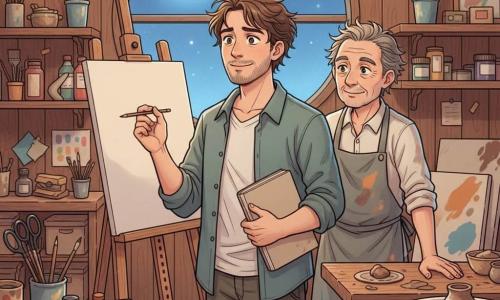
Tonight, he sat alone in his studio above the bakery, where the air always smelled like warm sugar and brave new beginnings. The studio window was huge and a little bossy. It showed the whole street like a stage.
On his desk lay a stack of thick paper, a jar of nib pens, a cup of brushes, and a pencil worn down to a polite stump. Beside them was a sheet filled with letters.
Not typed. Drawn.
Milo was practicing hand typography—letters made by hand, shaped carefully, like building tiny houses for words.
He whispered to the paper, “Okay, ‘S.' Don't be dramatic.”
The ‘S' was dramatic anyway. It leaned like it was tired of standing.
Milo sighed, not angry. Just curious. He flipped the page, tried again, and made another ‘S' that looked like a confused snake.
From downstairs, the baker, Mrs. Bibi, called up the stairwell, “Milo! Are you awake?”
“I am,” Milo answered, voice small but steady.
“Good. Because tomorrow is the Night Market. We need a sign that makes people hungry just by looking at it!”
Milo looked at his messy sheet of letters. Hungry. That was a big promise for a quiet man with a dramatic ‘S.'
Still, he nodded to himself. Art wasn't magic. It was work. And work could start with a mistake.
Chapter 2: A Job With Crumbs on It
The next morning, Milo visited Mrs. Bibi's bakery. The bell above the door jingled like it had secrets. Trays of pastries lined the counter: cinnamon knots, lemon tarts, croissants shaped like sleepy moons.
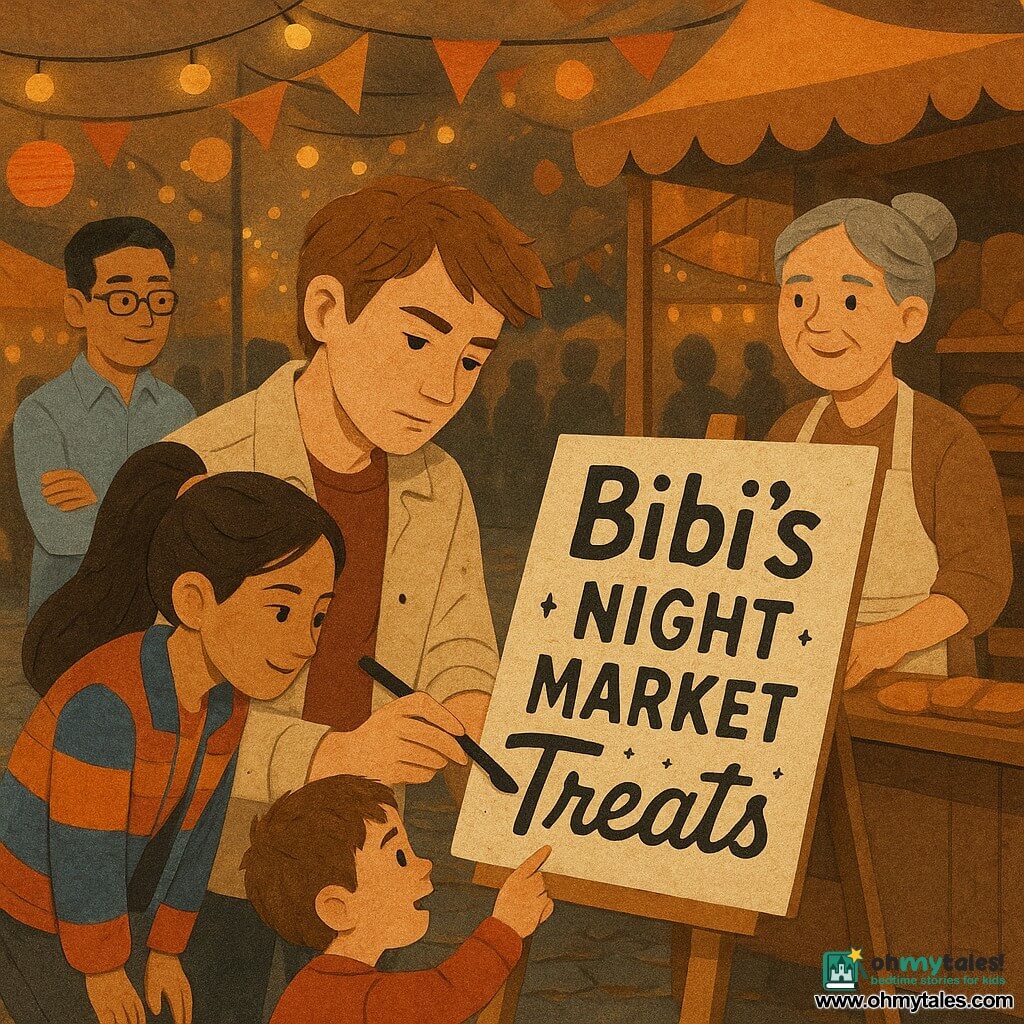
Mrs. Bibi leaned over the counter and pointed at the empty space above it. “A sign,” she said, “that says: ‘Bibi's Night Market Treats.' Big enough to see from the street. Friendly enough to trust.”
Milo listened more than he spoke, as usual. He watched how customers' eyes moved: first to the shiny glazed buns, then to the price tags, then to Mrs. Bibi's grin. Their eyes danced in a pattern.
Signs, Milo knew, were like quiet voices. They guided people without pushing.
“I can do it,” Milo said. Then, because he believed in honesty the way some people believed in lucky socks, he added, “I'll need a few tries.”
Mrs. Bibi waved a floury hand. “Try away. If the first sign is perfect, it means you didn't play enough.”
Milo smiled. That made his chest feel lighter.
Back upstairs, he cleared his desk. He taped a big sheet of paper down so it wouldn't wriggle away. He sharpened his pencil. He wrote the words lightly: Bibi's Night Market Treats.
Then he leaned back and squinted, like the paper might speak first.
The letters looked skinny and nervous.
Milo tried thicker lines. The ‘B' turned into a bubble. The ‘N' looked like it had a sore back. He erased until his eraser crumbled into little gray worms.
He held up the page to the window. From far away, the words were a fog.
He groaned, very quietly, like a polite owl.
Then he remembered something important about being an artist: you don't just draw. You solve problems.
He grabbed a notebook and wrote three questions:
1) Where will people see it from?
2) What feeling should it give?
3) How can letters help?
He walked to the window and looked down at the street. People moved fast. They glanced up for one second, maybe two.
“Then the letters need to be bold,” he murmured. “And warm.”
Warm, like the bakery.
Milo picked up a brush and dipped it in ink. It made a soft shhh sound, like a promise.
Chapter 3: The Letter Parade
In the afternoon, Milo took his sketchbook to the park for “letter hunting.” That was what he called it, though no letters were harmed.
He sat on a bench and watched the world write itself.
A dog's leash curved like a ‘J.' A bike rack made a row of ‘U's. A kid's scarf fluttered like a ribbon ‘S'—a better ‘S' than Milo's dramatic one, honestly.
Two preteens sat nearby, sharing fries from a paper bag. One of them noticed Milo's sketchbook.
“Are you drawing… words?” the girl asked, leaning in.
Milo nodded. “Letters,” he said. “They're like people. Same alphabet, different personalities.”
The boy squinted at Milo's page. “That ‘R' looks like it's running.”
Milo looked. It did. The leg of the ‘R' stuck out like it was late for school.
“That happens,” Milo said. “Sometimes my letters get ideas.”
The girl grinned. “Can you make it do a cartwheel?”
Milo hesitated, then drew a silly ‘R' with a loop like a tumbling arm.
The kids laughed, not meanly—like laughter was a friendly door opening.
“Why not just use a computer font?” the boy asked.
Milo tapped his pencil against the page. “Fonts are great,” he said. “But drawing letters by hand lets you choose the mood. Like… if I write ‘Treats' with soft curves, it feels sweet. If I write it sharp, it feels like… crunchy crackers.”
The girl made a face. “Now I want crackers.”
“See?” Milo said. “Letters are powerful.”
They watched him draw a few more versions: chunky block letters, curly script, tall skinny ones. Some looked cheerful. Some looked like they needed a nap.
The boy pointed at one. “That one looks like a haunted birthday card.”
Milo laughed under his breath. “Not my goal.”
Before the kids left, the girl said, “My art teacher says mistakes are just drafts with attitude.”
Milo wrote that down. He liked it.
On the way back, he studied shop signs: the spacing between letters, the contrast between dark ink and light background, the way a single extra curl could make a word feel fancy.
In his head, the sign for Mrs. Bibi began to form—not perfect, but possible.
Chapter 4: Ink, Smudges, and Bravery
That evening, Milo set up his workspace like a tiny lab. He placed a scrap sheet under his hand to protect the paper from sweaty smears. He tested his brush strokes on a corner page: thin, thick, thin again.
He penciled guidelines—faint lines to keep everything straight. Not because he couldn't freehand it, but because smart artists use tools. Rulers, grids, references, patience. Pride didn't help a sign read better.
He began with “Bibi's,” making the letters round and welcoming. He added a gentle shadow behind them so they popped from the page.
Then he moved to “Night Market.” He chose tall block letters, easy to read from across the street. He left space between them so they could breathe.
Halfway through, his brush caught on the paper and splattered a dot of ink right on the ‘a' in “Market.”
The dot spread like a tiny black puddle.
Milo froze.
His heart did that awful thing where it tries to climb into your throat and live there forever.
He stared at the blot. It looked like a fly had made a dramatic entrance.
He could throw the sheet away. He could pretend it never happened. He could be angry.
Instead, he took a slow breath, the way he did when his letters started acting like wild animals.
“What is this now?” he whispered.
He studied the blot, tilting his head. It wasn't a disaster. It was a shape.
He picked up a white gel pen and carefully added a small highlight to the blot, turning it into a shiny dot. Then, with a few tiny strokes, he made it the center of a small starburst.
Suddenly, the ‘a' looked like it had a twinkle.
Milo blinked. Then he chuckled. “Fine,” he told the ink. “You can stay.”
He finished the words, adding “Treats” in a playful script—curvy, sweet, with thick downstrokes like dripping chocolate.
When he stepped back, the sign didn't scream. It didn't have to. It invited.
But Milo still wasn't sure. Artists, he knew, could be their own toughest critics.
He let the sign rest overnight. That was another artist job: knowing when to stop touching things.
Chapter 5: The Committee of Honest Faces
The next day, Milo carried the sign downstairs to the bakery. It was big and crisp, the ink a deep black, the shadows a soft gray. The paper smelled faintly of his studio: pencil dust and coffee.
Mrs. Bibi took one look and pressed her hands to her cheeks. “Oh! It looks delicious.”
Milo relaxed a little, but he waited. Praise was nice, but he wanted the truth.
Mrs. Bibi called into the back, “Team! Come judge Milo's sign!”
Out came the “committee,” which was not official at all but acted like it was. There was Noor, the teenage helper with quick eyebrows. There was Mr. Chen from the flower shop next door. And there was a small child holding a sticky bun like it was a treasure.
Noor leaned in. “I love the thick letters. Very readable.”
Mr. Chen nodded slowly. “Good spacing. The words don't bump into each other.”
The small child stared at “Treats,” then licked the sticky bun with great seriousness. “It says snacks,” he announced, though it did not say snacks.
Milo smiled. “That's… close.”
Noor pointed at the little starburst in “Market.” “What's that?”
Milo rubbed the back of his neck. “Ink accident,” he admitted.
Mrs. Bibi gasped, delighted. “An accident? It's charming!”
Mr. Chen said, “In art, accidents sometimes become style.”
Noor grinned. “So you're telling me you're brave enough to mess up in public.”
Milo exhaled, surprised at the warmth in his own chest. “I guess I am,” he said.
Mrs. Bibi hung the sign above the counter. The bakery looked different instantly, like it had put on a nice jacket.
Milo watched customers walk in. Their eyes lifted to the sign without being told. They smiled, then ordered pastries as if the letters had whispered, Go on. You deserve a treat.
Milo's quiet pride grew. Not loud. Not showy. Real.
Still, one thing remained: the Night Market. The sign had to survive outdoors, among lanterns and wind and people.
Chapter 6: Night Market Letters Under Lantern Light
When evening came, the street transformed. Strings of lanterns glowed orange and gold. Stalls popped up like mushrooms after rain. Music floated from somewhere—maybe a violin, maybe a playlist, maybe both arguing politely.
Mrs. Bibi's stall sat near the center, a beacon of baked goodness. Milo helped set the sign on an easel. He tied it with twine so it wouldn't tip.
A gust of wind tried to grab the paper like a naughty ghost.
Milo tightened the knots. “Not today,” he told the wind.
People flowed in. Some carried crafts. Some carried drinks. Some carried the serious expression of someone hunting for the perfect dumpling.
A man stopped in front of the sign and read it out loud. “Bibi's Night Market Treats.”
His friend said, “That sign is nice. The letters look… friendly.”
Milo stood behind the stall, unnoticed, which suited him fine. He watched, the way he always did. He watched how people's faces softened when they read the words. He watched how kids traced the curves of “Treats” with their eyes before pointing at cupcakes.
Noor elbowed Milo gently. “Look. It works.”
Milo nodded, but his gaze snagged on a detail. Under lantern light, the shadows behind “Bibi's” were a touch too pale. The word didn't pop as much as it had indoors.
His stomach dipped. Not panic—more like a note to self.
He pulled out a small kit from his bag: a brush pen and a scrap of paper. Artists often carried tools the way other people carried gum.
Mrs. Bibi raised an eyebrow. “Are you going to perform sign surgery?”
“Just… a small adjustment,” Milo said.
He tested the brush pen on the scrap. Then he added a second, slightly darker shadow line behind the letters, carefully, stroke by stroke.
Noor watched. “You're not afraid of ruining it?”
Milo paused. The market noise swelled around them. Laughter. Music. The clink of coins.
“I am afraid,” he admitted. “But I'm more afraid of leaving it wrong when I can improve it.”
He finished, stepped back, and the letters lifted forward, clearer and warmer under the lantern glow.
Mrs. Bibi clapped once, sharp and proud. “That,” she said, “is craftsmanship.”
Milo's shoulders loosened. Craftsmanship. A word for careful effort. A word for work.
As the night went on, someone asked Mrs. Bibi who made the sign. She pointed to Milo.
The person looked surprised. “An artist?”
Milo almost shrank, like the word might be too big for him.
Mrs. Bibi said, “Yes. And he worked hard.”
Milo found his voice. “Art is work,” he said quietly, “even when it looks like fun.”
The person nodded, like they finally understood something important.
Chapter 7: The Last Line of the Day
When the market ended, lanterns dimmed and stalls folded away. The street returned to its usual self, but it felt kinder now, as if it had learned a new word.
Back in his studio, Milo washed his brushes. The water turned gray, then clear. He lined his pens in a row like sleeping pencils.
He placed the sign on his desk for a final look. It had a tiny smudge in the corner, and the starburst accident still winked at him.
Milo opened his notebook and wrote down what the day had taught him, not in fancy sentences, just plain truth:
— A sign is a job: it guides, it welcomes, it sells, it helps.
— Typography is drawing and thinking together.
— Tools matter: pencils, guidelines, testing scraps.
— Mistakes are not the end. They are information.
— Fixing something is also part of making it.
He thought about the kids in the park, their laughter like a friendly drumbeat. He thought about Noor's eyebrows and Mr. Chen's slow nod. He thought about Mrs. Bibi's floury hands hanging his work like it belonged there.
Artists, Milo realized, weren't people who never failed. They were people who kept returning to the page.
He turned off the lamp. The studio went soft and dark, the window reflecting a faint outline of him: a quiet man with inky fingertips.
Before bed, Milo looked at his hands and said, almost like a bedtime promise, “Tomorrow I'll try again. And if I mess up, I'll learn.”
Outside, the streetlights glowed steady and calm, like punctuation at the end of a long, good day.