Chapter 1: The Studio That Wouldn't Sit Still
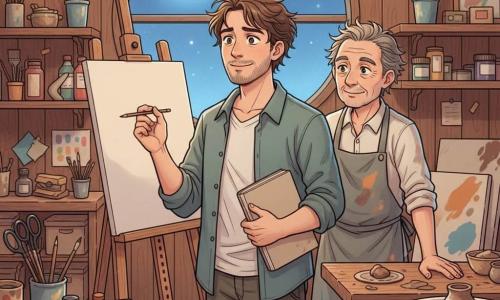
Milo was an artist, which meant his pockets were usually full of odd things: a stubby pencil, a torn paper napkin, a paint-stained eraser, and sometimes a pebble that “looked like a cloud.”
His studio was above a bakery. Every morning, the smell of warm bread floated up the stairs and mixed with the scent of paint. Milo liked that. It made the room feel friendly, like even the air was cheering him on.
Tonight, he planned to draw something simple before bed. A bowl of oranges. Quiet. Safe.
He set the bowl on his table, aimed his lamp, and picked up his charcoal.
“Alright,” he told himself. “Oranges. Round. Calm. Easy.”
But when he began, his hand did not stay calm.
The charcoal slid fast, almost like it had tiny skates. Milo watched, puzzled, as his lines turned into a whirl of loops and slashes. His wrist twisted. His elbow lifted. His shoulder joined in. The drawing looked less like fruit and more like… wind.
Milo blinked. “What are you doing?”
His hand kept going, as if it had its own idea and Milo was only the passenger. The charcoal made a bold curve. Then a jagged streak. Then a dot, right in the middle, like an eye.
Milo leaned back. The page showed something that was not a bowl of oranges at all.
It looked like a dancing storm wearing a surprised face.
He laughed, a short, startled sound. “Well. That's new.”
A soft knock came from the open window. Not a person—just the wind tapping the frame, as if it wanted to be included.
Milo stared at the page. His cheeks felt warm. Part of him wanted to rip the paper up and pretend it never happened.
But another part—the curious part—whispered, What if your body knows something you don't?
Milo set the charcoal down carefully, like it was a small animal that might run away.
“Okay,” he said to the room. “Tomorrow, we try again. But… maybe we let the storm dance a little.”
Chapter 2: The Museum of Accidents
The next day, Milo visited the local community center. The hallway smelled like floor polish and poster paint. A sign on the wall read:
ART NIGHT: BRING YOUR CURIOSITY. LEAVE YOUR FEAR.
Milo liked that sentence. He repeated it in his head as he walked into the art room.
At a long table, kids and adults worked side by side. Some painted. Some sculpted. Some made collages from magazine scraps. Nobody looked like they were winning. Nobody looked like they were losing. They just looked busy—like explorers.
A woman with silver braids waved at him. “Milo! You're early.”
“Hi, Ms. Rowan,” Milo said. “I… had a weird drawing moment.”
Ms. Rowan smiled as if weird was her favorite flavor. “Show me.”
Milo pulled out his sketchbook and opened to the storm-face.
Ms. Rowan studied it. “Your hand was moving fast.”
“Too fast,” Milo admitted. “I tried to draw oranges. Instead, I drew… a windy creature having feelings.”
“That sounds like art to me,” she said. “Did you hate it?”
Milo hesitated. “I don't know. I was embarrassed. But I also laughed.”
Ms. Rowan tapped the paper gently. “This is an accident that has energy. Many artists collect these. I call it a Museum of Accidents.”
Milo raised an eyebrow. “You keep your mistakes?”
“I frame them sometimes,” she said, completely serious. “Mistakes show your path. They prove you tried something brave.”
Across the room, a boy groaned at his painting. “My tree looks like broccoli!”
A girl beside him tilted her head. “Then make it a broccoli tree. In a world where vegetables rule.”
The boy snorted. “Broccoli Kingdom!”
They both started laughing, and the tree suddenly seemed less tragic.
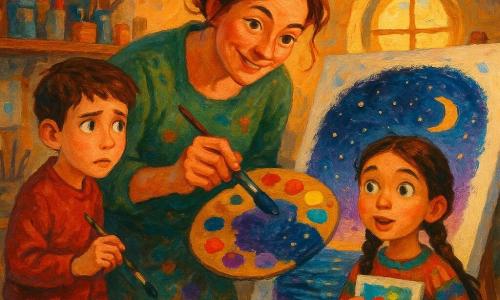
Ms. Rowan handed Milo a thick paintbrush. “Tonight's challenge is quick studies. One minute each. No erasing.”
“No erasing?” Milo repeated, alarmed.
“No erasing,” Ms. Rowan confirmed. “Your hand will make choices. Some will be smart. Some will be silly. Both are useful.”
Milo dipped the brush into blue paint. His stomach fluttered. One minute sounded like a race.
But when Ms. Rowan set a timer, something surprising happened.
Milo's arm loosened. His brush swished. His hand made bold shapes without asking permission from his worried thoughts.
When the timer beeped, Milo looked down.
He had painted a chair that looked like it was leaning into a joke.
He laughed again. “My chair is… smug.”
Ms. Rowan nodded, pleased. “Excellent. Smug furniture has personality.”
Milo glanced around the room. Everyone's pages looked different, and yet nobody seemed wrong.
On the walk home, Milo kept thinking about that sign.
Bring your curiosity. Leave your fear.
He wasn't sure he could leave his fear forever.
But maybe he could ask it to wait outside for a while.
Chapter 3: The Body's Secret Dance
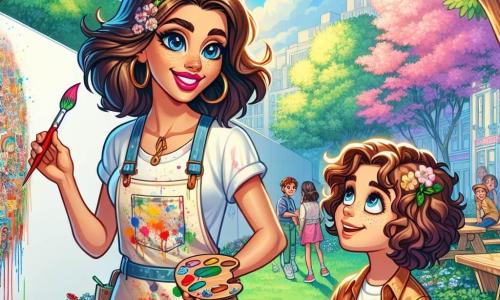
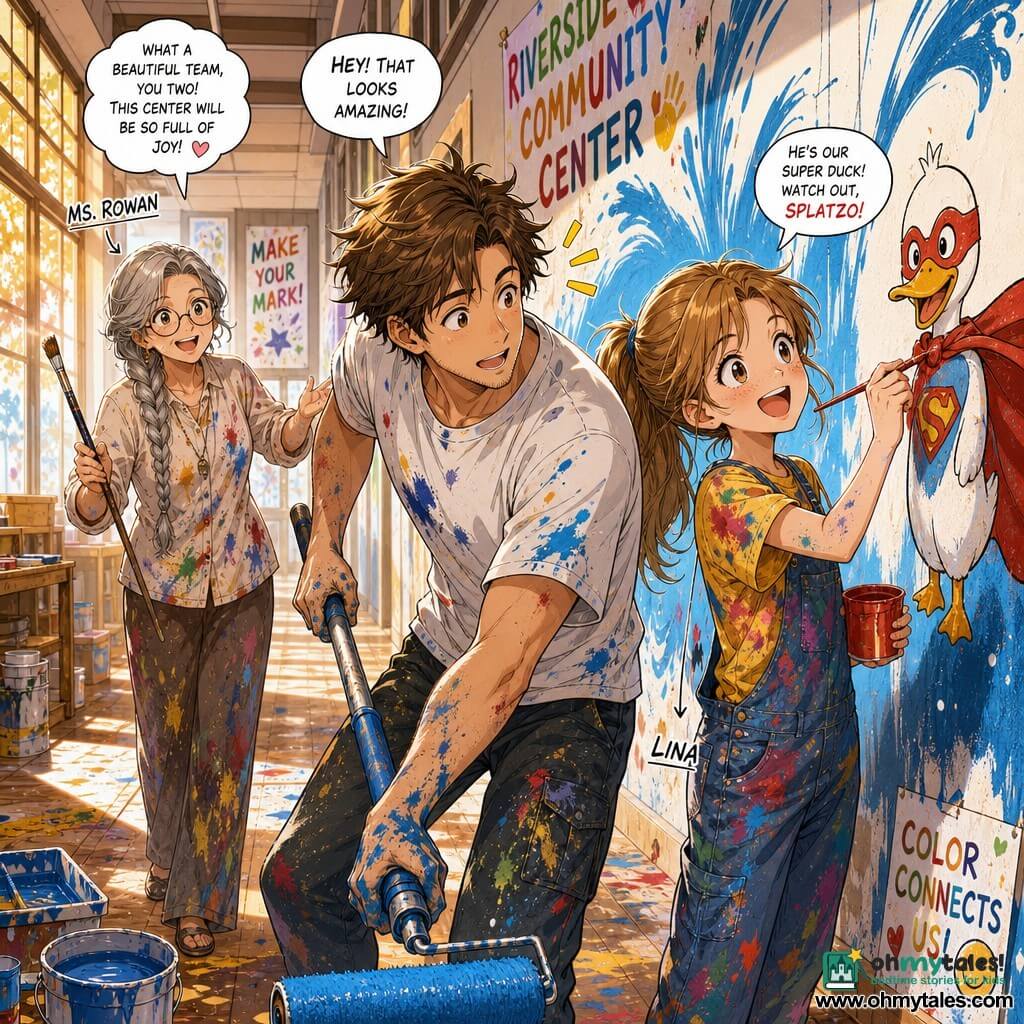
That weekend, Milo agreed to help paint a mural at the community center. It would cover a whole wall in the hallway: a bright scene of the town, with gardens, rooftops, and a river that curled like ribbon.
Milo arrived with his paint clothes on—old jeans and a shirt with enough stains to count as a pattern.
Ms. Rowan handed him a roller. “You can start with the river. Long strokes. Smooth and steady.”
“Smooth and steady,” Milo repeated like a promise.
He pressed the roller to the wall and began.
At first, the river behaved. It flowed in a neat curve. Milo felt proud. He was doing the sensible part.
Then his foot tapped.
Just once.
Tap.
His knee bent. His shoulder dipped. And suddenly the roller swept in a bigger arc than planned, making a wide, dramatic wave.
Milo froze. “Oh no.”
The river now looked like it had just heard exciting gossip.
Behind him, someone giggled. Milo turned and saw a girl about eleven, with a paint-splattered ponytail and curious eyes. She held a small tray of colors like it was a treasure chest.
“That's a fun river,” she said.
“It's a mistake,” Milo said, trying not to sound too miserable.
The girl shrugged. “Rivers make mistakes all the time. They change directions. They spill. They swirl. That's why they're interesting.”
Milo stared at the wave. He had meant calm. The wall had gotten drama.
Ms. Rowan walked over and studied the river. Instead of frowning, she nodded. “This is lively. Milo, you've made movement.”
“I didn't mean to,” Milo admitted.
“Sometimes the body invents,” Ms. Rowan said. “Artists don't just think. They listen—to the eyes, to the hands, to the breath. Your body is part of your toolbox.”
The girl leaned closer to the wall. “If the river is dramatic, it needs something dramatic in it. Like… a boat. Or a giant fish.”
“A giant fish?” Milo repeated.
“Or,” she said, grinning, “a duck with a cape.”
Milo laughed. “A heroic duck.”
“Yes,” she said, delighted. “A duck who rescues lost socks from the current.”
Milo looked at the bold wave again. The mistake felt less like a stain and more like a doorway.
“Alright,” he said. “Let's give this river a reason to show off.”
They painted together. Milo added a little boat, then a fish that looked as if it was smiling at a secret. The girl—her name was Lina—painted a duck with a bright red cape.
As Milo worked, he noticed his movements. When he tried to control everything, his wrist tightened and his lines got stiff. When he breathed out and let his shoulder lead, his curves became smoother.
It felt like learning a new language, spoken by elbows and ankles.
By the time they cleaned their brushes, the hallway wall looked like it had a pulse. Not perfect. Not quiet.
Alive.
Milo stood back, hands on hips, and said softly, “I didn't know my body had ideas.”
Lina washed her brush and said, “Bodies are always thinking. They just don't use words.”
Chapter 4: Styles That Don't Match (Until They Do)
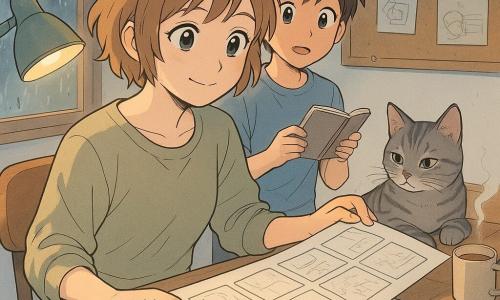
On Monday evening, Milo returned to his studio with a stack of blank paper. He wanted to understand what was happening. How could his hand lead him into such strange, exciting places?
He wrote a list on a sticky note:
1) Try neat realism.
2) Try messy abstraction.
3) Try something you think you'll hate.
He stuck the note to his lamp.
First, he tried neat realism. He drew the oranges again, carefully shading each curve. He paid attention to the way the light made bright spots like little moons. The drawing was accurate. Respectable. A proper bowl of fruit.
Milo nodded. “Good. I can still do that.”
Then he tried messy abstraction. He used thick paint and a palette knife, scraping colors into wild blocks. Orange became a flame. Shadow became a purple bruise. The page looked like the feeling of citrus instead of the shape of it.
Milo stepped back, surprised. “That's… kind of amazing.”
His old habit whispered, Pick one. Choose your style. Be consistent.
But Milo remembered the mural river and Lina's fearless duck.
He looked at the sticky note. The third task stared back.
Try something you think you'll hate.
Milo sighed. “Fine.”
He dug out a set of markers he barely used because they felt too bright, too loud. He also found a sheet of patterned paper covered in tiny stars. The colors made him nervous, like they were about to shout.
He began anyway.
At first, the drawing looked wrong. The markers were bold and unforgiving. The stars fought with his lines. Milo grimaced.
“This is awful,” he muttered.
Then his hand did something sneaky.
It slowed down.
Instead of forcing the page to obey, Milo let the stars become part of the picture. He drew a small figure walking through them, carrying a lantern. He added a shadow shaped like a question mark. He used the brightest marker—electric pink—to color the lantern glow.
The picture turned into a strange little story.
Milo stared, startled all over again. “I like it.”
He flipped to a new page. He tried another “hated” style: tiny doodles packed together like a crowd. Then he tried a loose ink wash that made everything look like mist. Then he tried cutting paper into shapes and gluing them down, even though glue always got on his fingers.
Each time, there was a moment when he wanted to quit.
And each time, something interesting happened right after that moment—like the art was waiting behind a stubborn door.
Later, Milo's friend Jae called him on video chat. Jae was a photographer who always had a camera strap around his neck, even indoors.
Milo held up his pages. “I think I'm… changing.”
Jae squinted at the drawings. “You're experimenting.”
“I used to think artists had one ‘real' style,” Milo said. “Like a signature.”
Jae chuckled. “A signature can have loops. Or spikes. Or tiny hearts if you feel like it.”
Milo laughed. “So I don't have to pick?”
“You can,” Jae said. “But you don't have to do it now. Artists try things. They borrow. They mix. They keep what feels true.”
Milo looked at his hands, stained with ink and a little glue. His fingers felt tired, but in a satisfied way—like they had been on an adventure.
“I'm surprised,” he admitted. “I like styles that don't match.”
Jae said, “Maybe they match you.”
Chapter 5: The Poster That Went Wrong
A week later, Ms. Rowan asked Milo to design a poster for the community center's Spring Art Night. It would hang in the window, where everyone could see it.
Milo felt honored—and nervous. A poster wasn't like a private sketchbook. A poster was public. A poster could be judged by people buying bread downstairs.
He promised himself he would be careful.
That night, he planned the poster: big letters, a cheerful picture, clean layout. He measured with a ruler. He penciled in guides. He even made tea like a serious professional.
“This time,” Milo told his reflection in the dark window, “no storm-creatures.”
He began with the letters: SPRING ART NIGHT.
But the “R” leaned. The “I” was too thin. The spacing looked odd. Milo tried to fix it, but his eraser smudged the pencil into a gray fog.
His heart dropped.
He stared at the page as if it had insulted him.
“No,” he whispered. “Not now.”
He started over on a new sheet. Same problem. The letters wobbled again, like they were dancing when they should have marched.
Milo felt heat behind his eyes—the kind that comes when you care too much and it hurts.
He pressed his palms to the table and took a slow breath.
Bring your curiosity. Leave your fear.
But his fear was sitting right on the chair, heavy and stubborn.
Milo texted Ms. Rowan: The poster is going badly.
She replied almost instantly: Come tomorrow. Bring the “bad” one.
The next day, Milo walked into the community center holding his crumpled attempts like guilty evidence.
Ms. Rowan laid the pages on the table. “These aren't bad,” she said. “They're unfinished.”
“They're messy,” Milo insisted. “People will think I don't know what I'm doing.”
Ms. Rowan pointed to a smudged area. “This smudge is interesting. It looks like wind.”
Milo groaned. “Not the wind again.”
“Yes, the wind again,” she said, amused. “Look. If your letters want to dance, let them. Make it part of the design.”
Lina happened to be there, working on a collage. She leaned over and said, “Your letters look like they're having a party.”
Milo frowned. “A party isn't professional.”
Lina snipped a magazine picture of a flower and held it up like a judge holding a stamp. “Spring is a party.”
Ms. Rowan nodded. “Your job as an artist isn't only to be neat. It's to communicate. To invite. To make people feel something. What do you want this poster to feel like?”
Milo looked at the wobbly letters again. They did feel like movement—like music.
“I want it to feel welcoming,” he said quietly. “Like anyone can come, even if they've never made art before.”
“Then make the poster that says that,” Ms. Rowan replied.
Milo took a deep breath and chose a page—the messiest one. He kept the dancing letters. He painted gentle color behind them, like spring light. He turned the smudge into a swirl of petals. He added a small drawing of a heroic duck with a cape in the corner, holding a paintbrush like a flag.
Lina gasped. “Yes.”
Milo couldn't help smiling. The poster looked playful and alive. Not perfect. Not stiff.
Honest.
When they taped it to the window, people passing by slowed down to look. A little kid pointed at the duck and laughed. An older man nodded as if the poster had just told him a secret.
Milo's shoulders relaxed. His fear, at last, stepped outside for fresh air.
Chapter 6: The Useful Error
Spring Art Night arrived. The community center glowed with warm lights. The hallway mural shone like a river you could step into. Tables were covered with paper, paint, clay, and bright scraps for collages. Someone played soft music. Someone else carried trays of cookies from the bakery downstairs.
Milo walked through the room, greeting people. He showed a teenager how to shade with charcoal using the side of the stick. He demonstrated how to clean a brush properly: “Rinse, wipe, reshape the bristles. Your tools deserve kindness.”
A boy asked, “Is it okay if my dragon looks weird?”
Milo remembered his storm-face creature and smiled. “Weird dragons are the best kind. Make it weirder if you want.”
Later, Ms. Rowan tapped a glass gently. “Before we end, I want to show you something.”
She led everyone to a small display board near the entrance. It held sketches, paint tests, paper scraps, and even a page with a big coffee stain.
At the top, a sign read: THE MUSEUM OF ACCIDENTS.
People chuckled and leaned in.
Ms. Rowan pointed to Milo's storm-face drawing, now pinned proudly among the others. “This began as a mistake. Milo tried to draw oranges.”
Milo felt his ears go pink.
Lina called out, “And now it's famous!”
Everyone laughed kindly, not at Milo, but with him. The laughter felt like a blanket, warm and soft.
Ms. Rowan continued, “Artists make choices. We learn techniques—how to mix colors, how to build light and shadow, how to plan a composition. But we also learn to notice surprises. Sometimes the hand slips. Sometimes the paint runs. Sometimes the letter dances. The question is: do we panic, or do we explore?”
Milo looked at the storm-face. He remembered the moment he almost tore the page.
He stepped closer and said, “That drawing taught me something. My mistake wasn't the end. It was a beginning.”
A quiet hush settled, the kind that feels peaceful.
Milo added, “When something goes wrong, I try to ask, ‘What is this trying to become?' Not every mistake turns into magic. But every mistake can teach me something. Even if it only teaches me what not to do next time.”
A woman near the back nodded slowly. A kid beside her whispered, “I'm gonna keep my broccoli tree.”
Milo grinned.
As the night ended, people packed up their creations. Some carried paintings still wet around the edges. Some carried lumpy clay animals with crooked smiles. Everybody looked proud, not because they were perfect, but because they had tried.
Outside, the air was cool and sweet. Milo walked home under streetlights that made little pools of gold on the sidewalk.
In his studio, he washed his hands. A faint stain remained on his thumb, a tiny blue memory.
He sat by his window and opened his sketchbook to a fresh page. For a moment, he simply listened—to the quiet, to his breath, to the soft, steady beat of his own heart.
Then he picked up his pencil.
“Okay,” he whispered. “Show me what you've got.”
His hand began to move.
Not fighting. Not forcing.
Exploring.
And if an error appeared—if a line slipped, if a shape turned strange—Milo knew what he would do.
He would smile, make room for it, and see where it wanted to lead.