Chapter 1: Under the Shaded Arcades
In the Kingdom of Lumenvale, the streets did not simply lead you somewhere—they guided you like gentle hands. Shaded arcades curved through the city like stone ribbons, cool and dim even at noon, and every archway held a pocket of mystery. Beyond them, sunlit squares rang with laughter, music, and the clatter of wooden carts. Markets breathed out warm clouds of cinnamon, roasted chestnuts, orange peel, and fresh bread. Kindness moved through those places the way wind moves through wheat—quiet, constant, impossible to trap.
Prince Alaric walked there without a crown on his head, though everyone could still tell. He had the posture of someone who had been taught that duty was a straight line and time was a strict tutor. His dark hair was neatly tied back. His cloak was brushed clean. Even his boots seemed to obey him.
He carried a small leather notebook, and in it he wrote down observations the way other boys collected marbles.
“Five stalls selling saffron,” he murmured, counting with a finger. “Three jugglers. One—”
A voice popped up beside him like a firework.
“One prince pretending he's invisible!”
Alaric turned. A girl about his age stood with a basket of mint and lemon balm. Her grin was bright enough to make the shadows blink.
“You're Mira,” Alaric said, recognizing the herb-seller's daughter. “And you are blocking the footpath.”
Mira stepped aside with a theatrical bow. “Your Highness, the footpath is free. Your face, however, looks locked.”
“I am not locked,” Alaric replied, but his voice sounded like a key turning in a stiff door. He glanced at her basket. The herbs were fresh, their leaves glossy, as if they had been polished by morning dew. “Those are for tisanes.”
“For everything,” Mira said. “Tea for comfort, tea for courage, tea for when your math lesson bites you. Are you buying?”
Alaric hesitated. A prince was expected to host feasts, sign decrees, and speak in grand halls. Yet his deepest wish—so private it felt like a secret candle—was simple: he wanted to share a tisane with someone, not as a ceremony, but as a quiet kindness.
“I am… considering,” he said, carefully.
Mira's eyes sparkled, sharp with curiosity. “Then consider this: there's a rumor in the market. A new stall appeared under the farthest arcade. No one remembers building it. It sells one thing.”
“What thing?” Alaric asked, despite himself.
Mira leaned closer, whispering as if the arches might listen. “A leaf that makes a tisane that tastes like the truth.”
Alaric's pen paused above his notebook.
Truth was a heavy word in a light city. Curiosity tugged at him like a sleeve.
“Show me,” he said.
Mira grinned again. “Careful, Your Highness. Your curiosity is showing.”
Chapter 2: The Stall That Wasn't There Yesterday
They passed beneath arch after arch, each one a stone mouth swallowing sunlight and sighing out cool air. The farther they went, the quieter it became, until the market noises faded into a distant hum. The last arcade was older than the others, its pillars worn smooth by centuries of fingertips.
“There,” Mira said, pointing.
A stall sat beneath the deepest shadow. Its wood looked ancient and new at the same time, like a story retold so often it became real. Instead of a sign, a small lantern hung above it, glowing with a pale, thoughtful light.
Behind the stall stood a woman with silver hair braided into a rope. Her eyes were the calm green of pond water. She smiled as if she had been waiting for them, not for minutes, but for years.
“Prince Alaric,” she said, and her voice was soft as steam. “And Mira, who always arrives with questions in her pockets.”
Alaric straightened. “Who are you?”
“Someone who sells what people need, not what they want,” the woman replied. “Today I sell only one leaf.”
She opened a small box lined with velvet. Inside lay a single leaf, dark as midnight and edged with a thin line of gold.
Mira inhaled sharply. “That looks expensive.”
The woman's smile deepened. “It costs nothing you can carry in your hands.”
Alaric's heart beat once, firm and loud. “What does it cost, then?”
“An honest choice,” said the woman. “Brew it, share it, and speak plainly. The tisane will not permit cruel lies. It will not let you hide behind fancy words.”
Mira tilted her head. “What if someone asks you something you don't want to answer?”
“Then you will discover,” the woman said, “what you truly fear.”
Alaric felt the leaf pulling at him like the moon pulls at the sea. In his world, words were often polished until they shone too brightly to look at. He had been taught diplomacy like a dance—step, bow, turn, never stumble.
Still, he imagined a simple cup between two people, steam curling upward like a friendly ghost. A tisane shared not for show, but for connection. He wanted that the way a thirsty person wants water.
“I will take it,” he said.
The woman closed Alaric's fingers around the leaf. It was cool, almost humming.
“One caution,” she added. “To share it well, you must brew it with water from the Mirror Fountain in the King's Square. But the fountain has been silent since yesterday. Something has stolen its voice.”
Mira's eyebrows rose. “Stolen water's voice?”
The woman nodded. “Without the fountain's song, the leaf will brew bitter. And a bitter truth can turn into a weapon.”
Alaric looked toward the city's heart, where the great square lay. Duty tried to pull him back toward the palace. Curiosity pulled him toward the fountain.
He realized, with a strange lightness, that the two pulls were not enemies. They could be two hands rowing the same boat.
“Come,” he said to Mira. “We will find the fountain's voice.”
Mira gave him a salute so exaggerated it made him almost smile. “At last! An adventure with a timetable.”
Alaric held the leaf carefully in his palm. It felt like a small promise.
Chapter 3: The Silent Mirror Fountain
The King's Square was usually a bright orchestra: merchants calling, pigeons applauding with their wings, children laughing like bells. But today, a hush lay over the stones. People spoke in low voices, as if the air itself might shatter.
In the center stood the Mirror Fountain, a wide bowl of silver-blue stone. Its water was famous for reflecting not faces, but moods. On joyful days it glittered like a smile. On sad days it looked like rain trapped in a dish.
Now it was still. No splash. No ripple. The surface lay flat as a sheet of glass, and the water looked dim, as if it had forgotten how to be water.
Alaric approached, his steps precise. He leaned over and saw his reflection—and something else. Behind his reflected shoulder, a faint shadow moved beneath the surface, like ink drifting.
Mira whispered, “Is it… alive?”
A guard nearby overheard and hurried over. “Your Highness,” he said, bowing. “We've checked the pipes. We've prayed. We've shouted compliments at it.”
“Compliments?” Mira echoed.
The guard shrugged helplessly. “It used to sparkle when the baker's wife told it she liked its shine. Now nothing works.”
Alaric looked at the still water. It reminded him of himself on certain mornings: proper, quiet, and somehow missing a song.
He touched the fountain's rim. The stone felt cold and tired.
“How long has it been silent?” he asked.
“Since the new moon,” the guard said. “Yesterday morning, it just… stopped.”
Alaric opened his notebook and wrote: Mirror Fountain—voice stolen. Possible cause: enchantment. Suspect: shadow beneath surface.
Mira peered over his shoulder. “You write like you're building a ladder out of words.”
Alaric snapped the notebook shut. “We need facts.”
“Facts are good,” Mira said. “But mysteries don't always wear nametags.”
The air above the fountain smelled faintly of iron and wilted petals. Mira leaned closer and squinted at the water. “Look. There's something caught in the bottom—like a chain.”
Alaric narrowed his eyes. She was right. Something glimmered deep down, coiled around the fountain's heart like a snake around an egg.
He straightened. “We must go beneath.”
The guard paled. “Beneath? There are old tunnels under the square. They were sealed after—after the Whispers.”
Mira's curiosity flared like a struck match. “What whispers?”
The guard lowered his voice. “People used to hear their own doubts speaking to them down there. Some went in brave and came out trembling. Some never came out at all.”
Alaric felt fear, but it did not stop him. It sat beside him like a stern advisor. If the fountain's voice was stolen, the city's kindness would dry into politeness, and politeness without warmth was a winter coat with no lining.
He looked at Mira. “Will you come?”
Mira lifted her basket of herbs. “Of course. Someone has to keep you from arguing with a shadow.”
Alaric nodded. “Then we go with care. With courage. And with curiosity.”
They found the sealed stairway behind a statue of the first queen. The stone door was marked with an old symbol: a mouth crossed out with a line.
Alaric placed his hand on it. “We will return the fountain's song.”
And the door, as if listening, clicked open.
Chapter 4: The Tunnels of Whispers
The stairway spiraled down into cool darkness. Their footsteps echoed as if the stones were repeating everything they did, just to practice. The air smelled of damp earth and forgotten secrets.
Mira lit a small lantern she had tucked under her basket. “Never go into a mysterious tunnel without snacks or light,” she declared.
Alaric, in spite of himself, asked, “Do you have snacks?”
Mira patted her pocket. “Dried apples. I'm not a monster.”
They walked deeper. The tunnel walls were carved with faded murals: fountains, flowers, cups of steaming tea held between smiling hands. It was as if someone long ago had believed that gentle things deserved to be immortal.
Then the whispers began.
At first, they were so faint they could have been the lantern's flame thinking aloud. But they grew, curling around their ears like cold smoke.
“You'll fail,” breathed a voice that sounded uncomfortably like Alaric's own thoughts. “You always do when it matters.”
Another voice, sharp as a pin, slipped into Mira's ear. “You're just a merchant's daughter playing at heroism.”
Mira stopped short, her face tightening. “That's rude.”
Alaric's jaw clenched. He knew these were not true statements—yet they landed with the weight of stones because they wore familiar shapes.
He recalled the stall woman's warning about truth becoming a weapon. These whispers were lies shaped like truth, designed to wound.
He took a slow breath, the kind his tutors had taught him for speeches. “They are trying to turn us against ourselves.”
Mira lifted her lantern higher. “Well, I refuse. If my doubts want attention, they can stand in line.”
They walked on, but the whispers grew bolder. Shadows on the walls lengthened and twisted, forming figures that seemed to mimic them. Ahead, the tunnel opened into a chamber where the air shimmered like heat above a road.
In the center stood a creature made of darkness and reflected light, like a mirror cracked and filled with night. Chains of silver mist looped from its hands, trailing down through a hole in the floor.
Its voice was beautiful and awful, like a lullaby sung backward. “Prince,” it said. “Precise prince. You came to fetch a song.”
Alaric stepped forward. “You stole the Mirror Fountain's voice.”
The creature tilted its head. “I saved it. The city wastes kindness on strangers. Kindness should be earned.”
Mira's lantern flickered. “That's not how kindness works. That's how bargains work.”
The creature's smile was thin. “Kindness makes people careless. They share too easily. They forgive too quickly. I am teaching them caution.”
Alaric looked at the chains. They pulsed faintly, as if carrying water's music somewhere else.
“What are you?” he demanded.
“I am the Keeper of Doubts,” the creature said. “I live beneath bright places. I drink the songs people don't guard.”
Mira whispered to Alaric, “It's like a moat, but made of worry.”
The Keeper of Doubts glided closer. “Leave the leaf,” it purred, eyes fixed on Alaric's palm. “That truth-tea belongs to me. Truth without warmth is my favorite flavor.”
Alaric curled his fingers over the leaf. He thought of the city above—its markets smelling of spices and oranges, its arcades cool and welcoming. He thought of kindness moving through people like wind through wheat.
He spoke carefully. “You think you're protecting them. But you're starving them.”
The Keeper laughed softly. “Bold words from a boy trained to avoid them.”
Alaric felt the sting of that. It was close enough to be dangerous.
Mira stepped forward, chin high. “You can't steal a fountain's voice and call it a lesson. That's like stealing someone's shoes to teach them to walk barefoot.”
The Keeper's eyes narrowed. “Children and their metaphors. Very well. If you want the fountain's song, earn it. Drink the truth-tea here, in my chamber. Tell each other what you hide. If you survive your honesty, I will release the chains.”
Alaric's throat went dry. Honesty was easy when it was harmless. But true honesty was a blade that could cut both ways.
Yet he remembered why he wanted the tisane: to share, to connect. Truth with warmth.
He nodded. “We accept.”
Mira swallowed, then nodded too. “Fine. But if your ‘lesson' makes him cry, I'm haunting you.”
The Keeper's smile widened. “Then brew it.”
Chapter 5: A Cup of Truth
They returned up to the square with the Keeper drifting behind them like a cloud that had learned to walk. The people in the King's Square gasped at the sight, but no one moved. Fear held them like glue.
At the silent fountain, Alaric knelt. The water still lay flat, trapped under the shadow's spell. He could not collect singing water, but he could collect what remained.
“Will it work?” Mira whispered.
“It must,” Alaric said, though his voice trembled at the edges.
The Keeper extended a hand. “A cup. A leaf. And your brave little hearts.”
Mira muttered, “He talks like a poem that's trying too hard.”
Alaric took out a small metal cup from his satchel—usually used for travel. He placed the midnight leaf inside. Then he scooped water from the fountain. It poured without sound.
Mira added a sprig of mint from her basket. “Warmth,” she said simply. “Just in case.”
They found a nearby brazier where chestnuts were usually roasted. The vendor, wide-eyed, offered a small flame without a word. Alaric held the cup above it, steady as a statue.
The water warmed. Steam rose, thin at first, then richer, curling into shapes that looked like question marks. The scent was strange: like rain on stone, like paper and honey, like a memory you couldn't name.
Alaric's hands were careful. Rigorous. He watched the brew as if precision could protect him.
When it was ready, he held the cup between himself and Mira. The Keeper hovered, delighted.
“Share,” it whispered.
Alaric took the first sip.
It tasted like clear water and deep winter at once. His tongue prickled, as if the drink were tapping on a locked door.
Mira took the second sip. Her eyes widened. “It tastes like when you finally say ‘sorry' and mean it.”
Alaric swallowed. Words rose in him, not like planned speeches, but like bubbles that could not be held down.
The Keeper's voice purred, “Now. Speak plainly.”
Alaric turned to Mira. His heart thudded.
“I… envy you,” he said, surprised by the sentence. “Because you can ask questions out loud. When I ask questions, I worry they will sound foolish. I worry I will disappoint everyone who expects me to know things.”
Mira stared, then her expression softened. “That's… honest.”
Alaric continued, the tea nudging him forward like a kind but relentless tutor. “I also act strict because if I don't, I feel like everything might fall apart. Like I'm holding the kingdom with my shoulders.”
Silence hung between them—not empty silence, but a listening one.
Mira took a breath. She sipped again, then spoke, her voice steady.
“I tease you,” she admitted, “because I'm scared you'll look down on me. Not because you have, but because people with crowns sometimes do. And I pretend I'm fearless because if I stop joking, I might notice I'm shaking.”
Alaric blinked. He saw her more clearly, like a window wiped clean.
The Keeper of Doubts leaned in, hungry. “More,” it urged. “Say the sharp parts.”
Alaric felt the tea warm his chest. Not like fire—like a hearth.
He looked at the crowd watching from a distance: merchants, bakers, guards, children clutching parents' sleeves. Their faces were pale with worry. Kindness was still there, but it was holding its breath.
Alaric raised the cup so others could see it. “Truth without warmth is not wisdom,” he said, and the sentence felt like it had been waiting in him for years. “It is just cold.”
The Keeper hissed softly. “Warmth makes people weak.”
“Warmth makes people brave,” Mira shot back. She stepped closer to the fountain and addressed the onlookers. “Who here has ever been helped for no reason?”
A hand went up. Then another. Then many. Like a field of small flags.
The Keeper recoiled as if the raised hands were sunlight.
Alaric turned to the shadow. “You feed on hidden doubts. But doubts shrink when spoken kindly. We will not seal our fears away for you to drink. We will share them, like tea.”
He offered the cup to the nearest guard. “Sip,” he said. “Say one worry.”
The guard hesitated, then drank. His eyes watered. “I worry I'm not enough to protect anyone,” he confessed.
A baker took the cup next. “I worry my kindness is foolish,” she said.
Each confession fell into the square like a pebble into water—and something astonishing happened.
The Mirror Fountain shivered.
A ripple crossed its surface, widening in rings. The water brightened, as if it had remembered the shape of joy.
The Keeper of Doubts shrieked, its chains trembling. “Stop! You're—”
“—giving the fountain its voice back,” Mira finished, grinning through her nerves. “Imagine that.”
The fountain began to murmur, then to sing—soft at first, then louder, a sound like silver bells dropped into a stream. The chains of mist snapped one by one, dissolving into harmless fog.
The Keeper staggered, smaller now, thinner, as if its body had been made of borrowed shadow.
Alaric stepped forward, not with anger, but with a diplomat's gentle courage. “You can remain,” he told it, “but not as a thief. If you must live beneath bright places, then learn this: doubts are not rulers. They are messengers. We will listen—then choose.”
The Keeper's eyes flickered. For the first time, it looked less like a monster and more like a lonely thought.
It bowed, stiffly. “Perhaps,” it whispered, “I can learn.”
Then it sank into the fountain's reflection and vanished, leaving behind only the fountain's music.
Chapter 6: Where Flowers Come to Rest
By evening, Lumenvale had regained its rhythm. The arcades cooled as the sun lowered, and lanterns bloomed one by one like golden fruit. The markets smelled sweeter, as if the spices had been waiting all day to exhale.
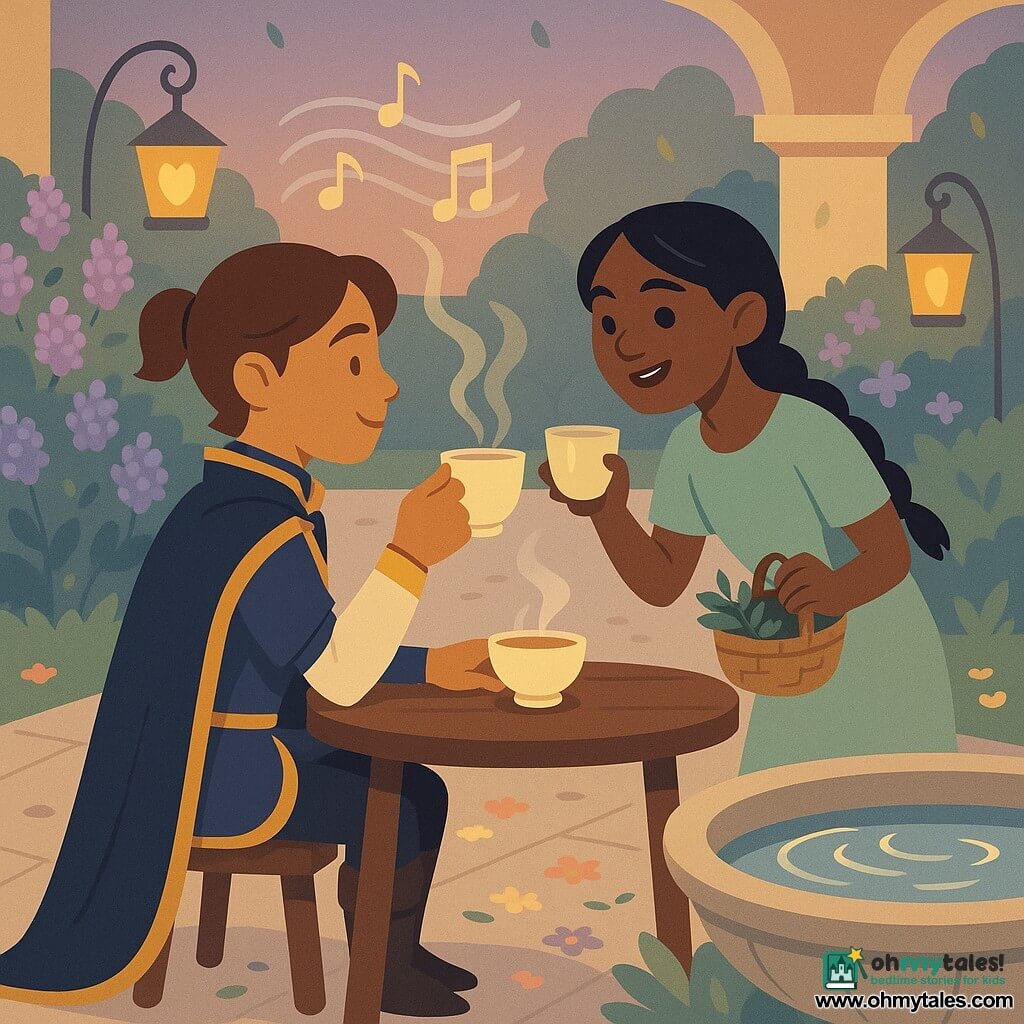
In the palace garden, Prince Alaric arranged a small table beneath a lilac tree. He had insisted on doing it himself, with the same rigorous care he used for royal documents—only now his precision felt like a gift, not a cage.
Mira arrived with her basket. “Your Highness,” she said, curtsying dramatically, “I bring mint, lemon balm, and a shocking lack of fear.”
Alaric's mouth twitched into a real smile. “And I bring cups,” he replied. “And an improved ability to admit I am uncertain.”
They brewed a tisane—this time with water from the now-singing Mirror Fountain. Steam rose, gentle and fragrant, curling upward like a story finding its ending.
They sat. For a moment they simply listened to the garden: the hush of leaves, the distant fountain's song, the faint laughter drifting from the city like a friendly echo.
Alaric lifted his cup. “To curiosity,” he said. “Not the kind that pokes at people like a stick, but the kind that opens doors.”
Mira clinked her cup against his. “To kindness,” she added. “Not the kind that shows off, but the kind that shows up.”
They drank, and the tea tasted of mint and honey and something else—something like courage that had learned to be gentle.
As twilight deepened, the palace gardeners came quietly, carrying trays of flowers: white anemones, soft blue cornflowers, and pale pink roses. They placed them carefully along the garden paths, laying them down as if tucking in small, colorful dreams.
“What are they doing?” Mira whispered.
Alaric watched. The flowers rested on the earth, petals open to the evening, as if they had decided to stop striving and simply be.
“It's an old custom,” he said. “When the kingdom faces a fear and chooses tenderness instead, we let flowers rest. Not in a vase to be displayed, but on the ground, where they belong. A reminder that gentle things don't have to fight to be valuable.”
Mira looked thoughtful. “Like people.”
“Like people,” Alaric agreed.
In the distance, the Mirror Fountain sang on, bright and unbroken. Under the shaded arcades, the city's kindness flowed again—quiet, constant, impossible to trap.
And in the garden, as the flowers rested, Prince Alaric understood a simple royal truth: curiosity is a lantern, kindness is the road, and courage is the hand that carries the cup without spilling.