Chapter 1: Warm Stones, Quiet Shoes
In the Kingdom of Larkhill, the sun loved the ground. It lay on the village squares like a golden blanket, warming the stones until they held heat the way a secret holds a whisper. Wooden benches sat in neat rows beside fountains and flowerpots, and if you pressed your palm to their smooth backs, you could almost feel the stories of a hundred waiting people.
Princess Elowen walked there often, not with trumpets and banners, but with quiet shoes and a ribbon tied in her hair like a small flag of peace. She was the kind of princess who listened more than she spoke. When others hurried like wind through a keyhole, she moved like a calm river—steady, shining, and patient.
That morning, her tutor, Lady Meris, had placed a heavy book on the breakfast table. Its cover was dark blue and studded with tiny silver dots like a night sky.
“The Book of Royal Graces,” Lady Meris announced. “Every ruler must learn the art of gratitude.”
Elowen traced one silver dot. “I already say ‘thank you.'”
Lady Meris lifted an eyebrow. “You say it the way one drops a coin—quickly, without looking. Gratitude is not a coin, Your Highness. It is a lantern. It lights the face of the person you're thanking, and it lights your own heart, too.”
Elowen looked out the window. The village square shimmered. People were gathering: bakers, seamstresses, gardeners, guards. They were the gears that made the kingdom tick.
“I want to do it properly,” Elowen said, surprising herself with how much she meant it. “I want to thank everyone.”
Lady Meris smiled as if she had been waiting for those words. “Then begin. But be warned: thanks given only when it is easy are like flowers in a painting—pretty, but without scent.”
Elowen rose, feeling a brave tenderness settle in her chest. She took a small satchel, a notebook, and a quill. If gratitude was a lantern, she would carry it through the whole kingdom.
Chapter 2: The Baker and the Bread-Sun
The village square smelled of yeast and cinnamon, warm as a hug. Master Olin the baker stood beside his stall, flour dusting his sleeves like pale snow.
Elowen approached. The warm stones beneath her feet seemed to hum, as if the earth itself was pleased she had come.
“Master Olin,” she said. “May I speak with you?”
He blinked, startled, then bowed so quickly a loaf nearly toppled. “Your Highness! If the bread is too dark, I—”
“It's perfect,” Elowen said. “That's not why I'm here.”
She reached into her satchel and pulled out her notebook. The page looked suddenly empty and shy. Elowen swallowed, searching for words that weren't just polite dust.
“I want to thank you,” she said slowly, “for waking before sunrise every day. For feeding the kingdom so we can work, learn, and dream. Your bread is… it's like a little sun we can hold.”
Master Olin's face changed. It wasn't a grand change, like a curtain opening at the theater. It was smaller, like a candle being lit. His shoulders dropped, and his eyes shone.
“Well,” he said, clearing his throat. “No one's ever called my rye a sun before.”
Elowen laughed softly. “Then they've been missing the obvious.”
He handed her a small roll shaped like a spiral shell. “For your journey. It's filled with honey. Hope tastes a bit like honey, I think.”
Elowen accepted it. “Thank you.”
This time, she looked directly at him as she said it, and the word felt heavier—in a good way, like a crown that finally fit.
As she turned to leave, a shadow slid over the square. The fountain's water stopped sparkling. The air cooled, as if a cloud had swallowed the sun.
Lady Meris's warning echoed: thanks given only when it is easy…
Elowen lifted her chin and kept walking.
Chapter 3: The Bench That Wouldn't Speak
Near the fountain stood an old wooden bench, its boards polished by thousands of hands. Elowen had sat there as a child, swinging her feet and pretending the pigeons were knights.
Today, the bench looked unusually dull, as if the wood had forgotten how to shine.
On the bench sat a stranger in a cloak the color of wet stone. His hood was up, but Elowen could see the edge of a smile—thin as a paper cut.
“Good morning,” Elowen said.
“Is it?” the stranger replied. His voice sounded like someone dragging a stick across gravel. “The square is cold. The people are busy. And you, little princess, are playing at kindness.”
Elowen didn't step back. She felt her courage rise, gentle but stubborn, like a sprout pushing through hard soil.
“I'm not playing,” she said. “I'm learning.”
The stranger tilted his head. “Learning to say ‘thank you'? How heroic.”
Elowen sat on the bench beside him. The wood felt chilly under her palm.
“My father says a kingdom is like a choir,” she said. “If one voice is missing, the song sounds thin.”
The stranger made a small sound—half laugh, half cough. “And you think your ‘thank you' will make people sing louder?”
“I think it will make them feel seen,” Elowen replied. “And when people feel seen, they remember they matter. That's how hope grows.”
At the word “hope,” the stranger's smile twitched, as if stung.
“So,” Elowen continued, “I will thank everyone. Even if the square is cold. Even if someone tries to make it colder.”
The stranger's hood shifted, and for a second Elowen thought she saw eyes like dark ink.
“Then start with the hardest,” he murmured. “Thank the one who never gets praised.”
He stood, and as he did, the bench creaked like an old throat clearing. The stranger walked away, his cloak trailing a thin ribbon of shadow that curled around the fountain's edge.
Elowen watched him go. She didn't know his name, but she knew what he was: a kind of winter that enjoyed spoiling spring.
She opened her notebook and wrote: Thank the one no one notices.
Chapter 4: The Sweeper of the Square
At the far end of the village square, where the stones met the market road, a girl about Elowen's age swept with a broom nearly as tall as she was. Dust rose in soft clouds and fell again, as if the ground sighed.
Her name was Tamsin, and most people passed her the way they passed a lamppost—grateful for the light, but rarely stopping to speak.
Elowen walked over. The air still felt cooler than it should, but the sun tried its best.
“Tamsin,” Elowen said.
Tamsin paused mid-sweep, startled. “Your Highness? Did I—did I sweep the wrong way?”
Elowen shook her head. “No. You sweep the right way. That's why I'm here.”
Tamsin's cheeks flushed. “It's just sweeping.”
“It's more than ‘just,'” Elowen said. She knelt and touched the warm stone. “These stones are the kingdom's floor. People dance on them at festivals. They march on them when they're worried. They stand on them when they argue and when they forgive. You keep them clean so our days can begin without stumbling.”
Tamsin stared at her broom as if it had suddenly become a scepter. “No one ever says that.”
Elowen smiled. “Then I will.”
She took a breath. Saying thank you to a baker was easy; the smell of bread did half the work. Saying thank you to a sweeper felt like planting a seed in plain dirt and trusting it would bloom.
“Tamsin,” Elowen said clearly, “thank you for caring for our square, for keeping our village bright. Thank you for doing a job that doesn't shout but still matters.”
For a moment, the air shifted. The chill loosened like a knot undone. A patch of sunlight slid across the stones and warmed Elowen's knees.
Tamsin blinked fast. “You're… you're welcome,” she managed. Then, with a brave grin: “If you ever want to learn sweeping, I can teach you. It's all in the wrist.”
Elowen laughed. “I might take you up on that.”
As Elowen stood, she noticed the fountain's water sparkle again—just a little, like a wink.
Hope, she thought, was not a fireworks show. It was a steady match held against the dark.
Chapter 5: The Tower of Unsaid Thanks
By afternoon, Elowen had thanked the gardener who coaxed roses from stubborn soil, the guard who stood through rain without complaining, and the seamstress who stitched torn cloaks into new beginnings. Each time, her words grew stronger, like a song finding its melody.
Yet the shadow had not vanished. It hovered at the edges of her vision, thin and watchful.
Lady Meris met Elowen near the palace gate. “How goes your lantern?”
Elowen showed her notebook, now crowded with names and little notes: “Breads like suns.” “Sweeping is caring.” “Stitching is mending hearts.”
Lady Meris nodded. “And have you thanked the one you least want to?”
Elowen's stomach tightened. She knew who that was, even before her mind named it.
“My brother,” she said quietly.
Prince Rowan was older, clever, and sharp-tongued. He could turn a compliment into a prank and a serious conversation into a joke. Elowen loved him, but lately he had been… thorny. He teased her about her “thank-you quest” until her ears burned.
“He's in the West Tower,” a servant told them. “Writing letters. Or pretending to.”
Elowen climbed the spiral stairs. Each step echoed like a question. At the top, the tower door was half open, and inside, Rowan sat at a desk surrounded by crumpled paper.
He glanced up. “Come to thank the ink bottle for existing?”
Elowen felt the old irritation flare—quick as a spark. The shadow, like a sneaky cat, seemed to purr in the corner.
She took a slow breath. Gratitude was a lantern. Lanterns didn't throw themselves at people; they simply shone.
“I came to thank you,” she said.
Rowan leaned back. “For what? For being annoyingly perfect at being annoying?”
Elowen held his gaze. “For teaching me courage in your own way. When you joke, it's like you're holding up a shield. I think sometimes you're scared people will see you care too much.”
Rowan's smirk faltered. “That's ridiculous.”
“Maybe,” Elowen said, soft but steady. “But I remember when I was little and afraid of thunderstorms. You sat outside my door and told stories louder than the thunder. You didn't have to. You did it anyway.”
For the first time all day, Rowan looked young.
“I… forgot that,” he muttered.
“I didn't,” Elowen said. “Thank you.”
The shadow in the corner shivered, as if it had been splashed with warm water. A draft rushed through the tower, and the crumpled papers lifted, spinning like startled birds. For a second, Elowen saw something on the wall: a dark stain shaped like a hooded figure.
Then it thinned, stretched, and slipped away under the door.
Rowan rubbed his neck. “So. This ‘thank you' thing,” he said, trying to sound casual. “Does it actually do anything?”
Elowen smiled. “It does something to me. And maybe to you.”
Rowan snorted, but it sounded more like laughter than mockery. “Fine. If you're thanking everyone… I should come with you. Otherwise it'll look like I'm the only ungrateful royal.”
Elowen's eyes widened. “You want to help?”
“Don't make it weird,” Rowan said, standing. “Let's go before I change my mind.”
Hope, Elowen thought, could be contagious.
Chapter 6: The Stranger's True Name
At dusk, the village square returned to its familiar glow. The stones released the day's warmth in gentle breaths. Lamps flickered on, turning the air honey-colored.
Elowen and Rowan walked together, side by side. Their footsteps sounded like a promise.
Near the fountain, the old bench waited. The stranger in the wet-stone cloak sat there again, as if he had never moved.
Rowan's hand drifted toward the small practice sword at his belt. “Who's that?”
“A chill with a mouth,” Elowen whispered. Then she stepped forward, lantern-heart steady.
“Good evening,” she said to the stranger.
He looked up. “Still doing it? Still scattering your little ‘thank yous' like birdseed?”
Rowan opened his mouth, but Elowen lifted a hand. Diplomacy first, courage second, tenderness always.
“I came to thank you, too,” Elowen said.
The stranger froze. Even the fountain seemed to hold its breath.
“Thank me?” His voice cracked, just slightly, like ice under a careful foot. “For what? For being honest? For pointing out that your gratitude is a game?”
Elowen shook her head. “For testing it. A lantern's flame matters most when the wind tries to blow it out.”
The stranger's hood slipped back, and the village lamps revealed his face—not old, not young, but tired. His eyes were the color of storm clouds. Sorrow clung to him like damp cloth.
Rowan stared. “I've seen you before. In the castle corridor. You're… the court messenger who quit.”
The stranger's jaw tightened. “I was called Sable. Once.”
Elowen's voice softened. “Why did you quit, Sable?”
Sable looked away, toward the benches, toward the stones, toward the people laughing and trading goods and leaning into one another's warmth.
“Because no one saw me,” he said, bitter as burnt sugar. “I carried letters that could stop wars, start festivals, save villages. And all I ever heard was ‘Move aside,' or ‘Hurry up,' or nothing at all. Gratitude is a feast,” he whispered, “and I was always left outside the hall.”
Elowen felt the truth of it land in her chest. Not like a stone, but like a key turning.
“I'm sorry,” she said. “I can't rewrite your past. But I can see you now.”
Sable's shoulders trembled, just once.
Rowan cleared his throat, awkward. “Look… I'm not great at speeches. But—” He shuffled his feet on the warm stones. “Thanks for delivering that letter to me last winter. The one from Aunt Briony. I never said it. I should have. It… it mattered.”
Sable blinked, stunned, as if someone had spoken his name in a dream.
Elowen continued, her words careful and bright. “Thank you for every message you carried. For every mile you walked. For keeping secrets that weren't yours. For serving a kingdom that forgot to serve you back.”
Something in Sable's face softened. The wet-stone cloak seemed less heavy.
The air warmed. The shadow that had followed Elowen all day—this was its heart, she realized. Not evil, exactly. More like hurt wearing a mask.
Sable swallowed. “If you truly mean it,” he said hoarsely, “then ring the bell.”
Rowan frowned. “What bell?”
Sable pointed toward the palace gate, where the old bell tower stood. “The Gratitude Bell. It's been silent for years. They say it only rings when thanks are real enough to wake it.”
Elowen looked up. The bell tower rose against the dusky sky like a watchful guardian. Its bell hung still, a sleeping bronze moon.
Elowen squared her shoulders. “Then let's wake it.”
Chapter 7: The Bell of Hope
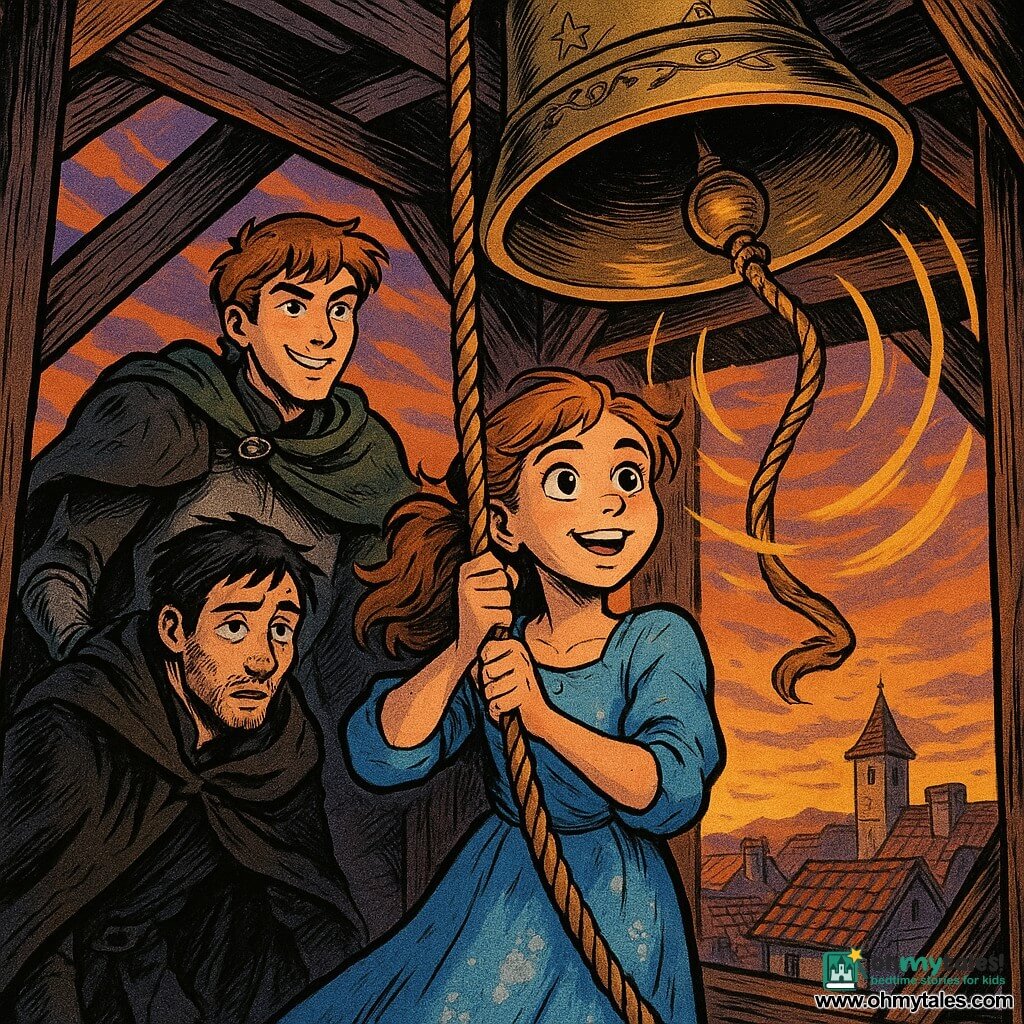
They climbed the bell tower stairs together: princess, prince, and former messenger. The steps were narrow, the air smelling of old wood and rain. Below, the village sounds drifted up—laughter, footsteps, a distant fiddle—like the kingdom breathing.
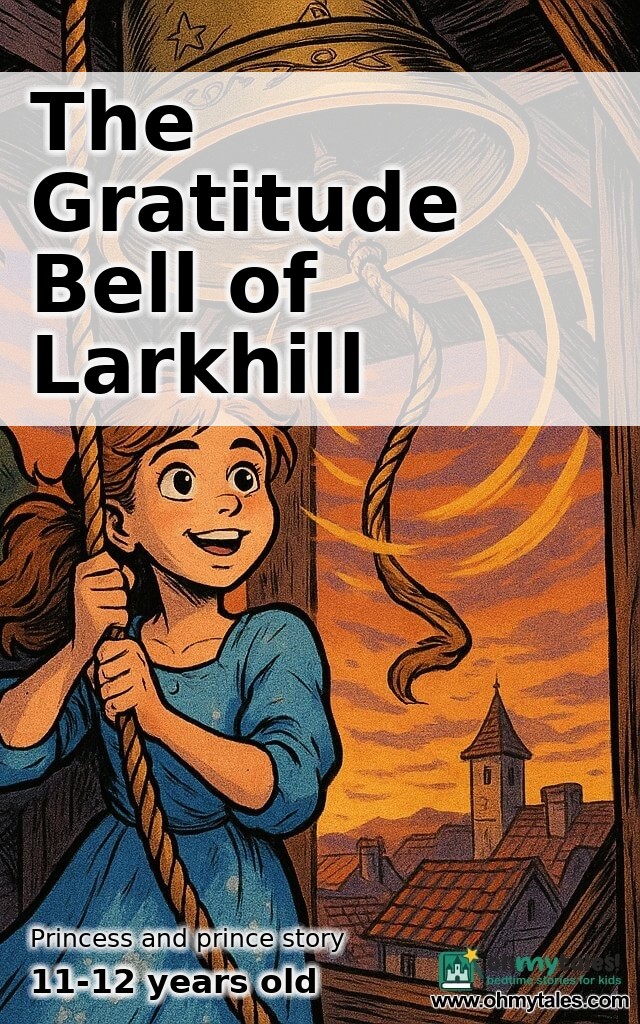
At the top, the bell waited in its wooden frame. Up close, it was enormous, etched with vines and small stars. A rope hung down, rough against Elowen's palms.
Rowan peered over the edge. “If this works, it'll be loud.”
“That's the point,” Elowen said. Her voice was steady, but her heart galloped. “Gratitude shouldn't have to whisper.”
Sable stood back, as if afraid to hope. Hope is a shy creature, Elowen thought. It comes near only when it feels safe.
Elowen looked at Rowan. “Together?”
Rowan nodded. “Together.”
They took the rope—Elowen's hands above, Rowan's below—and pulled.
At first, nothing happened. The bell stayed still, stubborn as a closed door.
Elowen shut her eyes and pictured everyone she had thanked: flour-dusted hands, sweeping bristles, needle and thread, guard's steady stance. She pictured Sable walking through storms with letters against his chest. She pictured her own thank-yous, not as coins, but as lanterns lining a dark road.
“Please,” she whispered—not to the bell, but to the idea of a kinder kingdom. “Let people feel seen.”
She pulled again.
The bell moved.
A single deep note rolled out, slow and rich, like a golden wave. It flowed across rooftops and down alleys, over warm stones and wooden benches, into open windows and quiet hearts. The sound did not scold or command. It invited.
Down in the square, people looked up. Conversations paused. Even the pigeons stilled, as if listening.
The bell rang again—clearer this time—until the air itself seemed to shimmer.
Sable exhaled, and something like a smile found its way onto his face, small but real. The wet-stone cloak slipped from his shoulders, and for a moment, the dusk light made him look less like a shadow and more like a person.
Rowan nudged Elowen, grinning despite himself. “Your lantern worked.”
Elowen looked out at her kingdom, bathed in the bell's fading echo. She felt tired, but it was the good kind of tired—the kind you feel after planting a garden.
Lady Meris stood in the square below, her face turned upward. Even from this distance, Elowen could tell she was smiling.
Elowen thought of the moral her tutor had tried to teach, and of the one her own feet had learned on warm stones:
Gratitude is not a tiny word tossed behind you. It is a light you carry forward. And when you share that light, hope stops hiding.
The bell gave one last, gentle chime, like a promise settling into place.