Chapter 1: The Prince Who Longed for Pieces
In the Kingdom of Lumenfair, the towers were round as moons and the battlements shone pale as seashells. Bright pennants fluttered from every turret, stitching the sky with color—scarlet, sapphire, and a green so lively it seemed to laugh in the wind.
Prince Hardy lived in the highest tower, where the windows were wide and the horizons generous. He was brave enough to ride at dawn, polite enough to bow to bakers, and thoughtful enough to notice when a servant's hands trembled from carrying too much.
Yet his deepest wish was not for a new horse, or a louder trumpet, or even a grander crown. It was, strangely and dearly, to finish a puzzle.
Not an ordinary table puzzle with a missing corner and a picture of a cat. Hardy longed for the legendary puzzle of Lumenfair: the Star-Map Mosaic, a puzzle said to be made from the kingdom's own hopes, pressed into pieces like sweets in a mold. When completed, it would reveal a path through any confusion—through foggy feelings, tangled problems, even the secret knots of worry.
At supper, his father, King Alderic, spoke of duties and treaties. His mother, Queen Seraphine, spoke of kindness and patience, as if they were flowers that needed watering.
Hardy pushed peas around his plate like tiny green marbles.
“Mother,” he said, “do you think the Star-Map Mosaic is real?”
The Queen's eyes softened. “Some treasures are real because people keep believing in them.”
King Alderic set down his goblet. “Belief is fine, but a prince needs proof. Puzzles are for idle afternoons.”
Hardy tried to smile. “Then I shall find proof, Father. And perhaps a little afternoon, too.”
A court jester nearby—thin as a question mark—chirped, “Careful, Highness. Some puzzles bite!”
Hardy laughed, but only a little. Desire can be a lantern; it lights your way, but it can also show you how far the road goes.
That night, while the castle slept and the flags whispered like paper birds, Hardy visited the royal library. The shelves rose like dark cliffs, and the candles flickered in their golden cups, nodding like sleepy heads.
There, behind an atlas of storms, he found a folded note sealed with pale blue wax. The seal bore a simple symbol: a small star broken into five parts.
Hardy's heart clicked, as if a hidden piece had finally found its place.
He broke the seal and read:
“Seek the puzzle where hope hides—beneath the round towers, beyond the bright battlements, past the lake that mirrors dreams. Take courage gently, as you would carry a candle through wind.”
Hardy breathed in, and the air tasted of dust and destiny.
“Then tomorrow,” he whispered to the shadowy stacks, “I begin.”
Chapter 2: A Riddle Under the Round Tower
Morning arrived wrapped in silver mist. The castle's crenellations shone like teeth of pale stone, and the pennants tugged at their ropes as if eager to run ahead.
Hardy slipped through the courtyard with only his small satchel and a cloak the color of midnight ink. He did not go alone for long.
At the stable gate stood Mira, the head groom's daughter, who could braid a horse's mane faster than most knights could buckle a belt. Her eyes were sharp, her grin sharper.
“Going somewhere noble and secret?” she asked.
Hardy hesitated. “How did you—”
“The castle has ears,” Mira said, tapping her own. “And you have the face of someone who's swallowed a song and can't stop humming it.”
Hardy tried for dignity and almost achieved it. “I'm searching for the Star-Map Mosaic.”
Mira's eyebrows climbed. “The royal puzzle? The one that's supposed to show a path through anything?”
“Yes.”
Mira tilted her head. “That sounds useful. Sometimes I can't find a path through my chores.”
Hardy chuckled. “Then come. I could use a friend who notices things.”
“Finally,” Mira said, and swung onto a pony as easily as a sparrow landing on a branch.
They began at the oldest round tower, the one that leaned a little, like an elder listening for gossip. Its stones were worn smooth by centuries of hands. Around its base, ivy curled in green question marks.
A narrow door lay half-hidden, and inside, a spiral staircase wound upward like a cinnamon roll.
“Are we climbing?” Mira asked.
Hardy sighed. “We are royal. We climb.”
Up they went. The air grew cooler, and the light thinner, as if the tower were drinking it. At the top, they found a small chamber with a single window. On the floor lay a circle of chalk, and inside the circle, five carved grooves shaped like star points.
Hardy knelt. “Five parts,” he murmured, thinking of the seal.
Mira peered closer. “There's writing.”
Etched into the stone were words, delicate as spider silk:
“THE FIRST PIECE IS NOT FOUND BY HANDS,
BUT BY A HEART THAT UNDERSTANDS.”
Hardy frowned. “What does that mean? I can understand with my mind.”
Mira pointed at the window. “Maybe it means you need to understand someone else.”
Outside, in the courtyard far below, a young page stood by a fountain, blinking hard. A stack of books lay at his feet, and a few pages floated away like startled doves.
Hardy watched. The page looked small against the tall world, like a comma in a long sentence.
Hardy's throat tightened. He remembered what his mother said: kindness and patience, watered like flowers.
He hurried down the stairs. Mira followed, two steps behind, silent in a way that meant she was paying attention.
In the courtyard, Hardy approached the page. “Are you all right?”
The page swiped at his eyes. “I—I dropped the treaty scrolls, and Sir Brann said if I lose another page, I'll be polishing armor until I'm ninety.”
Hardy crouched and began gathering papers. “Then we must rescue every page. A treaty is like a bridge; you don't want it missing a plank.”
The page sniffed. “You're the prince. You don't have to—”
“I want to,” Hardy said. “Besides, I'm excellent at picking up things I didn't mean to drop.”
Mira made a small sound that might have been a laugh.
They chased the last floating sheet together, cornering it against a rosebush. When the page had every paper stacked neatly again, his shoulders loosened.
“Thank you,” the page whispered, as if gratitude were a secret spell.
At that moment, the fountain's water shimmered. A small object rose from the surface like a fish made of starlight: a puzzle piece, pale and smooth, shaped like one point of a star.
Hardy stared. “So… it was found by understanding.”
Mira folded her arms. “Told you. Hearts have hands too, in a way.”
Hardy took the piece carefully. It was cool, but it warmed in his palm, like a promise waking up.
“One piece,” he said. “Four to go.”
Chapter 3: The Lake That Mirrors Dreams
The note had spoken of a lake. Lumenfair had many ponds and streams, but only one lake that people approached with quiet voices, as if loud words might splash.
They rode beyond the bright battlements, past fields where wheat bowed and lifted in golden waves. Soon the land dipped, and the air grew damp with the smell of moss and mystery.
The lake appeared like a polished shield laid flat upon the earth. Its surface reflected the sky so perfectly that it seemed you could step onto a cloud.
Mira slid off her pony. “Do you feel that? Like the world is holding its breath.”
Hardy nodded. The lake was still, but not empty. It felt watchful, like an eye that saw not faces, but thoughts.
At the shore stood a stone arch, half-covered in lichen. On its top was carved another message:
“THE SECOND PIECE LIES WHERE DREAMS ARE SEEN.
SPEAK THE TRUTH YOU'VE KEPT BETWEEN.”
Hardy swallowed. Truth could be heavier than armor.
Mira read it and whistled softly. “That's a bold riddle for a puddle with ambitions.”
“It's not a puddle,” Hardy said, then sighed. “But the riddle is… difficult.”
They stood at the water's edge. The lake reflected Hardy's face, but then the reflection shifted, like a curtain stirred by wind. In the water, he saw himself not as a prince with neat hair and steady posture, but as a boy in the library at night, pressing his forehead to the window and feeling small beneath the stars.
He heard his father's voice in his memory: Puzzles are for idle afternoons.
Hardy's chest tightened again. It was not anger, exactly. It was something like fear wearing a stern mask.
Mira watched the water too, though her reflection stayed stubbornly herself. “Well?” she asked gently.
Hardy stared at the lake until his eyes stung. “I'm afraid,” he said, and the words fell into the air with a soft thud, like a book closing. “I'm afraid that if I want something that seems silly—like a puzzle—people will think I'm not fit to be a prince.”
Mira blinked. “That's your secret? Hardy, wanting to understand things isn't silly.”
“It feels silly,” Hardy insisted, voice wavering. “Like chasing fireflies while others forge swords.”
Mira crouched and skimmed a pebble across the lake. It bounced three times, each skip a tiny act of defiance.
“Listen,” she said. “A sword cuts. A puzzle connects. A kingdom needs both. Besides, if you can't admit what you want, how will you ever lead anyone through what they want?”
Hardy stared at her. Her words were plain, but they shone.
The lake rippled. From beneath the surface, a second puzzle piece rose, darker than the first, like a sliver of night sky.
Hardy reached for it, then paused. “Mira?”
“Yes?”
“Thank you. For… not laughing.”
Mira shrugged, but her smile was warm. “I save my laughter for the right times. Like when a prince tries to be serious and ends up dripping lake water down his sleeve.”
Hardy looked at his soaked cuff and groaned. Mira laughed, and the lake seemed to laugh too, its surface glittering.
Two pieces now lay in Hardy's satchel. They felt heavier than stone and lighter than feathers—like hope, which can weigh on you until you share it, and then it becomes a lift.
Chapter 4: The Whispering Market of Mothlight
To find the third piece, they followed an old road paved with pale cobbles that gleamed at dusk. Lanterns along the path lit one by one, as if night were being politely introduced.
They reached Mothlight Market just as its stalls opened like bright petals. The market was hidden between two hills, and tiny moths with silver wings fluttered above the lamps, making the air sparkle. Merchants called out in cheerful voices, selling cinnamon buns, ribbon spools, enchanted buttons that changed color with mood, and maps that insisted on being folded the “proper way.”
Hardy tugged his cloak forward. “We should be discreet.”
Mira snorted. “A prince trying to look ordinary is like a swan trying to look like a duck. But fine.”
They wandered through the stalls, scanning for anything that might fit a star. Hardy's satchel seemed to hum faintly, as if the two pieces were eager for their siblings.
At the center of the market stood a wooden booth painted midnight blue. Above it hung a sign: “MADAM BRAMBLE'S LOST-AND-FOUND (AND FOUND-AND-LOST).”
Inside sat an old woman with hair like spun sugar gone gray. Her eyes were bright as pins.
“Well, well,” she said. “A prince and a pony-girl. How charmingly predictable.”
Hardy stiffened. “How do you know who I am?”
Madam Bramble smiled, showing one gold tooth. “Secrets leak. Especially royal ones. Now—are you here to buy something, or to be bought by something?”
Mira leaned on the counter. “We're looking for a puzzle piece.”
“Ah,” Madam Bramble said, and she drew out the word like a ribbon. “The Star-Map Mosaic. A puzzle that pretends it's about stars, but is actually about people.”
Hardy's hands curled. “Do you have a piece?”
“I might,” she said. “But my pieces don't like greedy hands. They prefer bargains.”
“What sort of bargain?” Hardy asked cautiously.
Madam Bramble lifted a small hourglass. Instead of sand, it held glittering dust that rose upward.
“A choice,” she said. “I will offer you two boxes. One contains a glittering trinket that will impress the court. The other contains your third puzzle piece. But you must choose without opening them.”
Mira muttered, “That's suspiciously dramatic.”
Hardy looked at the boxes. One was wrapped in gold paper and tied with a shining bow. The other was plain wood, scratched and humble.
His fingers hovered over the gold one. He imagined returning to the castle with a dazzling object, proving he had been on an adventure that looked like an adventure.
Then he remembered the page's shaky hands and the lake's honest ripple. He remembered that hope wasn't always shiny. Sometimes it was a plain box that you chose because it mattered.
Hardy placed his hand on the wooden box.
“I choose this,” he said.
Madam Bramble's smile widened, and for a moment she looked less like a merchant and more like a guardian of old stories.
“Good,” she said. “Because if you'd chosen the gold box, you would have gained applause and lost yourself.”
Mira exhaled loudly. “I hate it when old ladies are right.”
Madam Bramble slid the wooden box forward. Hardy opened it. Inside lay the third piece, tinged with dawn-pink, shaped to fit the star's growing form.
Hardy lifted it carefully. “Thank you.”
Madam Bramble tapped the counter. “Don't thank me yet. The fourth piece is the trickiest. It's guarded by something that isn't a monster… but can still stop you cold.”
“What?” Hardy asked.
Madam Bramble's eyes flicked toward the darkening sky. “Doubt,” she said. “And it wears a familiar face.”
As Hardy and Mira left the booth, the moths swirled above them, writing bright loops in the air like punctuation marks to a sentence that wasn't finished yet.
Chapter 5: The Knight of Doubt
They rode back toward Lumenfair under a sky stitched with stars. The castle towers rose ahead—round silhouettes against the night, their pennants barely visible, like sleepy dragons' tongues.
Near the outer wall, a figure waited on the road, blocking the way. A knight in polished armor sat astride a tall horse. His helmet was tucked under his arm, and the moonlight lit his face.
Sir Brann.
Hardy's stomach dropped as if it had missed a step. Sir Brann was captain of the guard: loyal, stern, and famous for frowning at joy until it apologized.
Mira muttered, “Of course.”
Sir Brann lifted a hand. “Your Highness,” he said, voice like iron cooled too quickly. “Out after dark with no escort. With… company.”
Hardy tried to keep his voice steady. “I am on a matter of importance.”
Sir Brann's gaze flicked to Mira, then back. “Important as in war? Or important as in a whim?”
Hardy's fingers tightened on the reins. The words Madam Bramble had spoken echoed: Doubt wears a familiar face.
Hardy could lie. He could claim he was inspecting borders or investigating smugglers. It would be easy. Lies are like shortcuts through a swamp; they look faster until you sink.
Instead, Hardy lifted his chin. “I am searching for the Star-Map Mosaic.”
Sir Brann stared, then barked a short laugh. “A puzzle? Forgive me, Highness, but that is not the sort of quest that makes songs.”
Hardy's cheeks burned. For a moment, the old fear returned—small as a thorn, sharp as a needle.
Mira leaned forward. “Songs aren't the only thing that matters,” she snapped. “Sometimes you need a map more than a melody.”
Sir Brann's eyes narrowed. “And you encourage this nonsense?”
Hardy raised a hand, gentle but firm. “Mira has helped me. And I am not ashamed of wanting to complete something that teaches understanding.”
Sir Brann's horse shifted, restless. “The King will not approve.”
Hardy breathed in slowly. He thought of the first piece rising from the fountain when he helped the page. He thought of the lake giving its gift when he spoke the truth. He thought of the plain box that held what mattered.
Hope, he realized, was not the loud cheer of a crowd. It was the quiet decision to keep going when someone laughed.
“Then I will speak to my father,” Hardy said. “But I will not abandon this.”
Sir Brann studied him for a long moment. The night was still. Even the pennants on the wall seemed to pause.
Then Sir Brann did something unexpected. He lowered his gaze, just slightly.
“You remind me of your mother,” he said quietly. “She once insisted on planting roses in a courtyard full of stone. I thought it was foolish. But now the roses climb the walls and soften them.”
Hardy blinked. “Does that mean—”
“It means,” Sir Brann said, “that I will not drag you back like a runaway child. But I will accompany you to the place where the fourth piece is said to hide. If you insist on walking into trouble, at least do it with a shield nearby.”
Mira's mouth fell open. “Did… did your face just… unfrown?”
Sir Brann cleared his throat. “Do not be absurd.”
They rode together through a small postern gate and into the oldest part of the castle grounds. Sir Brann led them to a narrow stairwell carved into the stone itself, descending beneath the round towers.
At the bottom was a door of dark wood with a star carved into it—missing one point.
Hardy's satchel throbbed as if it had a heartbeat.
Sir Brann placed a hand on the door. “Beyond this lies the Corridor of Echoes,” he said. “It repeats what you fear most, until you either crumble… or learn.”
Hardy swallowed. “And the fourth piece?”
Sir Brann's voice softened. “If the stories are true, it appears only to those who keep walking.”
Mira gave Hardy a small nudge. “You've come this far. Don't let a hallway bully you.”
Hardy managed a smile. “Since when do hallways have such confidence?”
“Since always,” Mira said. “They're very linear.”
Hardy groaned, and even Sir Brann's mouth twitched, just barely.
Hardy pushed the door open.
Chapter 6: The Lighted Corridor
The corridor beyond was long and narrow, lit by torches that burned with a steady, honey-gold glow. The light did not flicker wildly; it breathed, calm and constant, as if it trusted the darkness to behave.
The walls were smooth stone, but they seemed to shimmer faintly, like the inside of a seashell. The air smelled of cedar and old vows.
As they stepped forward, the corridor began to whisper.
Not with voices like people, but with sounds like thoughts: quick, sly, and slippery.
“You'll never finish,” the corridor sighed.
“You'll disappoint everyone,” it murmured.
“You're a prince—why do you want childish things?”
Hardy's steps faltered. The whispers felt like cold fingers trying to pinch out his courage.
Mira walked beside him, jaw set. Sir Brann was behind them, silent as a guard statue.
Hardy pressed a hand to his satchel. The three pieces inside felt like small, steady stones. He remembered the page's relief. He remembered his own truth at the lake. He remembered choosing the plain box.
“I want to finish the puzzle,” Hardy said aloud, voice firming like clay in a potter's hands, “because it teaches me to see the whole picture, not just my own corner.”
The corridor whispered back, sharper now:
“What if you fail?”
“What if you are laughed at?”
“What if hope is only a story?”
Hardy's throat tightened. But the torches kept glowing. The corridor's light did not scold him for trembling. It simply illuminated his next step.
Hardy took that step anyway.
“I might fail,” he admitted. “But hope isn't a guarantee. It's a choice.”
The whispers wavered, as if startled.
Mira added, “Also, if you're going to be laughed at, it's better to be laughed at for being kind than for being cruel.”
Sir Brann rumbled, “And better to be laughed at while standing up than praised while kneeling.”
Hardy glanced back at him. “Did you just say something inspiring?”
Sir Brann's ears turned slightly red. “The corridor is… annoying.”
They continued. The whispers grew softer, like bullies losing interest when their target refuses to cry.
At the corridor's far end stood a pedestal of pale stone. On it lay the fourth puzzle piece, bright as morning, shaped like the missing point on the door.
Hardy approached as if nearing a sleeping animal. When he touched the piece, warmth spread up his arm, and the torches flared—not wildly, but joyfully, as if the corridor itself approved.
Only one piece remained.
Hardy turned, and the corridor behind them seemed less narrow now, less threatening. It was still long, but it felt like a path rather than a trap.
As they walked back, the torches lit their way in a gentle procession, each flame a small banner of light.
Hope, Hardy thought, was like this corridor: it didn't erase the dark, but it taught you how to walk through it without losing your name.
At the door, Sir Brann stopped. “The final piece,” he said, “is not hidden in stone or water or markets. It is… in the King's Solar.”
Hardy froze. “My father's room?”
Sir Brann nodded. “Your mother placed it there years ago. She said that when you were ready, you would come not as a child asking permission, but as a prince offering understanding.”
Mira's eyes widened. “That's very… queenly.”
Hardy's stomach fluttered. Facing riddles was one thing. Facing his father's disappointment was another.
But the corridor behind him still glowed, as if reminding him: Keep walking.
Hardy squared his shoulders. “Then I will go.”
Chapter 7: The Whole Star
The King's Solar was a high chamber with wide windows and a hearth that smelled of pine. Maps covered one wall, and a long table held documents stacked like small, stubborn towers.
King Alderic stood by the window, hands clasped behind his back. He turned as Hardy entered, Mira and Sir Brann waiting respectfully at the door.
Hardy bowed. “Father.”
The King's gaze moved over Hardy's dusty boots and travel-worn cloak. “You were gone,” he said, voice controlled. “Sir Brann tells me you chased… a puzzle.”
Hardy felt the corridor's whispers in his memory, trying to creep back. He breathed in and spoke before fear could steal his words.
“Yes,” Hardy said. “I searched for the Star-Map Mosaic. Not to play, but to learn. Each piece was given when I helped someone, told the truth, chose what mattered, and kept walking through doubt.”
The King's eyebrows rose, slightly. “And what do you have to show for this… learning?”
Hardy opened his satchel and placed the four pieces on the table. They gleamed softly against the dark wood, like bits of fallen star.
King Alderic stared. For a moment, his sternness cracked, just a hairline.
“They are… real,” he murmured, as if surprised that legend could sit on paperwork.
Hardy swallowed. “I believe the final piece is here, Father. Mother hid it.”
At the mention of the Queen, the King's eyes softened, though his mouth stayed firm. He walked to the hearth and lifted a small carved box from the mantel. He held it as if it were fragile as a memory.
“She did,” he said quietly. “She told me to keep it until you came with a reason worth more than excitement.”
He opened the box. Inside lay the fifth piece, shining like a pale flame.
Hardy's breath caught. “May I?”
The King nodded once.
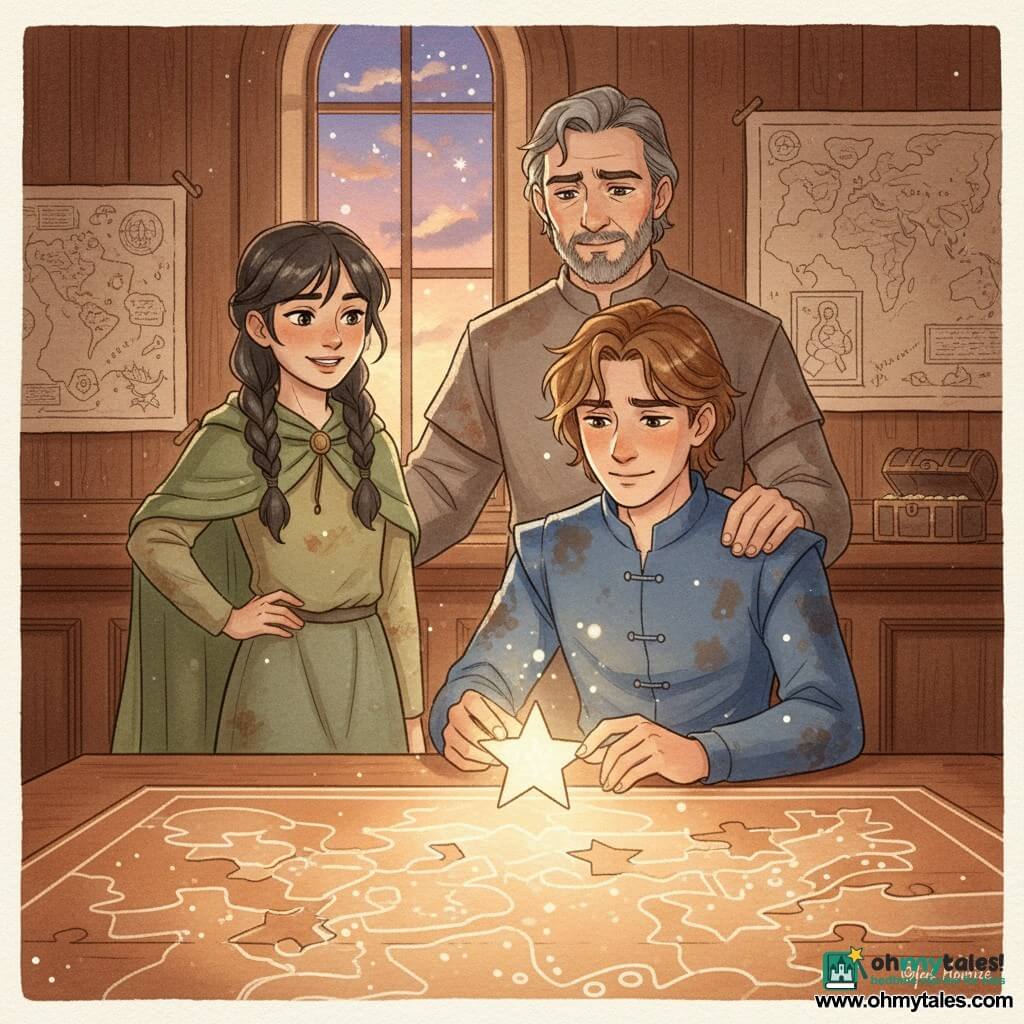
Hardy took the final piece and set it with the others. They tugged toward one another, as if magnets lived inside them. With a faint click—like the satisfying end of a long search—the star came together.
Light spilled across the table, forming a delicate map of lines and symbols: a path winding through the kingdom, looping not around dangers, but through them, marking places where help could be found and kindness offered. At the center of the map pulsed a small star, steady as a heartbeat.
King Alderic looked at the glowing pattern. His voice was quieter now. “I thought strength meant never wasting time on softness.”
Hardy met his father's eyes. “Strength can be soft, Father. Like a candle in wind. It bends, but it doesn't go out.”
The King stared, then gave a slow nod, as if fitting a long-missing piece into his own understanding.
“You went seeking a puzzle,” he said. “And returned with… a way to lead.”
Mira, unable to help herself, whispered, “And also with wet sleeves and terrible jokes.”
Sir Brann cleared his throat. “The jokes were not tactical.”
Hardy laughed, relieved. Even the King's mouth curved, small but real.
The Star-Map Mosaic's light rose from the table and drifted outward, casting a gentle glow down the hall beyond the Solar. The corridor outside brightened, each torch catching the map's shimmer until the passageway looked like a river of gold running through stone.
Hardy stood at the doorway and looked down that lighted corridor. It seemed to promise that no matter how twisting life became, there would always be a next step you could see—if you carried hope like a lantern and listened with your heart.
King Alderic placed a hand on Hardy's shoulder, firm and warm. “Go on, my son,” he said. “And when the world feels like scattered pieces, remember: you do not find the whole by forcing it. You find it by caring for every part.”
Hardy nodded. The corridor shone ahead, lit and welcoming.
And with his friends beside him and hope bright in his chest, the prince walked forward—ready to help his kingdom fit itself into a kinder, clearer picture.