Chapter 1: The Suitcase and the Same Small Things
Milo liked summer best when it had a shape.
At home, summer could feel like a long blank page. But at Grandma Lina's seaside village, it always began the same way: the squeaky gate, the smell of warm stone, and Grandma calling, “Shoes off by the door, my sandy explorers!”
Milo stood on the porch with his backpack straps tight in his hands, listening. A gull cried somewhere beyond the roofs. The air tasted like salt and sun.
Beside him, Nia bounced on her toes. She was eleven too, but she moved like she had springs hidden in her sneakers. “Do you think the bakery still sells those lemon buns?”
“If they don't,” Milo said, “I will be very disappointed in the village.”
Nia grinned. “Dramatic.”
He was a little dramatic. But the rituals helped. They kept his thoughts from spinning like a pinwheel in wind.
Grandma Lina hugged them one at a time, her arms strong and warm. Then she pointed at the little chalkboard sign by the door. She always wrote the same message when they arrived.
WELCOME, SUMMER GUESTS!
1) Drink water.
2) Say hello to neighbors.
3) Respect the sea.
Milo read it out loud, because reading it was part of the welcome. “Respect the sea,” he finished, and nodded as if he had signed an agreement.
“Good,” Grandma said. “Now you can unpack. And then—” She lowered her voice like it was a secret. “We walk to the harbor. The boats have returned.”
Nia's eyes widened. “Today?”
“Today,” Grandma confirmed. “But first, your ritual.”
Milo relaxed. “Lemon buns?”
Grandma winked. “Lemon buns.”
They went to the bakery with the late-afternoon sun warming the backs of their necks. Milo liked the street because it was easy to remember: the blue door with a shell stuck above it, the cat that always sat in the same window, the fountain that splashed in a steady, patient rhythm.
Outside the bakery, a wooden sign leaned against a pot of rosemary.
TODAY'S SPECIAL:
LEMON BUNS
HONEY BREAD
LOCAL FIGS
Milo traced the letters with his eyes. Signs were like friendly voices that didn't rush you.
Inside, the baker, Mr. Armand, dusted flour from his hands. “Two little travelers,” he said. “Back again.”
Nia sniffed loudly. “It smells like a cloud made of sugar.”
Mr. Armand laughed. “A very accurate weather report.”
They carried their buns out into the bright street, and Milo took a careful bite. The lemon was sharp and sweet at the same time, like a surprise that turned out well.
“This,” he said solemnly, “is why I believe in traditions.”
Nia bumped his shoulder. “I believe in snacks.”
Milo chewed and watched the sunlight slide along the stones. Summer was starting to take its shape.
Chapter 2: The Harbor Notices
The harbor path curled downhill, and the air grew cooler near the water. Fishing nets hung like tired lace. The sea glimmered, bright and busy, as if it had secrets.
Grandma Lina walked between them. She had a basket on her arm and a slow, steady pace that matched Milo's breathing. Nia kept darting ahead and returning, like a curious bird.
At the entrance to the docks, a tall board stood with weathered information panels. Milo stopped automatically.
“Come on!” Nia called. “The boats!”
“One second,” Milo said, already reading.
WELCOME TO PORT SAINT-LUC
PLEASE:
— DO NOT CLIMB ON MOORING ROPES
— KEEP DISTANCE FROM WORKING CREWS
— NO PLASTIC BAGS (PROTECT THE SEA TURTLES)
— GREET THE FISHERS WITH RESPECT
He read each line carefully, hearing the voice inside his head say them in an even tone. Rules were like railings on stairs. You didn't have to grab them, but they were there.
Grandma watched him with soft eyes. “Good habit,” she said. “The harbor has its own manners.”
Nia leaned in. “Sea turtles? Do they really come here?”
“Sometimes,” Grandma said. “When the water is calm and warm.”
Nia's face grew serious. “Then no plastic. Got it.”
They walked along the dock, stepping around coils of rope and puddles that reflected the sky. The fishers were unloading crates. Their hands moved fast and sure. A man with a red cap waved at Grandma.
“Lina! You brought the young ones.”
“We did,” Grandma called back. “They will behave.”
Milo felt his shoulders straighten. He wanted to behave. He wanted to belong, even for a few weeks.
They stopped by a small boat with faded green paint. On its side, a name was painted in white letters: MARIE-LOU.
A fisher with sun-browned cheeks pointed at a poster on the nearby post.
LOCAL FESTIVAL THIS SATURDAY
— TRADITIONAL BOAT BLESSING
— MUSIC IN THE SQUARE
— PLEASE WEAR LIGHT COLORS
— BRING FLOWERS FOR THE SEA
“Boat blessing?” Nia repeated.
The fisher smiled. “We do it every year. We thank the sea for what it gives. We ask it to be kind.”
Milo read the poster twice, as if the second reading would place the words more safely inside him. “Bring flowers,” he murmured.
Grandma touched his shoulder. “We will.”
Nia tilted her head. “What kind of flowers?”
“Whatever grows,” Grandma said. “But no picking from protected dunes. There's a sign for that too.”
Milo felt a small spark of pride. He liked that Grandma cared about signs the same way he did.
As they headed home, the sun began to soften. Milo kept seeing the words in his mind: BRING FLOWERS FOR THE SEA.
A tradition wasn't just a thing people did. It was a way of saying, We remember. We respect.
And somehow, that made summer feel even more real.
Chapter 3: The Courtyard Playground
The next morning, the village woke up slowly. Heat shimmered above the road. The cicadas buzzed like tiny electric engines. Grandma Lina set a jug of water on the table and lined up three glasses.
“Morning ritual,” Milo said, and poured carefully.
Nia raised her glass like a toast. “To not melting.”
After breakfast, Grandma pointed out toward the courtyard behind the house. It was a simple space: a rectangle of stone, a fig tree, and an old wall with sun-worn paint. There were no swings or slides. Just open air and the smell of leaves.
“Perfect,” Nia said, as if Grandma had revealed a secret amusement park.
Milo squinted. “For what?”
“For an improvised playground,” Nia announced. “We can build one.”
Milo liked things that already had instructions. A playground built from nothing sounded like trouble. Still… the courtyard did look inviting. The stones held warmth like a gentle hand.
Grandma smiled. “You may use what you find. But no damaging the wall. It's older than me.”
Nia saluted. “Yes, ma'am.”
They gathered items like careful scavengers: a chalk box from the kitchen drawer, two lengths of old rope from the shed, a broom, and three empty crates Grandma said they could borrow.
Nia drew a hopscotch grid on the stones. “Classic,” she said. “But with a twist.”
“What twist?” Milo asked.
She wrote small challenges in the squares: CLAP TWICE, SPIN ONCE, SAY A KIND THING, NAME A FISH.
Milo read them aloud, smiling at “NAME A FISH.” “Sardine,” he offered.
“Too easy,” Nia said. “Next time: mackerel.”
Milo helped tie the rope low between two sturdy hooks on the wall, making a line to jump over. Then they stacked crates into a wobbly obstacle to step across.
When they tested it, Nia flew through like she had practiced in secret. Milo went slower, watching his feet.
“Don't overthink,” Nia said.
“I don't,” Milo lied, stepping onto a crate that creaked dramatically.
Nia held out her hand. “Balance buddy.”
He took it. Her grip was firm and warm, not teasing. Milo made it across without falling, and a small laugh escaped him.
They added rules, because rules made it feel safer.
“Rule one,” Milo said, “no pushing.”
“Rule two,” Nia said, “if someone messes up, you cheer, not laugh.”
Milo nodded. “Rule three: water breaks.”
They wrote the rules on a piece of cardboard and propped it near the fig tree. Nia insisted on a sign.
IMPROVISED PLAYGROUND
OPEN DAILY
BE KIND
DRINK WATER
RESPECT THE FIG TREE
Milo read it with satisfaction. “Now it's official.”
They played until their cheeks were pink. Chalk dust coated Milo's fingers like pale flour. The courtyard echoed with their footsteps and their jokes. Even the fig tree seemed to watch, its leaves flickering in the breeze.
At one point, Milo missed a hop and landed with a thump.
He froze, waiting for the sting of embarrassment.
Nia clapped. “Great thump! Ten out of ten sound effects.”
Milo laughed so hard he had to sit down.
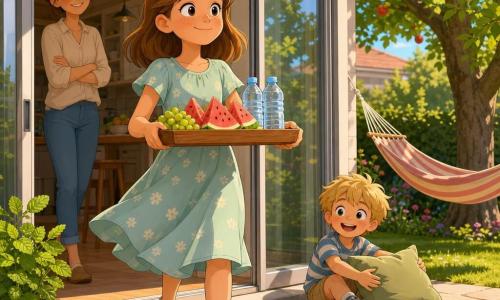
When Grandma brought out slices of cold watermelon, Milo ate slowly, feeling the sweet juice drip down his wrist. He looked at the chalk grid, the rope, the crates, and the sign.
It wasn't a real playground. But it was theirs. And it had rules that made space for fun.
That felt like growing up in a quiet, surprising way.
Chapter 4: The Dunes and the Small Choices
On Wednesday, Grandma Lina suggested a walk to the dunes in the late afternoon, when the sun wasn't as sharp. Milo liked that she always explained the plan ahead of time.
They packed their ritual items: water, hats, and a cloth bag for any litter they might find.
Nia swung the bag proudly. “We are official beach helpers.”
Milo adjusted his hat. “We are unofficial but enthusiastic.”
At the dunes, a wooden post held another information panel, sun-bleached but readable. Milo stopped to read, as always.
PROTECTED DUNES
— STAY ON THE PATH
— DO NOT PICK FLOWERS
— BIRDS NEST HERE
THANK YOU FOR RESPECTING LOCAL NATURE
Nia leaned close. “So we can't pick flowers here for the festival?”
“Not from the dunes,” Grandma said. “We can pick from our garden, or buy from the market. Traditions and nature go together. One should not hurt the other.”
They followed the path between tall grasses that whispered against their legs. The sand was warm under Milo's shoes. Somewhere, a small bird chirped, quick and nervous.
Nia pointed. “Look, tiny tracks.”
Milo crouched. “Maybe a lizard.”
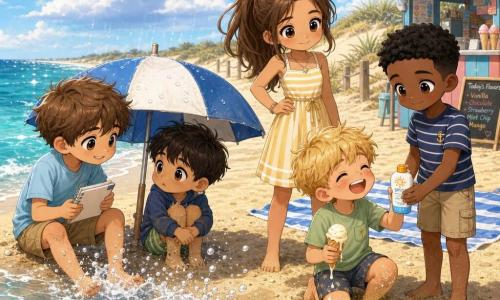
They reached a spot where the path widened and the sea appeared, wide and shining. The smell was stronger here, clean and salty. Milo breathed in slowly.
A plastic bottle rolled near a clump of grass, clicking against a shell.
Nia grabbed the cloth bag. “Target spotted.”
Milo picked up the bottle carefully, as if it might bite. “I don't get it,” he said. “There are signs.”
Grandma's voice stayed gentle. “Some people forget. Some people don't look. But we can choose differently.”
Milo dropped the bottle into the bag. The small action felt like placing a stone in the right spot.
On the way back, they passed a little market stall near the road. A woman arranged bunches of wild-looking flowers in buckets of water.
A handwritten sign said:
LOCAL FLOWERS
ASK BEFORE TOUCHING
THANK YOU
Milo read it out loud. Nia, for once, didn't rush.
The woman looked up. “Hello, young ones.”
Grandma greeted her with a familiar nod. “Good evening, Marta. We will need flowers for the blessing.”
Marta's smile widened. “Of course. These were grown in my garden, not picked from the dunes. Good traditions need good care.”
Nia picked a bunch of small white flowers. “Are these okay?”
Marta lifted the bunch and checked it like a jeweler. “These are perfect. They're called sea stars. They last well in the heat.”
Milo chose a bunch with purple petals that looked like tiny fireworks. He asked, “How do you keep them fresh?”
Marta tapped the bucket. “Water, shade, and patience.”
Milo liked that answer. It sounded like advice for people too.
As they walked home, the flowers brushed Milo's arm, cool and soft. He felt proud, not loud-proud, but steady-proud. The kind that sat quietly inside you and didn't need to show off.
That night, he put the flowers in a jar of water on the windowsill. He read the harbor poster again, just to be sure he remembered.
BRING FLOWERS FOR THE SEA.
He whispered it like a promise.
Chapter 5: The Boat Blessing
Saturday arrived bright and clear, as if the sky had dressed up.
Milo woke early, not because he had to, but because his body remembered the excitement. Grandma Lina had laid out light-colored shirts on the chair, as the poster requested. Milo put his on carefully, smoothing the fabric.
Nia burst into the room already dressed. “I look like a walking cloud,” she declared.
Milo checked his reflection. “I look like a nervous marshmallow.”
“You look fine,” Nia said, then paused. “Actually, you look like someone who is about to read every sign in the village.”
Milo didn't deny it.
They walked to the square, where music drifted between the buildings. People had hung ribbons from windows. Tables were set with simple food: olives, bread, slices of melon. The air smelled like grilled fish and sunscreen.
Near the fountain, a large board showed the festival schedule. Milo stood in front of it, reading.
10:00 MUSIC PARADE
11:30 BOAT BLESSING AT HARBOR
13:00 LUNCH IN THE SQUARE
PLEASE:
— KEEP PATHS CLEAR
— RESPECT LOCAL CUSTOMS
— TAKE YOUR TRASH WITH YOU
Nia nudged him. “Milo, we're going to miss the parade.”
“I'm coming,” he said, but he read the last line one more time. TAKE YOUR TRASH WITH YOU. He liked how polite it was. Not angry. Just firm.
The parade was small but joyful. A drummer walked backward while playing, grinning like it was the easiest thing in the world. Children carried paper boats on sticks. An old man played an accordion with his eyes closed, as if he was remembering something beautiful.
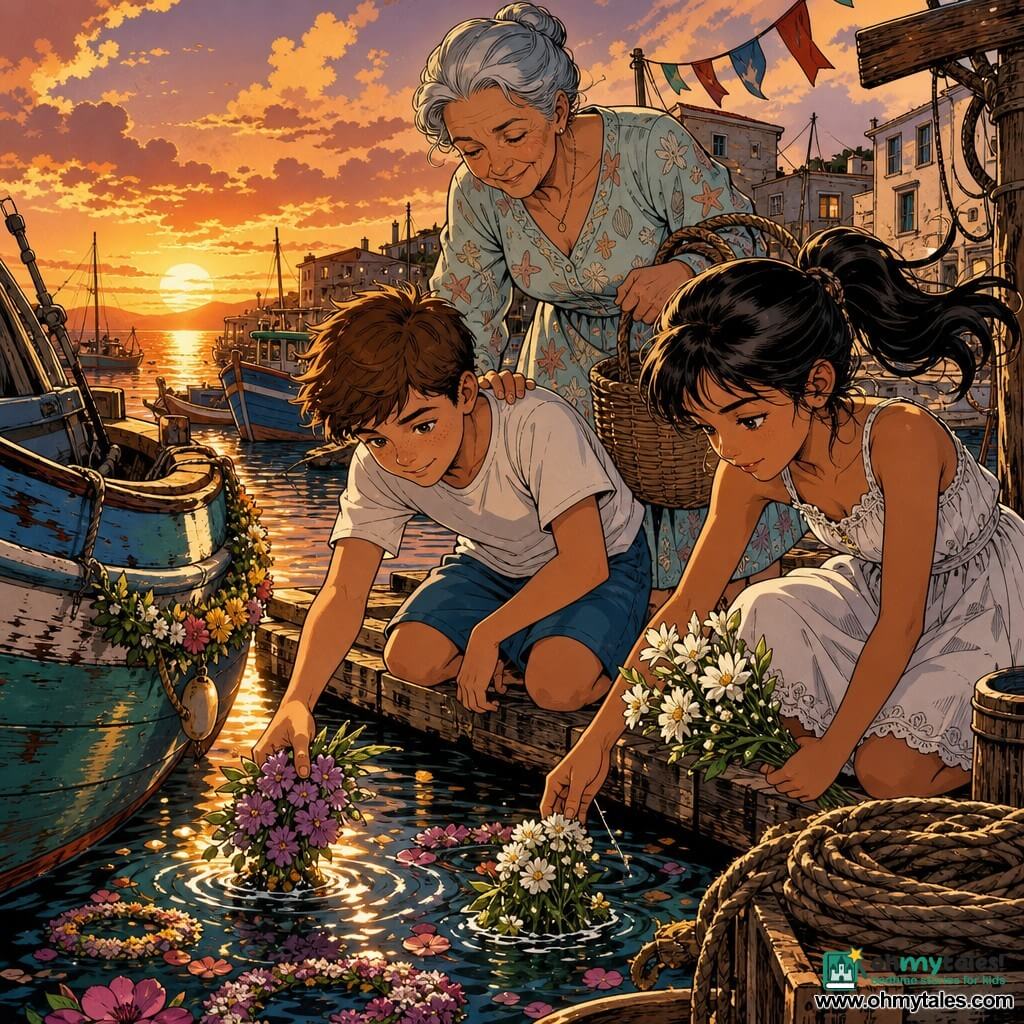
At the harbor, the boats bobbed gently, decorated with light cloth and small flags. People gathered with flowers in their hands. Milo held his purple bunch carefully, trying not to crush it. Nia held the white sea stars like they were important.
A local elder spoke in a calm voice. Milo didn't catch every word, but he understood the feeling: gratitude, respect, and a quiet kind of hope.
Then the elder dipped a bundle of herbs into a bowl of seawater and sprinkled it over the nearest boat. Drops glittered in the sun.
Nia whispered, “It's like the sea is blessing itself.”
Milo whispered back, “Or like we're saying thank you properly.”
When it was time, Grandma Lina guided them forward. “Gently,” she said.
Milo leaned over the edge of the dock and laid his flowers on the water. They floated for a moment, purple against blue, then drifted away in a slow spiral.
Nia released hers beside them. The white petals looked bright, like small stars on the surface.
Milo watched until the flowers were just dots.
He felt something in his chest loosen, like a knot he hadn't noticed. The ritual wasn't only about the sea. It was about people choosing to remember what matters, together.
On the way back, Nia spun once, arms out. “I like this festival,” she announced. “It's serious but not gloomy.”
Milo nodded. “It's like… a warm rule.”
Nia laughed. “Only you would call a tradition a warm rule.”
He shrugged, smiling. “It is.”
Later, as they ate lunch in the square, Milo saw a child drop a napkin and start to walk away. The child's mother pointed at the sign on the schedule board and said something quietly. The child ran back, picked it up, and put it in a bin.
Milo noticed it the way he noticed the tide changing. Small choices. Many of them. All day long.
He took another bite of melon and let the sweetness fill his mouth. Summer tasted like sunlight and care.
Chapter 6: The Last Evening and the Long Remembering
The final week slipped by in simple scenes: early swims when the water was cool and brave, lazy afternoons with books in the shade, and evening walks when the stones released their stored warmth.
Milo kept reading signs. Not because he had to, but because it made him feel connected, like the village was speaking to him in neat sentences.
At the beach, a sign reminded everyone:
FLAG SYSTEM TODAY:
GREEN — SAFE
YELLOW — CAUTION
RED — DO NOT SWIM
Milo always checked it. Nia teased him less now. She checked it too.
On their last evening, they returned to the courtyard. The improvised playground was faded. The chalk had softened with footsteps and wind. The cardboard sign drooped a little at the corners.
Nia poked the rope. “Our playground is getting old.”
Milo sat on a crate and listened to the fig leaves rustle. “It's supposed to,” he said. “That means we used it.”
They decided on one final round. A “farewell championship,” Nia called it, even though there were only two players.
They took turns doing the hopscotch challenges. When Milo landed on SAY A KIND THING, he looked up at Nia and said, “You make new things feel safe.”
Nia blinked, then cleared her throat dramatically. “Ew, feelings.”
Milo raised an eyebrow. “It's literally written on the ground.”
She laughed and continued hopping. When she landed on SAY A KIND THING, she paused and said, quieter, “You notice things. Like signs. Like… when people need a hand. It's good.”
The courtyard felt very still for a second, as if even the stones were listening.
Grandma Lina came out with two small cups of mint tea, warm but not hot. The smell was fresh and green. She sat with them under the fig tree.
“I liked watching you two,” Grandma said. “You played well together. You respected the house, the village, the sea.”
Milo wrapped his hands around the cup. “I like it here,” he admitted. “Because it's predictable.”
Grandma nodded like that made perfect sense. “Rituals are not cages,” she said. “They are doors. They help us enter the day with trust.”
Nia leaned back against the wall. “And then you can do new stuff inside the day.”
“Exactly,” Grandma said.
The sky turned orange, then pink, then a deep blue that made the first stars easy to spot. Somewhere nearby, a radio played softly. A dog barked once and fell silent.
Milo looked at the faded hopscotch grid and the drooping sign. He could already feel the edge of leaving, like the first cool breeze before night.
He tried to imagine forgetting this place. The lemon buns. The harbor posters. The boat blessing flowers drifting away. The small choices, repeated until they felt natural.
He couldn't.
Nia nudged him. “Hey. When we go home, we can make an improvised playground in my building's courtyard.”
Milo smiled. “We'll need a sign.”
“Obviously,” she said. “And rules.”
“Warm rules,” Milo corrected.
Nia groaned. “You and your warm rules.”
Milo laughed, and the sound fit the evening.
Later, in bed, he listened to the village settling into sleep. He pictured the sea in the dark, steady and vast. He pictured the flowers floating, the boats rocking gently, the signs standing quietly in their places.
He felt certain, in the calm way you feel certain about the taste of lemon or the sound of waves, that these memories would stay with him for a long time.