Chapter 1
Leo leaned out of the car window and breathed in the warm air. It smelled like sun-baked pine needles and something salty drifting up from the sea. His hair kept flopping into his eyes, and he didn't even mind. Summer did that to you. It made you messy in a good way.
“Are we there yet?” his little sister, Mia, asked for the sixth time.
Dad tapped the steering wheel. “We're close. Two more turns.”
Leo didn't ask. He watched. He liked knowing where they were, like he was part of the plan. He was eleven now. Almost twelve. In his mind, that meant you didn't whine about turns and traffic. You helped.
When the camping sign finally appeared—painted green with a cartoon tent—Leo pointed. “That's it.”
Mom smiled at him in the mirror. “Good eye.”
The campground opened up like a small village: rows of tents, a few caravans, a snack bar with a striped awning, and bicycles lying on their sides as if they'd fallen asleep.
Dad parked near their pitch. “All right, team. Unload time.”
“I'll do the poles,” Leo said quickly.
Dad raised an eyebrow. “Like the grown-ups?”
Leo nodded, trying to look casual. Inside, his stomach fizzed with pride.
He grabbed the bag of tent poles. It clinked and rattled like a bundle of metal spaghetti. He carried it carefully, because grown-ups didn't drop things, and also because he didn't want Mia to laugh at him.
Setting up the tent was harder than it looked. The fabric kept flapping. The poles refused to behave. A corner peg popped out and nearly snapped Leo's fingers.
“Ow!” he hissed.
Dad crouched beside him. “You okay?”
“I'm fine,” Leo said, even though his finger throbbed. “I can do it.”
Mom handed him a small mallet. “Try tapping the peg in at an angle. Like this.”
Leo copied her. Tap. Tap. Tap. The peg slid into the earth with a satisfying crunch.
“There,” he said, a little breathless.
Dad nodded. “Nice work.”
Leo stood taller. Around him, the campsite buzzed with ordinary summer sounds: zippers opening, a ball bouncing, someone laughing too loudly, a dog barking once and then deciding it was too hot to keep barking.
When the tent finally stood upright, Leo stepped back and admired it. It wasn't perfect. One side sagged slightly. But it was standing. It was theirs.
Mom handed Leo a folded paper. “Here's the campsite map. Want to check where the washrooms and the water tap are?”
Leo took it like an important document. “Sure.”
He walked with Dad down a sandy path. The sun flickered through leaves overhead. At the water tap, Leo filled their bottle, twisting the cap tight. At the washrooms, he read the signs and tried to memorize the way back.
“This is great,” he said, surprising himself with how true it felt.
Dad bumped him gently with his shoulder. “Camping does that. Makes you notice things.”
Leo noticed the way his shoes got dusty. He noticed the itch of sunscreen on his arms. He noticed that he felt… capable. Like he could carry a pole bag and not complain.
That night, when they ate pasta from plastic bowls, Leo was still glowing inside. The sky turned pale pink, then soft purple. A breeze came in from the sea and cooled his cheeks.
“I'm doing really well,” Leo told Mom quietly, like he was sharing a secret.
Mom's eyes crinkled. “I noticed.”
Leo grinned, and for once, he didn't rush his food. He let the evening stretch out, long and warm, like a cat in the sun.
Chapter 2
The next morning, the campsite smelled like toast and damp grass. Leo woke to the sound of someone pumping air into a mattress nearby. A bicycle bell chimed. Somewhere, a radio played a cheerful song that sounded like it had been trapped inside a tin can.
Leo crawled out of the tent and squinted. The sun was already bright. Mia was brushing her hair so hard her face looked serious.
“Mom said we can go to the little shop,” Mia announced. “To buy bread.”
Leo's chest lifted. “I can do it,” he said. “I'm old enough.”
Mom sipped her coffee from a mug that said BEST CAMPER. “You can both go. Leo, you're in charge.”
“In charge,” Leo repeated, trying not to look too happy about it.
They walked together, passing pitches where people were shaking out towels and hanging swimsuits on lines. Leo held the coins Mom had given him. They clinked in his pocket, heavy with responsibility.
The shop was small but busy. Inside, it was cooler. The shelves were stacked with crackers, sun cream, postcards, and bright inflatable pool rings shaped like animals.
Behind the counter stood a woman with short dark hair and a kind face. A small flag hung on the wall: red and yellow stripes. Spain. Leo remembered what Dad had said in the car: “We're in Catalonia, so you might hear Catalan and Spanish.”
Leo had practiced a few words on his phone the night before. He'd even whispered them to himself in the sleeping bag, like they were magic spells.
The woman smiled. “Hola.”
Leo froze for half a second. He felt Mia's eyes on him.
He cleared his throat. “Hola,” he said back. It came out softer than he wanted, but it came out.
Mia giggled. “He said it!”
Leo shot her a look. “Shh.”
The woman's smile widened. “¿Pan?”
Leo nodded and pointed at the bread basket. He took a deep breath. This was the part he wanted to get right.
“Por favor,” he said, carefully. Please.
The woman handed him a loaf still warm in a paper bag. The smell puffed up into Leo's face like a hug.
Leo paid, counting slowly. The coins were different here—some had strange buildings on them. He concentrated hard, like he was solving a puzzle.
When she gave him change, Leo remembered the other word. He wanted it to feel natural, not forced, but it mattered to him.
“Gracias,” he said.
Thank you.
The woman nodded with a pleased expression, as if he had just done something brave. “Muy bien,” she said.
On the way out, Leo's ears felt hot. In a good way.
Mia leaned close. “You sounded like a superhero.”
“A superhero who buys bread,” Leo said.
“That's the best kind,” Mia replied, perfectly serious.
They walked back, and Leo held the warm loaf against his chest. The paper bag scratched his arms slightly. He liked that. It made it real.
At the tent, Mom tore off a piece and handed it to him. “How did it go?”
Leo chewed. The crust cracked. The inside was soft. “I said hello and please and thank you,” he said, trying to sound normal.
Dad nodded. “In Spanish?”
Leo corrected, because he liked being accurate. “Mostly. They say ‘hola' and ‘gracias.' And maybe Catalan too, but I'm learning one step at a time.”
Mom touched his hair, gentle. “One step at a time is exactly how you learn.”
Leo looked down at the bread, then up at the bright day. He felt taller again. Not in his body—he still had the same legs—but in the way he stood inside himself.
Chapter 3
After lunch, the heat settled over the campsite like a thick blanket. Even the shadows looked tired. Dad suggested a quiet hour.
Mia groaned. “Quiet is boring.”
Leo wanted to argue, but his eyelids felt heavy. Still, he didn't want to waste the afternoon doing nothing. Grown-ups knew how to rest without feeling guilty. That was part of being grown-up too, right?
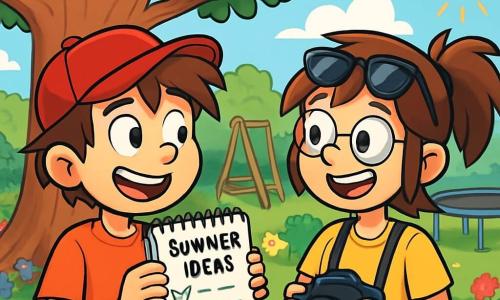
He lay on his sleeping bag with a notebook. It was blank except for the first page, where he had written: SUMMER IDEAS. The letters were messy. He didn't care.
He listened to sounds outside: flip-flops slapping, distant splashes, someone calling for a lost towel. A fly buzzed lazily near the tent door.
Leo thought about the shopkeeper's smile. How a few words had made a small bridge between them. A bridge made of “hola” and “gracias.”
He started drawing. Not perfect drawings—just fast, lively ones. A map of the campsite, but with extra things. He added a “secret shade spot” under a tree. He drew the snack bar with a dragon on top, because why not. He drew their tent like a castle, complete with a flag.
Then he had an idea that made him sit up.
He grabbed some cardboard from the box of fruit they'd bought. He cut it carefully with Mom's little scissors. He wrote in thick marker:
“GOOD MORNING = HOLA”
“THANK YOU = GRACIAS”
“PLEASE = POR FAVOR”
He copied the words three times, practicing the letters so they looked neat. He didn't want them to look babyish. He wanted them to look like someone who knew what he was doing.
Mia peeked in. “What are you making?”
“A sign,” Leo said. “A… helpful sign.”
Mia read it slowly. “Is this homework?”
Leo laughed. “No. It's camping.”
Mia looked suspicious. “Camping homework.”
“Camping creativity,” Leo corrected. He held up the cardboard. “We can hang it inside the tent. So we remember.”
Mia's face softened. “Can I decorate it?”
Leo hesitated. He liked things looking a certain way. But he also knew creativity wasn't just one person's idea. It was like making a sandwich. Better with extra ingredients.
“Okay,” he said. “But no glitter. We're in a tent.”
Mia saluted like a soldier. “Understood.”
They used colored pencils. Mia drew tiny suns around “hola” and little stars around “gracias.” Leo drew simple speech bubbles. Together, they made the sign bright but readable.
When Mom saw it, she leaned in. “This is actually really smart.”
Dad added, “And practical.”
Practical. That word made Leo's heart bounce. Practical meant grown-up.
Later, they went to the beach. The sand was hot enough to make Leo jog in silly hops. Mia laughed and tried to hop faster than him. In the water, the sea was cool and clear, and small fish flickered near their ankles like quick silver lines.
Leo practiced quietly in his head: Hola. Por favor. Gracias.
On the way back, they passed the little shop again. The same woman was stacking oranges outside.
Leo slowed. His stomach fluttered. He didn't have to say anything. But he wanted to. He wanted the words to belong to him, not just to his notebook.
He lifted his hand. “Hola.”
The woman looked up and smiled. “Hola, chico.”
Leo didn't know what “chico” meant, but he guessed it was something like kid. It didn't bother him. He felt included, like he was part of the place for a moment.
He walked on, and Mia bumped his arm. “You're getting good at this.”
Leo shrugged. “Practice.”
But inside, he felt warm, like he'd swallowed a spoonful of sunshine.
Chapter 4
That evening, the campsite changed its skin. The bright heat faded. The air cooled. People's voices softened, as if they didn't want to disturb the sunset.
And then, one by one, the little lights came on.
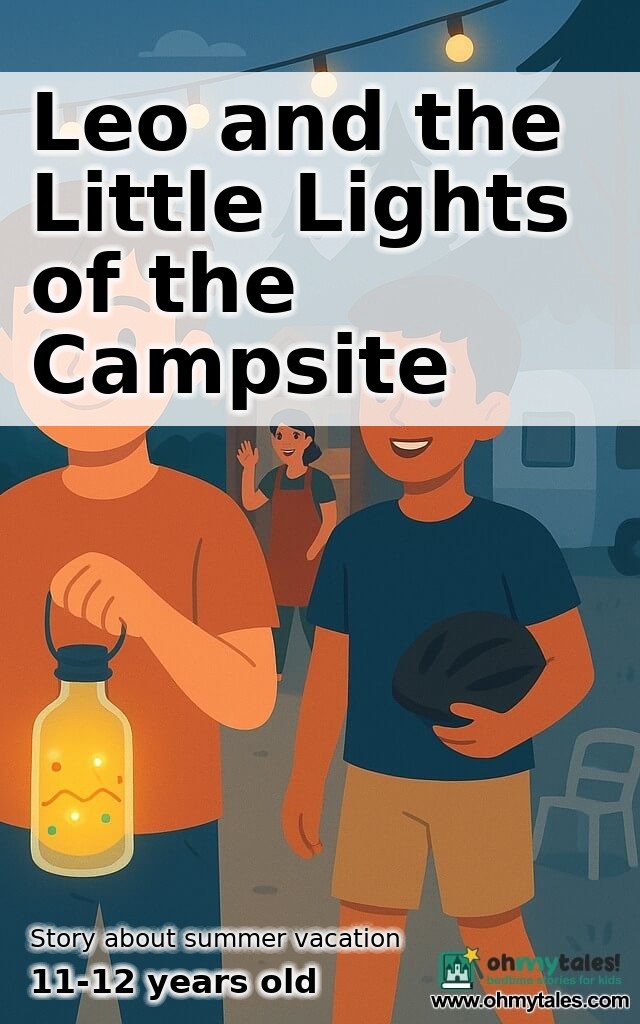
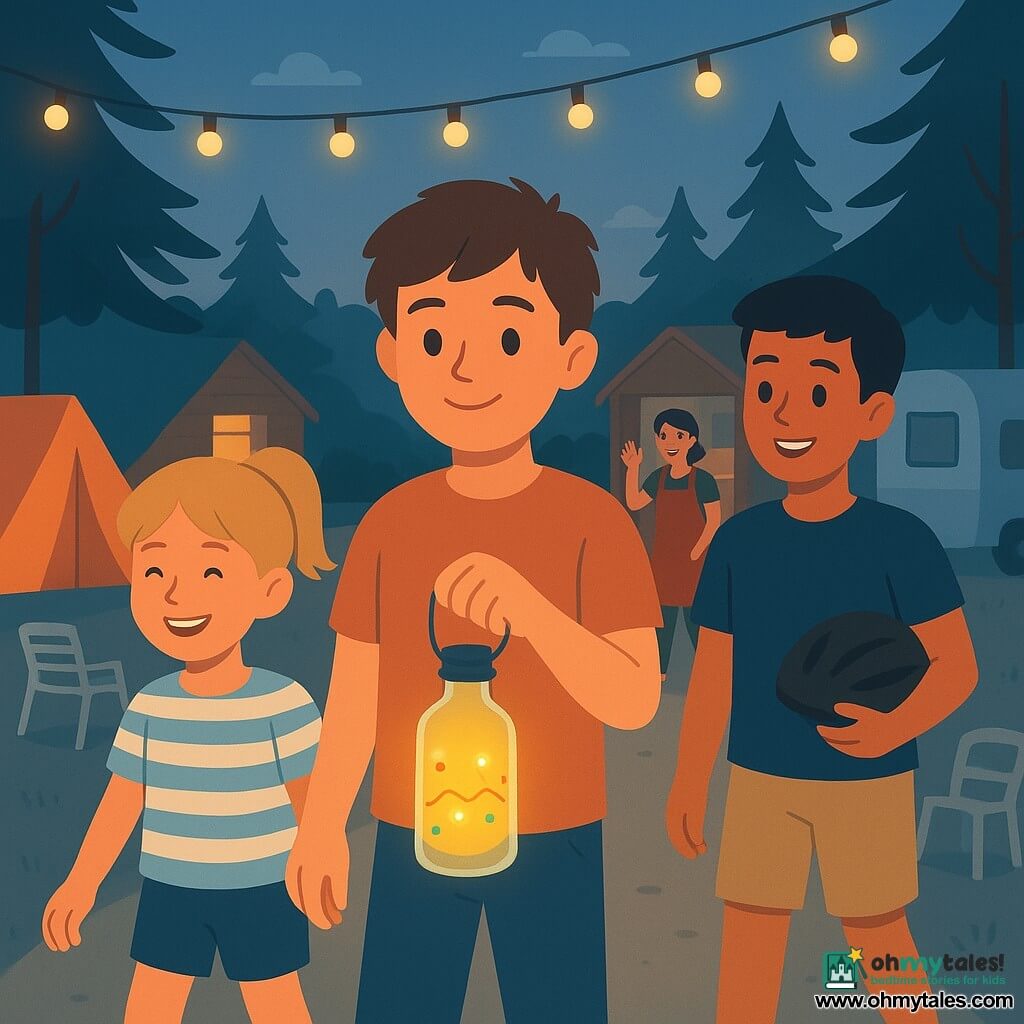
The main camping alley ran between rows of pitches. Along it, strings of tiny bulbs twinkled from posts and trees. Some were plain white. Some were colored. They made the sandy path look like a gentle runway leading into the night.
“Wow,” Mia whispered, even though no one had asked her to whisper.
Leo and his family walked down the alley to the snack bar for ice cream. Leo tried to walk with an easy, confident stride. Like the older teens he'd seen earlier, carrying their own drinks and talking as if the world belonged to them.
He held his ice cream carefully. It was melting fast, dripping down the cone.
“Grown-ups don't drip,” Mia teased.
Leo licked the melting edge quickly. “Grown-ups definitely drip,” he said. “They just pretend they don't.”
Mia snorted, and a bit of her own ice cream slid onto her hand. She stared at it in horror. “It's attacking me!”
Leo laughed. “Quick, defend yourself!”
They walked on, passing a group of campers singing softly near a guitar. The lights made everyone's faces look gentle and slightly magical, but everything was still real: plastic chairs, mosquito spray, flip-flops.
Up ahead, a boy about Leo's age was standing by a signpost, looking frustrated. He held a folded map and kept turning it upside down.
Leo slowed. He could have walked past. It wasn't his problem. But he noticed the boy's shoulders, the way they tensed, like he was trying not to look lost.
Dad leaned close to Leo. “If someone looks like they need help, you can offer. Just be polite.”
Leo's heart thudded. This felt like a test. Not a school test. A life test.
He took a breath and stepped closer. “Hey,” he said. “Do you need help finding something?”
The boy looked up, relief flickering across his face. “Yeah. I'm trying to find the bathrooms, but I keep ending up at the recycling bins.”
Leo nodded. “That happens. The bins kind of… call you.”
The boy blinked, then laughed. “Exactly.”
Leo pointed down the alley. “Bathrooms are that way. Past the big pine tree, then left at the yellow caravan.”
The boy's eyes widened. “How do you know?”
Leo tried not to grin too hard. “I did a scout walk yesterday. I'm… sort of in charge.”
“Nice,” the boy said. “I'm Nico.”
“Leo.”
They shook hands, quick and awkward, like preteens do when they want to be friendly but not dramatic.
Nico hesitated. “Are you from here?”
“No,” Leo said. “We're just on holiday. I'm learning a few words, though.”
Nico nodded. “My mom says you should always say hello and thank you. Even if your accent is terrible.”
Leo laughed. “Mine is probably terrible.”
“That's fine,” Nico said. “At least you try.”
They walked together for a few steps. The little bulbs overhead reflected in Nico's eyes.
As they reached the turn, a woman came out of a pitch carrying a bag of trash. She smiled at the boys and said, “Buenas noches.”
Good night. Leo recognized it from his phone.
Without thinking too hard, he answered, “Buenas noches.”
His voice didn't shake. It just came out, like it belonged there.
The woman nodded warmly. “Muy bien.”
Leo felt a spark in his chest. Not pride like a trophy. Pride like a quiet lamp turning on.
Nico looked impressed. “See? Not terrible.”
Leo's laugh sounded brighter under the lights.
When Leo returned to his family, Dad raised his eyebrows. “Made a friend?”
Leo nodded. “And I helped him find the bathrooms. Like a grown-up.”
Mom's smile was soft. “Like a kind person.”
Leo held onto that as they walked back through the glowing alley. Kind. Grown-up. Creative. He liked the way those words fit together.
Chapter 5
The next day, the wind picked up. It was still warm, but the sea looked restless, and the trees made a shushing sound.
After breakfast, Dad announced, “We're doing a small challenge today. A camping challenge.”
Mia's eyes lit up. “Like a treasure hunt?”
“Sort of,” Dad said. “We're going to make something useful out of what we have. No buying anything new.”
Leo's brain woke up instantly. Useful creativity. That sounded like his kind of game.
They gathered their supplies on a picnic table: string, clothespins, a few empty water bottles, cardboard scraps, markers, and an old towel that had seen better days.
“What should we make?” Mom asked.
Leo looked around their pitch. The wind tugged at the tent door. A plastic bag tried to escape from under a chair.
“We could make a wind flag,” Leo suggested. “So we can see how strong the wind is. And… we could make a bottle lantern for the night alley. Like a little light we carry.”
Dad nodded slowly. “Okay. How?”
Leo outlined his plan. The flag was simple: a strip of towel tied to a stick, with clothespins to adjust its length. The lantern would be a clear bottle with a small flashlight inside, cushioned with cardboard so it didn't rattle.
Mia jumped in. “And we can draw on the bottle!”
Leo looked at her. “No glitter,” he warned automatically, then sighed. “But drawings are fine.”
They worked together. Leo cut and tied and tested. The string bit into his fingers, but he kept going. He liked the feeling of solving a problem with his hands.
Mia drew waves and suns on the bottle with blue and yellow marker. Mom added small stars around the top. Dad secured the flashlight so it pointed outward.
When they finished, they stood back and admired their work. The bottle lantern looked a bit homemade—because it was—but the drawings made it cheerful.
That afternoon, the wind flag snapped and fluttered. It actually worked. When the towel strip whipped hard, Dad said, “Maybe no inflatable toys at the beach today.”
Leo felt oddly proud. They'd made a tool. A silly tool, but still.
In the evening, the campsite alley lit up again. Leo held their bottle lantern by a string handle. The flashlight inside glowed through Mia's drawings, turning her blue waves into soft underwater shadows.
“It looks like the ocean is trapped in a bottle,” Mia said.
Leo swung it gently. “A friendly ocean.”
They walked toward the snack bar again, because summer holidays were allowed to repeat good things. On the way, they passed the little shop. The woman was closing the shutters.
Leo remembered his sign in the tent. He remembered how small words could open doors.
He stepped forward. “Buenas noches,” he said, and then added, “Gracias.”
The woman's face lit up like the campsite bulbs. “Buenas noches. Gracias a ti,” she replied.
Leo didn't understand every word, but he understood the feeling. It was like being handed something warm.
As they continued down the glowing alley, Nico appeared on his bike, coasting slowly so he wouldn't crash into anyone.
“Cool lantern,” he said, nodding at Leo's bottle.
Leo lifted it. “Made it. Out of a bottle.”
Nico whistled. “That's actually awesome. Way better than my phone flashlight.”
“It's less dramatic when you drop it,” Leo admitted.
Nico laughed and rode alongside them for a bit. Under the tiny lights, with the bottle-ocean swinging and Mia humming a made-up song, Leo felt something settle inside him.
Not just the excitement of being away. Something steadier.
He could do things. Small things. Real things. He could learn words. He could help someone. He could make something useful.
He didn't have to be perfect. He just had to keep trying.
Chapter 6
On their last morning, the campsite felt quieter, as if it knew goodbyes were happening. A few pitches were already empty, the ground pressed flat where tents had been.
Leo helped pack without being asked. He folded sleeping bags, rolled mats, and tried to get the air out with his knees like Dad did.
“This is the hardest part,” Mia complained, wrestling a stubborn pillow.
Leo grinned. “That's why grown-ups look so strong. They fight pillows for fun.”
Mia glared, then laughed.
When the tent came down, it looked strange—like a missing tooth in the campsite row. Leo felt a small pinch in his chest. He hadn't expected to care this much.
Before they left, Mom suggested one last walk to the shop to return a borrowed ice pack. The sun was gentler today, more golden than fierce.
Leo carried the ice pack like it was important. At the shop, the woman recognized him immediately.
“Hola,” she said.
Leo answered, “Hola.”
He handed over the ice pack. “Gracias,” he added, and then, because it felt right, “Por favor,” even though he wasn't sure it fit. It didn't matter. The effort did.
The woman chuckled softly, not in a mean way. “Muy bien,” she said again, kindly. “Buen viaje.”
Dad leaned toward Leo as they walked out. “That means ‘have a good trip.'”
Leo nodded, storing the phrase away like a souvenir you didn't have to fit into a suitcase.
Back at the car, everything was packed. The seats were warm. The air inside smelled like sunscreen and fabric and the last crumbs of beach snacks.
As they drove out, Leo watched the campsite disappear behind the trees. He thought of the alley with its little lights. Of the warm bread in his hands. Of the bottle lantern glowing with Mia's drawings. Of saying hello and thank you and feeling the world answer back.
He rested his head against the window. The glass was cool on his temple.
Mom turned in her seat slightly. “What was your favorite part?”
Leo didn't answer right away. He wanted to pick a big thing, like the beach or the ice cream. But what rose up in him were smaller moments, stitched together: holding a tent pole, offering directions, practicing words, walking under lights.
“The calm parts,” he said finally. “And… doing stuff on my own.”
Dad nodded. “That's a good answer.”
Mia yawned and leaned against Leo's shoulder. “I liked the bottle ocean.”
Leo smiled. “Me too.”
The road curved, and sunlight flashed between trees, bright and steady. Leo let his eyes close for a moment. He felt tired, but not the bad kind of tired. The kind that comes after a day well used.
In his mind, he whispered the words one more time, like a quiet promise: Hola. Gracias. Por favor.
And then he added something else, not in Spanish, just in his own language, because it filled him completely.
Thank you for the rest.
Thank you for the slow mornings.
Thank you for the warm nights and the small lights.
Thank you for summer, for letting everyone breathe.