Chapter 1: A Shoebox of Summer
Milo the rabbit liked quiet moments. Not the boring kind—just the kind where you could hear the world thinking. This morning, the world sounded like warm air and distant seagulls.
In the little cottage by the coast, sunlight lay on the floor in wide, golden rectangles. Milo sat inside one of them with a shoebox in his lap. The box was a little bent at the corners. It smelled faintly of paper and salt.
Across the table, Aunt Juniper adjusted her glasses and slid a mug of mint tea toward him. “Ready for the Great Sorting?” she asked.
Milo's ears tilted forward. “I think so. But… what if I pick the wrong ones?”
Aunt Juniper smiled in a way that made her whole face look softer. “Then we learn what ‘wrong' means. Usually it just means ‘not for today.'”
Milo opened the shoebox. Inside were printed photos—some glossy, some matte—and a stack of drawings with crayon smudges along the edges. A picture of a sandy picnic blanket. A drawing of a bright red kite. A photo of Milo's best friend, Tessa the squirrel, making a face with jam on her nose.
Milo's chest warmed. He liked having proof that good days had happened.
Aunt Juniper placed three empty folders on the table. She wrote on them with a neat marker: KEEP, SHARE, and LET GO.
“Let go?” Milo repeated, whiskers twitching.
“It doesn't mean forgetting,” Aunt Juniper said. “It means making room. Your memories stay in you. The paper is just one way of holding them.”
Milo nodded, though his paws still felt careful, like they were holding something fragile.
He picked up the photo of Tessa with jam. He laughed a little. “This one is definitely KEEP.”
“Or SHARE,” Aunt Juniper suggested. “Tessa might enjoy seeing it.”
Milo imagined Tessa's squeal of embarrassment. He grinned. “SHARE.”
The sorting began. Milo moved slowly, like a librarian of his own life. He listened to his thoughts, the way Aunt Juniper had taught him: one breath, one picture, one choice.
When he found a drawing of a stormy sky he'd made on a gloomy day, his paws paused. The picture wasn't pretty. The clouds were heavy scribbles. But it reminded him of how Aunt Juniper had read stories to him while rain tapped the windows.
“I don't want to let this go,” he said quietly.
“Then don't,” Aunt Juniper replied. “Your box, your heart.”
Outside, a breeze moved through the tall grass like someone combing it gently. Milo kept sorting until the shoebox looked less crowded, and the folders looked like they held the shape of his summer.
At last, Aunt Juniper leaned back. “We're taking a train tomorrow,” she said.
Milo's ears shot up. “A train?”
“To visit Grandpa Rowan in the hills,” Aunt Juniper said. “He's been asking about you. And you can show him your drawings, if you want.”
Milo touched the SHARE folder. A tiny thrill ran through him. “Will the train go past farms?”
“It will go right through the countryside,” Aunt Juniper said. “Fields, rivers, little towns. You'll see more green than you can count.”
Milo looked at his folders and thought of connections—photos meant for others, drawings that held stories, people waiting in different places. Summer felt suddenly bigger than the cottage.
He closed the shoebox gently, like closing a promise.
Chapter 2: Tickets and Goodbyes
The next day smelled like sunscreen and toast. Milo ate breakfast quickly, then checked the shoebox twice, as if it might sneak away.
Aunt Juniper packed light: a water bottle, a few sandwiches, and a small notebook. Milo tucked the SHARE folder into his backpack, along with a pencil.
“Why the pencil?” Aunt Juniper asked, amused.
“In case the train gives me ideas,” Milo said.
Aunt Juniper nodded as if that made perfect sense, because to her it did.
Before leaving, Milo stepped outside to the little path that led to the dunes. The sea glimmered in the distance, bright as a sheet of coins. A gull cried out, bold and sharp.
Tessa appeared from behind a bush with a hop and a rustle. She wore a tiny cap that sat crooked between her ears. “So it's true,” she said. “You're leaving without me.”
“It's just for a few days,” Milo said. He tried to make it sound easy, but his stomach felt tight.
Tessa crossed her arms. “If you see a cow, tell it I said hello.”
Milo laughed. “I'll do better. I'll draw it.”
Tessa's eyes softened. She flicked his shoulder with her tail, not too hard. “Okay. But don't forget our shell-collecting contest.”
“I won't,” Milo promised. The promise felt solid, like a smooth stone in his pocket.
Aunt Juniper waited by the gate. Milo waved goodbye to the cottage, the mint plant by the door, even the beach towel hanging on the line.
At the station, everything sounded busier. Suitcases bumped. Shoes squeaked. Someone's phone chimed with a cheerful tune.
Milo stared at the big board with times and destinations. Letters slid and clicked as they changed. It felt like the station was alive and speaking in code.
Aunt Juniper held two tickets between her fingers. “Here,” she said, handing one to Milo. “Your responsibility.”
Milo held it carefully. The paper was stiff and warm from her hand. His name wasn't on it, but it still felt like it belonged to him.
On the platform, the train arrived with a long sigh and a metallic clatter. Doors opened. People poured in like a tide.
Milo hesitated at the step up. It was only a step, but it was also a new place.
Aunt Juniper noticed. “Nervous?”
“Just… thinking,” Milo admitted.
“Thinking is fine,” she said. “Just don't let it glue your feet to the ground.”
Milo smiled and climbed aboard.
Inside, the air smelled of fabric seats and a hint of coffee. He found a window seat and pressed his nose close to the glass.
As the train jolted forward, the station slid away. Milo watched as the familiar signs, the benches, the little kiosk—everything shrank until it disappeared.
He swallowed. It felt like leaving a chapter behind.
Aunt Juniper sat beside him and opened her notebook. “What do you notice?” she asked.
Milo looked out at the sunlit buildings turning into trees. “That everything keeps going even when I'm not there.”
Aunt Juniper's pencil paused. “That's a wise observation.”
Milo leaned back. The train gathered speed. His ears vibrated slightly with the movement.
He whispered, mostly to himself, “And I keep going too.”
Chapter 3: The Moving Window
Soon the town gave way to open land. The countryside rolled out like a green blanket being shaken free of wrinkles.
Milo watched fields stitched with hedges. He saw rows of corn standing tall and serious. He saw round hay bales that looked like giant cookies someone had forgotten to eat.
“Cows,” Aunt Juniper murmured, pointing.
Milo's eyes widened. A group of cows stood under a tree, their tails flicking lazily. One lifted its head as the train passed, as if it had heard Tessa's imaginary hello.
Milo pulled out his notebook and pencil. He began to sketch quickly: a cow shaped like a soft hill, a fence line, a sky with puffy clouds.
A boy across the aisle leaned over. He had freckles and a cap that said RIVER CLUB. “Nice drawing,” he said.
Milo blinked, surprised. “Thanks.”
“I'm Ben,” the boy said. “We're going to my grandma's. She makes pancakes bigger than my face.”
Milo chuckled. “I'm Milo. I'm going to my grandpa's in the hills.”
Ben pointed at Milo's page. “That cow looks like it's judging us.”
Milo looked. He had accidentally drawn the cow's eyebrow line too low, making it look suspicious. Milo giggled. “Maybe it is.”
They talked for a while, the way strangers do when a journey makes you braver. Ben told Milo about a camping trip where he forgot the tent pegs. Milo told Ben about the time he tried to build a sandcastle moat and flooded his own feet.
Aunt Juniper listened with half an ear, smiling behind her tea bottle.
The train crossed a river. Sunlight sparkled on the water like scattered glass. A fisherman stood still on the bank, patient as a statue.
Milo's chest tightened, in a good way. The world felt huge, but also friendly, like it had space for everyone.
Ben asked, “Do you miss your friend already?”
Milo hesitated. He could have said no to sound tough. But he liked honesty. It made things simpler.
“A little,” Milo admitted. “We made plans. I don't want her to think I forgot.”
Ben nodded, serious now. “You could send a postcard.”
Milo thought of the SHARE folder in his backpack. He thought of the jam-nose photo. “I brought something to share,” he said. “For my grandpa. And maybe… I could share something with her too.”
Aunt Juniper leaned closer. “That's a lovely idea. Loyalty isn't loud,” she said softly. “It's steady.”
The words settled into Milo like warm tea.
A little later, Ben's stop came. He stood, slung his bag over his shoulder, and held out his hand. “Good luck with the hills,” he said.
Milo shook his hand, surprised by the simple strength of it. “Good luck with the giant pancakes.”
Ben laughed and stepped off. The doors closed. The train pulled away.
Milo watched until Ben was gone from sight. A small sadness flickered, then faded.
Aunt Juniper said, “New people can be important too, even if you only know them for an hour.”
Milo nodded. He added a tiny train in the corner of his drawing, like a secret signature.
Chapter 4: Grandpa Rowan's Porch
When the train finally slowed, the air outside looked different. The light felt softer. The hills rose in the distance, blue-green and calm.
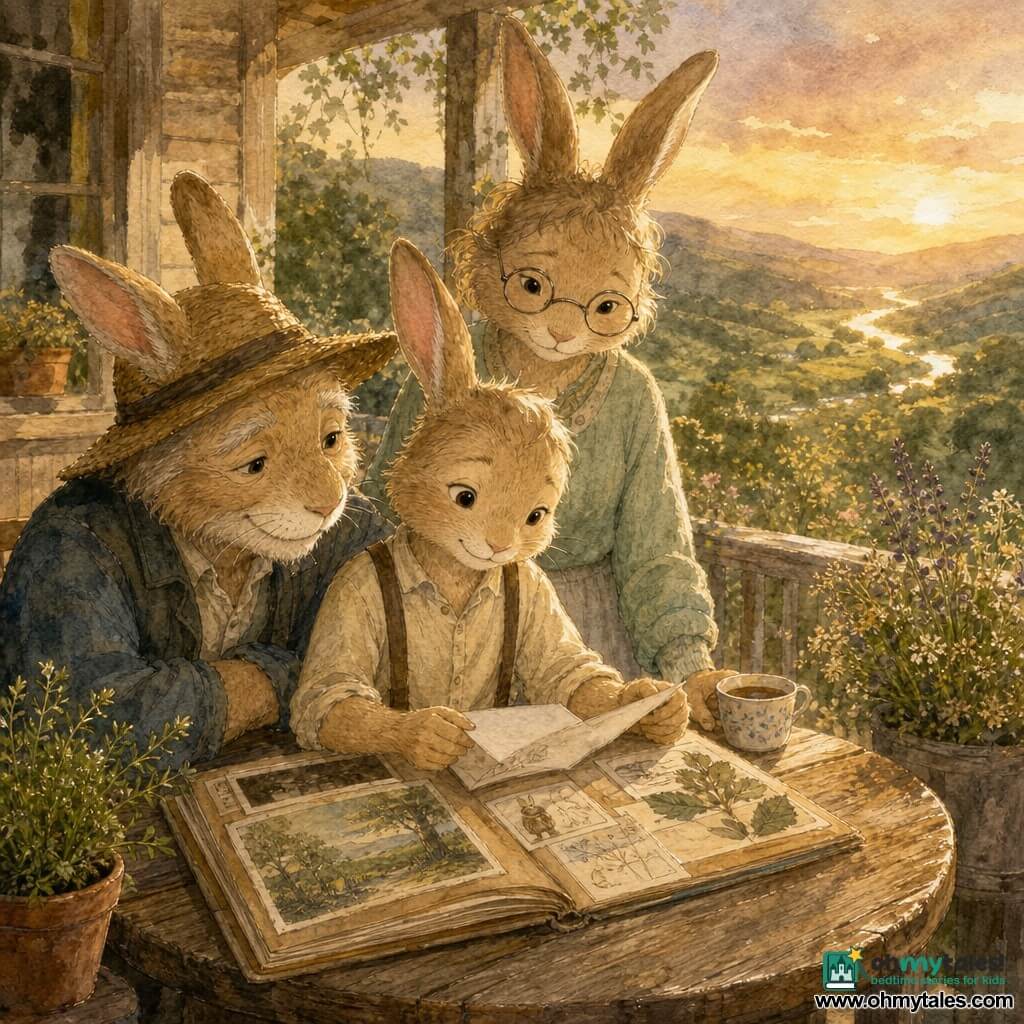
Grandpa Rowan met them at the small station. He was a rabbit like Milo, but older, with whiskers that curled a bit and fur the color of toasted oats. He wore a straw hat that made him look like he belonged to every summer that had ever existed.
“Milo!” Grandpa Rowan opened his arms.
Milo ran into the hug. Grandpa smelled like pine needles and clean earth. Milo felt his chest loosen, as if a knot had finally agreed to untie itself.
“Look at you,” Grandpa Rowan said, holding Milo at arm's length. “Taller. And those ears—still excellent.”
Milo laughed. “They help me hear trouble coming.”
“Smart,” Grandpa said. “Trouble has noisy feet.”
They walked up a path lined with wildflowers. Bees moved between blossoms with busy seriousness. Milo watched them and felt a tiny respect. They had jobs. They kept the world going.
Grandpa Rowan's house sat on a hill with a porch that faced a wide view. From there, you could see fields and trees and a slice of shining water far away.
On the porch, Grandpa Rowan poured lemonade into tall glasses. The ice clinked like small bells.
“So,” Grandpa said, settling into a creaky chair, “what have you brought me? Treasure? Secrets? A map to buried carrots?”
Milo reached into his backpack and pulled out the SHARE folder. His paws were careful. “Photos and drawings,” he said. “Aunt Juniper helped me sort them.”
Grandpa Rowan's eyes warmed. “Ah. The art of remembering.”
Milo opened the folder and spread a few things on the porch table. The jam-nose photo made Grandpa chuckle. The kite drawing made him nod like he could feel the wind again.
Then Milo showed the stormy sky drawing.
Grandpa Rowan tapped the paper gently. “This one feels different.”
“It was a rainy day,” Milo said. “I was sad. But Aunt Juniper read to me. So… it's not just sad.”
Grandpa Rowan leaned back. “Real life is like that. It mixes things. That's what makes it true.”
Milo watched Grandpa's face as he looked at each piece. It made Milo feel brave, like his small memories mattered.
Later, Grandpa Rowan took Milo for a walk behind the house. The path wound through tall grass that brushed Milo's legs like soft paintbrushes. A lizard darted across a stone and vanished.
Grandpa Rowan pointed to a patch of herbs. “Smell this.”
Milo rubbed a leaf between his paws and sniffed. “It smells like… lemons and pepper.”
“Lemon thyme,” Grandpa said. “Plants are quiet teachers. They don't chase you. They just wait until you notice.”
Milo looked around with new attention. He noticed the way the wind bent the grass all at once, like the hills were breathing. He noticed the tiny purple flowers he might have stepped on.
That night, Milo lay in a bed with a quilt that smelled faintly of sun. He listened to crickets outside. He missed the sea, but the hills had their own music.
Before sleeping, he whispered into the dark, “I'm still me, even far away.”
And somehow, that felt comforting.
Chapter 5: The Day the Folder Fell
The next morning, Grandpa Rowan suggested a visit to the little market in the nearby village. “They sell honey candies,” he said. “And the baker makes rolls that could make a stern owl smile.”
Milo liked the idea. He liked small trips inside big trips.
They walked down the hill. The sun was warm but not too hot. Milo carried his backpack, and inside it, the SHARE folder sat flat, like a sleeping animal.
At the market, Milo listened to the sounds: coins clinking, people chatting, a dog barking once and then deciding it was done. He smelled ripe peaches and fresh bread.
Grandpa Rowan talked with a neighbor. Aunt Juniper examined tomatoes like she was interviewing them for a job.
Milo wandered to a postcard rack. There were pictures of the hills, the river, and a distant view of the sea. He picked one with a bright blue sky and a train crossing a bridge.
For Tessa, he thought.
He imagined writing: I saw a cow. It looked like you.
He smiled.
When it was time to leave, Milo swung his backpack onto his shoulders a bit too fast.
The zipper was not fully closed.
The SHARE folder slid out, slow at first, then faster—like a smooth sled on a sudden slope. It fell onto the dusty path. A gust of wind lifted the top photo and flipped it end over end.
Milo froze. His heart jumped into his throat.
“No, no, no—”
He dropped to his knees. A drawing skidded across the ground. The stormy sky one. The corner bent.
Milo's ears felt hot. His eyes stung.
Aunt Juniper was beside him in an instant. “Breathe,” she said, calm but firm. “First we collect. Then we fix.”
Grandpa Rowan stepped forward, blocking the wind with his body like a human fence. “I'll catch the runners,” he said.
Milo scrambled after the drawing, paws dusty, breath quick. He caught it and held it to his chest. The bent corner looked like a tiny injury.
Benign laughter came from a woman passing by. Not mean—just amused. “Your papers are trying to travel without you,” she said.
Milo managed a shaky smile, but his throat felt tight. “They're important,” he whispered, more to himself than to her.
Aunt Juniper gathered the photos carefully and stacked them. “Nothing is ruined,” she said. “A bent corner is a reminder that we carried it somewhere.”
Milo stared at the crease. “But it won't be the same.”
Grandpa Rowan crouched beside him. “Neither are we,” he said gently. “And that's not always bad.”
Milo took a slow breath. The air tasted like dust and peaches.
Aunt Juniper opened the folder again and slid everything back inside. She closed it and held it out to Milo. “This time, you zip the backpack,” she said.
Milo nodded. He zipped it all the way, then tugged it once to be sure.
They walked on. Milo's paws still felt a bit shaky, but as the minutes passed, the tight feeling loosened.
At the market's edge, Grandpa Rowan bought three honey candies. He handed one to Milo.
Milo unwrapped it. The candy was golden and sticky-sweet. It tasted like sunlight stored in a tiny square.
He looked up. “Thank you for helping,” he said.
Grandpa Rowan winked. “That's what we do. We keep each other from blowing away.”
Milo held that sentence in his mind, the way he held his photos—carefully, gratefully.
Chapter 6: A Steady Kind of Goodbye
The last day came quietly. Milo didn't like that about last days. They arrived like a cat—soft paws, sudden presence.
In the morning, Milo sat with Grandpa Rowan and Aunt Juniper on the porch again. The SHARE folder lay open. Milo had added new drawings: a hill with a winding path, the herb patch, and the suspicious cow from the train.
Grandpa Rowan chuckled. “You've been busy.”
Milo nodded. “I wanted to keep it. Not just in my head.”
Aunt Juniper sipped her tea. “And what will you share?”
Milo pulled out the postcard he'd bought. He wrote to Tessa carefully, pressing hard enough for the pencil to leave a confident line.
Dear Tessa,
The train went through fields and over a river. I saw cows, and one looked like it had your attitude. The hills smell like thyme and warm stones. I didn't forget our shell contest. I'm bringing you a drawing.
Your friend,
Milo
He showed it to Grandpa Rowan and Aunt Juniper.
Grandpa Rowan nodded. “That's loyalty,” he said. “Not just missing someone. Showing them they matter.”
Milo felt a proud warmth in his belly.
At the station, Grandpa Rowan hugged Milo again. “Come back when the leaves start to turn,” he said. “Autumn has its own stories.”
“I will,” Milo promised. And he meant it. He liked promises that could be kept.
On the train ride home, Milo watched the hills fade into flatter land. He felt a tug of sadness, but it didn't scare him now. It meant the visit had been real.
Aunt Juniper asked, “What did you learn?”
Milo thought, tapping his pencil against his notebook. “That memories are like photos,” he said slowly. “You can hold them, share them, and sometimes they get bent. But they still mean something.”
Aunt Juniper nodded. “And about friends?”
Milo pictured Tessa's crooked cap, Ben's handshake, Grandpa Rowan's porch. “That bonds don't disappear when you travel,” he said. “You just have to take care of them. Like… zipping the backpack.”
Aunt Juniper laughed softly. “Exactly.”
When they reached the seaside cottage, the air tasted of salt again. The sea was waiting, wide and bright. The gulls sounded like they were arguing about something unimportant.
Milo walked down the path to the dunes with Aunt Juniper. The grass was warm against his ankles. He stopped and looked out at the water.
Waves rolled in, again and again, faithful as a heartbeat. Seaweed swayed. Tiny crabs hurried along the edges of pools. Plants clung to sand that never stayed still.
Milo breathed in. “Thank you,” he whispered—not to anyone in particular, and also to everything. “For the animals that work and play. For the plants that grow even when I'm not watching. For the sea that keeps coming back.”
Aunt Juniper stood beside him, quiet and close. Milo felt the summer around him like a soft blanket: bright, real, and full of ties that held.