The Evening the Curtains Yawned
Toby the tortoise had never been called a hero before. At most he had been called "tardy," "methodical," and once, by a particularly brisk sparrow, "an oddly heavy pebble with opinions." He didn't mind. He liked slow things: the careful drip of honey from a jar, the long curl of a snail trail shining like a tiny silver road, the way tea cooled so you could taste each note. He also liked shows.
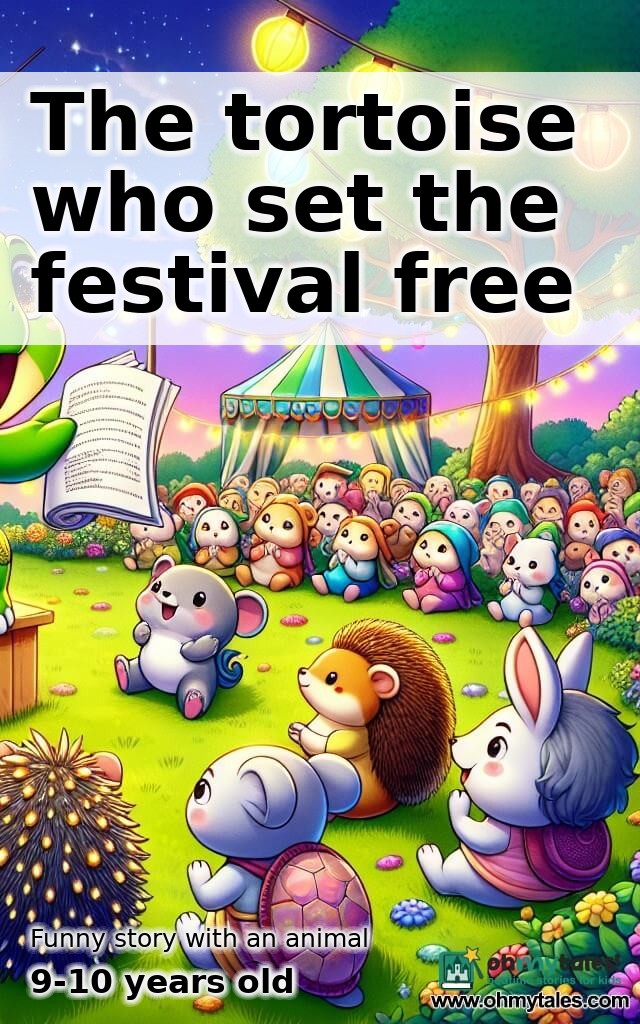
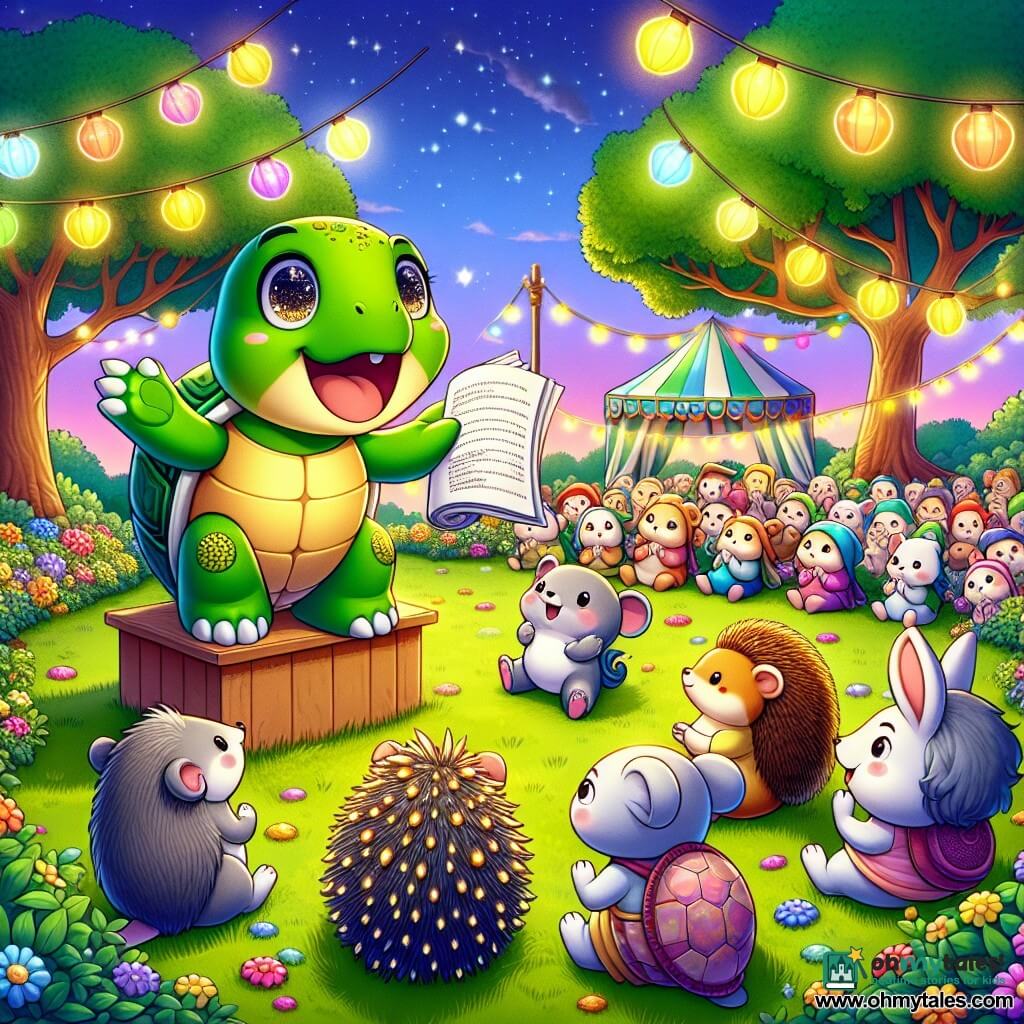
On the edge of Whimble Wood, the Meadow Theatre was a circle of benches and lanterns and a painted stage where animals gathered every Tuesday for the Festival of Fancies. Tonight should have been the brightest Festival yet. Posters fluttered on lampposts—badgers in bow ties, penguins with tiny canes, a rabbit promising "Triple Somersaults!" The benches filled with hedgehogs, fox cubs, mice, a very punctual goose, and a family of badgers who brought blankets and jam sandwiches.
But the festival had been practicing. For weeks. Each act had been polished until it clicked, which was excellent for hinge-makers but terrible for giggles. The juggler juggled exactly seven balls and then bowed. The poet recited a poem about numbers in order. Even the clownfish—yes, a clownfish that lived in a charming glass bowl on stage—told the same joke about hats three times, and the punchline arrived with the punctuality of a sleepy clock: "It was a hat, of course." Chairs sighed. A child mouse began to count backwards until she fell asleep.
Toby's shell scratched against the backstage wall as he watched the yawns spread through the audience like a polite fog. He had been hired as a prop wrangler because the director, Mrs. Magpie, liked someone steady who would not zips and whirl like a rabbit. Toby carried trunks and taped down banners. He liked the hush before the music starts and the sudden burst when it does. He liked the way stories could lift you like a kite.
But this evening the kite drooped.
He clutched the old Lark-Lantern in his mouth—a bronze lamp with a crooked beak and a tiny carved lark on its side. It had sat in the prop room for as long as anyone could remember. Mrs. Magpie said it was "temperamental," which was a theatre word meaning "full of surprises." Toby remembered a Sunday when, as a hatchling, he'd watched the lantern sputter a single speck of light that made the tap-dancing mice tap twice as fast. He thought maybe, just maybe, the lantern might help tonight.
He poked his head outside. The audience was being wonderfully, stubbornly dull. Behind them, the moon looked like a thin coin and a moth wore a waistcoat. Toby felt his legs pull him forward like a very slow tide. He had one wish: make the crowd laugh so true that their knees forgot to be orderly.
"All right," he murmured. "We will try something different."
No one moved. The theatre had been practiced into a polished silence. The very air smelled of waiting and peppermint. Toby took a breath that steamed in the cool air, and he grinned—a small, shell-tucking grin—and began to plan how to wake the whole place up without snapping like a twig. He had time. He had patience. He had an idea that, in the space between giggle and whoop, could let everyone fly free for a bit.
And perhaps that was what made Toby dangerous: he was slow enough to think of the whole grass-and-moon picture, not just the next step.
Tonight, the show either slept or it would dance. Toby chose dance.
A Plan in Three Steps and a Sneeze
First, he gathered the performers. The juggler frowned as though someone had asked him to wear a hat with holes. The poet adjusted his monocle and recited a stanza about cloud shapes—perfectly measured, perfectly measured out. The clownfish blinked in his bowl and made a sad bubble. Mrs. Magpie fluttered her glossy wings and preened a worry into every feather.
"You must be patient," she told Toby. "The programme must be kept."
Toby blinked slowly and said, "What if it's kept... lively?"
He had an audacious plan. It involved three small things: a little freedom for each act, the Lark-Lantern, and the one thing that makes even the stiffest tail wag—the unexpected.
"Freedom?" the juggler asked, spinning a ball on his nose to prove he could.
"Improvisation?" the poet echoed, because poets like new words to polish.
Toby explained quietly: each act would add one silly surprise. If the juggler dropped a ball, he'd make the drop part of the act. If the poet laughed mid-line, he'd read the laugh like a new rhyme. The clownfish could tell his hat joke—backwards. It would be messy. It would be unpredictable. Most of all, it would be free.
They debated, which is another way animals say "argued with politeness." A hedgehog insisted on knowing the exact time of all surprises. A rabbit wanted an exact number of hops. A parrot demanded the right to say "Squawk!" precisely twice.
Toby handed the Lark-Lantern to Mrs. Magpie and said softly, "When the laughter comes, give it a little light. Not to guide anyone, only to tumble the colors."
She cocked her head. "It might sputter," she warned, which was true; the lantern had a habit of dimming at important moments. The word "sputter" sent a tiny shiver down the mouse's spine. But you cannot argue with an idea that smells like fresh bread.
"Now," said Toby, "when I tap the stage with my shell, the first act will flip its plan. Then, we let the rest—"
He paused for effect, and the hedgehog sneezed, which made about twenty-one pens pen differently in their pockets. It was enough. It was also when the lantern decided to do its dramatic thing.
At the first tap—Toby's shell thumped like a slow drum—the juggler let one ball fall. It bounced up, then, like a very polite thing, rolled into the clownfish's bowl and made a tiny splash.
The bowl's splash tickled the clownfish. The clownfish, offended and delighted at once, spat a bubble that popped with a sound like a startled snore. The poet, surprised, guffawed. The parrot squawked. Laughter—a startled, bright little thing—ripened like fruit.
Mrs. Magpie leaned forward, Lark-Lantern lifted, and the trees held their breath. The lantern blinked. It blinked to the rhythm of the laughter. For a split second—just a blink—the stage filled with colors that hopped like frogs: scarves unrolled into streamers, drumsticks sprouted tiny wings, and a sombrero began to tango with a bow tie.
Then the lantern coughed, as lanterns sometimes do, and went out. The lights winked off. Silence rushed in like a tide. The juggler froze with a ball on his nose. The clownfish looked at his empty bowl as though someone had stolen a moon. The poet's last word fell unfinished into the dark. The audience made a small noise that could have been a gasp or a yawn.
Mrs. Magpie's feathers puffed. "It was supposed to do that," she muttered, which is what one says when something has gone wrong on schedule.
Toby felt the slow, heavy hour on his shoulders. This was when a tortoise could be useful: not by sprinting, but by footing the scene with a steady step. He had one move left: be slow and bold.
Slow Moves, Fast Giggles
Toby walked out onto the stage. Downstage left, he leaned his shell against the curtain like a stubborn rock. The audience blinked. A single firefly hovered like a question mark.
"Good evening," Toby said, and his voice was soft but clear, like a bell underwater. "We appear to have a lantern with dramatic tendencies."
A mouse behind a blanket smirked. A badger cleared his throat as though checking whether he still had ribs. The hush changed shape. It wasn't the big laugh—yet. It was curiosity unwinding into attention.
"What would you like to see?" Toby asked, which was the very free sort of question that makes people dangerous—or joyful.
A small rabbit near the front shouted, "Anything but numbers in order!"
"Very good," said Toby. "Then let's not have numbers." He reached into a trunk with one careful foot and pulled out a hat that was the size of a biscuit. He put it on.
The hat seemed to giggle. The parrot peered over a shoulder and repeated, "Giggle. Giggle." The audience laughed quietly. Quiet laughter is like the first ripple when you throw a pebble into a pond; you can usually tell where it will go.
Toby told a story. It wasn't long or fancy. It was about a tortoise who learned to ride the wind on a ribbon. He described the ribbon's color—"sort of like lemon sherbet with a stripe of blueberry"—and the sound it made—"a sizzle like pages turning in a hurry." He spoke with slow rhythm, stretching each image so it sat like jam on bread. The animals listened, their faces softening.
As he spoke, something happened: the audience began to participate. The hedgehog added a prickly sound effect. The rabbit hopped in an improvised chorus line. The poet stopped counting and instead rhymed off the last two words of Toby's sentences because he couldn't help himself. The juggler began to toss balls with wilder arcs; when one fell, he clapped and used the fall as a punchline. The clownfish blew bubbles in complex, spiraled patterns that shimmered like tiny planets.
Laughter grew louder, not because it was forced but because it was allowed. It was freer and messier than any rehearsal. It leapt and looped like ribbons at a fair.
Somewhere in the crowd, a goose laughed so hard that she honked. That honk landed in the wings and nudged the Lark-Lantern. The lamp coughed, then blinked awake again. This time it didn't sputter but shimmered, like sugar under sunlight.
The lantern's light was not normal. It painted motion on walls. Small things came alive in the theater: a row of chairs performed a slow wave like the sea, a stack of hats did a conga, and the clownfish's bowl sent up bubbles that popped to the rhythm of a tap dance. The audience roared. The show was no longer a show following a tidy list; it was a festival spilling itself into every corner of the stage.
Toby watched, smiling, his shell reflecting colors that weren't supposed to be there. The Lark-Lantern made things playful instead of perfect. It turned neat routines into surprises and gave each animal the freedom to tumble out of the script and find a new step to dance.
By the time the moon reached the top of its coin, animals were leaping where they had been timid, and timid where they had been leaping. The air tasted like lemon sherbet, snacks, and a hint of faraway adventure. Freedom, Toby thought, was a breeze that smells like popcorn.
But the Lark-Lantern was a creature of quirks. It loved a good laugh, but it also adored a dramatic exit. As the troupe prepared for the grand finale, no one noticed it beginning to twitch, like a bee that wanted one last flower.
The Hopping, Singing, Flying Finale
For the finale, Toby had an idea both slow and wildly foolish: a parade of animals, each making their silliest sound, all moving like a river across the stage. At the back, Mrs. Magpie would set the Lark-Lantern on a stand and let it throw just one final surprise.
The animals lined up. A troop of tap-dancing mice clicked their toes. A troupe of frogs warmed up their kazoos. The juggler juggled with flair. The poet wore a hat upside down because this was a festival of reverse things.
Toby stood in the middle and raised his slow hand. "On my shell," he said. "We go out like wind."
They began. A honk. A squeak. A kazoo that played the wrong tune in exactly the right key. Bubbles that popped into confetti. A marching band of beetles played a beat so tiny that mice could feel it in their whiskers. The audience clapped, stomped, and whistled, their boredom worlds away.
Mrs. Magpie lifted the Lark-Lantern. It hummed like a throat clearing and then exploded—gentle as a sneeze—in a rain of tiny, soft balloons shaped like rabbits. The balloons were not ordinary. They bobbed, each with a small squeaker inside. When they bumped, they gave a single, silly "PEEP!"
The sky of tiny rabbit-balloons leapt above the stage, alight with color. One hit the frog section and made all the kazoos roar a single note. Another bounced into the juggler's path and rolled into his hat. The clownfish's bowl filled with bubbles shaped like little musical notes. Everyone laughed until cheeks hurt pleasantly.
Then something quite ridiculous happened: a gust of wind lifted the rabbit-balloons and sent them over the audience. They rose, headed for the moon, and then found a cheeky updraft over the old willow tree that sent them spinning in a merry circle. Each pass produced a "PEEP!" and the sound was catchy—like a song that piggybacks on your ribcage.
At first it was a delightful chorus: "PEEP! PEEP! PEEP!" The sound tickled like a feather. People joined in, first in a rhythm then as a single roaring wave that hummed across the meadow. Even the owl, who usually said nothing more dramatic than "who," cleared his throat and peeped along.
The Lark-Lantern, content with the freedom it had created, dimmed down and gave a soft, satisfied chime, like a teacup clapping its saucer. The stage was a tangle of laughter, confetti, half-worn hats, and happy chaos. The Festival of Fancies had been saved in the most messy, marvelous way possible.
Toby took one careful bow. He felt the slow, proud warmth of a job done. Mrs. Magpie preened and called it "a triumph," which meant she had enough feathers to sell the idea to other theatres. The audience chirped, cheered, and, mostly, peeped.
But one tiny rabbit-balloon was more ambitious than the rest. It hitched itself to a string of bunting and rolled across the town like a rubber pebble. It squeezed past the bakery, where a cat drummed on a pie crust, and bobbed by the river where fish looked surprised enough to form a small chorus. It then found the wind and kept going, squeaking its single silly note every time it kissed the air.
The Gag That Lasted Too Long
The rabbit-balloon's peep was a good sound. It was honest and perfectly ridiculous. The mice squealed. The frogs tried to harmonize. A baker tapped a rhythm on a tin tray. But the balloon kept floating. It drifted past the mill, over the school where a class of geese were taking lessons in "Dear Diary" handwriting (their diaries were all clipped to feathers), and up over the hill.
As the balloon went, other animals followed suit. Someone found a leftover kazoo. A hedgehog discovered a lemon-shaped whistle. A squirrel, who had a habit of collecting oddities, tied a tiny bell to his tail and jingled along, for reasons known only to squirrels. Soon, the peep had friends: a chorus of small noises rising and circling like musical birds.
People began to glance at watches, to check if perhaps the show had a curfew. Children giggled until they couldn't breathe properly. Adults giggled because they had never been given permission to giggle in such free-form ways. The peeps and squeaks and kazoos made a melody that wound through the town like taffy. It was charming, and then it was insistent.
"Is it—" began the goose, who always worried about schedules.
"It is," said Toby, who had stopped checking time long ago. He watched the balloon sail like a small, rubber moon. "It is delight."
The peeps marched on. The balloon traveled past the post office, where a squirrel mailed a postcard to himself with the words "Dear Squirrel, Keep Going." It sailed over fields and then, improbably, got caught in a gentle eddy above the bakery again, where it bounced off a loaf and gained speed. The peeps multiplied. Someone taught the geese to harmonize. A violinist fox found the rhythm and the town's clock tower chimed a note so perfectly in step that the clock considered changing careers.
At midnight, villagers still heard the peeps. At dawn, chickens peeped in sympathy. Days passed. The peeps became a weather pattern. People argued at first about whether the noise ought to be called charming or a minor catastrophe. Then they stopped arguing because arguing interfered with listening. They began to plan their days around the peep schedule: peep before breakfast, peep during the stroll, peep after your nap.
The balloon, stubborn and perhaps a little proud, looped and circled and peeped. It crossed mountains and returned with new accents. It gained an echo that sounded like a chorus of tiny kazoos. It found a sympathetic gust near the sea and sang to the waves, which frothed and applauded.
Toby was not upset. If anything, he sat on a hill with a cup of tea and thought the peeps were rather good. They had started with one silly idea, and they had become a sound everyone could ride like a kite. Freedom, he decided, liked to last.
At long last—if "long" can be used at all for a peep that floated round the world—someone asked the balloon to stop. But balloons rarely obey polite requests, especially when they're performing an encore. The rabbit-balloon peeped once more, a little higher and a bit louder, as though clearing its tiny throat.
And then, just when everyone was ready for the silence to come, the balloon did what balloons do when they refuse to end their fun: it hitched itself to the wind, sang a final, very joyful "PEEP!" and sailed off toward a horizon that looked like a promise.
It peeped. It peeped again. It peeped, and the sound kept going and going and going—so happily, so insistently, so wonderfully long that even the clocks stopped looking cross.