Chapter 1: The Storm With Bad Manners
Mira Quill liked things that made sense.
She liked straight lines in her notebook. She liked tidy rows of library books. She liked knowing exactly how many steps it took from her front gate to Mrs. Puddlewick's bakery (sixty-three, if you didn't hop).
So when a storm moved into Bramblewick and refused to leave, Mira took it personally.
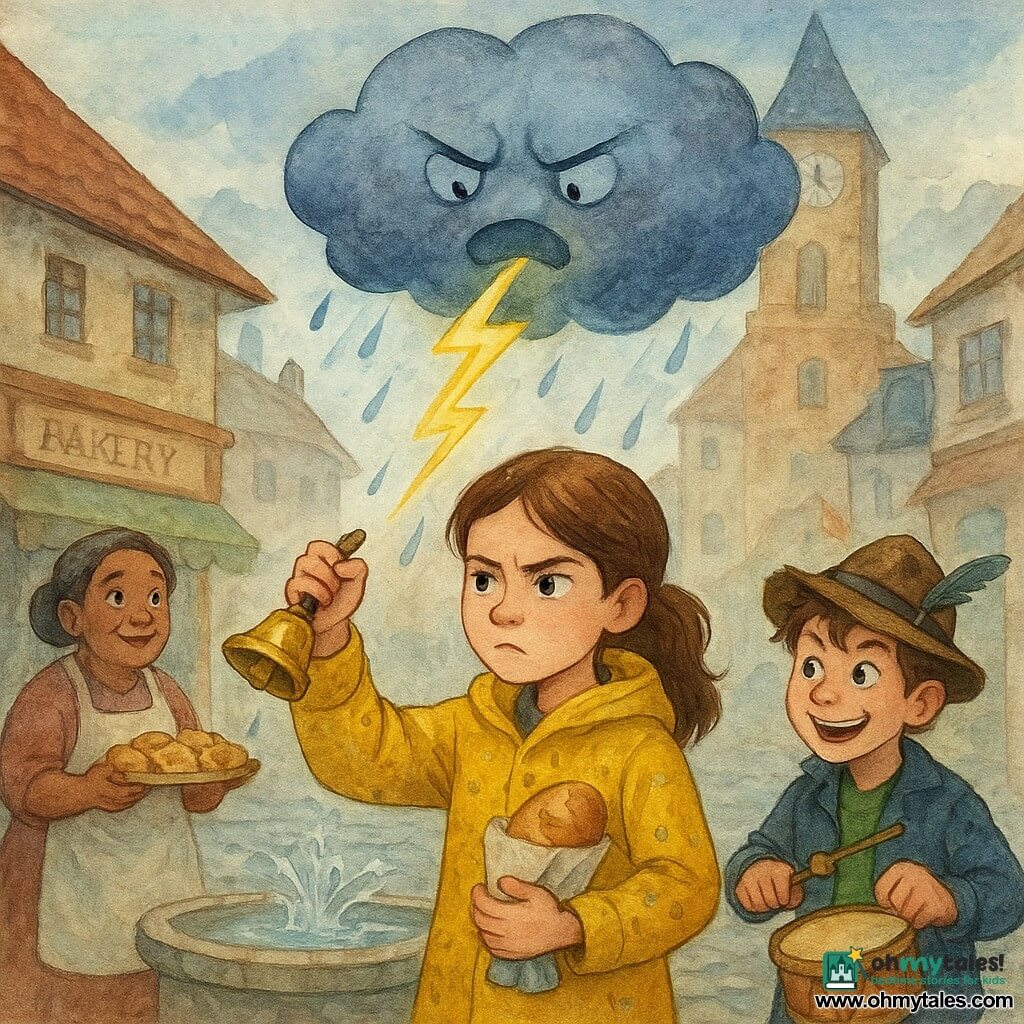
It wasn't a normal storm. Normal storms arrived, did their loud business, and wandered off like embarrassed guests. This one parked itself above the town clocktower like a sulky cat and began to grumble.
Not thunder. Grumble.
The sky wore a grey frown. Raindrops fell with the attitude of someone flicking crumbs off a table. Lightning scratched the air in short, irritated scribbles.
“Honestly,” Mira said at breakfast, peering out the window. “It's been three days.”
Her dad stirred his tea, which immediately started steaming in the shape of tiny umbrellas. “Some weather systems are stubborn.”
“This isn't stubborn,” Mira said. “It's… emotionally complicated.”
The storm gave a deep, offended growl, as if it had heard her. The kitchen spoon jumped out of the sugar bowl and hid behind the jam.
Mira's mum sighed. “Well, we can't do much. The town council sent a polite letter.”
“A letter?” Mira repeated. “To the sky?”
“They tied it to a kite,” Mum said. “It came back damp and judgmental.”
Mira pushed her chair back. “If it's grumpy, then we should find out why.”
Dad blinked. “How exactly?”
“Logically,” Mira said, as if that answered everything. She grabbed her raincoat, her pencil, and her best serious face. “I'm going to turn off the storm.”
Outside, Bramblewick looked like it had been washed too many times. The streets shone. The air smelled like wet stone and old secrets.
Mrs. Puddlewick stood under her shop awning, holding a tray of buns like a shield. “Morning, Mira! Careful out there. The storm's in one of its moods.”
“It's always in a mood,” Mira said.
“That's what I mean,” Mrs. Puddlewick said, and a raindrop fell on her bun with such disdain it nearly rolled its eyes.
Mira walked toward the clocktower, counting steps to keep her thoughts neat. The storm hovered low, as if it was trying to listen in on everyone's conversations, ready to misunderstand them.
A gust of wind tugged at Mira's hood and tried to flip it inside-out.
“Stop that,” Mira told it.
The wind hesitated, surprised at being spoken to, then did it again out of spite.
Mira narrowed her eyes. “Fine. We're doing this properly.”
She marched to the library.
Because if there was a rule about how to handle a grumpy storm, it would be written down somewhere. And if it wasn't written down, it should be, and Mira would be the one to do it.
The library door creaked like it was whispering gossip. Inside, old Mrs. Calverton sat at the desk, knitting a scarf that looked suspiciously like a map.
Mira shook water off her sleeves. “Do we have any books on… turning off storms?”
Mrs. Calverton didn't look up. “Aisle seven. Between ‘Sea Serpents: Myths and Mild Inconveniences' and ‘How to Talk to Your Teapot.'”
Mira blinked. “We have a book called ‘How to Talk to Your Teapot'?”
“Only if you're polite,” Mrs. Calverton said. “Teapots are sensitive.”
Mira hurried to aisle seven, trailing dripping footprints that tried to arrange themselves into little puddle-letters. The storm was already getting involved.
She pulled out a thick book with a battered spine: WEATHER: A PRACTICAL GUIDE FOR PEOPLE WHO PREFER SUNLIGHT.
It opened by itself, as if eager to complain.
Mira read:
Some storms are merely weather.
Some storms are feelings with poor communication skills.
Mira nodded. That sounded right.
She flipped the page and found a chapter called: Dealing With a Gloomcloud (Do Not Offer It Poetry). Another called: Thunder as a Social Situation.
Finally, in the back, she found a section titled: The Off Switch.
It wasn't a switch. Of course it wasn't. Nothing magical was ever simple. It was a list.
1. Identify what the storm wants.
2. Provide it in a way that does not encourage further tantrums.
3. Express gratitude. (This is important. Storms are vain.)
4. Offer a respectful farewell, preferably involving stars.
Mira tapped her pencil on her lip. “So it's basically a rude guest.”
From the window, the storm grumbled again, louder, as if it had overheard and disagreed with being compared to a guest. A lightning bolt flicked like a tongue.
Mira shut the book. “All right. We'll do this logically.”
A small voice behind her said, “Logic is brave. It's also sometimes silly.”
Mira turned. On the ladder in the next aisle sat a boy about her age, wearing a hat that looked like it had lost an argument with a bird. His eyes were bright and amused.
“Who are you?” Mira asked.
“Name's Finn,” he said, hopping down. “Part-time errand runner. Full-time eavesdropper. I heard you're going to turn off the storm.”
“That's the plan,” Mira said.
Finn grinned. “Plans are my favourite kind of disaster. Want help?”
Mira considered. Help meant variables. Variables meant chaos. Chaos meant… well, the storm.
But Finn looked like he knew where the weirdness kept its spare socks.
“Fine,” Mira said. “But we do it properly.”
Finn saluted with two fingers. “Properly improper. Excellent.”
They stepped outside together, into the rain that pretended not to notice them.
Above the clocktower, the storm rumbled like a stomach that had been offered the wrong kind of soup.
Mira looked up. “All right,” she said. “What do you want?”
Chapter 2: A Complaint Department in the Sky
You can't really ask a storm what it wants. Not in the usual way.
Mira tried anyway.
She stood in the town square, lifted her chin, and spoke like she was addressing a very large, very unreasonable customer.
“Excuse me,” she called. “Storm! Could you please state your problem clearly and in one sentence?”
The storm answered with a clap of thunder that sounded like a door being slammed.
Finn winced. “That was definitely not one sentence.”
Mira scribbled in her notebook: Storm communication style: dramatic.
A gust of wind stole her pencil and threw it into a puddle. The puddle burped and produced the pencil again, looking smug.
Finn picked it up. “It's moody, all right.”
Mira glanced at the clocktower. Its hands pointed stubbornly forward, but the face was fogged as if the storm was breathing on it just to be rude. Around the base, townspeople hurried with umbrellas turned inside-out and hair flattened into tragic shapes.
Old Mr. Hobb carried a basket of apples, each one wrapped in a tiny leaf like a raincoat. “If you see the storm,” he muttered, “tell it to stop sulking. My apples are getting ideas.”
A little girl ran past with a toy sword, shouting, “I shall defeat the sky!” The sky replied with a sprinkle of rain right down her collar. She squealed, laughing anyway.
Mira watched her. People were annoyed, but they were also… dealing. Smiling through it. Sharing umbrellas. Laughing at themselves.
The storm seemed to hate that most of all.
Finn nudged Mira. “Maybe it wants attention.”
“It has an entire town looking up,” Mira said. “How much attention does it need? A parade?”
Finn's eyes lit up. “A parade!”
“No,” Mira said quickly. “We're doing this logically.”
They headed for the only place in Bramblewick that handled odd problems: the back room of Mrs. Puddlewick's bakery.
Mrs. Puddlewick's front room was warm and smelled like cinnamon bravery. The back room smelled like secrets and slightly overbaked experiments. Hanging on the wall was a notice board labelled: FOR EMERGENCIES, SPELLS, AND SPILLED JAM.
Mrs. Puddlewick herself was dusting flour off her apron as if trying to erase the concept of mess. “Mira Quill,” she said, “you look like you've decided something.”
“I'm turning off the storm,” Mira said.
Mrs. Puddlewick nodded as if Mira had said she was going to buy a loaf. “Good. It's making my croissants feel gloomy.”
Finn hopped onto a stool. “Do you know how to talk to it?”
Mrs. Puddlewick reached under the counter and pulled out a tin labelled: DO NOT OPEN UNLESS YOU MEAN IT.
She opened it anyway.
Inside was a small brass bell, a spool of blue thread, and a folded scrap of paper that looked older than most mountains.
“That,” Mrs. Puddlewick said, tapping the paper, “is a complaint form.”
Mira stared. “A complaint form for storms?”
“For everything,” Mrs. Puddlewick said. “Bramblewick runs on quiet magic. The kind that sneaks in when you're not watching. And quiet magic loves paperwork.”
Finn leaned in. “What does it say?”
Mrs. Puddlewick unfolded it carefully. The paper creaked like an old door.
At the top it read: OFFICIAL SKY GRIEVANCE FORM. PLEASE WRITE NEATLY. THE SKY IS SENSITIVE.
Mira's heart did a little pleased flip. This was her kind of magic.
Underneath were boxes to tick:
— Is your thunder too loud?
— Are your clouds feeling unappreciated?
— Have you been compared to a damp blanket? (This hurts.)
Mira took the form with reverence. “This is perfect.”
Mrs. Puddlewick handed her the brass bell. “Ring it under the clocktower. The storm has to listen when the bell rings. It's a rule.”
Finn frowned. “And the thread?”
Mrs. Puddlewick held up the spool of blue thread like it was a jewel. “That's for tying the form to something the wind can't resist. Wind loves a good flutter.”
Mira nodded. “We'll attach it to—”
“A bun,” Finn said instantly.
Mira glared. “No. A bun is not official.”
“It's delicious,” Finn argued. “And if the wind eats it, the storm might calm down.”
Mrs. Puddlewick's eyes twinkled. “Try a compromise. A bun with paperwork.”
Mira sighed the sigh of someone allowing chaos a small chair in the corner. “Fine. One bun. But I'm writing neatly.”
They selected the flattest bun available, the one that looked most like it had signed up for responsibility. Mira filled in the form with sharp, tidy letters:
Dear Storm,
Please state your grievance. Also, please stop soaking everyone's socks.
Yours respectfully,
Mira Quill (Age 12, Reasonable Person).
Finn added, in loopy handwriting:
P.S. If you want a parade, we can talk. Please don't electrocute anyone.
Mira stared at his addition. “Why would it want a parade?”
Finn shrugged. “If I were a storm, I'd want dramatic music and a cape.”
“You already have a hat,” Mira said.
“It's not a cape,” Finn said mournfully. “Yet.”
They tied the form to the bun with blue thread. The bun looked confused but willing.
Outside, under the clocktower, Mira rang the brass bell.
The sound was surprisingly polite. Not loud. Just clear, like a spoon tapping a glass.
The storm stopped grumbling.
The wind paused mid-tug.
Raindrops hung for half a heartbeat, then fell straight down, as if remembering proper behaviour.
Mira held the bun up. “Storm,” she said, “we have your complaint form. Please respond in an orderly fashion.”
The wind, as if compelled, swept in and snatched the bun, lifting it up toward the clouds.
Finn shaded his eyes. “There goes lunch.”
Mira watched, hopeful.
The bun vanished into the grey belly of the storm.
For a moment, everything went quiet.
Then the storm sneezed.
It was the loudest sneeze Bramblewick had ever heard. A burst of thunder. A spray of rain. A single bolt of lightning that wrote an angry squiggle across the sky.
Finn yelled over the noise, “I think it read the P.S.!”
Mira's notebook fluttered open in her hands, and a fresh page filled itself with wet ink. Letters formed as if written by an invisible quill:
GRIEVANCE RECEIVED.
I AM NOT GRUMPY.
I AM UNDERAPPRECIATED.
Mira blinked. “It's… writing back.”
The letters continued:
I BROUGHT RAIN FOR YOUR GARDENS. THUNDER FOR YOUR STORIES. LIGHTNING FOR DRAMA.
AND WHAT DO I GET?
UMBRELLAS. COMPLAINING. PEOPLE SAYING ‘UGH, WEATHER.'
Finn whispered, “It has a point.”
Mira swallowed. She hadn't thought of that. She had thought of wet socks, not thirsty gardens.
The page finished with:
I WILL LEAVE WHEN I AM THANKED PROPERLY.
Mira looked up at the storm, which seemed to puff itself larger, like it was waiting.
Mira's logical mind clicked into place. Identify what it wants. Provide it. Express gratitude. Offer farewell with stars.
“All right,” she said, voice steady. “We can do that.”
Finn grinned. “A thank-you party for a storm. This town is going to be so confused.”
Mira allowed herself a tiny smile. “We'll keep it organised.”
The storm rumbled, hopefully.
Mira nodded once. “We need a plan.”
Chapter 3: The Thank-You That Went Slightly Sideways
Mira's plan had three parts:
1. Gather the town.
2. Deliver a proper thank-you.
3. Avoid anyone getting zapped.
Finn's plan had one part:
1. Make it fun.
Somehow, they decided to combine these.
They ran through Bramblewick, recruiting helpers like two generals of nonsense.
At the market, Mira called, “We need everyone at the square at sunset! It's important!”
A fishmonger looked up from his stall, where fish were flopping with offended dignity. “Is this about the storm?”
“Yes,” Mira said.
The fishmonger pointed a sardine at the sky. “Tell it my beard hasn't been dry since Tuesday.”
Finn leaned in. “Come anyway. Bring your most dramatic face.”
At the school, Mira spoke to Mrs. Lark, who was trying to keep twenty-seven children from turning puddles into a sport.
“We need a gratitude gathering,” Mira explained.
Mrs. Lark blinked. “A what?”
“A thank-you,” Mira said, slower, as if saying it carefully would make it less strange.
Mrs. Lark considered, then nodded briskly. “If it stops the storm, I'll thank a potato.”
“Bring the potato,” Finn whispered.
At home, Mira asked her parents for help.
Dad raised an eyebrow. “You're thanking the storm.”
“Yes,” Mira said. “It wants appreciation.”
Mum's lips twitched. “Well. It did make the roses look very heroic.”
Dad stood, solemn. “I will contribute my best umbrella.”
Mira frowned. “No umbrellas. That looks like complaining.”
Dad sat back down, wounded. “Then I will contribute… my second-best umbrella, kept out of sight.”
“Better,” Mira said.
By afternoon, the town square was busy with people carrying odd offerings: fresh bread, shiny apples, a jar of honey, a knitted scarf that looked like a cloud, and—because Finn had whispered too loudly—three potatoes wearing little paper crowns.
The storm hovered overhead, watching.
Mira climbed onto the fountain edge. The fountain water had been replaced by rainwater that tasted faintly of grumpiness.
Finn stood beside her, holding a small drum he'd borrowed from the school band room. It had a dent shaped like a previous mistake.
Mira cleared her throat. “Everyone! We're here to thank the storm.”
A murmur rolled through the crowd.
Mr. Hobb called, “Does it understand thank-yous?”
Mira raised her notebook. “It wrote to me. It understands perfectly. It's… sensitive.”
Mrs. Puddlewick waved from the front, flour on her nose like a friendly ghost. “Storms like manners! Use your best ones.”
Finn thumped the drum softly. “All right, everyone. On the count of three, we say—”
Mira hissed, “We don't need a count.”
“We absolutely need a count,” Finn whispered back. “For drama.”
Mira surrendered. “Fine. Count.”
Finn raised his hand. “One… two… three!”
The crowd shouted, “THANK YOU, STORM!”
It should have been wonderful.
Instead, the storm made a choking noise.
The wind hiccupped. The rain stopped mid-fall, then dumped itself all at once like a bucket. A thunderclap boomed so hard the pigeons left town for good.
Mira wiped water off her face. “What was that?”
Her notebook page went damp and began writing again:
THAT WAS TOO LOUD.
Mira stared. “Too loud?”
Finn coughed. “Maybe it wanted a gentle thank-you. Like… a personal one.”
Mira glanced at the storm. The clouds were thickening. Lightning flickered in annoyed little blinks.
Mira tried again, speaking calmly. “Storm. We are grateful for the rain. It helps our gardens. It fills the stream. It makes the air smell clean. And thunder can be exciting, in a safe, storybook way.”
The storm rumbled, uncertain.
A toddler in the crowd pointed upward. “Boom-boom!”
The storm, possibly offended, boomed again.
Mira raised her hands. “No, no. Not now.”
Finn leaned close. “Maybe it wants specific thanks. Like when you thank someone for doing the dishes, not just ‘thanks for existing.'”
Mira's brain clicked. Gratitude wasn't just a loud word. It was noticing.
She stepped down from the fountain and walked through the crowd, speaking in short, clear lines.
“To the storm,” she said, “thank you for the puddles children jump in. Thank you for watering Mrs. Lark's sunflowers. Thank you for cooling the bakery when the ovens are too hot. Thank you for making the town smell like wet leaves and adventure.”
As she spoke, people began adding their own.
Mrs. Puddlewick lifted a tray of buns. “Thank you for making my cinnamon swirl smell even cozier when it rains!”
Mr. Hobb held up an apple. “Thank you for giving my trees a drink. Sorry about the beard complaint.”
Mrs. Lark said, “Thank you for teaching children that indoor voices are sometimes useful.”
Even Dad, who had been hiding his second-best umbrella behind his back, raised his chin. “Thank you for the excuse to drink extra tea.”
One by one, the storm's grumble softened. The thunder became less like a slammed door and more like someone clearing their throat politely.
The rain turned gentler, as if it had remembered it could fall without drama.
Finn tapped his drum in a calmer rhythm. “It's working,” he whispered.
Mira nodded, but her logical mind kept scanning for the last item on the list.
A respectful farewell, preferably involving stars.
She looked up. The storm still sat over the clocktower, like it wasn't ready to admit it enjoyed the attention.
Mira lifted her notebook again. “Storm,” she said, “we've thanked you. Will you leave now?”
The page wrote:
THANKS RECEIVED.
BUT I DO NOT KNOW WHERE TO GO.
Mira blinked. “You don't know where to go?”
Finn stared up at the clouds. “It's lost.”
The storm rumbled, smaller now. Almost embarrassed.
Mira felt a surprising pinch in her chest. Being grumpy was one thing. Being lonely was another.
“All right,” she said gently. “We'll help.”
The storm's lightning flickered, shy as a firefly.
Finn grinned. “We need a map.”
Mira's eyes narrowed with determination. “We need stars.”
Chapter 4: Instructions for a Lost Storm
Stars were tricky in Bramblewick.
Not because the town lacked stars. The sky had plenty. But the storm was sitting on them like a sulking blanket on a bed, and you can't see stars through a blanket, even if the blanket has opinions.
Mira and Finn retreated to the library again, dripping quietly, as if trying not to offend the books.
Mrs. Calverton looked up from her knitting-map scarf. “Let me guess. The weather is having feelings.”
“Yes,” Mira said.
Mrs. Calverton nodded as if this happened every Thursday. “You'll want Aisle Nine. Astronomical Accidents.”
Finn whispered, “That sounds promising.”
Aisle Nine smelled like ink and midnight. Mira found a slim book titled: THE POLITE USE OF STARS (AND OTHER SHINY THINGS).
She opened it, and a small sprinkle of glitter drifted out, as if the book had been storing a tiny galaxy.
Finn sneezed. “I just inhaled a constellation.”
Mira read aloud: “If a magical being is lost, offer it a guiding gift. Stars are traditional. Not the real ones. Nobody likes being plucked. Use gathered starlight: small, harmless, and portable.”
Finn squinted. “How do you gather starlight if you can't see stars?”
Mira flipped the page. “You borrow it from somewhere that already saved it.”
Finn's eyes went wide. “Like… a jar?”
Mira nodded slowly. “Like… Mrs. Calverton's knitting.”
Mrs. Calverton's scarf lay over her chair, a long ribbon of yarn stitched into careful patterns. Mira had thought it was a map. Now she saw something else: tiny bright specks woven through it, like trapped sparks.
Mira approached the desk. “Mrs. Calverton… is your scarf… starry?”
Mrs. Calverton sniffed. “It's a map of the night sky. I knit it when I miss summer. The stars get caught in the wool. Saves them from falling on people's heads. Stars can be clumsy.”
Finn leaned over the scarf. “Could we borrow some?”
Mrs. Calverton watched them, eyes sharp but kind. “Borrowing stars is serious. You must return gratitude.”
Mira nodded. “We will.”
Mrs. Calverton rummaged in a drawer and produced a small wicker basket. It looked ordinary, except the handle was wrapped with silver thread and the inside smelled faintly of wishes.
“This,” she said, “is for carrying light. Do not put sandwiches in it.”
Finn looked disappointed. “Not even one?”
“Especially not one,” Mrs. Calverton said. “Starlight tastes like old music. It would ruin your lunch and insult the sky.”
Mira held the basket carefully. “How do we collect the starlight?”
Mrs. Calverton took her knitting needles and tapped the scarf three times. “Like this.”
A few star-specks lifted from the wool and drifted into the basket, tinkling softly, like tiny bells.
Mira's breath caught. The basket now held a gentle glow, not bright enough to glare, but bright enough to feel brave.
Finn whispered, “That's… actually amazing.”
Mrs. Calverton pointed a needle at Mira. “Do not waste it. Starlight is for guiding, not showing off.”
Mira straightened. “Understood.”
They hurried back into the rain, cradling the basket between them. The storm overhead noticed the light instantly. The clouds shifted, curious.
At the clocktower, the town still lingered, as if waiting for the final act of the strangest play they'd ever been in.
Mira climbed the fountain edge again. “Storm,” she called, lifting the basket. “We brought you a guide.”
The storm leaned down. The air grew cold for a moment, like someone opening a giant fridge. Lightning glimmered, gentle and unsure.
Finn called up, “These are travel stars. Pocket-sized! Very convenient.”
Mira shot him a look. He shrugged. “Marketing.”
Mira spoke clearly. “Storm, you said you don't know where to go. These stars can show you a path. But you must promise to leave Bramblewick in peace.”
The storm rumbled softly. A drizzle of rain fell in a careful circle around Mira, like a signature.
Her notebook page wrote itself, the letters neat this time:
I PROMISE.
Mira held the basket higher. The star-specks rose, one by one, lifting into the air like fireflies remembering they had places to be. They formed a thin line, stretching away from the town toward the distant hills.
The storm watched them, silent.
Then, slowly, the clouds began to move.
Not quickly. Not dramatically. Just… drifting, like a heavy sigh.
The rain eased. The wind stopped trying to steal hats. The thunder faded into a sleepy murmur.
The town square brightened as if someone had opened curtains.
Finn exhaled. “We did it.”
Mira didn't celebrate yet. She watched the storm follow the star-line toward the hills. It looked smaller already, less like an enemy and more like a creature that had finally been heard.
Mira turned to the crowd. “We should say goodbye.”
Mr. Hobb raised his apple. “Goodbye, storm! Travel safely! Try not to scare any sheep!”
Mrs. Puddlewick waved a bun like a flag. “Come back when you're in a better mood!”
Mrs. Lark called, “Preferably on a weekend!”
Even the toddlers waved, shouting, “Bye-bye, boom-boom!”
Mira felt something warm settle in her chest. Gratitude wasn't just for getting what you wanted. It was for noticing what you had, even when it was inconvenient.
Finn nudged her. “You look like you're thinking.”
“I am,” Mira said. “About the stars.”
Finn peered at the basket. It still glowed, but more faintly now. “We didn't use all of them.”
Mira remembered Mrs. Calverton's words. Borrowing stars was serious. Return gratitude.
“We should give the starlight back,” Mira said.
Finn grinned. “Or we could make a hat.”
Mira stared at him.
“Joking,” Finn said quickly. “Mostly.”
They walked back to the library together, through streets that were drying fast, as if the town itself was relieved.
Behind them, the last of the storm drifted away, following its little borrowed stars like a child walking home by lantern-light.
Chapter 5: The Basket of Stars
The library felt different without the storm pressing on the roof. Quieter. Lighter. As if the books had stopped holding their breath.
Mrs. Calverton looked up when Mira and Finn entered. “Well?”
Mira held out the basket. “We used some to guide the storm away. We're here to return what's left. And to say thank you.”
Finn nodded, unusually solemn. “Properly this time.”
Mrs. Calverton's expression softened, just a little. “Good. Show me.”
Mira set the basket on the desk. The remaining star-specks drifted lazily inside, like they were resting after a long day of being important.
Mira took a breath. She didn't shout. She didn't make it dramatic. She spoke in a clear, steady voice, like a promise.
“Thank you,” she said to Mrs. Calverton, “for lending us something precious. Thank you for trusting us. Thank you for knitting the night into something we could carry.”
Finn added, “Thank you for not letting me put a sandwich in it.”
Mrs. Calverton sniffed. “You're welcome. And you're still not putting sandwiches in it.”
Mira looked at the basket again. “May we keep it? Not the stars. Just the basket.”
Mrs. Calverton's eyebrows rose. “For what purpose?”
Mira glanced at Finn, then back. “For gratitude.”
Mrs. Calverton paused. Then she reached into the basket and lifted one last tiny speck of light, the smallest of the lot. It floated above her finger like a patient dot over an invisible i.
“This one,” she said, “is a leftover. A thank-you star. It doesn't belong to any constellation. It's for people who notice things.”
She let it drop back into the basket. The basket brightened slightly, as if pleased.
Mrs. Calverton slid the basket toward Mira. “Take it. But remember: you don't own stars. You carry them for a while.”
Mira swallowed. “We will.”
They stepped outside. Evening had arrived, clean and fresh. The sky was pale, like it had washed its face. Over the hills, the last shadow of the storm melted into the distance.
And above Bramblewick, stars began to appear—real ones—one by one, blinking awake.
Finn looked up. “So. What now?”
Mira held the basket with both hands. It glowed gently in the growing dusk.
“Now,” Mira said, “we fill it with thanks.”
Finn frowned. “We already thanked everyone.”
Mira shook her head. “Not like that. Not just words. Small things. Moments. Noticing.”
She walked to Mrs. Puddlewick's bakery and held the basket out. Mrs. Puddlewick leaned over, curious.
Mira said, “Thank you for warm bread when the world is wet.”
Mrs. Puddlewick's smile was wide and quiet. A tiny spark—barely visible—lifted from the bakery window, the colour of cinnamon and comfort, and drifted into the basket.
Finn's eyes widened. “It's… collecting it.”
Mira nodded. “A basket of stars.”
They went to the stream, where the water ran full and happy from the rain. Mira whispered, “Thank you for carrying everything along, even when it's heavy.”
A pale blue glimmer rose from the water and joined the others.
They passed Mrs. Lark, who was herding children home. Mira said, “Thank you for patience.”
A warm golden speck floated into the basket, shaped like a tiny laugh.
Finn stepped forward, suddenly awkward. He looked at Mira, then at the basket. “Um. Thank you for… letting me help. Even though I'm a variable.”
Mira blinked, surprised. Then she felt her face go warm, like a secret torch had been lit.
“Thank you,” she said back, “for making the plan less boring.”
A bright little spark, quick and cheeky, zipped into the basket like it had been waiting for that exact moment.
Finn grinned. “Nice.”
By the time they reached Mira's front gate, the basket held a soft, shifting glow. Not blinding. Just enough to make the shadows friendly.
Mum opened the door. “You're late.”
Mira lifted the basket. “We brought stars.”
Dad peered over Mum's shoulder. “Are those… safe?”
Finn said, “Mostly.”
Mira said, “They're gratitude.”
Mum's face softened. “Well. That's a good thing to bring home.”
They sat on the front steps, Mira and Finn and Mira's parents, watching the real stars overhead and the small, borrowed ones in the basket.
The air smelled like clean stone and fresh beginnings. Somewhere far away, a storm learned how to leave without slamming the door.
Mira hugged the basket closer, careful and proud.
Logic had helped. But gratitude had done the real magic.
And in Bramblewick, that night, the stars—every single one—seemed just a little brighter, as if they'd heard someone say thank you and decided to stay awake a bit longer.