The Kettle That Wouldn't Boil
Nora Finch was nearly twelve, which meant she knew lots of things. She knew that dragons were absolutely not real, except maybe when teachers talked about exam schedules. She knew that socks vanished in pairs because one sock went first, and the other ran away to look for it. And she knew that kettles boiled when you turned them on and waited.
So when the kettle on Tumbledown Road refused to boil, Nora folded her arms and glared.
“Come on,” she said. “Tea. Now.”
The kettle clicked. It hummed. It did not boil. Outside, a cloud stumbled across the sky. Inside, Nora's mother rattled a drawer. Somewhere upstairs, a mountain of laundry sighed like a tired sheep.
A small voice came from the counter.
“Needs a please.”
Nora looked around. The voice had a squeaky chime to it, like a spoon tapping a glass. Nobody else was in the kitchen. Just the kettle, the biscuit tin, and a heroic crumb brigade marching across the table.
“What?” Nora whispered.
“Needs a please,” the voice repeated. “Honestly. Standards.”
Nora leaned closer to the kettle. It was a normal kettle, bold and stainless, with a handle like a curved eyebrow. It did not have a mouth. It had a spout, which is not the same. Kettles do not usually talk. But then, kettles do not usually refuse to boil, either.
“Please?” Nora said to the air. She felt ridiculous.
The kettle gave a smug little burble, as if someone had tickled it, and began to boil.
Boil. Just like that. Nora stared. Steam curled up, smug and warm, making the window sigh.
“Thank you?” she said, because it seemed only fair.
The little voice sounded pleased. “That's more like it.”
Her mother appeared with a spoon in her hair and a laundry peg clipped to her sleeve. “Tea?” she asked, as if the kettle had not just gone on strike.
“Yes,” Nora said slowly. “Please.”
After the tea was poured, and after the spoon was rescued from her mother's hair with considerable dignity, Nora leaned on the counter and listened. There were ordinary clinks and taps and household noises. And there was something else, too. A faint rustle of tiny feet. A yawn from the bread bin. A giggle from the sugar bowl. It sounded like a lot of very small things trying very hard to be ignored.
The front door rang. Not the bell. The door. It went “DING” in a voice that was slightly annoyed with itself.
Nora opened it to find Aunt Petal on the step, wrapped in a scarf the size of a picnic blanket and carrying a suitcase that had stickers of places like “Probably Somewhere.”
“Darling!” Aunt Petal cried. She threw her arms wide. A moth flew out of her scarf and apologized politely for the inconvenience. “I bring biscuits that are definitely not cursed and a book that definitely is.”
“Petal,” said Nora's mother, delighted and worried in the same breath. That was how people usually sounded around Aunt Petal.
Aunt Petal swept into the kitchen like a cheerful hurricane and thumped her suitcase down. The kettle, still pleased with itself, gave a little haughty sniff of steam.
“Ah,” said Aunt Petal, peering at it. “Have you been saying please?”
Nora opened and shut her mouth. “To the kettle?”
“Of course,” said Aunt Petal. “They like it. Everyone likes it. Even doors. Especially doors. You never know when a door might need to hear it.”
Nora decided that if this was a joke, she was going to enjoy it. And if it wasn't, she was going to enjoy it more.
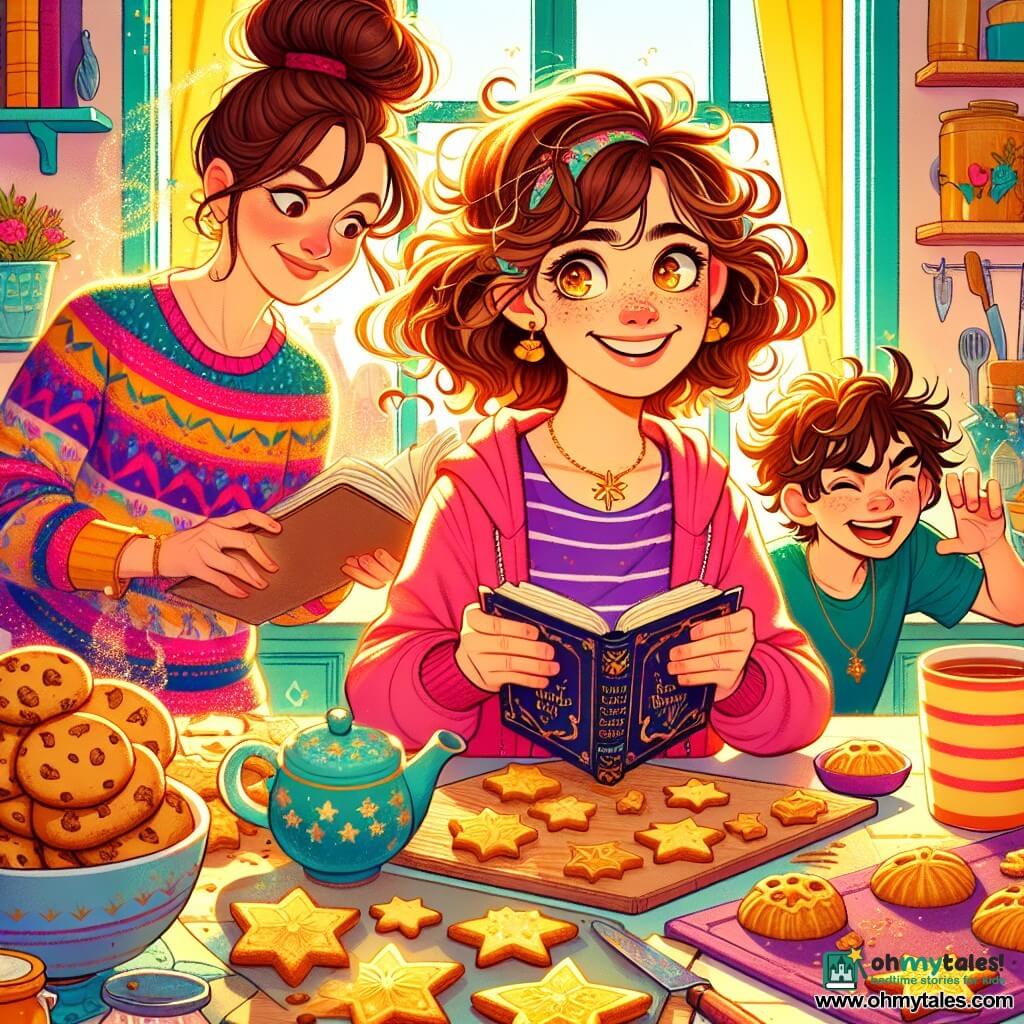
Aunt Petal clicked open the suitcase. Inside were teabags, a sweater shaped like a question, and a book bound in oilcloth. The book had a title stamped on the cover in letters that seemed to blink when you blinked, like they were trying to stay awake.
“The Slightly Useful Grimoire of Everyday Charms,” Aunt Petal announced, and the book tried to slide under the sweater and pretend it was shy.
“For me?” Nora asked, in awe.
“For you,” said Aunt Petal, with a smile like a sunrise. “Because you are eleven and have excellent eyebrows. And because your town,” she sniffed the air, as if it had a flavor, “is buzzing.”
“Buzzing?”
“Tiny magic,” said Aunt Petal simply. “The kind that makes toast land butter side up. The kind that remembers your birthday before you do. It's fussy. It likes manners. It hates shouting. It hates being ignored. And it's thick as midwinter soup around here.”
The bread bin squeaked in excitement and tried to sit still. The spoon hummed.
Nora felt all at once like she had discovered a secret door behind the coat rack. She reached for the book. It shivered under her fingers, as if it was ticklish.
“Please,” she told it softly, because she was learning fast.
The book warmed and fell open to a page titled: For Finding Laces, Keys, and Other Escape Artists.
Aunt Petal winked. “Start small,” she said. “If it asks for glitter, put the book down and leave the room.”
The Slightly Useful Grimoire
The first spell in the Slightly Useful Grimoire was gloriously ordinary. It involved a shoelace, a pencil, and three taps that were not at all a dance but felt like one.
“A Lace-Location Lilt,” Aunt Petal explained. “Very good for mornings. Also good for anything that has walked off in protest.”
Nora crouched by her trainers. One lace had indeed escaped and was halfway under the radiator, sulking. She tapped the pencil on the floor, tap-tap-tap, and sang the little line written on the page.
“Lace that wanders, lace that roams,
Skip back quick to proper homes.”
The lace wriggled like a happy worm and slid back into her hand. It tied itself in a bow with a flourish, showing off. The bow was slightly crooked but proud.
“Wow,” Nora breathed.
“Remember to thank it,” said Aunt Petal.
“Thank you,” Nora told the bow. It puffed up with joy.
The second spell was for bread. It promised toast that would never burn if you whispered to the crumbs and set the dial to “marmalade.”
“Careful,” Aunt Petal warned. “The toaster is sensitive. It believes it is an artist.”
Nora did all the steps, and the toaster glowed with a cozy sort of pride. The toast popped up golden and soft, like a small edible sun.
Her mother took a bite and said, around the crunch, “I love Aunt Petal, but if the radiator starts giving us advice, she sleeps in the shed.”
“It only gives advice if you ask for it,” Aunt Petal said, which was not the comfort Nora's mother was hoping for.
The third spell looked harmless. It was called The Tidiest Desk Trick and required a glass of water and a whispered promise to put pencils back with their own kind.
Nora whispered. She waited. Her desk shuffled itself. Papers stacked with the neatness of a librarian's heart. A paperclip slithered into a jar and clicked in happiness. A lone sweet wrapper crawled into the bin, trying to be brave.
“This is brilliant,” Nora said, suddenly hooked. “I could use this at school. For my project.”
“What project?” Aunt Petal asked.
“The Incredible Ordinary Science Fair,” Nora said, bouncing a little. “It's next week. We have to show how everyday things are amazing. I was going to show how water swirls when you stir it clockwise and anticlockwise, but… magic.”
“Magic is just manners with a cape,” Aunt Petal murmured. “And capes get in the soup. Be careful. Keep it small. Tiny magic is happiest when nobody claps too loud.”
At school, tiny magic was not just buzzing. It was humming like bees on bicycles.
The corridor smelled of soup, ink, and mischief. Nora said “Good morning” to the noticeboard, because it seemed polite, and it rippled proudly. She said “Excuse me” to the door, and it opened in the exact way a door does when it would have done it anyway but appreciates the gesture.
She passed Ms. Beckett, the librarian, who had eyes like shiny buttons and a cardigan that seemed to have eaten a rainbow. “Good morning, Nora,” Ms. Beckett said. “We have a new book on mushroom detectives. It's very serious.”
People shuffled and laughed and shouted. No one said please to the lockers. No one thanked the chairs. Nora did not know how she knew that mattered. She just knew.
In class, Mr. Griggs said, “Today we begin our Incredible Ordinary projects. No explosions.”
“Oooh,” said the Bunsen burners quietly.
Nora opened her bag. The Slightly Useful Grimoire thumped against her lunch with the determination of a cat wanting attention. She slid it into the desk drawer and patted it. The desk purred.
Oliver, who sat next to her and had more hair than seemed strictly necessary, whispered, “What are you doing, Finch?”
“Science,” Nora whispered back.
He grinned. “Good. I was worried it was knitting.”
Nora tapped her pencil three times against the desk, careful and quick. The pencil hopped as if it had heard its name. She smiled.
The rest of the day went mostly like a day. There was a pop quiz which arrived with a smell of fear. There was a sandwich exchange that became complicated when someone tried to swap ham for air. And then, at lunchtime, something happened that was not like a day at all.
The lunch trays slid off the stack and wheeled themselves under a table. The vending machine beeped “No, thank you” and refused to vend. The salad bar sneezed leaves.
“Hey!” cried Ms. Beckett, clutching a mushroom detective book to her chest. “Who messed with the machines?”
“They're… sulking?” Nora said.
Oliver quirked an eyebrow. “Machines can't sulk.”
The napkins fluttered in a pout. Someone's spoon hid under the mashed potato and refused to come out.
Nora felt the buzzing, strong now, like bees on a drum set. She heard the little voice again, not one voice, but many, like a whispering crowd.
“Not enough pleases. Not enough thank yous. Nobody looks. Nobody notices. We lift, we nudge, we fix, and what do we get? Jam fingerprints and shouting.”
“Hello?” Nora said under her breath, to the air. “Who's there?”
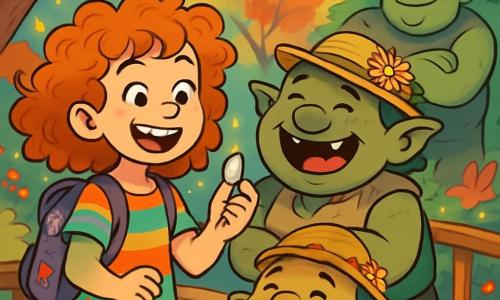
A thing peered up at her from under the table. It was maybe the size of a plum. It wore a hat made of a leaf and a tie made of a shoelace. Its eyes were bright, like two buttons stolen off a coat.
“Oh,” it said. “We've been heard.”
The Strike of the Nudgers
“Don't scream,” said the small thing under the table. “It upsets the cutlery.”
Nora did not scream. She had a spoon balanced on her nose. It was a good excuse.
Oliver, under the pretense of tying his shoe, bent down. “Is that a mushroom?”
“It is clearly not a mushroom,” the small thing said, offended. “Mushrooms lack ties. I am Mr. Sprig, Repsprite for the Nudgers' Guild, Tumbledown Chapter.”
“Nudgers?” Nora whispered.
Mr. Sprig tipped his leaf hat. “We are the tippers of salt shakers. The finders of lost keys. The gentle push that makes the bus arrive on time. The whisper in your ear that says, ‘Look left now,' so you don't step in a puddle that thinks it is a lake.”
“I knew it,” Nora breathed.
Oliver blinked. “You did?”
“Sort of,” Nora said. “Also no.”
Mr. Sprig brushed a crumb from his tie. “We work behind scenes, under tables, inside shoes, in coats' warm pocket corners. We do not ask for wages, for we cannot reach the coin slots. But we do insist on three small rules. One: People say please. Two: People say thank you. Three: Once a day, make someone or something smile, even if it is your lamp.”
Oliver's mouth twitched. “You can make a lamp smile?”
“Plainly,” Mr. Sprig said. “Lamps love knock-knock jokes. Knock knock—”
Nora leaned in. “What's gone wrong?”
“What always goes wrong,” Mr. Sprig sighed. “Hurry. Noise. Forgetting. The town has grown sloppy. The bus drivers yell. The doors get slammed. No one laughs at the lamp's jokes. We nudged and nudged. No one noticed. So we have initiated a Gentle and Reasonable Strike.”
“The lunch trays hiding?” Nora guessed.
“Reasonable,” Mr. Sprig said.
“That door that rang?” Nora added.
“Gentle,” Mr. Sprig nodded.
“The kettle,” Nora said.
“Setting standards,” Mr. Sprig said. “We hope for quick resolution. We do not enjoy chaos. Chaos is sticky. But we will not be taken for granted. We have dignity. And tiny clipboards.”
Nora looked around. The cafeteria was in shambles. The vending machine had folded its arms. The napkins were sulking in a corner. Kids were poking carrots and getting nowhere. Teachers were trying to pry trays out from under the table with the patience of saints and the strength of dust bunnies.
“We can fix this,” she said.
Oliver whispered, “We can?”
“Yes,” Nora insisted. “We can explain. We can get people to say please. We can—”
“Ah,” Mr. Sprig said, holding up both tiny hands. “Careful. Explaining is big. And you are small. Big makes small nervous. Small likes small. It's in the name.”
“I can do small,” Nora protested.
Mr. Sprig considered her. His bright eyes softened. “You said please to a kettle,” he said. “And you thanked your lace. And you listened. Listening is our currency. Very well. Come to the park after school. Under the third bench with the wobbly leg. Bring something to share. Not olives. We never did understand olives.”
Oliver whispered, “I can come too, right?”
Mr. Sprig looked at Oliver's hair. “Yes,” he said solemnly. “If your hair apologizes for taking up two seats.”
“We'll talk,” Oliver told his hair.
The rest of the day was a muddle. The photocopier refused to copy unless you flattered it. The water fountain refused to spurt unless you sang to it. The fire alarm, thankfully, remained professional.
After school, Nora stuffed the Slightly Useful Grimoire into her bag, along with a packet of biscuits shaped like stars and a note that said: Please be careful. —Mum. She and Oliver walked to the park, where the third bench had a leg that went clonk when you sat on it, like a donkey that had never learned to clap.
They ducked under the bench. There were crumbs. There were old leaves. There were bottle caps with interesting lives. And there were Nudgers. Dozens. Maybe hundreds. Tiny folk with hats made from bits of things and laughs that sounded like bells in a pocket.
“Guild in session!” cried Mr. Sprig. “Bring forth the biscuits!”
Nora held up the packet. It rustled. A tide of tiny hands accepted one star, then another. Polite murmurings. “Thank you.” “Much obliged.”
A Nudger with a skirt made of ticket stubs sniffed the air. “Ordinary biscuits,” she declared. “Excellent.”
Mr. Sprig cleared his throat. It was a small sound that made everyone listen. “This is Nora Finch and Oliver With The Hair. They have offered to help. They are children.”
“That is entirely usual,” said a Nudger in a jar lid helmet. “Children notice. Adults make lists.”
A cheer went up. Someone waved a bottle cap. Someone else swam in a leaf.
Nora knelt, careful not to squash anyone's hat. “We can talk to people,” she promised. “We can write signs. We can—”
Mr. Sprig held up a hand. “We require something before we can consider ending our Gentle and Reasonable Strike. Three somethings. Very small. It is our way. Complete three Small Courtesies. Then we will talk.”
“What are they?” Oliver asked.
“Tests,” said Mr. Sprig. “One: Tie a shoe that is not yours, with permission. Two: Rescue something small that is not alive. Three: Tell a joke to something that cannot laugh, and make it feel it did.”
Nora's heart did a brave little hop. “Okay,” she said. “Yes. We can do that. I think.”
Oliver whispered, “I am excellent at knots. And terrible at jokes.”
“Excellent,” said Mr. Sprig. “We adore ambition.”
The Grand Polite Scheme
The next morning, Nora woke up with a plan. Plans were exciting. Plans had arrows and boxes and often something underlined twice for importance. Her plan had all of that, plus a banner that said: THE GRAND POLITE PARADE.
“You know your face is doing a thing,” her mother said, pouring cereal.
“It's a plan face,” Nora said. “For a parade. With signs. And thank-you banners. And megaphones.”
“Megaphones?” her mother repeated warily.
“For telling everyone to be polite,” Nora explained. “Loudly.”
Aunt Petal, eating toast shaped by its own ambition, raised an eyebrow. “Tiny magic doesn't like loud,” she reminded. “It likes honest. It likes the kind of please you whisper to your shoelaces when you're late. It likes a thank you that isn't expecting applause.”
“It'll be fine,” Nora said, putting on her best determination. “It will be like a parade, but quiet. A whisper-parade.”
At school, she and Oliver used the Slightly Useful Grimoire's neatness spell to make the art cupboard behave. They made signs in neat letters. PLEASE IS MAGIC. THANK YOU IS COOL. BE NICE TO DOORS.
They set off at lunch, carrying the signs like heroic ants. Nora had borrowed a megaphone from the lost property, which could mean prison time in some schools. She held it up. She turned it on. She said, “Everybody, please—”
The megaphone coughed and swallowed her voice. It spat it out three times bigger. “EVERYBODY, PLEASE—”
The entire cafeteria froze. The napkins fainted. Somewhere, a fork fell in love with a plate. Nora felt the buzzing shift, then tremble, then roll like thunder. She had a sudden and terrible thought: She was doing it wrong.
The Nudgers popped into view between chair legs, hands over their ears. Mr. Sprig skidded toward her with a look that said I am very small and very upset in a very polite way.
“Big,” he hissed. “Too big.”
Nora fumbled with the megaphone. It slipped. Oliver caught it. It honked. The ketchup bottle shivered and sprayed a line that spelled SORRY on the floor, which was talented but unhelpful.
“Turn it off!” Oliver shouted. Then, remembering, added, “Please!”
Nora turned it off. She put it down gently. “I'm sorry,” she said to the room. “I forgot…”
The Slightly Useful Grimoire rustled ominously in her bag, as if to say, “We did warn you.”
Chaos had returned, but this time it wore a bow tie. The doors held themselves open so politely that a breeze got in and refused to leave. The chairs pulled out for people when they were trying to sit, and everybody landed one chair over. The water fountain bowed every time someone approached, and smashed its nose on the floor.
“After you,” said the revolving door, to the person inside it. “No, after you,” said the person. They went around twice.
Mr. Griggs pinched the bridge of his nose. “Nora Finch,” he said. “What have you done?”
“Trying to help,” Nora said miserably.
“Please stop helping,” Mr. Griggs said, in a voice that was only half joking. “We are drowning in courtesy.”
“I will fix it,” Nora promised. “Please don't panic.”
“I prefer panic,” Mr. Griggs said. “It's louder.”
Oliver touched her arm. “We need to do the three Small Courtesies,” he whispered. “You're thinking Big. We need to think tea-saucer.”
“You're right,” she said, and something unknotted in her chest.
They started small. They looked. They listened. They found an elderly man in the corridor with a shoe stubbornly untied.
“Excuse me,” Nora said. “May I help?”
He frowned. “Oh. My hands are silly. Yes. Please.”
She tied the shoe. She tied the other for good measure. She made the bows neat and friendly, because bows notice. “There,” she said. “Thank you for letting me.”
The man blinked. “Well,” he said, surprised warm. “That's… kind.”
A breeze blew. It felt like a sigh of relief.
Next, they rescued a leaf. It had fallen into a puddle that had ambitions to be a very small lake and a very big nuisance. The leaf was ordinary, except to the leaf.
Oliver knelt. “With your permission,” he told the puddle.
The puddle glimmered. It meant yes. He scooped the leaf out and placed it on the grass. The leaf shivered its little leaf shoulders and looked greener.
“Thank you,” Nora told the puddle. “Nice job being reflective.”
“Appreciated,” the puddle said, by making a ripple that looked smug.
Then came the joke. This was the hard one. In the park, a lamppost stood tall and stiff, as if it had been taught manners at a very strict school. It did not have a mouth. It did not have ears. But it had, Nora felt, a heart. Not the thumpy sort. The steady sort that likes doing its job and being useful.
Nora stood in front of it. “Hello,” she said. “May I tell you a joke?”
The lamppost did not say no. It flickered once, very politely.
“Knock knock,” Nora said.
Oliver winced. “Oh no.”
“Who's there?” Nora asked herself, because someone had to.
“Wanda,” she said.
“Wanda who?” Oliver sighed.
“Wanda be thanked for keeping us safe when it's dark.”
Oliver groaned for a few hours. The lamppost glowed a little brighter. It wasn't laughter, exactly. But it was a feeling that had put on its best shoes.
Mr. Sprig appeared at her elbow, out of the grass, out of the air. He looked at the lamppost, at the leaf, at the man's neat shoes, and then at Nora.
“You did small,” he said softly.
“I did,” Nora said. “I'm sorry for the big. I thought… if I shouted enough, people would listen.”
“They do,” Mr. Sprig said. “For a moment. Then they have to shout louder to hear themselves over you. But small stays. Small rustles into pockets. Small waits. Small grows.”
“I want to fix it,” Nora said. “Properly.”
Mr. Sprig's smile was as thin and bright as a piece of foil. “Shall we talk, then? Under the bench. Bring your plan. Not the megaphone.”
Under-the-Bench Bargains
They met again under the wobbly bench. The Nudgers were assembled like a tiny parliament, if parliament wore hats made of buttons and had crumbs for snacks.
Nora took out her plan. She had changed it. She had crossed out the parts that were very big and drawn stars next to the parts that were very small.
“First,” she said. “We do Thank-You Notes Day. Not fancy. Just small notes. To people. To things. To the bus stop. To the bin that never complains.”
“Good,” said the ticket-stub Nudger.
“Second,” she said. “We plant Please Seeds. They're paper hearts. You put them in your pocket. Every time you say please, you touch the seed. You don't get a prize. You just feel it crinkle. That's the prize.”
“Acceptable,” said the jar lid helmet Nudger, who struck Nora as tough but secretly soft.
“Third,” she said. “We make a Lost and Found Love Wall. Everyone brings one small thing they lost and found again because of a nudge. We pin little stories. We clap quietly.”
Mr. Sprig rubbed his chin, which was the size of a lentil. “We can agree,” he said. “On one condition.”
Nora held her breath.
Mr. Sprig's eyes were serious now. “It cannot be just for a day. It must be a habit. Habits are the blankets we tuck around the world.”
Nora nodded. “We'll make it stick,” she promised. “Promise.”
Oliver reached into his bag and pulled out the Slightly Useful Grimoire, which had a way of arriving exactly when needed. “We can write a Charm,” he said. “A very small one.”
Aunt Petal had said: Careful with Charms. But she had also said: You learn by living. Also she'd said: Never trust a frog who says it used to be a prince.
Nora opened the Grimoire. It fell open like it was listening. On a blank page, with a pencil that tried to hold its breath, Nora wrote:
“For moments handy, for hands not grand,
For kitchens, doors, and bits of sand,
Let manners hum in shoe and sleeve,
To make it easy to believe.”
She thought of the sound the kettle had made when she said please. She thought of the lamppost glow. She thought of Mr. Griggs, tired and trying. She thought of how small is not actually small when you see it enough times.
“May we?” she asked, to Mr. Sprig and the Nudgers and the book and the world.
“You may,” said Mr. Sprig.
They did the Charm. It wasn't a chant. It wasn't even a whisper. It was like breathing, but listening while you did it. The page warmed. The air tickled her ears, as if a breeze was reading over her shoulder. Somewhere, far away, a toaster bowed.
The next day at school, Nora and Oliver made a station in the hall. They had paper and pencils and a box for Please Seeds. They had two signs: WRITE ONE THANK-YOU NOTE (NO GLITTER) and TOUCH A SEED WHEN YOU SAY PLEASE (YOU WILL NOT EXPLODE).
Kids came by. They wrote notes because it looked like fun and because Oliver grinned at them and because Ms. Beckett made a note that said Thank you, stairs, for remembering up and down. Mr. Griggs wrote one that said: Thank you, coffee mug, for not losing your handle when I need you most.
Nora wrote a note to the revolving door. Sorry about earlier. Also thank you for stopping drafts. The revolving door sighed with happiness and did not trap any seventh graders that day.
People put Please Seeds in their pockets. They forgot, then remembered, then forgot. But the seeds were there, crinkly as courage. They rustled when someone said please without thinking, which is the best kind.
At lunch, the trays came out from under the table with extreme dignity. The vending machine vend-ed. The napkins sat up straight. A spoon peeked out of mashed potato and tried not to cry in relief.
Mr. Sprig appeared near the salad bar, looking like someone had ironed his worries. “We will slow our strike,” he announced. “We will watch. We will see.”
“Thank you,” Nora said.
“Please continue,” Mr. Sprig replied.
They set up the Lost and Found Love Wall. At first it was silly. A hairband. A library card. Then there were stories. A boy who had found his grandmother's ring behind the sofa because he'd looked one more time. A girl who had found her courage in the swimming pool because Ms. Beckett had said, “I'll wave at you every lap.” A teacher who had found a joke when the room needed one.
People read the notes. Some smiled. Some rolled their eyes. But even eyes that roll can read.
That night, the kettle boiled like a singer. The doorbell rang like it was proud to be a bell and not a door. The lamppost glowed like gold. Nora sat with Aunt Petal on the step, eating biscuits that might or might not have been cursed.
“How was your parade?” Aunt Petal asked.
“It wasn't a parade,” Nora said. “It was a rustle. It worked better. Mostly.”
Aunt Petal nodded. “Mostly is the best place to live. It means there is still room for biscuits.”
Nora looked up. Stars were freckles on the sky's face. Between them, something tiny zipped by. It might have been a firefly. It might have been a Nudger with important business.
“What happens if people forget again?” she asked.
“They will,” Aunt Petal said cheerfully. “That is how forgetting works. Then someone will remember. That is how remembering works. Your job is not to make everyone perfect. It is to make it easier to be kind.”
Nora sipped tea that tasted like stories. She thought of the Grimoire in her bag, humming quietly to itself. She thought of her project for the Incredible Ordinary Science Fair.
Maybe, she thought, she would do it on ripples. Not the water kind. The other kind.
The Small Magic Comes Home
The day of the Incredible Ordinary Science Fair arrived with tents on the lawn and a wind that pretended it wasn't there until it blew someone's hat into the goal net.
Nora and Oliver set up a table. No explosions. No megaphones. Just a bowl of water, a stack of paper, a handful of Please Seeds, and the Slightly Useful Grimoire sitting like a book that was determined to be normal and failing.
“What's your project called?” Ms. Beckett asked, chewing thoughtfully on a pencil.
“Ripples,” Nora said. “How a tiny thing makes another tiny thing and another, until standing up feels like dancing.”
Ms. Beckett's eyes crinkled. “Good title. Also the subtitle is excellent.”
“What subtitle?” Nora looked down. Someone had written, in small neat letters on the sign: Or, How To Be A Wizard Without A Wand.
Mr. Griggs walked by with a clipboard and the look of a man trying to arrange ducks. “Any actual magic?” he asked, in a tone that meant he would be okay about it as long as it didn't set off the sprinklers.
“Only the everyday sort,” Nora said.
Her demonstration was simple. She dropped a pebble into the bowl. Ripples spread. She touched a Please Seed and said “Please” to the wind, because it was being very clever about hats. The wind tried to hold a straight face. It failed. A hat swooped politely back onto a head with a whoof.
She showed people the Thank-You Wall now moved out to the fair. She asked them to write notes. A boy wrote: Thank you, bike, for not squeaking when I sneak chocolate. A girl wrote: Thank you, Mum, for finding my lucky sweater when it was on me. Mr. Griggs wrote: Thank you, students, for trying. Even when trying means megaphones. He glanced at Nora, and his mouth did an almost-smile.
Oliver ran a joke booth for lampposts. He stood in front of one and said, “Knock knock.”
“Who's there?” he asked himself, because lampposts are shy.
“Wanda,” he said.
“Wanda who?”
“Wanda hear the other one about LEDs?”
He was terrible. It was perfect. The lamppost shone like a lighthouse who had just been told it was doing a good job at being tall.
Aunt Petal circulated like a friendly storm system but did not take over, which is very hard if you are Aunt Petal. She pressed biscuits on people and murmured “Please” and “Thank you” like sugar in tea.
The Nudgers were present too, though most people did not see them. They scurried under tables, dusted shoe laces, and kept an eye on the cutlery. Mr. Sprig leaned against a paper cup and watched Nora with the air of a general who had decided that soup was the strategy after all.
When the judges came by, they looked at the bowl of water and at the wall of notes and at the seeds. They frowned in the way judges have practiced in mirrors. One asked, “But where is the device?”
Nora said, “It's not a device. It's a habit.”
The judge blinked.
Nora added, “It's science. Kind of. Small input. Repeated. Big output. Also you can do it at home.”
Oliver said, “Also it stops doors hitting people.”
The judge rubbed his chin. He smiled without meaning to. “Carry on,” he said.
Nora did not win the ribbon that looked like a sunflower. That went to someone who had made a volcano that burped confetti. She did win a special mention for Practical Kindness and an errand to help Ms. Beckett carry mushroom detective books back to the library, which was better.
That evening, as the fair packed away and the sun tucked itself into the trees, Nora stood by the lamppost. She touched the Slightly Useful Grimoire. It purred.
Mr. Sprig appeared on the sign again, as if he had been part of it all day. “Well, Nora Finch,” he said. “Guild meeting outcome: Strike postponed. Manners rising. Spirits lifted. Small magic returning to usual levels of faintly smug.”
“I'm sorry,” she said again, because it still mattered. “About the megaphone. About forgetting to be small.”
“Apology accepted,” Mr. Sprig said. “The chairs have stopped bowing. The trays are in therapy.”
They stood in companionable silence for a moment. A moth bumbled past, busy with nothing. The lamppost hummed lightly, as if practicing being the moon.
“Anything else?” Nora asked.
Mr. Sprig cleared his throat. “A minor complaint has been registered by the Spoon Society,” he said. “Apparently, soup slurping is at epidemic levels.”
Nora snorted. “What does the Spoon Society want?”
“Napkins,” Mr. Sprig said gravely. “And respect. And less soup. But mostly napkins.”
“We'll make a sign,” Nora promised. “Use your napkin. Spoons have feelings. Please.”
“Excellent,” Mr. Sprig said. He tipped his leaf hat. “On behalf of the Nudgers' Guild, Tumbledown Chapter, thank you. For listening. For tying shoes. For telling truly awful jokes to lamp posts.”
“You're welcome,” Nora said. “Any time.”
Mr. Sprig faded into the near air, which is where small things go when they are not in your pocket. The air smelled like tea and paper and new plans.
Nora walked home. She said “Thank you” to her front door, because doors are heroes too. The kettle boiled like a good story. She wrote in her notebook: Small is not less. Small is practice.
Aunt Petal sat at the table, weaving a scarf that looked like a map of everywhere and nowhere.
“How was incredible?” she asked.
“Ordinary,” Nora said happily. “And I think I prefer it that way.”
They ate soup. They used napkins. The spoons clinked politely and did not complain. Outside, the lamppost glowed. It wasn't laughing. But it was smiling, in its way.
Later, in bed, Nora felt the city breathe the way a sleeping cat does. She heard a faint rustle. The Nudgers, back at work. A key found. A sock rescued. A bus that decided to wait for someone running. Small things. Important things. Easy to miss. But not by Nora Finch. Not anymore.
And far off, under the wobbly bench, a leaf hat was tipped, and a tiny voice said into the night: “After you.” And the night, which was very polite, said, “No, after you.” And the stars seemed to wink because even stars know—please makes magic, thank you makes it stay.