Chapter 1: Boots in a Burrow
The problem with magical items is that they never stay where you put them.
Fennick the fox had tucked the boots under a polite stack of stolen tea towels, three shiny buttons, and a whisk he didn't know how to use but enjoyed owning. He'd arranged everything in his burrow the way a sensible creature would: in piles that made sense to him and to absolutely nobody else.
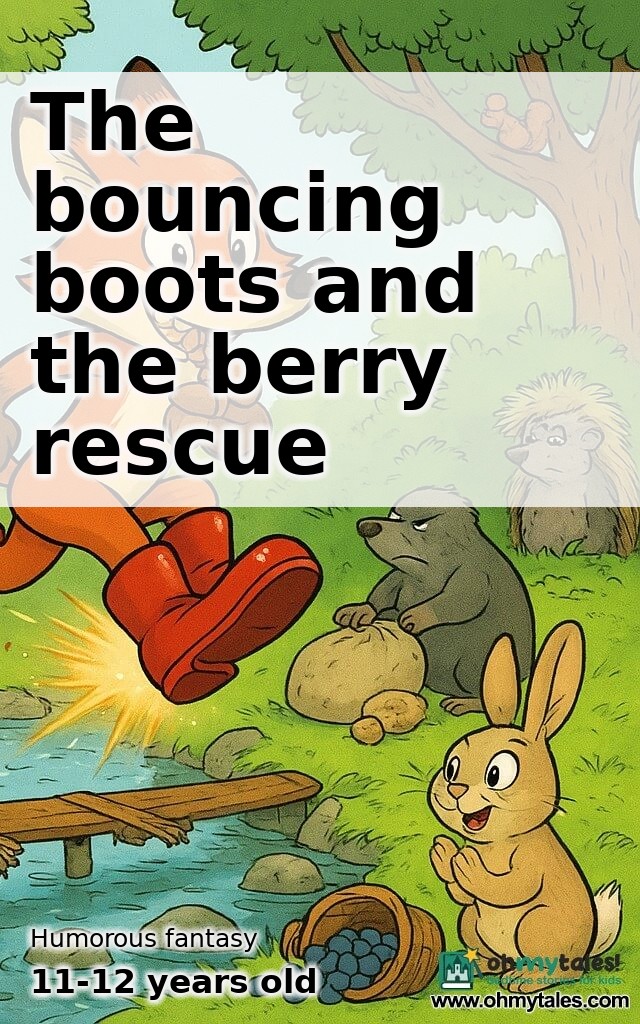
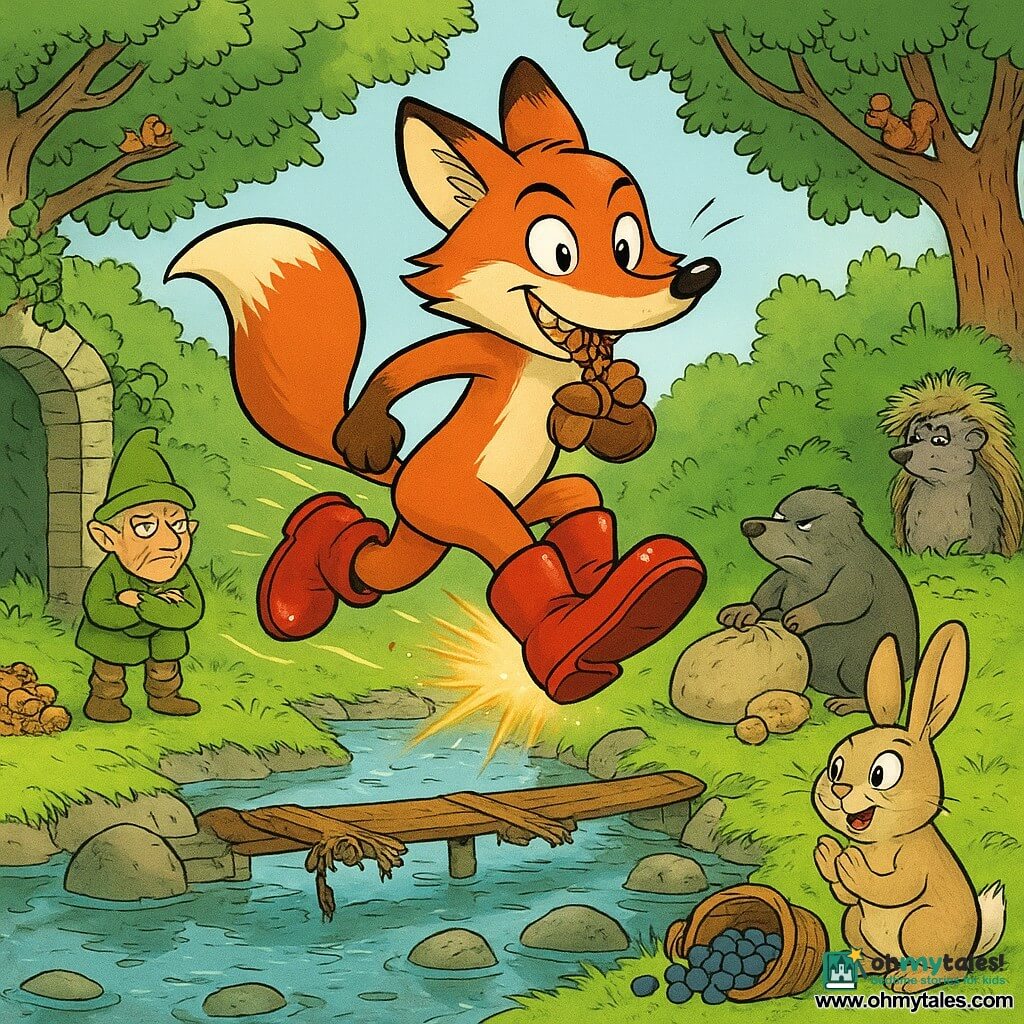
The boots were bright red. Not “berry red” or “sunset red.” They were “warning sign” red, the kind of red that suggested they might bite.
They didn't, exactly. They just bounced.
Fennick stared at them like they were staring back. “All right,” he told the boots, because talking to boots was a perfectly normal activity when you lived near a forest where mushrooms sometimes whispered gossip. “Today we do a controlled test.”
The boots wiggled. Or maybe the light flickered. Or maybe they were eager. Magic had a habit of acting like it had its own opinions.
He sniffed them. They smelled like new leather and old thunder.
He'd found them wedged behind a fallen log, beside a stone circle that had definitely not been there last week. The circle had been humming, quietly, like a bee that had read too many spellbooks. Fennick had, of course, done the responsible thing: he'd taken the boots.
Now he wanted to test them properly. Not just a tiny hop that knocked over his “important” pile of spoons.
He slipped one paw in.
The boot tightened politely, like it was shaking hands.
He slipped the other paw in.
The boots hummed.
Fennick crouched. He thought about safety. He thought about scientific method. He thought about the fact that he was a fox and therefore built for daring, mischief, and occasionally poor decisions.
“Hop,” he commanded.
The boots did not hop.
They launched.
Fennick shot out of his burrow like a cork from a bottle, sailed over a fern, skimmed the top of a blackberry bush, and landed—if you could call it landing—on a very surprised mole's front doorstep.
The mole blinked. “You're early.”
Fennick sat up, ears spinning like windmills. “Am I?”
“I don't know,” said the mole. “But you're definitely sudden.”
The boots bounced once, twice, as if applauding themselves.
Fennick grinned, despite the fact that his insides were still trying to catch up with his outsides. “They work.”
“That's nice,” said the mole, whose name was Mudge and whose hobby was being unimpressed. “Do they work away from my doorstep?”
“That,” said Fennick, “is what I intend to find out.”
Chapter 2: The First Proper Leap
Mudge escorted Fennick away from the doorstep with the gentle firmness of someone moving a problem into a different postcode.
Fennick trotted to a clearing, trying to look casual while his boots made tiny eager bobbing motions. The forest watched. The trees didn't say anything, but they always looked like they were listening.
He picked a spot between two mushrooms that were arguing softly about poetry.
“Controlled test,” Fennick repeated, mostly to remind his legs. He bent his knees. “Small hop.”
He pushed off.
The boots answered with an enthusiastic “ABSOLUTELY” and flung him into the air.
Fennick yelped, a sound that surprised even him, and wind rushed past his whiskers. The clearing shrank. The treetops rose. A crow stared at him mid-flight, offended at the competition.
Then gravity remembered its job.
Fennick came down toward a patch of bracken—and the boots bounced again on their own, turning a fall into a springy, ridiculous boing. He ricocheted like a happy pebble across a pond, except ponds usually didn't squeal.
He finally skidded to a stop beside a hollow stump where Old Thistle the hedgehog kept her emergency snacks and her emergency complaints.
Old Thistle peered out, eyes narrowed. “Why are you arriving like a thrown sausage?”
“I'm testing,” panted Fennick, trying to keep dignity from escaping out of his ears. “Boots.”
Old Thistle's gaze dropped to the red leather. “Those are not sensible boots.”
“They're magical.”
“That's the same thing,” she said. “Not sensible.”
Fennick stood tall. The boots bounced once, making him bob like a toy. “I need to learn control.”
Old Thistle snorted. “Control is a myth invented by squirrels to sell acorns.”
Mudge, who had followed at a safe distance, called out, “Try not to break anything important!”
Old Thistle shouted back, “In this forest, everything is important to somebody!”
Fennick looked around. A bee hummed near a thistle flower. A line of ants marched with grim purpose. A snail made slow progress across a leaf, as if late for an appointment.
He swallowed. The boots, he noticed, were not just a toy. They were a large, bouncy responsibility.
“All right,” he said, more quietly. “No more random launching.”
The boots hummed again, as if they'd heard “random launching” and liked it.
Fennick sighed. “We're going to need rules.”
Chapter 3: A Bouncy Problem
Rules were tricky because the boots did not appear to read.
Fennick tried speaking firmly. “Boots. Small. Hop.”
The boots launched him over Old Thistle's stump.
He tried whispering. “Tiny hop, please.”
The boots launched him even higher, possibly out of spite.
He tried flattery. “Oh, magnificent boots, surely you can manage a gentle bounce.”
The boots managed an enormous bounce, as if showing off.
Fennick's next attempt involved tying a vine around his waist so Mudge could hold the other end like an anchor.
“This is undignified,” Fennick said.
“So is flying past my face like a startled kite,” Mudge replied.
Fennick crouched. “Ready.”
He pushed off.
The boots yanked him upward. The vine snapped taut. Mudge grunted, dug his claws into the soil, and slid forward, leaving two neat furrows like he was ploughing a field with his body.
They both shot forward. Fennick arced through the air; Mudge skidded beneath him, eyes wide.
Old Thistle watched, chewing an emergency nut. “Well,” she said, “that's teamwork. Terrible teamwork. But still.”
Fennick landed—bounced—landed—bounced—then finally stopped, dizzy and laughing despite himself.
Mudge lay on his back, staring at the sky. “I have learned something.”
“What?” Fennick asked, trotting back.
Mudge's voice was flat. “Never help you.”
Fennick's ears drooped. “I'm trying! I just want to test them properly. There must be a way to—”
A sharp squeak interrupted him.
Across the clearing, a young rabbit named Pip was hopping in frantic circles. A basket lay overturned, and shiny blueberries rolled like marbles down a slope toward a narrow stream.
“Stop!” Pip squealed at the berries, which did not stop because berries rarely respect authority.
The stream was not deep, but it ran fast. Fast enough to steal snacks and laugh about it.
Pip glanced at the water, then at the blueberries, then at the long distance between them. “I can't— I'll never—”
Fennick's boots bounced once, as if clearing their throat.
Fennick looked at the runaway berries, then at Pip's trembling paws.
Magic or not, he thought, a fox could be quick. And with these boots…
Mudge groaned, still on the ground. “Don't you dare.”
Fennick squared his shoulders. “I dare.”
He took a breath, aimed himself down the slope, and whispered to the boots, “If you're going to misbehave… at least misbehave usefully.”
He sprang.
The boots launched him like a bright red comet.
Chapter 4: Berry Rescue, Mostly Successful
Fennick flew down the slope, wind whistling past his ears. Blueberries scattered like tiny blue planets escaping their orbit.
“Left!” Pip cried.
Fennick twisted midair. The boots corrected—sort of—by bouncing off a rock and sending him in a new direction that was technically left but also slightly upward and entirely unnecessary.
He landed with a boing beside the stream. A line of blueberries was about to plop into the water.
“Not today,” Fennick muttered.
He bounced again, trying to use the spring to skim along the edge. The boots, delighted by having a purpose, turned him into a fast, wobbling pinball.
He snatched berries with his mouth, with his paws, with his tail (that one was an accident), and once with a desperate scoop of leaf like a tiny shovel.
One berry popped into the stream and shot away.
Pip made a sad noise. “That was my luckiest berry.”
“There are luckier berries,” Fennick said through a mouthful of blueberries, which made it sound like, “Therr arr lurrrkierr berrrriess.”
Mudge had gotten up and was lumbering down the hill, grumpy but concerned. Old Thistle followed at a dignified hedgehog-waddle, as if rescuing snacks was simply what one did on a Tuesday.
Fennick saw the stream carrying the escaped berry toward a little whirlpool near a root. A dragonfly hovered above it, watching with dramatic interest.
“Hold my dignity,” Fennick told nobody, and bounced toward the root.
He misjudged. The boots hit the root and sprang him straight up. For a brief moment, he was above the stream, above the bushes, above the sense that he was in control of his own life.
Then he came down—right beside the whirlpool—paw outstretched.
He caught the berry at the last second.
“Ha!” he shouted.
The boots took this as encouragement and bounced again, flinging him backward into a patch of soft moss where he landed like a dropped pillow.
Pip reached him, panting. “You saved them!”
Fennick sat up, moss stuck to his nose. “Most of them.”
Pip tilted their head. “Why would a fox save a rabbit's berries?”
Fennick blinked. He could have said something clever. He could have said something dramatic. He could have said, “Because I am secretly noble.”
Instead he said, “Because you looked like you needed help. Also, blueberries are innocent.”
Old Thistle arrived and inspected the recovered pile. “Decent rescue,” she said. “Messy. Loud. Only slightly heroic.”
Mudge folded his paws. “And now you've taught the boots that chaos earns praise.”
Fennick looked at the bright red leather. The boots hummed smugly.
“Oh no,” Fennick whispered. “They're going to want applause.”
Pip hugged the basket. “Thank you. I— I can share.”
Fennick's stomach made a small interested sound.
Mudge's eyes narrowed. “Don't.”
Fennick sighed. “Fine. Share with someone else.”
Pip's ears drooped. “But I want to share with you.”
Fennick hesitated. Altruism was easier when it didn't smell delicious.
He nudged the basket back toward Pip. “All right. One berry. For… scientific reasons.”
Pip giggled and offered him a berry, which was, annoyingly, excellent.
Fennick chewed thoughtfully. “Okay. Two berries. For science.”
Chapter 5: The Gnome Who Wasn't There
As Pip gathered the remaining berries, Fennick noticed something odd near the stream: a small stone arch half-hidden under ivy. It wasn't big enough for a badger. It was barely big enough for a rabbit.
It shimmered, as if the air had forgotten how to behave.
Mudge noticed too. “That wasn't there yesterday.”
Old Thistle sniffed. “Nothing magical ever is, dear.”
Fennick's boots bounced once, then angled slightly toward the arch as if pointing with invisible toes.
Pip stared at it, wide-eyed. “Is that… a fairy door?”
“No,” said Mudge quickly. “Fairies have taste. That looks like a gnome door.”
As if insulted, a voice from nowhere said, “Excuse me! I do have taste.”
The ivy rustled. A figure stepped out—small, sharp-eyed, wearing a hat that looked like it had been argued into shape. A gnome, all right, though gnomes were technically “minor household spirits” and also technically “a nuisance,” depending on who you asked.
“I am Bopple,” announced the gnome. “Keeper of Small Thresholds, Guardian of Misplaced Keys, and—”
He paused, squinting at Fennick's boots.
“—oh no.”
Fennick lifted one paw. The boot bounced. “Oh no what?”
Bopple marched up, hands on hips. “Those are my prototype Spring-Step Boots. I left them under a log to marinate in ambient enchantment.”
Mudge muttered, “Marinate.”
Bopple glared. “Magic needs time. Like soup.”
Fennick's ears flicked. “So they're yours.”
“They were,” Bopple said, pointing accusingly. “And you've been using them like a… like a pogo stick with opinions.”
Fennick opened his mouth to argue, then remembered the berries, the launching, and Mudge's furrows in the soil.
“…Yes,” he admitted.
Bopple sighed the sigh of someone who had invented a miracle and watched it become a prank. “They're meant for helpful bouncing. Delivering messages over puddles. Leaping fences to rescue lost kittens. Not… whatever you've been doing.”
“I rescued berries,” Fennick said quickly. “And I'm trying to learn control.”
Bopple's eyes narrowed. “Control comes from kindness and focus.”
Old Thistle snorted. “So does good knitting, but look where that gets you.”
Fennick leaned forward. “Can you teach me?”
Bopple considered him. “Foxes are impulsive.”
“I can be… less impulsive,” Fennick said, and his boots bounced as if laughing at him.
Pip piped up, “Fennick helped me when he didn't have to.”
Mudge added, grudgingly, “He's tenacious. Like a burr.”
Bopple rubbed his chin. “Fine. Lesson one: the boots respond to intention. Not commands. Not flattery. Intention.”
Fennick frowned. “What's the difference?”
Bopple poked Fennick's chest. “Command is shouting at the world. Intention is listening to it first.”
Fennick thought of the stream, the berries, Pip's panicked face. He'd jumped without thinking about showing off. He'd jumped because it mattered.
The boots hummed softly, almost approving.
Bopple pointed to a flat stone near the bank. “Show me a small hop. Not to impress. Not to test. Just to… be gentle.”
Fennick swallowed. He focused on the stone. On the moss. On the quiet.
He hopped.
The boots lifted him in a neat, tidy arc. He landed on the stone with a soft thump.
No launching. No ricocheting. No startled crow.
Mudge blinked. “Well.”
Old Thistle nodded. “Huh. Look at that. He's teachable.”
Fennick stared down at his boots, amazed. “I did it.”
Bopple sniffed. “You intended it.”
Fennick's tail swished. “Can I keep practicing?”
Bopple hesitated, then nodded. “For today. But with a purpose. The forest has a problem.”
Mudge groaned. “Of course it does.”
Bopple pointed toward the path that wound between the trees. “The creek bridge is out. The squirrels are staging a dramatic hunger strike because they can't carry acorns across. Someone needs to ferry supplies. With… bouncing.”
Fennick stood taller. “That's me.”
The boots bounced, as if cheering.
Bopple sighed again. “And lesson two: no applause.”
Chapter 6: The Great Acorn Delivery
They found the broken bridge where the creek widened, chattering loudly over stones like it enjoyed gossip. A plank hung crookedly, and the rope looked like it had been chewed by something with both teeth and bad intentions.
On one side, a crowd of squirrels sat in a sulky heap beside bags of acorns. On the other side, more squirrels paced dramatically, clutching their stomachs as if starvation was a theatrical performance.
A jay perched nearby, calling, “Tragedy! Unbearable tragedy!” even though nobody had asked.
A squirrel with a twig stuck in its fur marched up. “We demand a solution!”
Mudge muttered, “They always do.”
Fennick stepped forward. “I can jump supplies across.”
The squirrels stared at his boots. One whispered, “He has fancy feet.”
Bopple cleared his throat. “These boots are an experimental civic resource.”
Old Thistle whispered to Pip, “That means he's going to do something silly for the good of others.”
Pip whispered back, “That's my favourite kind of silly.”
Fennick faced the creek. It wasn't huge, but it was wide enough that a normal leap would end with a wet fox and a very smug stream.
He focused. Intention, not ego.
He picked up a small bag of acorns in his teeth. It was heavier than he expected. The squirrels had packed it like they were preparing for an acorn apocalypse.
Fennick backed up, crouched, and thought: I want to help. I want to land safely. I want to not become a headline for the jay.
He jumped.
The boots gave him a smooth, powerful arc. The creek rushed beneath him, cold and loud. He landed on the far bank without even wobbling.
The squirrels gasped, then immediately began arguing about whether the landing was “stylish” or “acceptable.”
Fennick dropped the bag. “Next!”
He bounced back, lighter now, and carried another bag. And another. Each time, he concentrated on the purpose: feed the hungry, stop the drama, keep the acorns dry.
Bopple watched with his arms folded, but his mouth kept trying to smile and failing because he was a gnome and had an image to maintain.
Mudge helped by organizing bags and shooing squirrels away from Fennick's takeoff spot. Old Thistle supervised by making sharp comments that somehow improved efficiency.
Pip ran small items—berries, nuts, and a very important ribbon somebody had dropped—back and forth along the bank, cheering quietly.
After the last bag went across, the squirrels immediately stopped starving. Miraculously. They began eating with such enthusiasm that the tragedy ended on the spot.
The jay looked disappointed. “No heroic sacrifice? Not even a minor fainting?”
“Try fainting yourself,” Old Thistle suggested.
Fennick took a breath and felt something warm in his chest, like pride but softer. The boots hummed gently, almost calm.
Bopple approached. “You did well.”
Fennick grinned. “So I can keep the boots?”
Bopple raised a finger. “Temporarily. They're still prototypes. Also, they need a… final calibration.”
Fennick's ears perked. “Calibration sounds like more testing.”
“It is,” Bopple said. “But the kind where you don't turn into a thrown sausage.”
Mudge coughed. “A noble goal.”
Bopple pointed down the path where the forest opened into a quiet, sun-dappled lane. “Take a walk. Let the boots learn your pace. Gentle steps. No bouncing unless needed.”
Fennick blinked. “A walk? That's the test?”
Bopple nodded seriously. “The hardest magic is the magic of not showing off.”
Old Thistle looked impressed in the way hedgehogs did, which was mostly by narrowing their eyes.
Pip smiled. “I'll walk with you.”
Mudge sighed. “I suppose I should supervise in case your feet get ideas.”
Fennick looked at them all—his grumpy friend, his spiky advisor, the rabbit who shared berries, the gnome who invented trouble with good intentions.
“All right,” he said. “A peaceful walk.”
The boots bounced once, very small, like a polite nod.
Then they all set off together, down the lane, beneath the whispering leaves, with the creek behind them and the forest ahead—quiet now, as if even the magic was taking a breath.