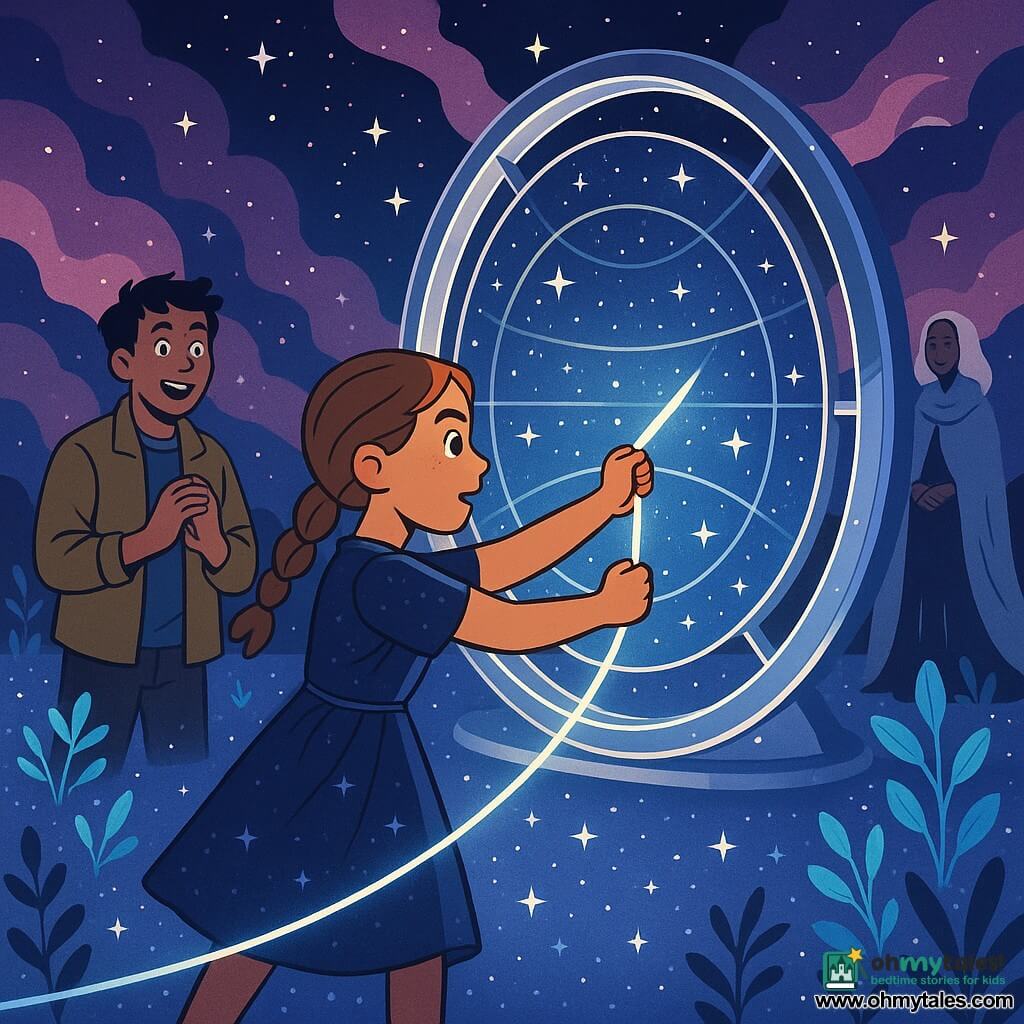
The Archive of Whispering Threads
Elira climbed the narrow stair of the old archive as if she were stepping into the hollow of a sleeping star. Stone wrapped around the staircase like the coils of an ancient snake; the air smelled of dust and honeyed parchment, and somewhere below, a distant bell remembered tides. She had come with a scholar's steadiness—her satchel full of notes, her fingers stained with ink—and with a secret that knotted her pulse: the knack for listening to the past. In the vaults beneath the city, history was not merely written. It hummed.
Shelves curved into dim arches, and between them drifted tapestries pinned with brass stars. Each tapestry bore scenes stitched in metallic thread—navies of winged ships, kings with crowns shaped like crescent moons, and forests where trees bent to shelter sleeping statues. Elira crouched before one aged panel, its threads silvered by time. When she brushed a fingertip across the weave, a soft sound rose, like a chorus of distant bells. The tapestry breathed. A story reached out by thread, and Elira listened until the letters trembled into meaning.
She had learned to read such voices as a child, under the patient tutelage of her grandmother, a keeper of small truths and smaller maps. That talent had made her useful to the city's historians, and it had made her dangerous to those who hoarded silence. The tapestries spoke of vanished festivals and treaties, of storms that swallowed whole fleets and of spells cast to keep rain from deserts. But there was one tapestry that had always been half-hidden behind a curtain of dust, its threads black as the midnight between stars.
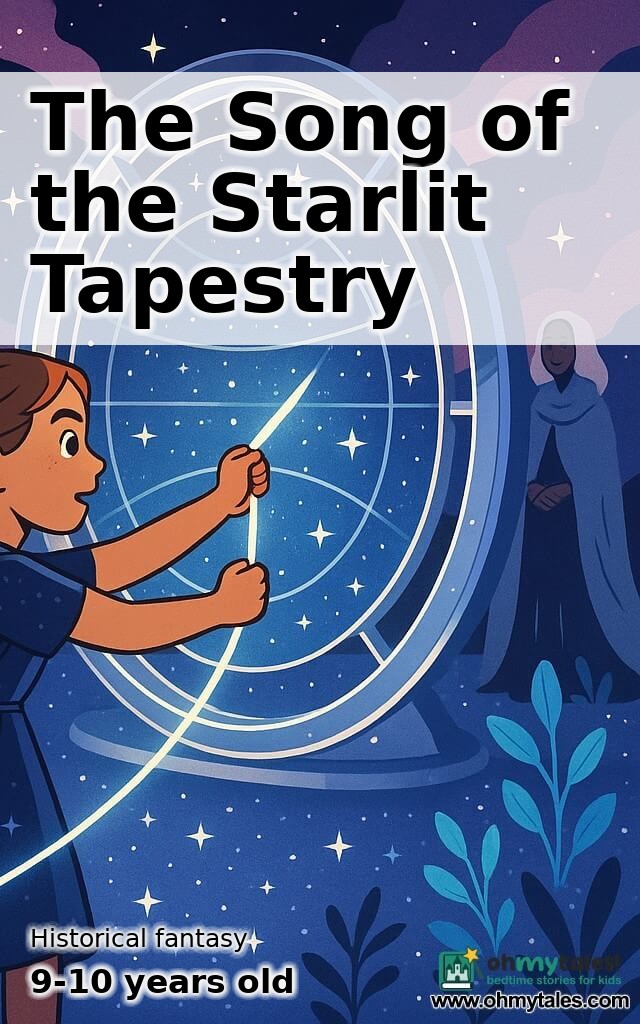
When Elira drew back the curtain, the dark tapestry opened like a closed eye. It was stitched with constellations unfamiliar and a single river of light that ran through kingdoms that no longer existed. At its center, a maiden held a loom threaded with living stars. Her hair was a cascade of night; her hands moved as if plucking chords from the sky. The tapestry thrummed with a cold, patient power. Elira felt a tug at the edge of her memory—an echo of a lullaby her grandmother hummed when lightning rambled near.
“You hear them, don't you?” The voice came from the shadow beyond the stacks. It was hoarse and laughing, belonging to Master Arweth, the archive's custodian. He had always had a way of arriving just as the quiet deepened. He peered at the tapestry as though expecting a friend. “Ah, the Starlit Tapestry. Very old magic there. Few dare lay hands upon it.”
Elira's fingers rested on the hem. “It sings of a loom,” she said. “Who wove it?”
Arweth's eyes softened. “Those who once stitched the world together. They called themselves the Loomwrights. They shaped seasons andsong-lines and treaties between mountain and river. Most of their places have fallen to moss. Some say their magic is sleeping. Others say it watches, waiting.”
Elira did not know whether she wanted to wake it or to let it dream. She had papers that argued both sides. But when the tapestry's light slid across her palm like a living current, it whispered a name she had known only in half-remembered songs: Caelith. A place, a person, and perhaps a promise.
She lifted the tapestry into the slow lamp light and found hidden stitches—an invitation threaded in a script of dawn. The letters sang: Follow the river of stars. Find the loom. Decide the weave. Elira folded the edge under her arm, feeling the pull of a story unfinished. That night, beneath a sky that seemed a pale imitation of the tapestry's brilliance, she set out with a map in her satchel and the hush of the archive in her bones.
Crossing the Ruined Roads
The road that left the city did not remember its old name; it was a ribbon of cracked stones and wildflowers shouting green. Villagers bowed to Elira as she passed—some with curiosity, some with wary respect. News traveled differently when one carried the archive's seal. Children chased after her, weaving garlands of thrifted ribbon and asking if she carried magic. She smiled and tucked their hopes into her satchel like spare compasses, because hope, she knew, had weight.
Days unfolded like a scroll. Elira crossed lands where ruins rose like jagged teeth from the earth and where the wind had learned to speak in fragments of old songs. On the third evening she arrived at the River of Stars, a slow waterway that reflected constellations even when the sky was white. Its banks glowed with bioluminescent moss that hummed quietly when touched, and fish below darted like living fragments of the night.
There, upon the river's edge, stood an old watch-tower, its stones tattooed with glyphs that plotted forgotten cartography. At its base sat a figure wrapped in cloth the color of cooled ash. He introduced himself with a name Elira forgot the moment she heard it, and he offered directions with the precision of someone who had given up claiming voyage for the simplicity of memory.
“Follow the river,” he advised, tapping his weathered staff. “But beware where the stars run thin. The Loomwrights wove bargains into the banks. Some bargains wear holes.”
Elira thanked him with a bow and continued along the river. At night she camped beneath arches of twisted trees whose leaves chimed like tiny bells. The river told her stories if she listened: of ferrymen who took tolls in memories, of a bridge that demanded riddles, of a cavern where echoes became mirrors. She kept her path steady, guided as much by the tapestry's fading glow as by the cartography inked on her maps.
On the fifth day the sky turned strange. Clouds gathered in banded sheets, and the stars on the river dimmed as if a hand had passed across them. Elira found a stone circle where the ground had sunk and a great wheel of carved bone lay half-buried. Around it, the grass shivered as though listening. The stitch of the tapestry hummed to a higher pitch. She understood, with that quiet, historian's certainty, that this was no mere landscape; it was an argument left by the Loomwrights.
A voice rose from the bone wheel—low, like wind through a flute—asking Elira which she would mend first: the recorded wrongs of kings or the unbecoming grief of the land. The question pelted her with the weight of ages. Elira sat and unrolled the tapestry. She had studied treaties until ink blurred, but choice required courage in the shape of action. She could see, in the woven river, the image of two towns: one whose walls had been raised by war, another whose wells had run dry to feed the first. To repair one thread would alter the rest.
She threaded her needle, thinking of her grandmother's hands, the slow art of repair. “I will weave both,” she promised the stone, though she did not know how yet. The bone wheel hummed like approval, and the stars on the river regained a timid pulse as if relieved.
The Cavern of Echoing Looms
The river guided her into a valley where cliffs leaned together like conspirators. A curtain of vines hid a narrow mouth; inside, the air tasted of copper and old stories. She lit a lantern and descended into the cavern called by hawks and old maps the Hollow of Threads. The walls were alive with tapestries—small at first, then enormous, each sewn with scenes that looked like chapters from impossible lives. Some told of gardens where statues spoke counsel; others showed roads that braided together like hair. Many tapestries had holes where time had taken bites.
At the cavern's heart, on a dais of basalt, stood a loom taller than a house. It was carved of living wood, its frame wrapped in runes that glowed faintly like afterimages. Spools of thread lay like sleeping lights around it—silver and bronze, indigo and green. The loom shivered when Elira approached, as though recognizing a missing hand. Beside the loom, a stone sarcophagus bore an inscription in the script of the Loomwrights: Inhaling Dawn, We Wove. It was a promise and an apology.
When Elira laid the tapestry's dark center upon the loom, the threads leapt as if bitten with sudden life. The loom accepted the fabric like a mouth tasting old flavors. Then the cavern sighed, and from the darkness emerged figures. They were small—the size of children—but their eyes held the weight of mountains. They called themselves Threadlings, remnants of those who once tended the Loom, their bodies woven of leftover yarn and echoes. They spoke in a chorus, thin and clear.
“You carry the Starlit Song,” they said. “We have slept until hands like yours came to wake one last stitch.”
Elira told them of her promise at the bone wheel, of towns split by vows and of rivers that remembered constellations. The Threadlings listened with the cadence of ears that age carefully. Then they warned her: the Loomwrights had bound choices to threads. To mend one harm might unmake another blessing. Magic in that place was patient, not cruel—it followed rules like weather.
She sat before the loom and felt the hum of the cavern align with the beating of her heart. She considered the towns: the fortified city and the thirsty hamlet, the ferryman and the watch-tower, the bargains embroidered into the river's bank. Her needle hovered over a spool the color of old midnight. She could feel the loom's hunger to stitch, to complete a design that had been set aside when the Loomwrights withdrew.
“Do you know the songs?” asked a Threadling, voice as small as moth-wings.
Elira closed her eyes and sang the lullaby her grandmother taught her—simple phrases that the archive shelves had turned into ten thousand echoes. The cavern took the song and unrolled it like thread. The loom listened, and slowly, with hands steady and trembling, Elira began to weave.
She weaved a bridge of compromised promises: stone for the fortified city's needs and wells rerouted to the hamlet with locks that closed only when both towns agreed to share. She stitched in margins, in loopholes, in new footpaths that would encourage trade and conversation. The linen of her choices shimmered with careful intent. The Threadlings worked with deft speed, knotting safety into the seams. Hours became days; the cavern's watches spun like moons. Outside, the river sang a different rhythm, as if pleased.
When she finished, the loom gave a final, low note and the tapestry settled warm beneath her hands. The cloth now bore a map of decisions rippled through time—an answer that was not neat, but honest. Elira rose, feeling both lighter and more burdened than before. The Threadlings bowed. The sarcophagus sighed, and a breeze like a page turning brushed her cheek.
Before she left, an elder Threadling placed a small spool into her palm—a spool of thread so fine it might wind around a finger twice without breaking. “This is a stitch of choice,” they said. “It will hold where your will must intervene. Use it when a path forks and the river forgets its stars.”
Elira tucked it into her satchel, feeling the weight of future decisions settle in her palm like a living thing.
The Weave of Home
She returned by a different route, for roads altered when one mends their pattern. The fortified city received news of bridges and wells with first astonishment, then cautious gratitude. Councillors argued; the hamlet's wells resisted at first, stubborn as mules, until the taste of cool water finally made a choir of old men. Elira walked between them, the archive's seal like a quiet anthem, the Threadling spool warm near her ribs.
Her greatest test came upon the eve of the Festival of Tides, when the city lit lanterns to remember its founding and the river swelled with tales. The sky braided with lantern glow and the river shivered with constellations. An accident—an old wall giving way—threatened to break the newly mended channels. Stones tumbled like cast-off dice and the water rushed toward the hamlet's open wells.
Instinct and slow training converged. Elira dropped to her knees and felt for the river's tape—imagining it like the loom in the cavern. She pulled, tugged, and coaxed the currents with the patient magic she had practiced since childhood, guiding water into side channels, easing pressure from old masonry, whispering to the river as one might to a frightened child. The spool in her satchel pulsed hotly, begging to be used for decisive action. She drew it, wound a single bright stitch across the fracture where stone would split a pledge between town and town, and tied it with the quiet of someone binding a wound.
The stitch held. Stones steadied. Lanterns bobbed without falling. The city exhaled, and the hamlet's wells glimmered with the first clear water in seasons. People lifted Elira on shoulders, then smiled at one another in the way people do when feeling the relief of shared safety. She felt, for a heartbeat, the weight of applause and the lightness of having acted.
That night, under a sky as generous as any tapestry, Elira walked alone to the river's edge. The stars above scattered like pins on a cloak. The river reflected a version of the loom's work—bridges that crossed with laughter, wells that sang, a watch-tower learning to count two towns as one circle. She thought of her grandmother's hands guiding her own, of the Threadlings' small proud faces, of the archive's hush that had nudged her into this quiet reckoning. She understood now that history did not demand perfection; it asked for courage and care, for stitches placed with thought.
“Decisions wear threads,” she murmured, tracing the spool's outline in her satchel. “We cannot unweave the past, but we can mend what it tears.”
Somewhere downstream the River of Stars hummed as if in agreement. In the months to come, traders would pass between towns and share dried figs and songs; old treaties would be re-read and rewritten into friendlier phrases. The Loomwrights' looms slept again, not for lack of need but because one young woman had learned the tone that wakes them—a tone that asks, rather than commands.
Elira returned to the archive with the taste of river salt on her lips and the memory of stitches warm under her skin. She rehung the Starlit Tapestry where it could dream in peace, and the threads settled with new light braided through them. Children pressed their faces to the tapestries and asked her questions, and she answered with a scholar's rigor and an artist's tenderness.
At night, beneath the city's roof, Elira tied a small spare of Threadling yarn to her wrist. It was a reminder and a promise: that the songs of the past must be heard and answered, that magic was a conversation, not a decree. The archive hummed around her like a contented heart. Her story had begun with a tapestry's whisper and moved through ruined roads, caverns of echoes, and towns stitched together by careful will. It would continue, in the daily stitches she made—a gift small and steady, the sort of magic that survives.