Chapter One — The Letter in the Loom
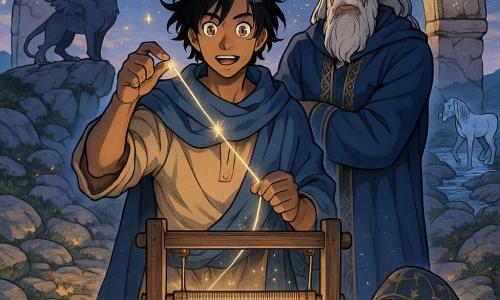
Anahid lived where the river remembered the stones and the houses leaned close like old friends. She was a weaver. Her fingers knew the secret language of threads: how to coax silver from ash-gray wool and how to calm a fretted pattern into a song. People said her cloth held warmth like a promise.
One dawn, while the sun stretched its fingers across the valley, Anahid found a folded scrap tucked inside her loom. It smelled faintly of thyme and ink. The letter's handwriting was thin and careful, as if written by someone who had learned to plant words like seeds.
"To the one who listens," it began. "Unbind the knot that holds the Free Wind. Go to the Stone of Songs and listen for what the past asks of us. Untying will ask of you a kindness and a memory."
Anahid read the lines three times. Her fingers trembled a little, not from fear but from the same feeling she had when a new pattern first showed itself. In the attic, she found an old map with faded coastlines and a tiny drawing of a round stone in the center of the hills. The map's ink led to a place everyone in the village called the Old Way — where the road bent and the sky stretched wide.
"What is the Free Wind?" her neighbor's boy asked when she told him, eyes wide like teacups.
"Some winds are like doors," Anahid said, pressing the letter to her chest. "They carry voices. This wind was bound long ago. The letter wants it free."
That night Anahid packed her cloak, a loaf, her sharpest spindle, and the letter. She wrapped a small square of cloth she had woven for luck. Then she walked out where the village lanterns blinked like low stars and the world smelled of embers and barley.
Chapter Two — The Road of Old Stones
The Old Way was not a road so much as an old story. Stones with carved faces leaned on one another; lichen made maps on gray cheeks. As Anahid walked, the wind moved like an animal that remembered how to be gentle. It whispered close to her ear and left tiny letters of dust on her cheeks.
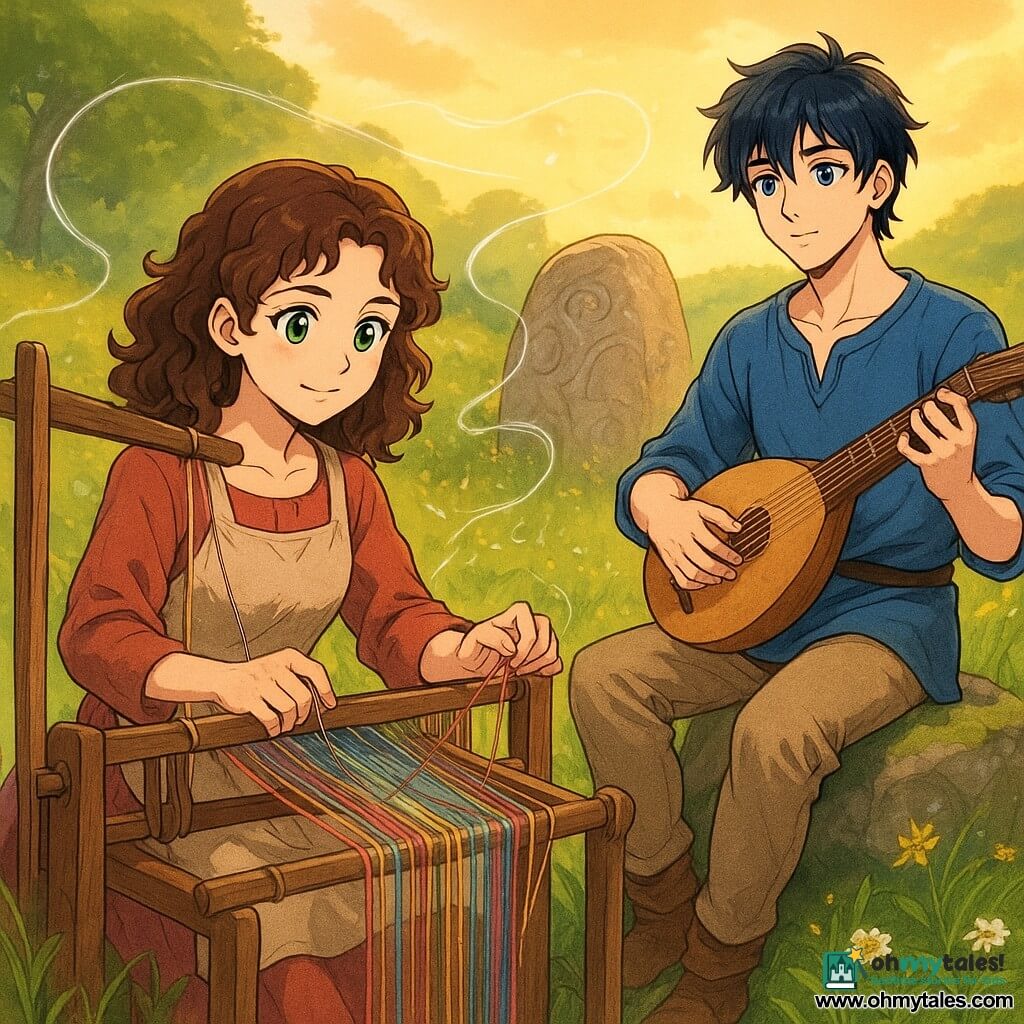
On the third day she met a man who carried a lute with a cracked soundboard. His name was Miro. He had eyes that seemed to look at the very bones of things.
"You're going to the Stone of Songs," he said simply. "My grandmother once hummed there. She said the stone keeps sorrows if you do not sing them out. Why do you go?"
Anahid showed him the letter. Miro's fingers paused on the lute strings as if touching a sleeping bird.
"Then we go together," he said. "My songs are small, but they remember places I have not seen."
They walked past a field of tall, thin poppies that bowed like rows of listening heads. At dusk they camped under a ruined arch where the wind seemed to sleep in the shadows. Miro hummed a tune that made the embers sparkle. Anahid wove a tiny pattern in the cloth she had brought, adding one thread for each place she had loved.
That night a wind came and pressed a cool note against their faces. It smelled of salt though the sea was not near. It seemed to try to speak, then curl back into itself like a tongue behind teeth. Anahid sat up.
"Can you hear it?" she whispered.
Miro shook his head. "It is held. It wants something."
"Perhaps it wants a knot unmade," Anahid said. She remembered the letter. "We will find the stone."
Chapter Three — The Stone of Songs
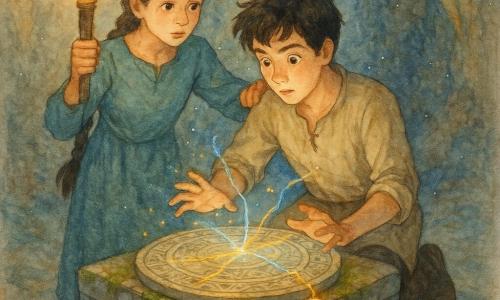
The stone rose from the hill like a great knuckle, round and smooth, stitched with thin veins of mica that winked like old stars. Carved around its base were tiny pictures: hands, waves, birds, a child dropping a clasped locket. The air around it thrummed.
When Anahid stepped close, the wind did not blow; it waited. She felt, quite strongly, that the world held its breath.
There was a knot bound at the stone's belly. It was not a rope knot but a knot of sound — a twist of echoes that had tangled the wind itself. The knot shivered with all the voices it had swallowed: laughs, cries, songs of harvests long ended.
"How do we unbind what isn't made of rope?" Miro asked, fingers bent around the lute as if to steady himself.
Anahid closed her eyes. She remembered her grandmother's stories of the first weavers, who could loosen threads by listening until the thread wanted to untwist. She unrolled her cloth and laid it on the stone. The patterns she had woven during the journey shone faintly, as though remembering their own origins.
"Listen," she told Miro, though she could not say which voice she addressed. "Listen with your hands."
Miro's hands trembled, then rested upon the cloth. He played a gentle chord — a sound that was less about rhythm and more about opening. The chord caught on the stone and repeated, like a ripple.
Anahid sang as she had never sung for anyone but the moon. Her voice braided with the chord, light and low, telling the wind all the small things it had missed: a child's first kite, a woman laughing with flour on her cheek, the quiet scrape of oars. The knot in the stone thrummed.
From the stone came a memory of old fear: long ago, the Free Wind had flown between kingdoms, carrying words of peace. Once, a ruler jealous of gentle talk had ordered a spell to trap the wind. They wound a chord of silence around it, thinking that if people could not hear other stories, they would not grow bold. The Free Wind, patient and bright, had been caught and tied with a knot of forgotten promises.
"Anahid," Miro said softly. "It remembers being stolen."
"Then we must give it back what it lost," she replied. She reached into her cloth and took out a small coin that had been sewn into the hem — a coin her grandmother used to keep her hands steady. It was not magic; it was memory. She placed it in a little hollow of the stone and spoke the simplest truth she had always known: "We share. We listen. We let go of what binds."
The stone answered with a long, low note that sounded like the turning of a page. The knot pulsed. Threads of wind, fine as silver, began to unspool. But with each thread that loosened, a shadow rose: fear. Faces made of fog gathered, whispering all the reasons the knot had been tied — old hurts, promises broken, bargains made in dark rooms where nobody listened. The shadows reached for Anahid and Miro.
"You mustn't fight them," Anahid said. "Listen to their fear. It is afraid of being forgotten."
She stepped forward and, instead of striking, she wrapped her cloak around a shadow. "Tell me your name," she asked. The shadow stuttered, giving a small sound. She learned that one was the memory of a lost song, another the echo of a word never spoken. Anahid hummed the tune she had sung before and fed the shadows with little kindnesses: a story of a child who forgave, a memory of a farmer who shared the last loaf. Each kindness unknotted a thread.
Miro found his voice then. He played a brave, bright tune and sang of the wind as a traveler that always returned what it carried. The shadows, warmed by the songs, began to dissolve into mist. The knot loosened until at last the silver threads slipped free and the Free Wind poured out in a single, laughing gust that smelled of rain and summer bread.
It spun around them like a delighted bird and then bowed its invisible head toward the valley. For a moment, Anahid felt every little lost thing float past: a lullaby, a promise, a broken toy mended in memory. The wind carried them, light as breath, and tucked them back into the world where they belonged.
Chapter Four — Patterns of Kindness
When the wind left, the air was different, not colder but fuller, as if the world had taken a deep, relieved breath. The Stone of Songs hummed a gentle, contented note. Miro and Anahid sat with their backs to the stone, tired but smiling.
"You have freed something that feeds stories," Miro said. "What will you do with it?"
Anahid looked around at the valley spread below them. She thought of the letter, folded and patient, and her grandmother's hands teaching her to weave. Then she took the cloth she had used at the stone and untied a little fringe from its edge. She handed each piece to Miro and tucked the rest into her satchel.
"We will return and weave," she said. "We will teach people to listen and to share the things they are afraid of. A knot is made of many hands; a knot is untied by many hands too."
On the road home, the Free Wind danced ahead of them, carrying whispers: a baker in the village setting out extra rolls, a child going to speak first in class, an old woman opening her shutters to let in the morning. When they reached the village, people paused and listened, then sang, then told stories they had kept folded. Little kindnesses began to unroll like threads.
Anahid opened a small school where she taught weaving by the river. She taught not only how to make patterns that held warmth but how to weave stories into cloth — stories of forgiveness, of tiny brave things, of meals shared. Miro stayed, and sometimes he would take his lute to the square and play songs that made people remember names they had nearly forgotten.
Years later, children would point to a square stone in the hill and their parents would say, "That is where the wind was once bound. We unbound it together." They would teach their children to listen before they spoke, to give away the extra bread, to ask what the wind carries when it passes.
Anahid grew older, but her hands remained quick and gentle. She kept the letter under her pillow, not to read again but to remember a promise. Sometimes at night she would step outside and feel the Free Wind combing the valley like a child's hand through hair. It would pause at her door, as if to thank her, and if she closed her eyes, she could hear, woven into the wind, a soft chorus of small, mended things.
"Why did you help?" a young girl once asked Anahid, sitting at the loom with bright, impatient fingers.
"Because every knot is made of something someone once feared to lose," Anahid answered. "And because untying a knot gives the world a little more space to breathe."
The wind laughed — a sound like chimes — and drifted away, carrying one more small secret: that kindness, once woven into the pattern of the world, keeps the knots from forming again.