Chapter 1: The Garden of Two Moons
Dawn spilled over Córdoba like warm honey, turning the white walls pink and the river silver. In the courtyards, orange blossoms floated their sweet smell into the air, and fountains spoke in gentle splashes, as if the stone itself was telling secrets.
Lady Samira tightened the strap of her travel cloak and checked the small leather satchel at her hip. Inside it lay a compass that did not point north. Its needle quivered toward whatever place needed her most—like a worried finger.
She was a knight, though her armor was lighter than most and her sword was slim and curved. It was made for speed, not bragging. People often expected her to charge into trouble with a shout.
Samira preferred to listen first.
A boy appeared at the arched doorway of the palace garden, panting as if he had run all the way from yesterday. His hair stuck up like a startled cat.
“Lady Samira!” he whispered. “Come quick. The lemons are… doing something.”
Samira raised an eyebrow. “Lemons have been doing something for centuries.”
“Not like this,” the boy insisted. “They're humming.”
In the garden, the lemon trees trembled even though there was no wind. Tiny yellow fruits glowed faintly, as if they held trapped sunlight. And beneath their leaves, the earth seemed to breathe—up, down—like a sleeping animal.
Near the fountain, an old gardener knelt with his palms pressed to the ground. His name was Yusuf, and his hands were always stained with soil, as if he had shaken hands with the world itself.
“It's the balance,” Yusuf murmured without looking up. “Someone has tugged at it.”
Samira crouched beside him. “Magic?”
“Old magic,” Yusuf said. “The kind that remembers the first river. The kind that doesn't like being pushed.”
The compass in Samira's satchel gave a soft clink, as if it had bumped into the future.
Yusuf lifted his head, and his eyes were clear and serious. “The Spring of Quiet Water has been disturbed. If it dries, the gardens will thirst, the birds will leave, and the wind will bring dust where laughter used to be.”
Samira felt a tightness in her chest. She loved these courtyards—the shade, the cool stone, the green that made summer bearable. Nature was not just decoration. It was a promise.
“Who would disturb it?” she asked.
Yusuf's mouth pressed into a thin line. “A seeker of shortcuts. A collector of power. Someone who thinks the earth is a chest to be forced open.”
Samira stood. “Then we close it gently,” she said. “We don't break the lock.”
The boy bounced on his toes. “Are we going on a quest?”
Samira smiled at him. “You are going back to your breakfast before your stomach starts humming too.”
He groaned theatrically and hurried away.
Yusuf reached into his robe and held out a thin tile of glazed blue, painted with a silver moon. “Take this. It belonged to a time when poets spoke to stars. It will open the way beneath the old bridge, where the river listens.”
Samira accepted the tile. It was cool, like river-stone. “And if I fail?”
Yusuf's gaze softened. “Hope is not a thing that breaks easily,” he said. “It bends. It waits. It tries again.”
Samira touched her sword hilt, then the satchel with the strange compass. “Then I'll try,” she promised.
She rode out as the city woke—past markets unfolding like bright rugs, past donkeys with sleepy eyes, past scholars with ink-stained fingers. Beyond the walls, the land rolled into orchards and fields, and the air tasted of thyme.
History lay everywhere, stacked like layers of sand and story. And somewhere ahead, ancient magic was shifting, impatient as a storm cloud.
Samira urged her horse forward, and the morning light followed like a blessing.
Chapter 2: The Bridge Where the River Hears
By midday, Samira reached an old stone bridge, its arches reflected in the river so neatly it looked like a necklace of circles. The water moved slow and steady, carrying small leaves like tiny boats.
Beneath the bridge, shadows gathered in cool pockets. Samira dismounted and led her horse to a fig tree for shade.
“Stay,” she told the horse. “If you wander off, I'll have to knight a donkey instead.”
The horse flicked its tail, unimpressed.
Samira stepped to the darkest arch and pressed the moon-tile against the stone. For a moment, nothing happened. Then the tile warmed, and a faint line of light traced itself across the rock, like a pen writing in the air. The stone sighed—yes, sighed—and a narrow passage opened where there had been only wall.
A smell drifted out: wet earth, mint, and something sharp like lightning.
Samira drew her sword, not because she wanted to fight, but because she wanted to be ready. “Easy,” she whispered to herself. “Not everything in the dark is an enemy. Sometimes it's just shy.”
The passage sloped down. Pale blue moss glowed along the edges, making the stone look underwater. The sound of the river faded, replaced by a quiet hum—like a distant choir holding one note.
At the bottom, the tunnel widened into a chamber. In the center stood a fountain with no water. Its basin was cracked, and the cracks sparkled with silver dust, as if a piece of the moon had fallen and shattered there.
Samira approached, and the compass in her satchel spun wildly. The needle slapped the glass so fast it sounded like impatient tapping.
“Someone is close,” Samira murmured.
A voice answered from the shadows, cheerful as if this were a friendly tea party. “Close enough to hear you talking to your bags.”
A woman stepped forward, wearing a cloak the color of dried leaves. Her hair was braided with copper rings, and her smile was sharp.
“Who are you?” Samira demanded.
“Zahra,” the woman said with a small bow that felt more like a joke than respect. “Collector of wonders. Finder of forgotten doors. And you must be the palace's little protector.”
Samira's grip tightened. “This place is protected for a reason.”
Zahra strolled around the dry fountain, peering into its empty heart. “Protected, hidden, locked—people love those words. They make my fingers itch.” She tapped the cracked basin. “This spring used to sing. Did you know that? Water with a voice.”
“It still can,” Samira said. “If you stop hurting it.”
Zahra's eyes glittered. “Hurting? I'm waking it up. Magic should not sleep under stone while people sweat in the sun. Imagine fountains in every street, gardens that never wilt. I can make that happen.”
“By forcing the spring?” Samira asked. “By pulling too hard until it snaps?”
Zahra shrugged. “Everything snaps eventually.”
Samira felt anger rise—but she held it gently, like a candle flame. “Then you don't understand nature,” she said. “It's not a jug you can tip forever. It needs rest. It needs balance.”
Zahra laughed softly. “Balance is for tightrope walkers. I prefer flying.”
She lifted her hand, and the silver dust in the cracks rose, twisting into thin threads. They looped around her fingers like strings, and the air turned colder.
Samira stepped between Zahra and the fountain. “Let it be.”
“Move,” Zahra said, her voice still light, but now edged like a knife.
Samira lifted the moon-tile. It shimmered, and for a heartbeat the chamber brightened, as if a second moon had appeared underground.
Zahra paused, suddenly less playful. “Ah,” she said. “So you brought a key.”
“I brought a promise,” Samira replied. “To keep magic and nature from tearing each other apart.”
Zahra's smile returned, smaller and meaner. “Then come and keep it.”
The silver threads snapped toward the fountain, and the cracked basin rang like struck glass.
Samira acted fast—not with a charge, but with a leap. She slid across the stone and pressed the moon-tile into the biggest crack. Light spread, sealing it like smooth water freezing.
The fountain shuddered.
Zahra hissed. “No!”
But Samira's hands stayed steady. “You won't rip it open,” she said. “Not today.”
The chamber trembled. Somewhere above, the river gave a deep, worried groan.
And then the passage behind Samira began to close, stone grinding against stone.
Zahra's eyes darted to the narrowing exit. “We're trapped,” she snapped.
Samira's heart pounded. “Then we find another way,” she said.
Zahra scoffed. “With your promises?”
“With hope,” Samira answered, surprising even herself with how certain she sounded.
The last sliver of daylight vanished, and the underground world swallowed them both.
Chapter 3: The Library Beneath the Earth
In the new darkness, the blue moss brightened, as if it had been waiting for the sun to leave. It painted the chamber in soft, watery light.
Zahra muttered, “This is your fault.”
Samira sheathed her sword. “You started the trouble,” she said. “But blaming won't open doors.”
Zahra crossed her arms. “So now we're partners?”
Samira glanced at the sealed fountain. It looked calmer, but still wounded. “Not partners,” she said. “Two people in the same storm.”
Zahra rolled her eyes. “Poetic. Annoying. Fine.”
A faint breeze brushed Samira's cheek—strange, underground. It smelled of paper and smoke from old lamps. The compass needle steadied, pointing toward a narrow crack in the wall that Samira was sure had not been there before.
“Over there,” Samira said.
They squeezed through the crack into a passage lined with carved shapes—leaves, fish, stars, and words in graceful script. The stone felt warm under Samira's fingertips, as if the wall had a pulse.
The passage ended at a wooden door bound with bronze. It had no handle. In the center was a small hollow shaped like a crescent moon.
Zahra eyed Samira. “You and your key.”
Samira placed the moon-tile into the hollow. The bronze bands loosened with a soft clatter, and the door swung inward.
They stepped into a chamber so wide it made Samira stop in awe. Rows of shelves curved along the walls, disappearing into shadow. Thousands of scrolls and books rested there, wrapped in cloth and tied with cords. Tiny lamps burned with blue flame, never flickering.
“A library,” Zahra breathed, and her voice lost its sharpness.
Samira felt the same wonder. “Hidden under the river,” she whispered. “So knowledge stays cool… and safe.”
On a stone table in the center lay an open book. Its pages were blank—until Samira came closer. Then ink bloomed across the paper like flowers opening, forming lines of writing that shimmered as if freshly written.
Zahra leaned in. “It's reacting to you.”
Samira read aloud, her voice echoing softly between the shelves:
“WHEN WATER IS FORCED, IT FLEES.
WHEN MAGIC IS HUNGRY, IT BITES.
THE SPRING WILL RETURN TO SONG
WHEN A KEEPER OFFERS REST.”
“A keeper,” Samira said slowly. “That's the task.”
Zahra scoffed, but it sounded uncertain. “Rest? You can't rest a spring. It's water.”
Samira's eyes lifted to a mural on the far wall. It showed a garden beneath moonlight. In the center, a knight—helmet off, hair flowing—knelt by a pool. She held her sword not like a weapon, but like a bridge, laying it across the water. Around her, animals drank peacefully, and trees bent close as if listening.
Beneath the mural were carved words: “THE STRONGEST STEEL IS STILLNESS.”
Samira felt her throat tighten. “To protect it,” she said, “I must stop fighting it. I must give it quiet.”
Zahra paced, restless as a trapped wind. “Quiet doesn't fix cracks.”
“It can,” Samira said. “If the quiet is true. If it's chosen.”
Zahra stopped and stared at the shelves, at the lamps, at the ancient patience of the place. “All this,” she murmured. “Kept for centuries.”
“Not hoarded,” Samira said gently. “Held.”
For a moment, Zahra looked like she might argue. Then she swallowed, and her voice came out smaller. “I didn't mean to break it,” she admitted. “I just… I wanted to matter.”
Samira studied her. Zahra's cleverness was real, her bravery too—only pointed the wrong way, like a spear aimed at the sky.
“You do matter,” Samira said. “But you can choose what kind of mark you leave. A scar… or a stitch.”
Zahra's face tightened. “And you think I can help?”
Samira nodded toward the mural. “The spring needs a keeper's rest. I can offer mine. But I may need someone to hold the door open—someone who can handle wild magic without flinching.”
Zahra's lips twitched. “That sounds like me.”
“It does,” Samira agreed.
Together, they searched the shelves until they found a thin scroll sealed with green wax. It smelled of rosemary. Inside was a simple instruction, written in a hand both elegant and firm:
“TO HEAL THE SPRING:
RETURN THE MOON-TILE TO THE BASIN.
LAY A BLADE ACROSS THE CRACKS.
SPEAK NO WORDS UNTIL THE WATER SPEAKS FIRST.”
Zahra raised an eyebrow. “No words? For how long?”
Samira gave her a quick smile. “Long enough.”
They walked back through the carved passage. Behind them, the blue flames kept burning, patient as stars.
Ahead, the wounded fountain waited.
Chapter 4: The Spring's Ancient Song
The chamber felt colder now, as if it were holding its breath. The dry fountain sat in the center like a throat that had forgotten how to sing.
Samira placed the moon-tile into the basin. Light spread again, not sealing this time, but soothing—like a cool cloth on a fever.
Zahra hovered near the wall, hands half-raised, as if ready to catch falling magic. “All right,” she whispered. Then she snapped her mouth shut, remembering.
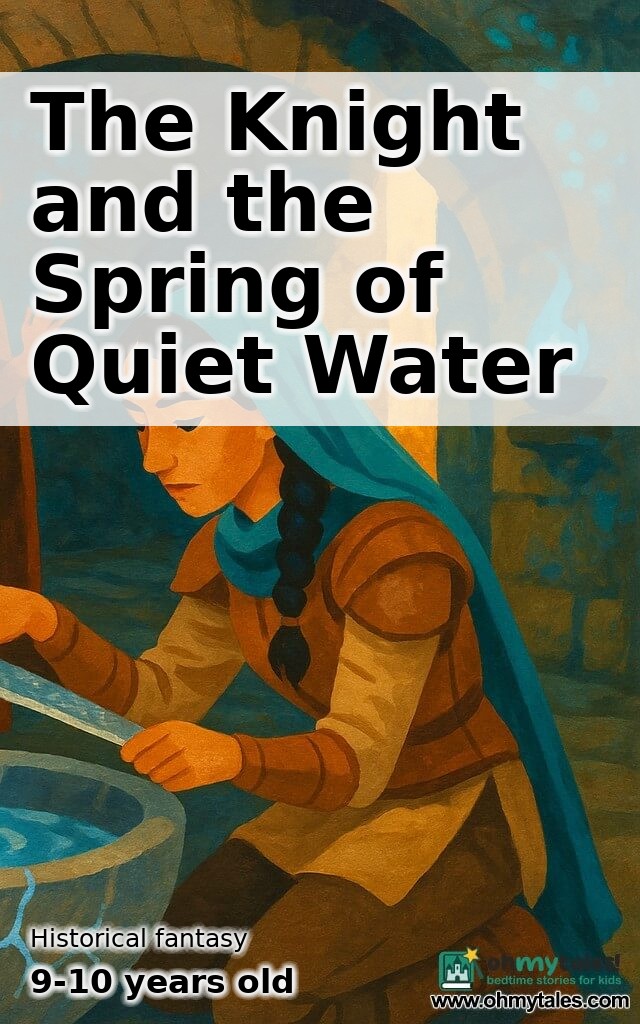
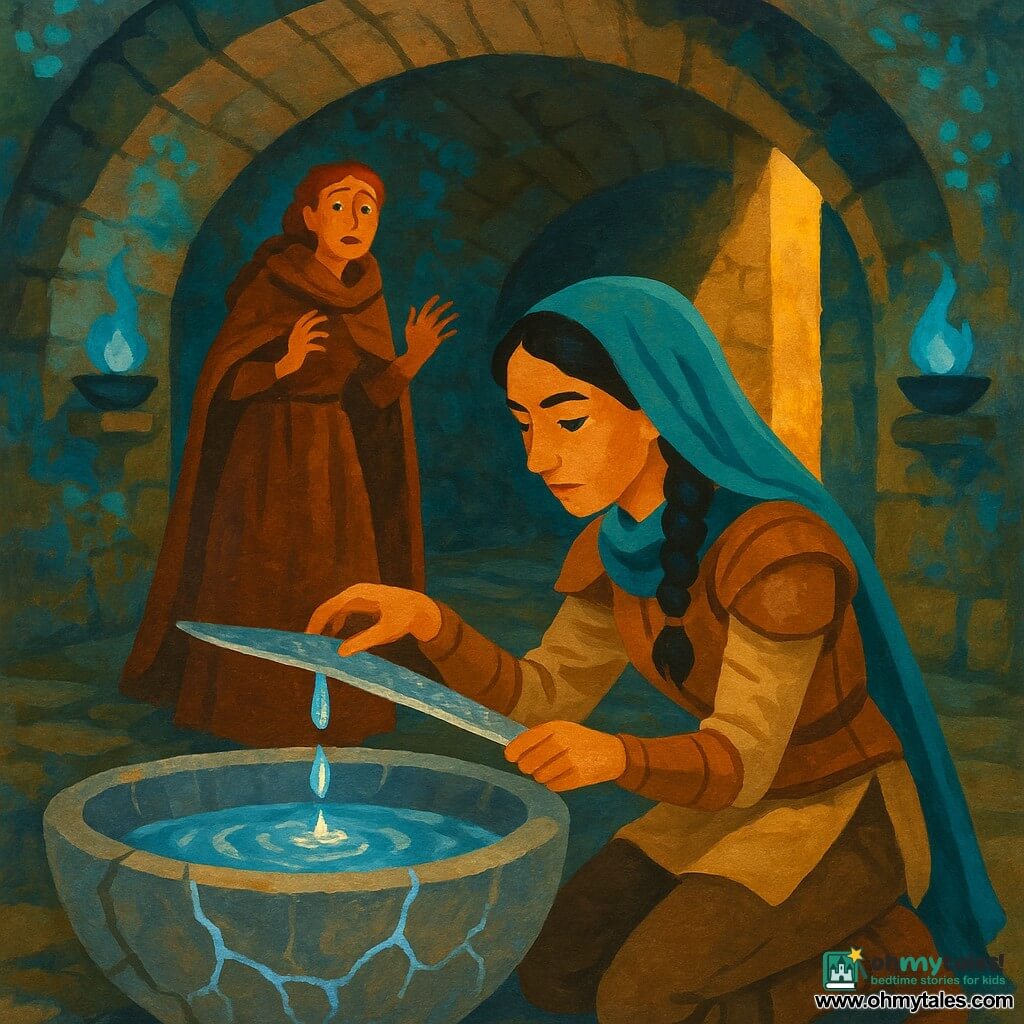
Samira drew her sword. The metal caught the moss-light and gleamed pale green, like a river seen through leaves. She laid the blade gently across the largest crack in the basin, exactly as the scroll had said.
Then she knelt.
Samira wanted to speak. She wanted to command, to beg, to explain. Words crowded behind her teeth like birds in a cage.
But she did not open the cage.
She closed her eyes and listened.
At first, she heard only her own breathing, the tiny scrape of Zahra's boot on stone, the distant, heavy silence of the river above. Then—very faint—came a sound like rain remembering how to fall.
A drop.
It landed on Samira's sword with a soft ping.
Another drop followed, then another, spaced apart like careful footsteps.
Samira stayed still. Her knees ached. Her mind wandered and tried to pull her away—toward fear, toward hurry, toward the idea that quiet meant doing nothing.
This was not nothing, she reminded herself. This was holding.
The dripping quickened. Water slid along the blade, as if the sword were guiding it the way a channel guides a stream. The silver dust in the cracks lifted and swirled, no longer sharp and angry, but gentle as mist.
Zahra's eyes widened. She pressed her palms outward, and the air around the fountain shimmered. The wild threads of magic that had once snapped like whips now moved like ribbons in a calm dance, circling the basin, smoothing the edges of the broken stone.
Samira felt the fountain's mood change. It was as if a frightened animal had stopped baring its teeth.
The water rose, thin at first, then stronger, filling the basin with clear, cool life. It did not rush. It did not roar. It simply returned—steady as a promise kept.
And then the spring spoke.
Not with words, but with a sound that filled the chamber: a low, beautiful note that seemed to come from the stone, the water, and the air at once. It was the song of roots drinking deep, of rivers finding their way, of old magic settling into its rightful bed.
Samira opened her eyes. The water reflected her face, and behind her, Zahra's. For a moment, both looked younger—less like fighters, more like people who had finally heard something important.
Samira lifted the sword away. The cracks in the basin were still there, but they were sealed with a pale glaze, like healed skin. The fountain began to flow, spilling into channels that led back toward the river.
Zahra let out a breath she'd been holding for too long. “It worked,” she said softly.
Samira put a finger to her lips—not scolding, just reminding. The spring had spoken first. Their part was to answer with respect.
Zahra nodded, understanding. She backed away, her usual restless energy replaced by a careful calm.
The stone wall behind them rumbled. The passage that had closed began to open again, sunlight slicing into the chamber like a golden ribbon.
Samira rose slowly, joints stiff but spirit light. She looked at Zahra and held out the moon-tile.
Zahra blinked. “You're giving it to me?”
“I'm trusting you,” Samira said, her voice low. “Not to use it for shortcuts. To use it as a reminder.”
Zahra took the tile with both hands, as if it were suddenly heavier than stone. “And if I slip?” she asked.
“Then you try again,” Samira replied. “Hope bends. It waits. It tries again.”
Zahra's mouth twisted into a small smile. “That gardener sounds annoying.”
Samira's eyes warmed. “He is.”
They climbed up into daylight, squinting. The river outside looked brighter, its surface more alive. A kingfisher flashed blue and darted away like a thrown gem.
Above them, Córdoba's distant towers shimmered in the heat. The world felt older than their worries—and kinder, too.
They rode back together, not as friends exactly, but as something new: two people who had seen an ancient miracle and decided not to ruin it.
Chapter 5: The Silence of Rest
Evening arrived with cool air and long shadows. When Samira returned to the palace gardens, the lemon trees had stopped trembling. The fruits no longer glowed with nervous light. They simply hung, content and ordinary—and somehow that felt like the greatest magic of all.
Yusuf waited by the fountain, as if he had never moved. He looked up when Samira entered and read her face the way gardeners read skies.
“It sings again,” he said.
Samira nodded. “Quietly. The way it should.”
Zahra stood a step behind, shifting her weight as if unsure whether she belonged in a place so peaceful. She held the moon-tile tucked inside her cloak.
Yusuf regarded her without anger, only with the tired kindness of someone who has pulled too many thorns from too many hands. “You walked into a deep story,” he said to Zahra. “Did it change you?”
Zahra swallowed. “It… reminded me,” she said. “That taking isn't the only way to matter.”
Yusuf inclined his head. “Good. Then you may begin to give.”
A breeze moved through the orange trees, and petals drifted down like tiny, fragrant snow. Servants lit lamps along the paths, their flames steady and golden.
Samira walked to the edge of the garden where a small pool mirrored the first stars. She sat on the cool tiles and removed her gloves. Her hands smelled faintly of stone and water.
Zahra approached quietly and sat a careful distance away. “What will you do now?” she asked.
Samira watched the pool's surface settle until it was smooth as glass. “Keep listening,” she said. “When balance is right, you can hear it in the world. The birds don't scream. The leaves don't shiver. Even the silence feels… soft.”
Zahra traced a pattern on the tile with her thumb. “I thought silence meant emptiness.”
Samira shook her head. “Sometimes it means rest. A place for tomorrow to grow.”
The garden's fountains murmured like gentle storytellers. Somewhere in the palace, someone laughed, and the sound floated out, then faded kindly into the night.
Samira leaned back against a pillar warmed by the day's sun. Above, the sky spread wide and deep, full of stars that looked like old promises.
She closed her eyes.
The world did not demand anything from her in that moment—not speed, not steel, not answers. Only stillness. Only breathing.
And as the gardens slept under the careful watch of moonlight, Samira let the silence settle around her like a cloak—quiet, healing, and whole.