Chapter 1: The Idea That Wouldn't Stop Wiggling
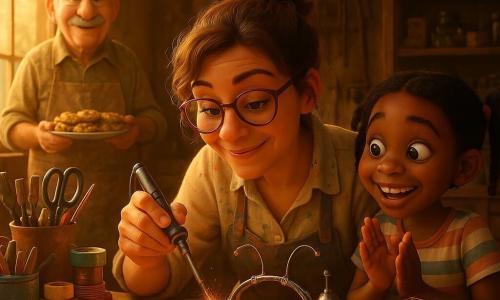
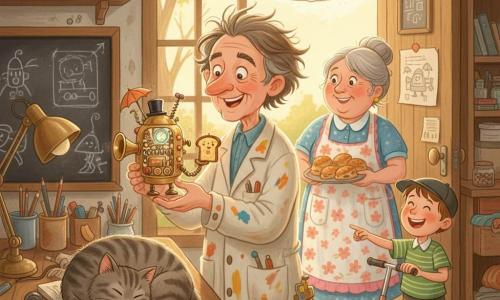
Mara Pindle liked her workshop the way some people liked blanket forts: private, cozy, and full of secret snacks. Her place smelled of sawdust, lemon soap, and the tiny electric burn of “oops.”
She was an inventor—an adult one, too—which meant she could buy glue without asking permission and also pay taxes, which felt unfair.
Mara was also shy in a very particular way. She wasn't scared of people exactly. She just didn't like being stared at while her ideas were still… squishy.
On Monday morning, she stood at her workbench, holding a bright yellow rubber duck in one hand and a spoon in the other, as if they were about to fight.
“I need something,” she muttered, flipping open her notebook. The cover said: MARA'S DEFINITELY NORMAL INVENTIONS (DO NOT JUDGE).
The problem was her town's annual “Practical Parade,” where everybody rolled down Main Street showing off useful creations. Last year, Mr. Kline had built a trash can that burped politely after you threw something away. It was disgusting, and everyone loved it.
This year, Mara wanted to make something actually helpful. Something that wouldn't burp.
She wrote a big sentence in her notebook:
INVENTION IDEA: A MACHINE THAT MAKES BORING CHORES FEEL LIKE A GAME.
Her eyes gleamed. Then she made a face.
“No,” she told herself. “That's too… reasonable.”
She tapped the duck against the table. It squeaked like a tiny trumpet. A spark fizzed in her brain.
“What if laundry didn't just get cleaned,” she whispered, “but got… applauded?”
She scribbled again, fast enough to scare the pencil:
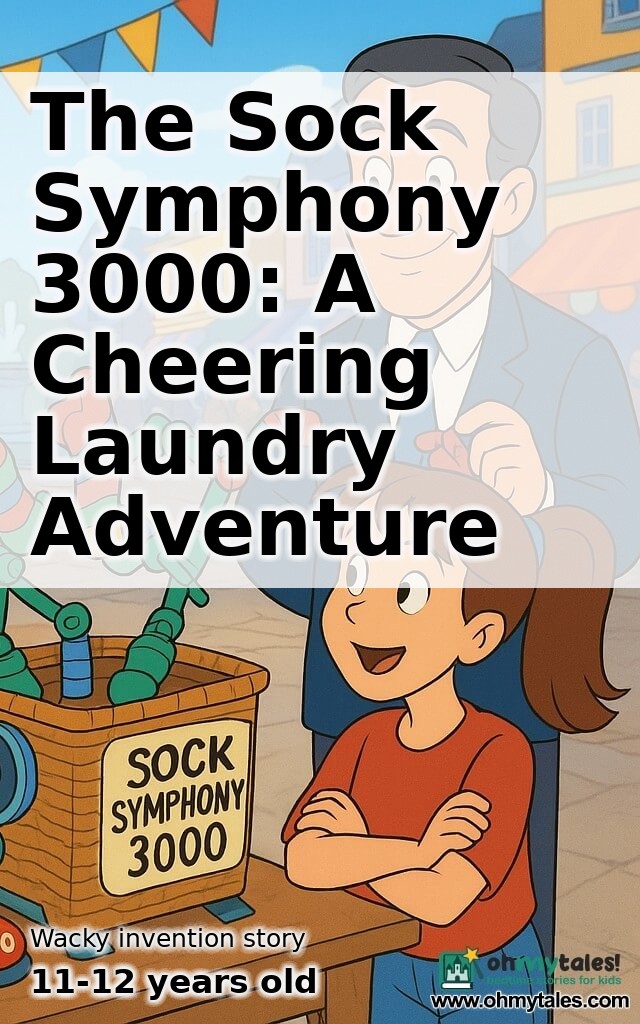
THE SOCK SYMPHONY 3000:
A LAUNDRY BASKET THAT SORTS SOCKS AND PLAYS A TRIUMPHANT TUNE EVERY TIME YOU MATCH A PAIR.
Mara leaned back and pictured it: mismatched socks, defeated no more. A basket with little flaps and whirring gears, humming victory music when it found the other half of a striped sock that had been missing since the Ice Age.
It was perfect.
It was also ridiculous.
Mara's cheeks warmed. “Okay,” she said to the duck, which squeaked as if agreeing. “We're doing it. But quietly. No crowds. No… clapping.”
She didn't notice the open window behind her, or the fact that her neighbor's cat—an orange loaf named Captain Pickles—was sitting on the sill like a fuzzy spy.
Captain Pickles narrowed his eyes at the rubber duck. Then he sneezed.
The duck squeaked.
Mara flinched. “Hush,” she told the duck. “This is top secret.”
Captain Pickles, who had never kept a secret in his entire life, hopped down and trotted off.
Mara, meanwhile, rolled up her sleeves.
“Sock Symphony 3000,” she announced to her tools. “Try to behave.”
The tools, as usual, did not respond. But the hammer looked smug anyway.
Chapter 2: Screws, Springs, and a Very Opinionated Cat
Mara began with a laundry basket and a dream. Then she added a motor from an old blender, a set of gentle rubber rollers, and two tiny arms she'd built from a toy dinosaur and a pair of salad tongs.
She labeled everything with masking tape.
LEFT ROLLER: DO NOT EAT SOCKS
RIGHT ROLLER: ALSO DO NOT EAT SOCKS
TINY ARMS: BE NICE
By Tuesday afternoon, the basket had a small control panel, three sorting slots, and a speaker that Mara had salvaged from a karaoke machine nobody wanted anymore.
She tested the motor. It whirred politely.
She fed in one sock—blue, with little planets.
The rollers grabbed it and pulled it in with the confidence of a machine that had never been responsible for anything important.
“Good,” Mara whispered. “Nice and gentle.”
The sock traveled along a track made of cardboard and duct tape, then dropped into the “LONELY SOCKS” slot with a soft plop.
Mara nodded. “Correct. That sock is lonely.”
Then she fed in the matching planet sock.
The rollers whirred again. The sock slid down the track. The machine paused, as if thinking hard.
For a second, Mara held her breath.
A cheerful chime rang out from the speaker—bright, triumphant, and slightly off-key. It sounded like a trumpet trying to laugh.
Mara gasped.
The machine's tiny arms popped up and clacked together like excited crab claws.
“You did it!” Mara whispered, smiling so hard her face felt stretched.
The speaker blasted a victory tune: DA-DA-DA-DAAA!
Also, because the karaoke machine had a “cheer” button, it accidentally added a recording of people shouting, “WOOO!”
Mara jumped backward, knocking over a jar of buttons. They spilled across the floor like a stampede of tiny eyes.
“Oh no,” she hissed. “Too loud. Much too loud.”
A shadow moved in the doorway.
Captain Pickles sauntered in, tail high, like he owned the place and also the concept of electricity. He hopped onto the workbench, sniffed the Sock Symphony 3000, and rubbed his cheek against the control panel.
“Please do not,” Mara said. “It's delicate.”
Captain Pickles pressed a button with his paw.
The machine's speaker shouted, “WOOO!” again, even though no sock had been matched.
Then the tiny arms clacked enthusiastically and accidentally pinched Captain Pickles' whisker.
Captain Pickles yowled with dramatic heartbreak and launched himself off the bench. In his panic, he bumped the basket.
The Sock Symphony 3000 wobbled, then began to roll—slowly at first, then faster—straight toward the open workshop door.
Mara's eyes widened. “Stop! Stop, stop, stop!”
But the machine had wheels now. Mara had added them because she thought it would be “handy.” The wheels took the compliment seriously.
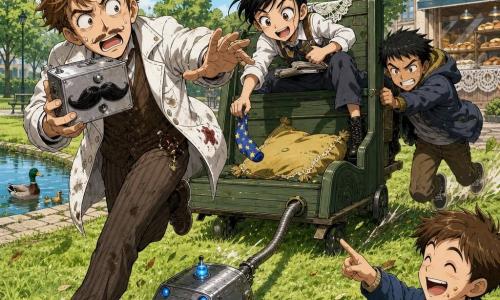
The Sock Symphony 3000 rolled out of the workshop and down Mara's driveway like a runaway shopping cart. Socks flapped from the sorting slots like flags of rebellion.
Captain Pickles chased it, offended.
Mara chased both of them, arms windmilling.
The machine hit a pebble, bounced, and turned directly onto the sidewalk.
Right where Mrs. Dalloway was walking her tiny dog, Peanut, who looked like a dust mop with feelings.
Mrs. Dalloway stopped. Peanut barked. The Sock Symphony 3000 rolled right up to them and, for no reason anyone could explain, played the victory music again.
DA-DA-DA-DAAA! WOOO!
Mrs. Dalloway blinked. “Mara?”
Mara skidded to a stop, panting. “Hello! This is—um—my basket. It's… very excited.”
Peanut barked again, then sniffed a sock and sneezed.
Mrs. Dalloway leaned in. “Did that basket just celebrate your laundry?”
Mara's face turned the color of strawberry jam.
“It's a prototype,” she squeaked.
Mrs. Dalloway's mouth curved into a smile. “Well. That's the most encouraging piece of laundry equipment I've ever met.”
Mara grabbed the machine and tried to roll it back home, but the wheels kept wanting to escape.
Behind them, Captain Pickles strutted, acting as if he'd planned the whole thing.
From across the street, a kid on a scooter yelled, “Cool! Is it gonna be at the Practical Parade?”
Mara almost tripped over a sock.
“Maybe!” she called, which was a lie.
But the idea of the parade began to itch at the back of her mind—annoying, impossible, and somehow hopeful.
Chapter 3: The Explanation Board of Doom
By Wednesday, rumors had sprouted like weeds.
Mara heard them at the hardware store while she bought more duct tape and a kinder kind of wheel brake.
“That's Mara Pindle,” whispered someone. “She has a cheering laundry basket.”
“No, it sings,” someone else whispered. “My cousin's friend's aunt heard it go ‘WOOO' and it was emotional.”
Mara pretended to be fascinated by a shelf of screws.
Back in her workshop, she stared at the Sock Symphony 3000. It sat in the middle of the floor like a dog waiting for a walk.
“You're not embarrassing,” Mara told it sternly. “I'm… just private.”
The machine did not reply. It simply looked ready to celebrate anything, including silence.
The parade rules said every invention needed an explanation board—a big sign showing how it worked. Mara hated explanation boards. They were like school presentations that never ended.
Still, she dragged a piece of poster board onto her workbench.
She wrote at the top in neat block letters:
HOW THE SOCK SYMPHONY 3000 WORKS
Then she paused, imagining a crowd reading it. Imagining someone pointing. Imagining laughter—mean laughter, not the good kind.
Her stomach did a small, anxious flip.
Captain Pickles hopped onto the stool and watched her with huge, unhelpful eyes.
“Don't look at me like that,” Mara said. “You started this.”
Captain Pickles blinked slowly, which was cat for: I regret nothing.
Mara drew a diagram of the basket: the rollers, the track, the sorting slots, the speaker. She added arrows. She labeled the arrows. She labeled the labels.
Then she wrote the steps:
1) FEED SOCKS IN (SINGLE FILE. SOCKS ARE BAD AT SHARING.)
2) ROLLERS GENTLY GUIDE SOCKS TO THE SCAN PATCH
3) SCAN PATCH READS COLOR + PATTERN (NOT THOUGHTS. YET.)
4) MATCHED PAIRS DROP INTO “SUCCESS BIN”
5) TRIUMPH MUSIC PLAYS (VOLUME CONTROL AVAILABLE. FOR SHY HUMANS.)
6) LONELY SOCKS WAIT IN “REUNION BIN” UNTIL THEIR FRIENDS ARRIVE
Mara stared at the board. It looked… good. Clear. Almost funny.
She added a final note at the bottom:
WARNING: MAY CAUSE UNEXPECTED PRIDE IN DOING LAUNDRY.
She snorted. “Okay. That's true.”
Feeling brave for half a second, Mara tested the new wheel brake. She pushed the Sock Symphony 3000 toward the door.
It stopped.
Mara exhaled. “Good. No more escape attempts.”
Captain Pickles immediately pressed the “cheer” button.
“WOOO!” shouted the speaker.
Mara nearly dropped the explanation board.
“Captain Pickles!”
The cat trotted away, tail swishing, like a tiny orange villain.
Mara rubbed her forehead. “If you ruin my parade debut, I swear I'll invent a cat-proof button cover.”
Captain Pickles sat down and began cleaning his paw, the picture of innocence.
Mara tried to imagine herself actually showing this invention to the whole town. Her chest tightened, then loosened, then tightened again like it couldn't decide.
She took a deep breath, then another.
Resilience, she reminded herself, wasn't a fancy word. It was a stubborn one. It meant: even if your invention rolls down the street and screams “WOOO” at strangers, you still fix the wheels and try again.
Thursday evening, she taped the explanation board to a wooden stand.
Then she stood back and whispered to herself, “I can do this. Quietly.”
The machine chose that moment to play one soft, hopeful note—like it was clearing its throat.
Mara glared at it.
The machine stayed silent.
They were learning manners together.
Chapter 4: Parade Practice, Featuring a Minor Sock Avalanche
On Friday, Mara decided to rehearse.
Not in public. Never in public.
She would practice in her backyard, where the only audience was her fence and a confused squirrel.
She set up the Sock Symphony 3000 on a folding table. She placed the explanation board beside it. She arranged socks in neat piles like colorful little pancakes.
Mara cleared her throat, because that seemed like something presenters did.
“Hello,” she said to the fence. “This is my invention. It sorts socks and celebrates matches. Please do not panic.”
The squirrel froze mid-chew, holding an acorn like a microphone.
Mara fed in two matching green socks with tiny frogs. The machine scanned them, dropped them into the success bin, and played a gentle, dignified version of the victory tune.
DA… da… da… daaa.
“Better,” Mara whispered. “Polite applause, not a stadium.”
She tried again with striped socks. Success.
Then polka dots. Success.
Then came the tricky ones: the socks with very similar patterns, like navy stars and black stars. The machine paused longer.
Mara leaned in. “Come on, you can do it.”
Captain Pickles appeared on the fence, watching like a judge. The squirrel watched too, now fully invested.
The machine made a small beep. It dropped the navy star sock into the success bin with a black star sock.
The speaker blared: DA-DA-DA-DAAA! WOOO!
Mara slapped the volume knob. “No! Wrong match!”
The tiny arms clacked as if clapping at a joke only they understood.
Then, perhaps offended, the Sock Symphony 3000 began scanning faster. It grabbed socks eagerly, rolling them down the track in a rush.
Mara's eyes widened. “Slow down!”
But the rollers were feeling confident. They pulled in sock after sock. The machine began sorting with wild enthusiasm, tossing socks into bins like it was hosting a game show.
The speaker began layering celebrations:
“WOOO!”
DA-DA-DA-DAAA!
“WOOO!”
DA-DA—
“WOOO!”
The bins filled. Socks bounced. One sock flew out and landed on Mara's head like a floppy hat.
“Emergency stop!” Mara shouted, smacking the off switch.
Nothing.
Captain Pickles, naturally, chose that moment to jump down and step on the wrong button. The machine responded by opening a side flap Mara had forgotten she installed.
A whole pile of socks poured out in a soft, colorful avalanche.
Mara disappeared up to her knees in cotton.
The squirrel dropped its acorn.
Captain Pickles stood on top of the sock pile like a conqueror on a fluffy mountain.
Mara's muffled voice came from somewhere under a towel: “This is… not… dignified!”
She shoved socks aside and found the off switch buried beneath a rogue sweater.
Click.
Silence fell.
A breeze stirred the sock pile. Somewhere, a bird chirped as if laughing politely.
Mara sat on the grass, surrounded by her own laundry like she'd been defeated by a closet.
Her cheeks burned. Her eyes stung with frustration.
Then the machine played one tiny accidental note—just a single “ding”—like a shy apology.
Mara blinked.
Captain Pickles licked his paw.
The squirrel, unbelievably, began clapping. It was not good at clapping, because squirrels don't have hands shaped for applause, but it tried. It tapped its paws together with serious effort.
Mara stared, then laughed—a real laugh, surprised and a little shaky.
“All right,” she told the Sock Symphony 3000, standing up and brushing off socks. “You messed up. I messed up. We're still alive. That's progress.”
She gathered the socks into a basket and carried them back to the workshop.
Inside, she adjusted the roller speed. She added a real emergency stop button—big, red, and impossible for cats to press without looking guilty.
She taped a label over Captain Pickles' favorite button:
DO NOT TOUCH: THIS MEANS YOU, PICKLES.
Captain Pickles sat nearby, blinking slowly, as if considering his next career move.
Mara looked at her explanation board. She added one more line at the bottom, in smaller letters:
IF IT GETS TOO EXCITED, PRESS THE BIG RED BUTTON. EVEN INVENTIONS NEED A BREATHER.
She read it twice.
Then she nodded. “Okay. Again.”
Resilience tasted a bit like lint and victory.
Chapter 5: The Practical Parade, Where Laundry Becomes Legendary
Saturday arrived with a sky so blue it looked freshly painted.
Main Street filled with booths and banners and inventions that clanked, buzzed, and occasionally hissed in a friendly way. Someone had built a self-watering plant hat. Someone else had built a bike horn that played dramatic opera.
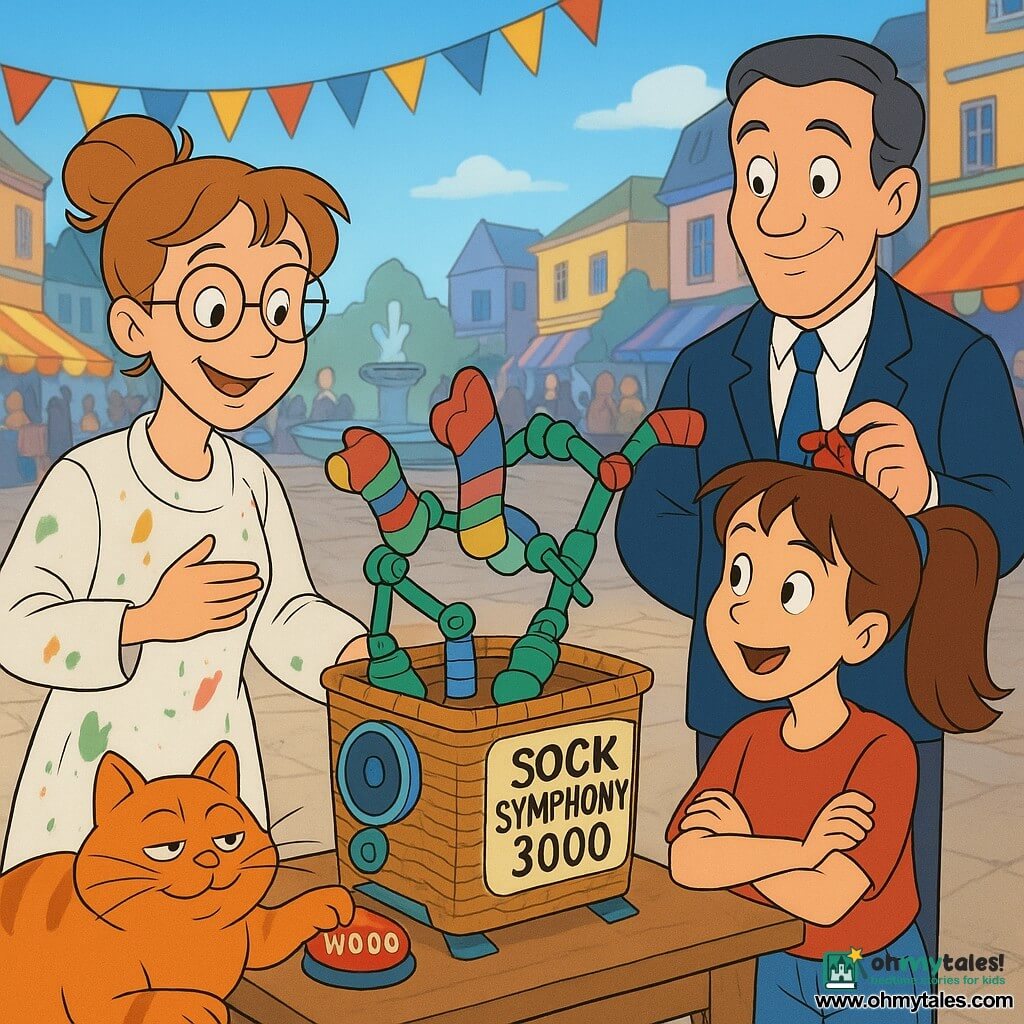
Mara rolled her cart into place near the fountain, hands sweaty on the handle.
She'd hidden behind her shyness all week, but now there was nowhere to hide. Her invention sat on the table like a bright, eager puppy.
Her explanation board stood upright beside it, neat and readable.
Mara adjusted her glasses. “You can do this,” she whispered to herself. “Just demonstrate. Breathe. Don't faint into the socks.”
Captain Pickles had followed her—because of course he had. He sat behind the table, looking like an unpaid assistant.
People drifted past. They stared at the basket.
A boy pointed. “Is that the cheering laundry thing?”
Mara's throat tightened. Then she forced her voice to work.
“Yes,” she said. “It's the Sock Symphony 3000.”
A girl about twelve stepped closer, arms folded. “That sounds fake.”
Mara swallowed. “Fair. I can show you.”
She picked two matching socks—bright red with lightning bolts—and fed them in.
The rollers hummed. The scan patch blinked. The socks dropped into the success bin.
The speaker played a short, cheerful fanfare—quiet enough not to scare anyone:
Da-da-da-DA!
A few people smiled. The skeptical girl's eyebrows rose.
“It… congratulated you,” she said, like she wasn't sure she liked the idea but couldn't argue with it.
Mara nodded. “Laundry doesn't get enough praise. It works very hard.”
A man laughed. “My laundry works harder than I do.”
More people gathered. Someone handed Mara a sock with a unicorn on it.
“Try mine!”
Mara hesitated. Taking socks from strangers felt like a new level of social adventure.
But she reminded herself: resilience. Try again.
“Okay,” she said. “Unicorn sock.”
She fed it in, then its match. The machine celebrated.
Da-da-da-DA!
A kid actually did a tiny victory dance.
Mara's shyness didn't vanish, but it loosened, like a knot being untied one patient tug at a time.
Then the mayor arrived. Mayor Nunez wore a sash and the expression of someone who had been asked to judge too many pies.
“What's this?” the mayor asked.
Mara nearly dropped a sock. “It's—um—an invention. For sorting socks. And encouraging humans.”
Mayor Nunez peered at the explanation board. “Hmm. Clear instructions. Good diagrams. Warning about unexpected pride… honest.”
Mara smiled nervously. “Thank you.”
Mayor Nunez picked up two socks from a nearby pile: one with blue stripes, one with black stripes.
Mara's eyes widened. “Those might—”
Too late. The mayor fed them in.
The machine scanned. It paused, thinking hard. Mara held her breath, ready to slam the emergency stop if it went wild.
The machine made a cautious beep.
It dropped both socks into the LONELY SOCKS slot.
No music.
The crowd went quiet.
Mayor Nunez blinked. “It… refused to celebrate.”
Mara's mouth twitched. “It has standards.”
A ripple of laughter moved through the crowd—warm laughter, not sharp.
The skeptical girl laughed too, and that felt like winning an invisible trophy.
Mayor Nunez nodded slowly. “I respect a machine that won't clap for nonsense.”
Captain Pickles chose that moment to jump onto the table and sit directly in front of the explanation board, blocking it with his entire cat body like a fuzzy billboard.
Mara whispered, “Move.”
Captain Pickles blinked.
The crowd laughed again.
Mara reached behind him and gently scooted him aside. He acted deeply offended and repositioned himself so he still looked important.
For the next hour, Mara demonstrated the Sock Symphony 3000. She explained the scan patch, the bins, the volume control. She pointed at her board and actually enjoyed how people leaned in to read it.
A boy asked, “Why'd you make it?”
Mara paused. The honest answer was: because she hated lonely socks and also hated being noticed.
But she didn't have to choose just one truth.
“I made it,” she said, “because chores can feel endless. And because I wanted something that cheers when you succeed, even at small things.”
The boy nodded like that made perfect sense.
At the end of the parade, Mayor Nunez returned with a small ribbon that said: MOST DELIGHTFULLY UNNECESSARY—AND SOMEHOW USEFUL.
Mara stared at it. Her throat felt tight again, but this time it wasn't fear.
“It's for you,” the mayor said. “And possibly for the cat.”
Captain Pickles meowed as if accepting the award on behalf of all orange loafs everywhere.
Mara laughed, and the laugh didn't shake.
Chapter 6: Confidence, Quietly Loud
That evening, Mara rolled the Sock Symphony 3000 back into her workshop. The room felt different now, as if it remembered her bravery and decided to make space for it.
She propped the ribbon on her workbench. Captain Pickles tried to bite it and was politely removed.
Mara sat with her notebook open, pen hovering.
In the corner, the Sock Symphony 3000 sat peacefully, wheels locked, volume low, emergency stop glowing red like a promise.
Mara wrote:
NEXT VERSION IDEAS:
—“LONELY SOCK SUPPORT GROUP” LIGHT (SOFT GLOW, NOT SAD)
—OPTIONAL APPLAUSE MODE (FOR HUMANS WHO LIKE NOISE)
—CAT-RESISTANT BUTTON COVER (URGENT)
She paused, then added:
—REMEMBER: FIXING IS PART OF INVENTING.
She leaned back and listened to the quiet.
It was a good quiet, not a hiding quiet.
Her phone buzzed. A message from Mrs. Dalloway: Peanut wants to know if the sock basket can cheer when he sits.
Mara snorted and typed back: Only if he matches his ears.
Another buzz—this time from the skeptical girl, whose name Mara now knew was Tessa. Someone must have given her Mara's number, probably the mayor, who took community spirit very seriously.
Tessa's message read: My brother loses socks like it's his job. Could you… maybe help?
Mara stared at the screen. Old Mara would have panicked. Old Mara would have written, Sorry, I'm busy forever.
Instead, Mara took a breath.
She typed: Sure. Bring a bag of lonely socks tomorrow. The Sock Symphony 3000 loves a reunion.
She set the phone down and looked at her invention.
“Well,” she told it softly, “we survived.”
The machine made a small, content hum, as if it agreed.
Mara walked to the window. Outside, streetlights glowed, and somewhere down the block someone laughed—just a normal laugh on a normal night.
Mara pressed her hand to the glass.
She hadn't become a different person. She was still shy. She still liked quiet corners and secret snacks. But now she also had proof—bright as a ribbon—that mistakes didn't have to end the story.
They could be the middle.
She turned back to her workshop, to her tools and tape and silly, stubborn hope.
“All right,” Mara said, rolling up her sleeves again. “Let's invent something else. And this time… let's try not to chase it down the street.”
Captain Pickles jumped onto the bench and sat like a supervisor.
Mara narrowed her eyes. “And no ‘WOOO' unless it's earned.”
Captain Pickles blinked, which—coming from him—was basically a standing ovation.
Mara laughed, picked up her pencil, and began.