Chapter 1: The Idea That Wouldn't Sit Still
Mara Quill liked things lined up.
Pencils: parallel. Paperclips: sorted by mood (shiny, shy, and dramatic). Her workshop: a cheerful chaos that only looked messy to people who didn't understand the difference between “pile for later” and “pile for very soon.”
On Tuesday afternoon, Mara stood in front of her workbench with a mug that said WORLD'S MOST PATIENT GENIUS. The mug was lying. Mara was patient with screws, not with problems.
The problem was this: her neighbor Mr. Peebles kept losing his words.
Not the big, important words like “taxes” or “microwave.” He lost small words. Handy words. “Hello.” “Sorry.” “Please don't let the dog eat my hat.”
He'd walk up to Mara's gate and say, “Good… er… the thing… you know.” Then he'd sigh like a deflated balloon. “I had it a second ago.”
Mara had watched this happen three times in a week. She wasn't worried in a scary way. Mr. Peebles was cheerful, healthy, and extremely good at forgetting where he put his own glasses while they were still on his face. But it was annoying, because his stories were excellent—when they arrived.
Mara tapped her pencil against her notebook.
“I need a device,” she said aloud, because ideas behaved better when spoken to firmly, “that helps people catch runaway words.”
At that exact moment, a breeze slid through the open window and flipped a page in her notebook, as if the air itself was impatient.
Mara's eyes lit up.
“A Word-Catcher!” she announced, pointing at absolutely nobody. “Like a butterfly net, but for sentences. A gentle, polite, non-embarrassing net.”
From the corner of the room, her young cousin Nia—eleven, quick-eyed, and visiting for the week—looked up from a pile of gears.
“You want to net words?” Nia asked.
“Yes,” Mara said, already sketching. “Words try to escape. We shall negotiate.”
Nia raised an eyebrow. “How do you negotiate with words?”
“With engineering,” Mara replied. “And possibly a snack.”
She drew a small collar, a tiny speaker, and something that looked suspiciously like a teapot with antennas.
Nia leaned in. “Is that a teapot?”
“It's a portable syllable reservoir,” Mara said.
“That's a teapot.”
“Fine,” Mara said. “But it's a teapot with purpose.”
Outside, a bird chirped as if laughing.
Mara flipped to a fresh page and wrote: PROJECT: THE POLITE WORD-CATCHER. She underlined it twice, because underlines were like seatbelts for ideas.
“I'm going to build it,” she said. “And then I'm going to teach someone else to build it, so the whole street stops yelling ‘WHAT WAS I SAYING?' at the sky.”
Nia grinned. “I'm in.”
Mara looked pleased. “Good. First rule of inventing: no panic. Second rule: label everything. Third rule: never trust glitter.”
Nia glanced at a jar on the shelf labeled “DO NOT OPEN: GLITTER.”
“Did you label that before or after the accident?” Nia asked.
“Both,” Mara said gravely. “Now: gathering materials!”
They opened drawers with the seriousness of treasure hunters. Mara found thin copper wire, a tiny microphone from an old toy karaoke machine, and a spool of ribbon.
Nia held up a spring. “What's this for?”
Mara considered it. “For when the words need encouragement.”
“Words are shy now?”
“Some are,” Mara said. “Especially ‘apologize.' It's practically nocturnal.”
Nia laughed and scribbled in Mara's notebook under the rules: FOURTH RULE: WORDS HAVE PERSONALITIES.
Mara pretended not to notice. She did notice. She liked it.
By sunset, a plan had taken shape on paper: a lightweight headband with a microphone, a “word jar” (the teapot, fine), and a little button labeled PLEASE RETURN WORDS.
Mara pressed her palm to the page like she was sealing a deal.
“Tomorrow,” she said, “we build a model. A small one. A kind one.”
Nia saluted with a screwdriver. “Captain Word-Catcher, ready for duty.”
Mara nodded, solemn and delighted. “Let's catch some manners before they escape.”
Chapter 2: The Mini Model and the Mischief of Sounds
Mara believed in prototypes.
Big inventions started as small, slightly embarrassing ones. If you couldn't build a tiny version without setting off an alarm, you were not allowed to build a giant version that might accidentally summon pigeons.
So on Wednesday morning, Mara and Nia built a miniature Word-Catcher.
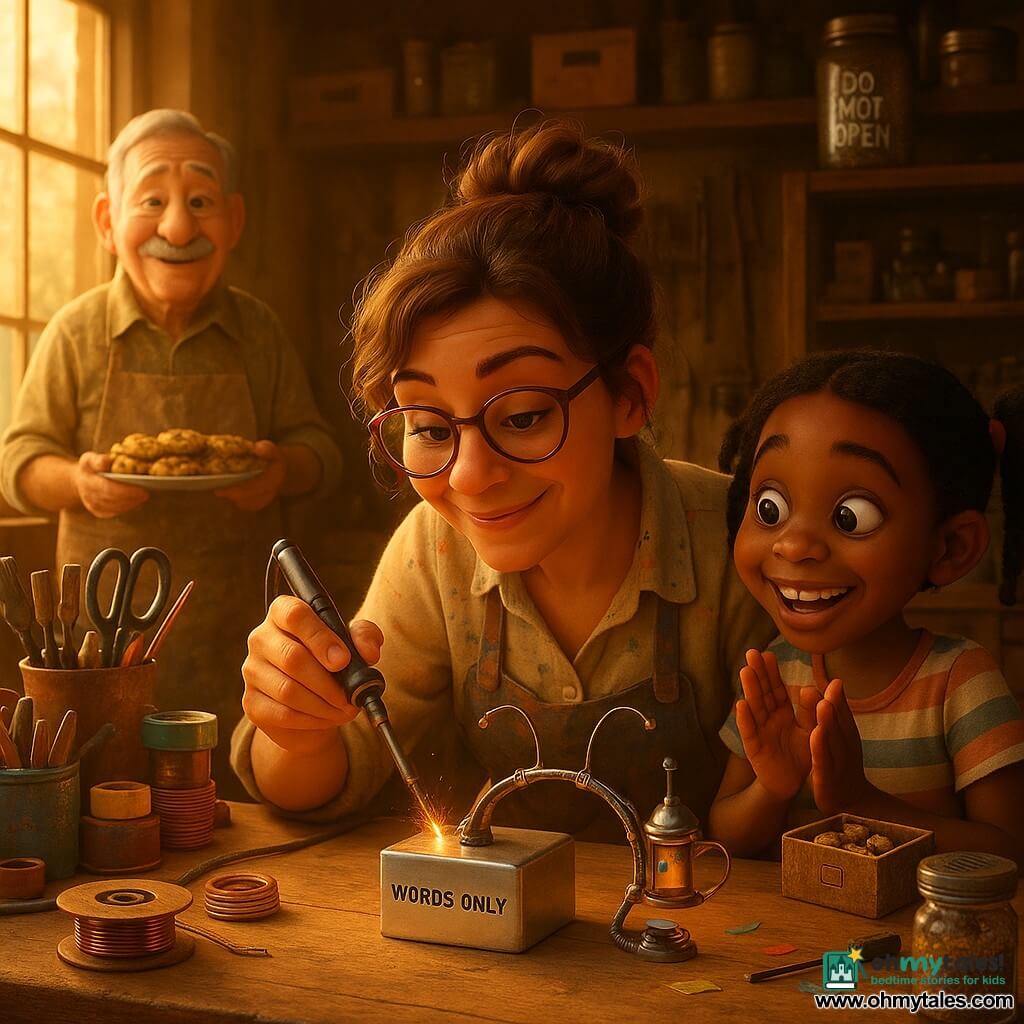
It sat on the table like a strange hat for a hamster: a small headband made from flexible plastic, a toy microphone taped on with careful precision, and a little tin labeled WORDS ONLY (NO COOKIES).
Nia read the label aloud. “Why do we need the ‘no cookies' part?”
Mara didn't look up from her soldering. “Because someone will test the theory.”
Nia held her hands up. “Not me.”
Mara just gave her a look that said: I have known you for three days.
When the solder cooled, Mara attached a tiny speaker, then connected everything to the tin.
“This is the reservoir,” Mara said, tapping the tin. “When a person forgets a word, the device will offer a polite hint. Like a friend, but less judgmental.”
Nia squinted. “How does it know the word?”
Mara opened her notebook to a diagram of swirling arrows. “The microphone listens. The device predicts what you're trying to say. It uses patterns—”
Nia pointed to the side margin where Mara had doodled a smiling banana.
“—and sometimes,” Mara admitted, “it guesses.”
They tested the mini model on a stuffed raccoon wearing a scarf.
Mara cleared her throat. “Hello, I would like to—” she paused dramatically “—purchase…”
The tin made a small hum. Then the tiny speaker chirped: “PINEAPPLE.”
Mara blinked. Nia snorted.
Mara tried again. “Hello, I would like to purchase… a…”
The speaker said, very confidently, “FISH.”
Nia fell backward into a chair laughing. “It's like a polite chaos machine.”
Mara, to her credit, did not throw the device out the window. She stared at her wires like they had personally betrayed her.
“Why is it suggesting pineapples?” she muttered. “I didn't say anything about fruit.”
Nia leaned in, listening. “Maybe it's hearing your stomach.”
Mara's stomach, as if offended, grumbled loudly.
Mara adjusted the microphone. “No worries. This is why we make a model. We are learning.”
Nia bounced on her heels. “Can I try?”
Mara handed her the headband. It looked ridiculous on Nia's head, which was perfect, because inventions were supposed to look ridiculous at first.
Nia spoke solemnly to the stuffed raccoon. “Dear Sir Raccoon, would you like to—”
The speaker said: “DANCE.”
Nia paused. “Actually… yes.”
She grabbed the raccoon and made it wobble across the table. The speaker, excited now, shouted, “WIGGLE! WIGGLE! WIGGLE!”
Mara pinched the bridge of her nose, but her mouth twitched.
“This is not a dance coach,” she said.
“But it's encouraging,” Nia pointed out. “It's very supportive.”
Mara sighed. “We need accuracy, not enthusiasm.”
Nia stopped the raccoon's wiggle and frowned thoughtfully. “Maybe the reservoir needs training. Like a dictionary brain.”
Mara looked at her cousin, impressed. “Yes. Exactly. We need to feed it better word patterns.”
“Not cookies?” Nia asked innocently.
“Not cookies,” Mara said firmly, then softened. “Though… I do have biscuits.”
Nia's eyes sparkled. “Engineering fuel.”
They spent the next hour recording phrases. Mara spoke clear sentences into the microphone. Nia wrote down the correct missing words on sticky notes and slapped them onto the tin.
The tin ended up wearing a bright patchwork of words: PLEASE, SORRY, EXCUSE ME, THANK YOU, HELLO, and one sticky note that said DON'T PANIC in extra-large letters.
Mara pressed the button labeled PLEASE RETURN WORDS.
The speaker warmed up with a tiny “Ahem,” which was unnecessary but oddly charming.
Mara tested again. “Hello, I would like to purchase…”
This time, the speaker said, “BREAD.”
Mara's eyes widened. “Better.”
Nia clapped. “Again!”
Mara tried a harder one. “I'm sorry I stepped on your…”
The speaker hesitated. It whirred. It hummed. Then it offered, quietly and with dignity: “FOOT.”
Nia pumped her fist. “Yes!”
Mara allowed herself a small smile. “Good. Now we have something. A working mini model.”
Nia tilted her head. “So… when do we build the real one?”
Mara looked at the tin, the wires, the sticky notes like little flags of progress.
“Today,” she said, “we start. But gently. No pigeons.”
Nia grinned. “No glitter?”
Mara's gaze slid to the glitter jar.
“…Absolutely no glitter,” she said, which was the kind of sentence that tempted fate.
Chapter 3: A Bigger Build and a Small Disaster
On Thursday, Mara spread her materials across the workshop like a careful magician preparing a trick.
She laid out a real headband—soft, adjustable, and not at all hamster-sized. She found a better microphone, a tiny rechargeable battery, and a sleek metal container that would become the reservoir.
Nia held up the metal container. “This looks like a lunchbox.”
“It's a wordbox,” Mara corrected.
“It's a lunchbox with dreams,” Nia said.
Mara pretended to be offended, but she wrote it down in her notebook anyway: WORDBOX WITH DREAMS.
They built in steps, because Mara loved steps.
Step one: attach the microphone.
Step two: wire the button.
Step three: connect the speaker.
Step four: don't solder your own sleeve. (Mara added this step after a brief moment of intense heat and regret.)
By afternoon, the full-size Word-Catcher looked like a sporty headband with a small, neat box clipped behind the ear.
Mara held it up proudly. “Elegant. Practical. Slightly strange. Perfect.”
Nia bounced. “Test time?”
Mara nodded. “We need a real person. Preferably one who often forgets words.”
As if summoned, Mr. Peebles appeared at the open door, carrying a plate covered in foil.
“Afternoon!” he said. “I brought you some… uh… round… sweet… you know. The ones that make your teeth happy.”
“Cookies,” Mara and Nia said together.
Mr. Peebles snapped his fingers. “Yes! Cookies! Exactly.”
Mara smiled. “Mr. Peebles, would you like to help with an invention?”
Mr. Peebles beamed. “I love inventions. Once I tried to invent a self-stirring soup. It stirred everything except the soup.”
Nia whispered, “He's perfect.”
Mara fitted the headband on Mr. Peebles carefully. “It's called the Polite Word-Catcher. If you forget a word, press this button.”
Mr. Peebles examined the button. “It says PLEASE RETURN WORDS. That's very polite. I like that. Machines should have manners.”
Mara nodded, pleased. “All right. Say a sentence. Any sentence.”
Mr. Peebles cleared his throat and faced the workshop like he was giving a speech to the tools.
“Yesterday,” he began, “I went to the… the… the place with the books.”
He frowned and tapped his temple. “What's the word?”
Nia whispered, “Library.”
Mr. Peebles pressed the button.
The Word-Catcher made a soft ding. Then the speaker said, in a calm voice: “LIBRARY.”
Mr. Peebles' eyes widened. “Well! That's it! That's the word! Marvelous!”
Mara's chest filled with warm pride. “Yes! It works.”
Mr. Peebles continued, delighted. “I went to the library to return my… my…”
He pressed the button again.
The speaker said: “WHALE.”
Silence.
Mr. Peebles stared into the middle distance. “I don't think I borrowed a whale.”
Nia choked on a laugh.
Mara's smile froze. “No, no, that's… that's incorrect.”
Mr. Peebles, still polite, nodded seriously. “Unless the library has expanded its services.”
Nia said, “Imagine the late fees.”
Mara snatched her notebook and flipped pages fast. “Why would it say whale? That's… that's not a common library item.”
Mr. Peebles tried again. “I went to the library to return my… my… my—”
He pressed the button.
The speaker, now confident again, announced: “KANGAROO.”
Nia burst out laughing. Mr. Peebles laughed too, which made the whole thing less embarrassing and more ridiculous.
Mara stared at the device. “Okay. New problem. It's… drifting.”
Mr. Peebles patted Mara's shoulder kindly. “All inventions drift at first. Like boats. Or my attention during long meetings.”
Mara took a breath. “The reservoir must be picking up random words.”
Nia pointed at the open window. Outside, children were playing in the street, shouting things like “WHALE ATTACK!” and “KANGAROO KICK!”
Mara's eyes narrowed. “They're playing ‘Animal Tag' again.”
The microphone was hearing everything. Not just Mr. Peebles.
“It's listening to the neighborhood,” Nia said. “It's basically gossiping.”
Mara pressed the off switch. The device went silent, as if caught eavesdropping.
Mr. Peebles looked disappointed. “I liked the whale idea. It made my day feel adventurous.”
Mara groaned. “I need to focus the microphone. Add a filter. A… a politeness barrier.”
Nia snorted. “A barrier for chaos.”
Mara nodded firmly. “Exactly. We'll teach it to listen only to the person wearing it.”
Mr. Peebles set down the cookies. “Take your time. If you accidentally invent a device that suggests kangaroos, that's still impressive.”
He walked away, calling back, “Good luck with the… the… thingy!”
“The invention,” Nia called.
“The invention!” Mr. Peebles said, triumphant, as if he'd caught his own word without help.
Mara watched him go, then turned to Nia. “We can fix this. We must fix this. Otherwise people will start returning whales to the library.”
Nia grinned. “Maybe the whales want to read.”
Mara tried not to smile. She failed.
“Get me foam padding,” Mara said. “And the quietest tape we own.”
Nia saluted. “On it, Captain Word-Catcher.”
Chapter 4: Training the Wordbox (and Avoiding Glitter)
On Friday, Mara approached the problem like a detective who suspected everyone, including the furniture.
She wrapped soft foam around the microphone to block outside noise. She adjusted the sensitivity. She added a small switch labeled ME / WORLD.
Nia watched the label being written. “That's dramatic.”
“It's accurate,” Mara said. “Also dramatic.”
Then came the harder part: teaching the Word-Catcher better guesses.
Mara opened a folder on her old laptop called “Polite Phrases.” It contained recordings of her own voice saying things like “Excuse me,” “Pardon,” and “Could you please stop feeding my screwdriver to the dog?”
Nia blinked. “You have a recording of that?”
Mara said calmly, “Yes. It happened twice.”
They spent the morning making the Word-Catcher smarter in a very unglamorous way: repeating sentences, tagging words, testing, correcting.
It felt a bit like training a puppy, except the puppy was a piece of electronics and it didn't chew shoes. It did, however, suggest the word “lasagna” at odd moments.
Mara tapped the device. “Why lasagna?”
Nia shrugged. “Because lasagna is always a good suggestion.”
Mara couldn't argue with that.
By lunchtime, the Word-Catcher reliably offered useful words. Mostly.
Mara decided it was time for a second model—not full size, not tiny hamster-size—something in between. A lighter mock-up they could pass around and not worry about.
“A middle model,” Nia declared, making a circle with her hands. “A… medium.”
Mara nodded. “A lightweight mock-up. We can test in public without looking like we're launching a satellite.”
They built the mock-up from cardboard, elastic, and an empty mint tin. Mara insisted on neat wiring anyway, even though the wires were pretend.
“Even pretend wires deserve respect,” she said.
Nia held up the mint tin. “Should we label it WORDS ONLY again?”
Mara thought, then wrote: WORDS ONLY (YES TO BISCUITS IF ASKED NICELY).
Nia laughed. “That's fair.”
While they worked, Mara explained every choice out loud. Not because Nia needed it—Nia was sharp—but because Mara believed knowledge was meant to travel.
“This foam stops outside noise,” Mara said, showing the padding. “This switch tells it whose voice matters. And we keep the button big so it's easy to find without looking.”
Nia nodded, taking notes in her own little notebook now. “So if someone else builds one, they won't copy the mistakes.”
“Exactly,” Mara said. “Inventions shouldn't be secrets. Secrets get stuck. Tools should be passed on.”
Nia paused, glue in hand. “Like… a recipe.”
Mara smiled. “Yes. Except sometimes recipes do explode, if you forget baking powder.”
Nia's eyes widened. “Have you exploded a recipe?”
Mara cleared her throat. “Once. The kitchen ceiling still remembers.”
They tested the mock-up on each other, pretending to forget words dramatically.
Nia put on a serious voice. “Mara, could you please hand me the… the… the—”
She pressed the button.
The speaker said: “SCREWDRIVER.”
Nia nodded gravely. “Thank you. Without it, I might have tried to use a spoon.”
Mara shuddered. “That's how disasters begin.”
Mara tried her own line. “Excuse me, Mr. Peebles, your… your…”
She pressed the button.
The speaker offered: “HAT.”
Mara nodded, satisfied. “Excellent.”
Then, because the universe enjoyed comedy, Nia glanced at the glitter jar again.
“Just wondering,” Nia said, innocent as a cartoon kitten. “What would happen if we put glitter in the wordbox?”
Mara put down her screwdriver very slowly. “We do not put glitter in the wordbox.”
“What if the words want sparkle?”
“The words do not want sparkle,” Mara said. “The words want peace.”
Nia grinned. “Okay, okay. No glitter.”
Mara relaxed. “Good. Now: tomorrow, we test it properly. In the most dangerous place of all.”
Nia gasped. “The hardware store?”
Mara shook her head. “Worse.”
Nia swallowed. “The school fundraiser bake sale?”
Mara nodded. “Exactly. Crowds. Noise. People trying to say ‘brownies' and accidentally saying ‘broomsticks.' Perfect conditions.”
Nia rubbed her hands together. “Operation: Save the Brownies.”
Mara wrote it down, because it deserved to exist.
Chapter 5: The Bake Sale, the Button, and the Great Biscuit Mix-Up
Saturday arrived with sunshine and the kind of busy air that made everything feel like it might happen at once.
The school playground was packed with tables, posters, and parents clutching coins. Someone had put up a banner that said BAKE SALE FOR THE LIBRARY, which felt like a sign from the universe apologizing for the whale incident.
Mara and Nia walked in wearing the Word-Catcher mock-up first—cardboard version—so nobody would panic. Mara carried the real device in her bag like a secret superhero gadget.
Nia scanned the crowd. “So many words. So many chances for them to run away.”
At the cake table, Mr. Peebles was volunteering. He wore an apron that read KISS THE COOK (PLEASE ASK FIRST).
He waved. “Mara! Nia! Come taste the… the… the—”
He froze.
Nia whispered, “Cupcakes.”
Mr. Peebles sighed. “Yes, cupcakes. My brain is doing that thing where it takes a quick nap.”
Mara pulled out the real Word-Catcher. “Want to try again? We improved it.”
Mr. Peebles brightened. “Absolutely. If it suggests another kangaroo, I'll name it.”
Mara fitted the headband gently. She flipped the switch to ME.
“All right,” she said. “Go ahead.”
Mr. Peebles faced a customer, a tall woman holding a plate. “Hello! Would you like to buy a—” he paused, eyes flicking upward “—a…”
He pressed the button.
The Word-Catcher chimed and said: “BROWNIE.”
Mr. Peebles exhaled like he'd been carrying that word in a heavy bag. “Yes! A brownie! Two for a pound!”
The customer smiled. “Lovely.”
Nia's grin nearly split her face. “It worked!”
Mara felt a happy fizz in her chest. “Again,” she whispered.
Mr. Peebles turned to a small boy who was staring at a tray of biscuits like it was sacred treasure.
“We also have—” Mr. Peebles paused “—”
Button.
“BISCUITS,” the Word-Catcher said.
The boy nodded solemnly. “I will take three. For research.”
Mara and Nia exchanged a look: this child understood science.
For twenty minutes, it went beautifully. The Word-Catcher helped with “napkins,” “change,” “spatula,” and even “thank you,” which Mr. Peebles delivered with extra sparkle in his eyes, as if the word tasted good.
Then Nia noticed something.
Every time anyone said “biscuit,” the Word-Catcher sounded a little too excited.
Not dangerous excited. More like “I have a favorite topic” excited.
At first it was funny. Then it became… suspicious.
A parent asked, “Do you have any gluten-free options?”
Mr. Peebles pressed the button, hoping for the right phrase.
The Word-Catcher said: “BISCUITS.”
Mara blinked.
Mr. Peebles tried again, slower. “We have… uh… options for—”
Button.
“BISCUITS,” the Word-Catcher insisted.
Nia leaned close to Mara. “Uh-oh. It's stuck.”
Mara whispered back, “On biscuits?”
Nia nodded. “It's obsessed.”
Mr. Peebles, still polite, said to the parent, “Apparently, the answer is biscuits.”
The parent laughed. “I'll take it.”
Mara quickly checked her device settings. The switch was still on ME. The microphone padding was fine. The battery was fine.
So why biscuits?
Then Nia's eyes fell on the wordbox clip behind the ear. On it, in neat handwriting, was the label they'd made yesterday:
WORDS ONLY (YES TO BISCUITS IF ASKED NICELY).
Nia's mouth fell open. “Mara.”
Mara followed her gaze. Her face went still.
“Oh no,” Mara breathed. “The training tag.”
Nia whispered, “You taught it that biscuits are always acceptable.”
Mara's ears went warm. “I did not mean it as a universal rule.”
Mr. Peebles pressed the button again, because now he was having fun.
“BISCUITS,” the Word-Catcher announced, proud as a trumpet.
Nia giggled. “It's like it has a biscuit agenda.”
Mara groaned. “Okay. We need a quick fix before it convinces the mayor to replace speeches with biscuits.”
She opened her bag and pulled out a marker. On the label, she crossed out the biscuit part and wrote in capital letters:
WORDS ONLY (NO FOOD OPINIONS).
Nia added a smaller note underneath: (UNLESS SOMEONE IS HUNGRY).
Mara shot her a look.
Nia shrugged. “It's compassionate.”
Mara flipped open the device's tiny panel and adjusted the training preferences. “There. Less bias toward biscuits.”
Mr. Peebles tried one more time, almost sadly. “We also have—”
Button.
The Word-Catcher paused, thought, and said: “MUFFINS.”
Mr. Peebles cheered. “Yes! Muffins!”
Nia whispered, “It's off biscuits. We saved the world.”
Mara breathed out, relief and laughter mixing. “Good. Let's keep it running.”
For the rest of the bake sale, the Word-Catcher behaved like a helpful friend: polite, quiet, and only slightly smug.
When the banner came down and the last crumbs disappeared, Mr. Peebles removed the headband carefully, like it was a tiny bird.
“That was marvelous,” he said. “Also, I'm suddenly very hungry.”
Nia said, “That might just be the bake sale.”
Mara smiled. “Mr. Peebles, would you like to keep it for a week? Test it in real life?”
His eyebrows jumped. “Really?”
Mara nodded. “But there's one condition.”
Mr. Peebles leaned in. “Yes?”
“You have to teach someone else how to use it,” Mara said. “Not just keep it. Pass it on. That's the point.”
Mr. Peebles' face softened. “Deal. I'll teach my book club. Half of us forget words, and the other half pretends not to.”
Nia whispered to Mara, “That's adorable.”
Mara whispered back, “Transmission.”
Chapter 6: Passing It On, Neatly and Kindly
On Sunday afternoon, Mara set up her workshop like a classroom, except the students were neighbors and the subject was “How to Stop Your Sentences From Running Away.”
Mr. Peebles brought three friends from his book club: Ms. Dalloway, who spoke like she was always in the middle of a dramatic speech; Jo, who laughed at everything; and Mr. Singh, who carried a notebook filled with tidy handwriting.
Nia sat at the corner of the workbench with her own notebook, ready to record what Mara said—because Nia had decided that if knowledge was going to travel, it needed good directions.
Mara held up the Word-Catcher. “This device listens only to the person wearing it,” she explained, “and offers a missing word when you press the button. It doesn't read minds. It guesses politely.”
Jo raised a hand. “What happens if it guesses wrong?”
Mara answered honestly. “Then you get a funny sentence. But nothing dangerous. Also, you get to laugh, which improves most situations.”
Mr. Peebles coughed. “Except when it suggests whales.”
Nia scribbled: DO NOT TRAIN ON ANIMAL TAG.
Mara brought out the lightweight mock-up. “Before you use the real one, practice with this. Find the button without looking. Feel the shape. This matters.”
Ms. Dalloway put it on and declared, “I am ready to confront my forgetful destiny!”
The mock-up, which was not turned on, said nothing, because it was cardboard.
Ms. Dalloway paused, then laughed at herself. “I have confronted a piece of cardboard. I feel braver already.”
Mara showed them the parts: microphone, padding, switch, wordbox, battery.
She explained each one slowly, then handed the explanation to Nia.
“Nia,” Mara said, “tell them why the padding matters.”
Nia looked up, surprised and proud. “It blocks background noise. Otherwise the device listens to everything and starts guessing based on whatever chaos is nearby. Like… playground games. Or somebody arguing about muffins.”
Mr. Singh nodded. “So, it's focused listening.”
“Exactly,” Nia said, and wrote that down with satisfaction.
Mara felt a warm glow. This was the good part. The part where an invention stopped being “mine” and became “ours.”
Then Mara did something she didn't do often: she handed her main notebook to the group.
Mr. Peebles held it like a treasure. “Are you sure?”
Mara nodded. “I made a copy,” she said, holding up a second notebook with the same diagrams. “And Nia made an even better index.”
Nia lifted her notebook. “Page numbers. Topics. Mistakes. Also a warning about glitter.”
Ms. Dalloway leaned forward. “Glitter?”
Mara spoke with the seriousness of someone who had survived. “Never trust glitter.”
Everyone laughed, but Mara wasn't joking. Not entirely.
They practiced with the real Word-Catcher, passing it around. Each person tried a sentence, pressed the button, received a word, and looked relieved, as if a tiny knot in their brain had loosened.
Mr. Singh said, “This would help my students. They freeze when they can't find the right word.”
Mara's eyes brightened. “Then teach them. And if you make a version for the classroom, add a ‘calm down' mode. Words arrive better when you're kind to yourself.”
Jo pressed the button just to see what happened and said, “I forgot my—”
The Word-Catcher replied: “KEYS.”
Jo stared. “How did it know?”
Mara pointed at the keys sticking out of Jo's bag. “Science.”
Nia whispered, “And obvious clues.”
When the lesson ended, Mr. Peebles carefully placed the Word-Catcher in its case.
“I'll return it in a week,” he promised, “and I'll bring notes. Real notes. Not the kind I write on my hand and then wash off.”
Mara nodded. “And while you test it, I want you all to improve something. A label. A setting. A suggestion. Even a drawing. Add your knowledge.”
Ms. Dalloway said softly, “So it becomes a shared invention.”
“Yes,” Mara said. “That's how good ideas stay alive.”
After everyone left, the workshop felt quieter, but in a satisfying way—like the silence after a successful song.
Nia closed her notebook. “You really gave them your plans.”
Mara wiped her workbench, aligning tools without thinking. “An invention that stays locked in one room isn't very helpful.”
Nia nodded slowly. “So you're not just catching words. You're passing them.”
Mara looked at her cousin, and her voice turned gentle. “Exactly. Tools, tips, mistakes, jokes—those are all words too. And they shouldn't get lost.”
Nia grinned. “Can we invent something else next?”
Mara's eyes twinkled. “Of course. But first—”
She reached for the glitter jar and moved it to a higher shelf.
Nia laughed. “Defensive engineering.”
Mara nodded, satisfied. “Always.”
And somewhere down the street, Mr. Peebles practiced saying “library” with confidence, while the Word-Catcher sat politely and did its best not to mention biscuits.