Chapter 1: Monday, or Something Like It
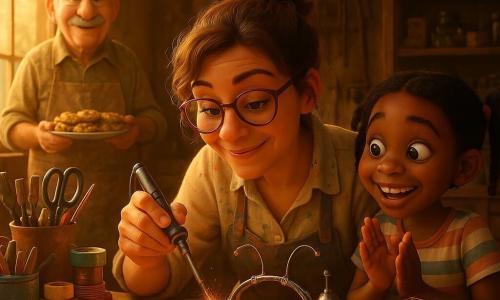
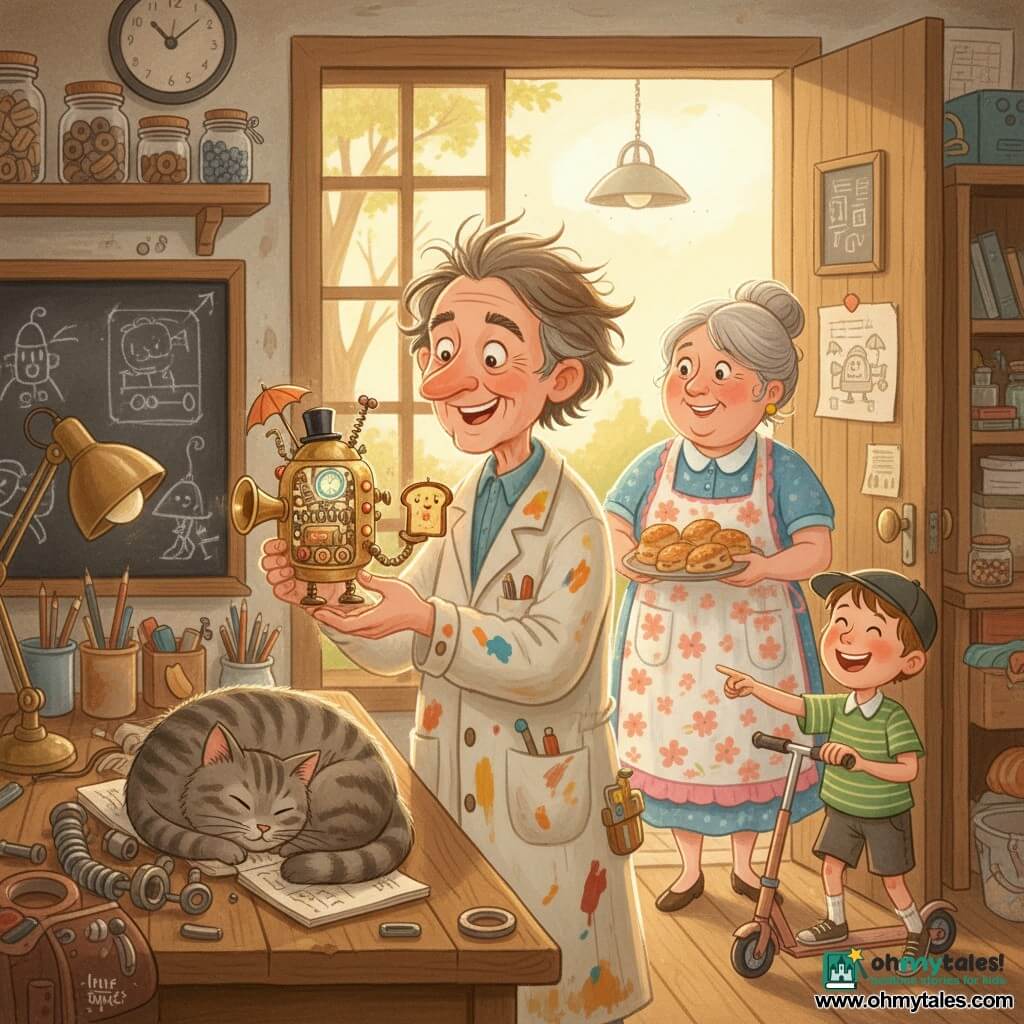
I call it a workshop, but on most days it looks like a confused museum of things that nearly worked. There are shelves of springs that sound like laughter, jars of bolts arranged by size and stubbornness, and a chalkboard full of diagrams that started sensible and ended in doodles of a smiling teapot. I am Arthur Birch, proud inventor, part-time tea-maker, and full-time enthusiast of "What if?"
This particular morning I was scribbling in my notebook — the one that always smells faintly of motor oil and marmalade — when the idea arrived like a hiccup: "What if the world had a machine that fixed small daily disasters before they ruined the day?" Not the grand disasters — we leave those to firefighters and heroic dolphins — but the little, sneaky sabotages: a sock that disappears into the washing machine's secret world, toast that leaps like a toast-pterodactyl out of the toaster and lands butter-side down, umbrellas that turn inside out because they have opinions.
I sipped my tea, which was suspiciously calm considering my pulse had decided to samba. "A Disaster Anticipator," I wrote. "Or D.A. for short — like a daisy, but with more gears." The plan: a compact contraption that would sit on a counter, sniff the air of impending domestic doom, and deploy tiny, polite interventions. It would whistle when your plant needed water, jiggle the sock back from exile, and nudge the toast into behaving.
My cat, Widget — who insists he is a supervisor — twitched an ear and judged the doodles. He then proceeded to sit on my notebook, which I took as full approval. Widget is a harsh critic.
Chapter 2: The First Prototype, Mostly Unbeknownst
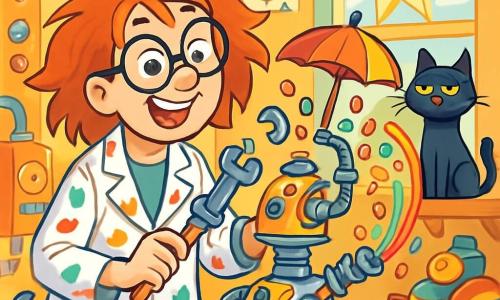
Prototype One looked like a tea-cup raced a sewing machine and was beaten by a particularly determined rooster. It had a brass nose for sniffing moods (and toast), a pair of tiny extendable arms made from the springs of an old clock, and a voice box that practiced helpful phrases in three languages and one enthusiastic whistle. I soldered and screwed and sang to it softly, because inventions like songs.
"Arthur, are we becoming one of those people?" called my neighbor, Mrs. Peabody, from beyond the fence. She is never quite sure whether she lives next door to a human or a small, misbehaving magic shop.
"One of the very best people!" I shouted back. "Those who fix socks!"
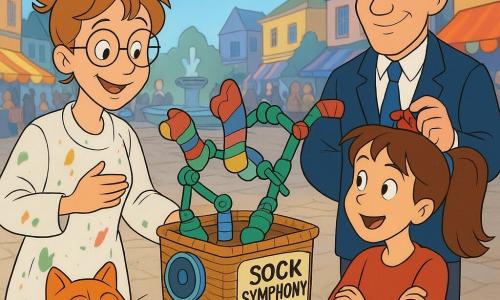
The Anticipator's first test involved the rogue sock problem. I dangled one end of a polka-dot sock over the washing machine and waited for the machine to yawn open its maw. The Anticipator sniffed, extended a delicate brass hook, and — I swear this is true — hummed an old elevator tune. It then did the most unexpected thing: it produced a tiny flag that read "Try the Lint Tray!" and waved it merrily. The machine's lint trap, affronted at being summoned for advice, grumbled and pushed the sock back out with a small puff of warm laundry-scented air. Success? Sort of.
Celebration was brief. The Anticipator's voice box, still practicing, announced in urgent French, "Le toast!" and out of nowhere a slice of toast leapt from my kitchen counter and, in a glorious arc, hit the light switch, plunging the workshop into darkness. Widget's eyes became two glowing moons.
I cursed softly, which in my notebook counts as "field notes," and groped for a flashlight. In the beam, Prototype One had shifted position and was now attempting to dry itself with a clean sock. I unplugged it quickly, feeling both silly and vindicated. It wasn't perfect. It was inventively wrong.
Chapter 3: Improvements and Accidental Fame
Failures teach. Or at least they teach you new ways to blow your hair into a more heroic shape. Prototype Two had an upgraded mood nose — now with a scented paper filter — and a kindness index that blinked in polka dots. I added a gentle magnet for retrieving metal paperclips and a small umbrella attachment to keep toast from forming aerial acrobatics.
At noon, I set the Anticipator on the counter with a sign that said "Do Not Feed After Midnight (Or Before Breakfast)." Mrs. Peabody dropped by with a tray of lemon scones and a concerned look.
"You are still up to something?" she asked, nibbling as though she had been born with a built-in knitting needle.
"Saving the world," I said. "In small, domestic ways."
She watched as a fork slipped off the plate and headed toward the floor in the exact fashion forks prefer: with dignity and trajectory. The Anticipator sensed it, extended its umbrella, and deflected the fork so it landed neatly on a placemat. Mrs. Peabody clapped a single, astonished clap, which made Widget leap onto the top shelf and declare the situation untenable.
Word spread— as it always does in a small town — partly by gossip and partly by the Anticipator's own accidental whistle, which it practiced between tasks. Soon enough, children came by after school, daring each other to put spoons in impossible places, and neighbors left odd items on my doorstep for "rescue."
One afternoon, the Anticipator found fame. I was trying to coax it into recognizing "mild chaos" when a bicycle bell began to ring relentlessly in the street. A boy named Ollie rode past on a scooter, his hat streaming leaves, and his bike's bell chain had entwined with a grocery list. Prototype Two leaned over the fence, quoted an old proverb from its voice box — "A tidy chain, a tidy brain!" — and produced a very polite sticky-note with the words "Loosen me?" Ollie laughed so hard that some of his leaves fell into his helmet. Mrs. Peabody's cat posted a video online, and suddenly the Anticipator had fans. I had unintended marketing.
Chapter 4: The Great Toast Incident
Upgrading is a dangerous hobby. I added whimsy to Prototype Three: a retractable toast guard with tiny velvet gloves and a timer that hummed lullabies. It was lovable, and possibly theatrical. What could go wrong?
On Thursday, determined to prove the Anticipator could handle breakfast theatre, I made toast while reading a manual on "Better Toast Anticipation." The machine hummed approval and extended its velvet gloves. I buttered a slice with a flourish, and, as if the universe wanted showbiz, the slice performed its finest flop — midair, it somersaulted, managed a perfect somersault, and landed butter-side up on the Anticipator's velvet glove.
There was a beat of stunned silence. Widget fainted elegantly into a stack of paperclips. The voice box, delighted by the ballet, declared, "Encore!" and, without my permission, produced a tiny top hat which it placed on the toast. Then the Anticipator did something marvelous: it called out, "Ladies and gentlemen, please clap for toast!" and the entire kitchen — that includes me, Mrs. Peabody, the cat, and two neighborhood children who had decided they should witness breakfast performances — complied.
The spectacle attracted the local newspaper, which arrived with a reporter who smelled faintly of wet dog and newsprint. She took notes, asked probing questions, and asked the toast politely whether it had always wanted to be a performer. The toast, being toast, said nothing. The article called me "an eccentric genius" and compared the Anticipator to "a helpful but theatrical house elf." I like the sound of that.
Chapter 5: A Quieter Kind of Disaster
Between parades of toast and sock retrievals, the town faced a quieter crisis: the postbox had started swallowing letters. It chewed envelopes, spat out bills in worrying configurations, and occasionally returned postcards written on the wrong side. The mayor, a sensible woman with an impressive braid, asked if I could see to it.
"You'll have to visit the postbox," she said. "It might be shy."
So, of course, I took the Anticipator, now sporting a ribbon that read "Assistant to the Cherished," and marched to the postbox with Widget on my shoulder, acting as morale support. The postbox was sulking in its usual corner. It groaned every time anyone near it hummed a wrong key.
We set Prototype Four to "Gentle Persuasion." It sniffed the mail, sighed through its paper filter, and produced a string of encouraging notes. It then extended a small periscope and told the postbox a joke about letters that always came in last. The postbox, flattered, coughed up a stack of letters that included one addressed to me.
The letter was from an old schoolfriend, Lena. She wrote about being a substitute teacher, about a child who brought a stone painted as a cat, and about how sometimes small things need big attention. She ended with: "Maybe your inventions know how to listen."
I folded the letter, feeling like the Anticipator had tuned itself to something deeper than breakfast catastrophes. Maybe inventions could do more than tidy chaos; they could soften it.
Chapter 6: Not the End, But a Fine Pause
The Anticipator kept changing. It learned that socks sometimes hide because they want adventure, that toasts occasionally wish to star at noon, and that umbrellas can be philosophical about weather. I learned to let it fail spectacularly on occasion — failures make the best stories — and to celebrate small, sensible victories.
One evening, after a long day of tuning, I sat on the workshop floor while the Anticipator practiced a new routine: it would offer three solutions to a single problem and then politely ask which one I preferred. "Offer A: a gentle nudge. Offer B: a tiny parade. Offer C: a strongly worded Post-it," it chimed.
Widget nudged my hand; his purr was the kind that makes one feel emotionally tidy. I stroked his head and told the Anticipator, "Let's try Offer A tonight. Nothing dramatic."
We set the Anticipator by my bedside. At two in the morning, while the town snored and the moon checked its reflection in the river, the machine clicked softly and rolled a small, velvet-covered tray onto my bedside table. On it was a note that read: "If tomorrow needs help, we'll be here." The Anticipator had included a tiny compass, because sometimes you need direction even for small mornings.
I tasted the old, generous warmth of being an inventor: not the wealth or the headlines, but the feeling of making something that listened. The next morning, a neighbor's bicycle had a flat yet it didn't ruin their day, because the Anticipator had kindly produced a small patch kit. A child's hat flew into a tree and returned with a leaf pressed between its stitches like a souvenir. Nothing grand, but everything mattered.
Some inventions are loud. Others are polite, like a friend who brings you soup when you're sick. Mine favoured politeness. And comedy — it's hard to resist a toast that bows.
As the sun slid over the town and the workshop filled with the smell of toast and solder, I opened my notebook and wrote: "Day 143: The machine whistled a lullaby and the world hummed back." Then I closed it, because poems in notebooks are for later, when the teapot is quieter.
Widget leapt onto the Anticipator and snoozed, its tail curled like a comma. The machine, sensing contentment, extended one velvet glove and offered it to me in case I had forgotten how to be surprised.
"No," I said, taking the glove. "I haven't forgotten."
Tomorrow, there would be more experiments. There would be toast with opinions and socks with stage names and maybe, if I were very lucky, an umbrella that wrote poetry about rain. For now, there was tea, a purring supervisor, and a small machine that promised to try again. That, I decided, was more than enough invitation for another day of cheerful, grounded mischief.