Chapter One: The Slow Orchard
In the hush beneath twisted apple boughs lived a snail named Marlow. He carried a shell painted like midnight, streaks of silver that shimmered when the moon watched. Marlow was slow by nature and patient by choice. He moved through the orchard taking long looks, listening for secrets the wind might drop.
The orchard was not like other gardens. Trees bent with long, knotted arms. Apples gleamed black in the shadows and sometimes a quiet voice seemed to ripple between trunks. At daybreak a pale fog sat on the grass like sleepy wool. Villagers said the place was haunted, so they kept their distance. But Marlow liked to visit the orchard at dusk. He liked thinking, collecting small truths, and storing them in his shell the way others store pebbles.
One evening, as the sky browned like old leather, Marlow found a tiny lantern smashed beneath a thorny hedge. Inside was a dying glow—no larger than a firefly. Marlow wrapped his soft body around it to warm the light. The lantern blinked and then sighed.
"Who are you?" Marlow asked, patient as ever.
"I am a lantern of the path," it whispered. "I guide, but tonight my glass cracked. My name is Lumen. I will fade unless I find a new beacon."
Marlow thought. He had seen things the villagers had not. He had memories stored in spirals beneath his shell: a crow's secret, the smell of rain on iron, a child's lullaby lost in wind. He liked to learn and to share. He promised Lumen the snail would help, and Lumen exhaled a faint, grateful glow.
That night the orchard felt colder. Distant, a church bell toll would have sounded if any church dared sit near those trees. Shadows pooled like spilled ink. Marlow felt a small prick of worry and tucked it away like a thorn. He decided he would find the place where beacons were born—the Hollow of Echoes, a place the orchard's oldest roots hushed about.
Marlow moved at his slow even pace. Each step was careful, each moment measured. He hummed a tune he had learned from an old hedgehog and told Lumen what he saw: spider webs that sang, mushrooms that opened like tiny waiting hands, and footprints of things that did not belong to birds or foxes.
They reached a mossy stone that marked the orchard's heart. The stone seemed to breathe. Lumen's glow faltered. Under the stone, in a crack like a smile, something breathed back, colder than fog.
Marlow pressed his antennae to the crack and listened. Far inside, something answered—a softer, older light. It spoke not with words but with feeling: longing. Marlow's shell pulsed with a slow, steady warmth. He would go deeper. He would be patient. He would learn.
Chapter Two: The Hollow of Echoes
The Hollow lay beneath a hollowed stump, down a spiral of roots where the air smelled of iron and memory. To get inside, Marlow slid through a spider's silk curtain, which felt like a sigh against his shell. The deeper he went, the colder the air became. The walls hummed with echoes of steps not taken.
They found an arch of bone-white roots, and within, an old lamp stood on a stone pedestal. It looked like Lumen but whole and burning steady as noon. Around it, dozens of tiny lights floated, moth-like and worried. The air carried whispers—half prayers, half warnings.
When Marlow asked the lamp if it knew how to mend Lumen, the lamp's flame fluttered slow and answered in a low voice.
"Beacons are mended with stories," it said. "Each light in here holds a forgotten tale. To fix a lantern, you must feed it a truth it recognizes."
Marlow listened. He had gathered truths his whole life: that the hedgehog liked to hum when it rained, that the crow stole shiny things because it feared being forgotten, that the little girl from the village had left a ribbon once and never returned. These were small truths, but they mattered. Lumen's glow grew a hair brighter.
A sound nudged the hollow—a scraping like nails on bark. Shadows moved where shadows should not. A shape slid along the wall: a Weeper. It was thin as wind and wore faces stolen from sleep. The Weeper's voice was many voices, and each one asked for something.
"Give us a memory," it hissed, reaching tendrils that smelled faintly of cold tea. "We eat what people forget."
Marlow recoiled inward. He had heard of Weepers—creatures of the orchard that fed on lost things. If they ate the village's memories, whole people could become empty shells, moving with no names in their mouths. But Marlow remembered then what he had promised: to be patient and to help Lumen. He also remembered the way his shell warmed when he shared a truth.
Instead of fear, he shared. He told the old lamp the story of the little girl and her ribbon, of the crow and the shiny button, of a lullaby hum. Each story rose like a small ember and flew into the lamp. The lamp accepted them, bowed in a draft, and shined warmer.
The Weeper lunged, but instead of devouring Marlow's stories, it recoiled, tasting the warmth and remembering its own face. For a blinking breath, it paused being a thing of appetite and became a thing with a past. Its tendrils trembled. It let out a sound like a sob and then, to everyone's surprise, began to cry real tears—tears that smelled of rain and apple skin.
Marlow felt pity—attachment—to the Weeper. He reached out with one slow antenna and touched a tear. It felt like a bead of music. The Weeper's faces slid away like peels from an orange, revealing not hunger but loneliness. It drifted toward the lantern light and, seeing itself reflected, lay still. The hollow became quiet, not with fear but with an odd hush.
Lumen's flame steadied. The lamp leaned down, a tiny sun bowing, and breathed a word into Lumen's glass: Remember.
Marlow learned something important there: that even frightening things might be frightened, and that memories can warm even a cold place.
Chapter Three: The Garden of Lost Names
Marlow and Lumen left the Hollow with new light and heavier hearts. They passed a gate made of black ivy that reached up like claws. Beyond it lay the Garden of Lost Names, where the orchard kept what people had misplaced—a lonely child's sock, a wedding ring no longer wanted, a key to a house that nobody used.
This garden smelled of dust and wishes. Little pools gathered reflections of evenings that had not happened. Pillars of stone had names carved into them that had blurred into nothing. Lumen flickered nervously. "Names are strong," it whispered. "Without them, people slip."
They found a pedestal where a name should have sat, but the plaque was empty. Marlow pressed his shell against the stone and listened. He felt a tug in the earth, a pebble of memory bumping at the surface.
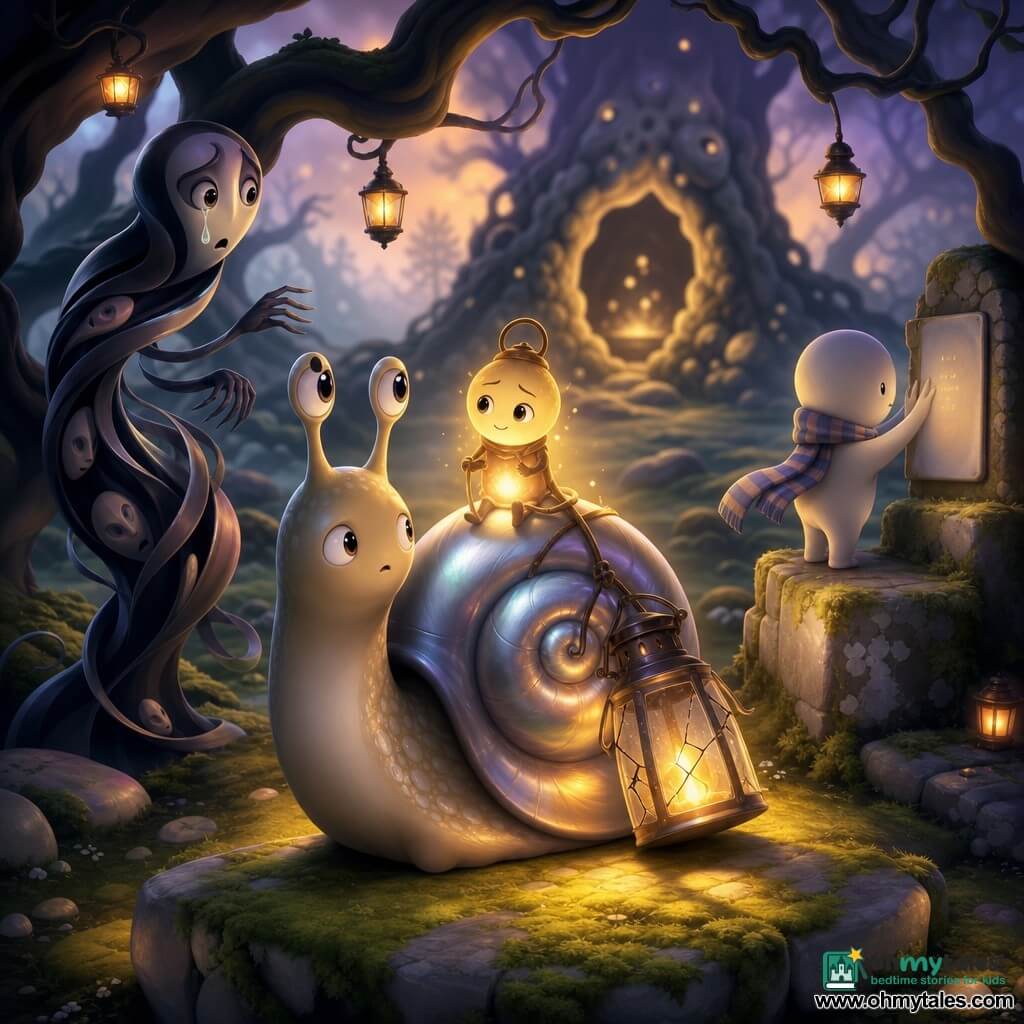
A shadow brushed past—a figure with no face, only a scarf, and it moved like someone trying to remember the next line in a poem. The faceless figure reached for the empty plaque, hands trembling. Marlow recognized the trembling from his own slow pace. It was worry.
Marlow told Lumen a story—the gentle tale of the hedgehog's rain-song, the crow's shiny button, and the girl who left a ribbon. He told it slowly, savoring the shapes of the words. The lantern's light drank the stories and burned brighter.
The faceless one paused. It smelled of corduroy and old bread. A memory stirred: a laugh at twilight, the sound of a horse on a cobbled lane, a name whispered in a doorway. The plaque on the pedestal sprouted a pale word like a sprout. It grew letters, thin as sprouts, and took the faceless figure's name: Thimble.
Thimble wept a soft, relieved sound. Its hands touched the letters; they felt warm and true. It folded itself around the name like someone putting on a coat. Marlow felt pride, like a sun in the center of his shell.
But the garden held darker corners. A small pond reflected not the stars above but the hollowed faces of things that had given themselves to forgetting. From its depth rose a ripple and a low song, a call that tasted like syrup and made Marlow shiver.
"Do not answer," Lumen warned. "The pond asks for more than memory. It begs for sacrifice."
Marlow thought of the Weeper and how it had been turned by stories. He thought of Thimble, curling into its true name. He had another truth tucked near his shell—a truth he had always kept private. It was the memory of his old home, a mossy stone under a willow where he had first learned to listen. It pulsed with warmth but was also a place he loved, a place that meant comfort.
Marlow faced the pond. He could give up his own cherished memory to calm its song. But he was patient; he would not rush. He shared instead: a thread of the willow memory, a sliver of the song but not the root of it. The pond drank, sighed, and the ripple faded. The singing lessened but did not vanish.
From the water rose a small glass key. It was clear as ice and heavy like truth. Marlow took it with care. Lumen's light steadied into a proud beam. The garden, which had been wary, seemed to bow a little. Marlow had learned how to give without losing himself—sharing enough to heal, keeping enough to belong.
Chapter Four: The Night of Unraveling
Word of the lantern's healing spread until even winds carried it like a secret. The orchard's shadows grew bolder the night the moon hid its face. Trees hissed; apples clattered like teeth. From the dark came a sound like paper being torn: the Unraveling.
Stitch by shadow-stitch, seams along the orchard's edges came undone. A fence that used to hold night in place sagged. Little lanterns in windows flickered and went out. The villagers leaned close to their doors and prayed quietly, though prayers sometimes sound like all other sounds when fear learns to copy.
Marlow felt the first tug in his shell. Something was trying to pry loose strands of memory from him. He could feel other things losing themselves—the crow misplaced its favorite stone, Thimble forgot the shape of laughter for a moment. The Weeper, no longer hungry, watched with glassy eyes, unsure what it wanted now.
From the orchard's deepest shadow emerged a figure taller than the rest. It wore a cloak sewn from midnight and had no face, only a smoothness where features should be. Around its wrists circled ribbons made from silence. It called itself the Unbinder.
"I come to free what holds you," it said in a voice like pages turning in a closed room. "Memories bind. Names trap. Let go."
Marlow trembled but did not flee. He had collected so many small truths. But he was patient; he would not throw them into the wind. He gathered what he could remember: the hedgehog's rain-song, the crow's button, the little girl's ribbon, the willow stone, the stories that had mended Lumen. He rolled them in his mind like smooth pebbles, each one shining tiny.
The Unbinder reached for Marlow's shell. It grazed it once, and for a blink, Marlow's oldest memory began to fray—the willow's sound untucked like unspooling yarn. He smelled the willow slipping and felt something like empty hollowing.
He had a choice. He could hold everything inside, and perhaps the Unbinder would tear harder. Or he could share, as he had learned, and make the Unbinder remember it had once been bound. He chose to speak.
Marlow recited the stories he had kept, not in a hurry but with all the care a patient snail could muster. He told them as if telling them to a child who had never heard rain. He handed each memory like a coin across a counter. Lumen absorbed them and made them warm light. Thimble repeated them in a shaky voice. The Weeper hummed a matching tune.
Something happened then that none of them had expected. The Unbinder, who fed on the idea of freedom, stumbled as the stories filled the air. It had never heard such rhythm; it had never felt the weight of a name that meant something to someone. The ribbons around its wrists began to tie themselves, not unbinding but binding—with patient knots, with love.
"Why would you tie me?" it asked, bewildered.
"Because some things deserve holding," Marlow said simply. "Names and memories are not traps; they're anchors."
The Unbinder tried to laugh, but the sound cracked like a brittle branch. It looked down at the ribbons that now bound it—not to smother, but to remind. Its cloak shivered and then folded. For the first time that night, it paused to listen to a story instead of telling everyone to let go.
The orchard stilled. The seams of the night began to stitch back together, slow but steady. Hands hoisted the sagging fence. Tiny lanterns relit like sleepy eyes waking. Marlow felt his shell warm with relief. He had not given up everything, but by sharing with patience, he had taught a fear to become a memory too.
Chapter Five: Morning Keeps the Memory
When dawn leaked back over the orchard, it did so as if ashamed to have left. Light smoothed the trees' knuckles, and even the apples blushed red rather than black. The Unbinder, now bound, sat quietly by the Hollow of Echoes, touching the knots and whispering half-truths. It was not dangerous anymore, only puzzled.
Marlow walked slowly along the path home, Lumen balanced on his back, burning a steady, honest glow. Villagers peeked from behind curtains. Some came out and bowed awkwardly to pet a snail that had saved their memories. Children laughed and chased their shadows, making them into games. The hedgehog hummed a tune that matched Marlow's slow steps. The crow presented Marlow with a small shiny—a button—wedged between twigs as a gift. Marlow tucked it into his shell like a badge of honor.
People asked him for the lessons he had learned. Marlow told them, always patient, how he had used stories like threads and names like anchors. He told of the Weeper's tear and the Unbinder's confusion. He said that even frightening things sometimes only needed to be listened to. He told them to keep careful benches in their hearts for memories, to share where they could, and to hold close what mattered.
Children sat on the grass and drew the Hollow on paper, making the lamp a smiling sun. The village made a little festival each year after that, where people brought lost things to the Garden of Lost Names to be remembered properly. They lit lanterns from Lumen and Lumen's kin and hung ribbons in trees as signs to never forget the small kindnesses.
Marlow would sometimes return to the orchard at night to sit by the mossy stone and hum his hedgehog tune. Lumen glowed in his shell and each time, Marlow stored another little truth. The orchard still sighed in the wind, and sometimes, when the moon walked away and left the sky bare, a shadow would smooth itself and remember being afraid. But the shadows now held stories like seeds and seeds like hope.
Years later, when children asked Marlow if he was still scared, he would smile and point to his shell. Inside it were spirals of memory: the Willow song, the face of Thimble, the Weeper's tears, the button from the crow. He had become an archive of small brave things, patient and firm.
Fear, he would say, becomes a memory when you name it and tell it, when you hold it like a lantern instead of letting it unmake you. The orchard agreed. Night after night, it kept its edges stitched, its lights tended, its lost things comforted.
And sometimes, when the moon was especially kind, Marlow would take Lumen out and let its light spill across the grass. The light would fall on an apple or a stone or a child's shoe left from play, and the orchard would breathe. The fear that had once been hunger and dark became a story told around small fires—a memory to learn from, not a thing to hide from.