Chapter 1: The Envelope That Wouldn't Wait
Leo was eleven and very good at two things: noticing small details and forgetting where he put his socks.
That Saturday, he found both at once.
He was digging under his bed for the missing blue sock when his hand bumped something stiff. Not a comic book. Not a dusty shoebox. An envelope.
It was cream-colored and sealed with a blob of dark red wax. A real wax seal, like in old movies. On the front, in neat handwriting, it said:
LEO HART—IMPORTANT.
Leo sat up so fast he bonked his head on the bed frame.
“Ow,” he whispered, rubbing his forehead. “Important to who?”
He stared at the wax. There was a tiny stamp pressed into it: a circle with a little star inside. It looked familiar, like a logo you'd see on a shop sign.
He sniffed the envelope. It smelled faintly of cinnamon and paper—like the old library downtown.
He should have asked his dad. Or his mom. Or at least his cat, Pickles, who was watching from the doorway with the serious face of someone who had never once lost a sock.
Instead, Leo slid his finger under the flap.
Inside was a single card. It read:
DELIVER THIS MESSAGE TODAY.
TO: MRS. ELLA WINTER, 14 LANTERN LANE.
DO NOT USE A PHONE.
DO NOT HAND IT TO ANYONE ELSE.
THE CITY IS LISTENING.
On the back, there was one more line:
BE GENEROUS. BE BRAVE. BE QUICK.
Leo's stomach fluttered. This was ridiculous. His life was mostly homework, cereal, and trying not to get picked last in gym.
But the card was in his hands. And it had his name.
Pickles trotted in and bumped Leo's knee with her head, as if to say, Well? We going?
Leo grabbed his hoodie, shoved the card into his pocket, and headed downstairs.
In the kitchen, Dad was reading the newspaper. Mom was stirring pancake batter.
“Going out,” Leo said, aiming for casual.
“To where?” Mom asked.
Leo opened his mouth and almost said, To deliver a mysterious message because the city is listening.
Instead, he said, “Uh… to return a book.”
Dad didn't look up. “Be back for lunch.”
Leo nodded like a perfectly normal kid and stepped outside into the bright, ordinary morning.
The sidewalk glowed from last night's rain. A pigeon strutted like it owned the block.
And somehow, everything felt like it was holding its breath.
Chapter 2: The Sidewalk Map
Leo walked fast, then faster.
Lantern Lane was across town. Not super far, but far enough that his parents would definitely want details. So he took the long way—through streets that felt familiar, yet strange today, like a song played in a different key.
At the corner shop, the sign above the door showed a circle and a star.
Leo slowed. “No way.”
It was “Starlit Supplies,” a dusty little store he'd passed a hundred times and never entered. Today, the window display had changed. A row of paper lanterns hung there, even though it wasn't a holiday. They swayed slightly, even though there was no breeze.
A bell chimed as he stepped in.
The inside smelled like pencil shavings and peppermint. Shelves were packed with odd but ordinary things: string, chalk, buttons, tiny notebooks, jars of glitter that looked suspiciously like crushed stardust.
Behind the counter stood a woman with silver hair in a braid. Her glasses were perched at the very tip of her nose, as if they were shy.
She looked at Leo's pocket. Not his face. His pocket.
“You're carrying paper that doesn't want to be carried,” she said.
Leo's throat went dry. “It's… a card.”
“Mm.” She lifted an eyebrow. “And you're going to Lantern Lane.”
Leo tried to stand taller. “How do you—”
“The city has habits,” she said, tapping the counter with one finger. “It leaves little trails. Most people step over them. Curious people follow.”
Leo swallowed. “Can you help me?”
She pulled out a stick of sidewalk chalk and slid it across the counter. “Take this. When you're unsure, draw a small circle with a star inside. If you're meant to go that way, the mark will brighten. If not, it will fade.”
“That's… not how chalk works,” Leo said, because he couldn't help it.
She smiled. “Not how ordinary chalk works.”
He hesitated. “How much is it?”
“Free,” she said. “But not cheap.”
Leo stared. “What does that mean?”
“It means you'll pay with effort,” she replied. “And kindness. You'll be surprised how heavy those can feel.”
Leo took the chalk. It felt warm in his palm.
As he turned to leave, the woman called, “Leo.”
He froze.
“I didn't tell you my name,” he said slowly.
“I didn't need to.” She nodded at his hoodie, which had his name stitched in crooked letters from when Grandma had insisted on “personalizing” it. “Try not to panic. Panic makes you loud.”
Leo blinked. “The card said the city is listening.”
The woman's eyes twinkled, but her voice softened. “Then speak with care. And remember—being brave doesn't mean being fearless. It means going anyway.”
Outside, Leo drew the circle-star on the sidewalk.
For a second, it looked normal. Then it glimmered, faint as a firefly.
He followed the glow.
Chapter 3: The Listening Drain
The glow led Leo down Maple Street, past the playground and the sleepy laundromat. Everything was normal… until it wasn't.
Halfway down the block, the circle-star on the sidewalk flared bright. Right beside a storm drain.
Leo leaned in. The metal grate was damp. A tiny trickle of water ran along the gutter, carrying a leaf like a green boat.
Then the leaf stopped.
Not against the grate. Not stuck on a pebble.
It stopped as if someone had told it to.
A whisper rose from the darkness under the drain. Not a voice exactly—more like the sound of pages turning.
Leo took a step back. “Hello?”
The whispering paused.
Then came a soft, thoughtful sound, like someone clearing their throat politely.
A scrap of paper slipped up through the grate. It was folded into a neat triangle.
Leo glanced around. Two joggers passed without looking. A dog sniffed a tree and moved on. No one acted like paper was climbing out of a drain.
Leo unfolded it.
TAKE THE QUIET WAY.
LOUD FEET WAKE THE WRONG THINGS.
Leo's heart tapped hard against his ribs.
“Okay,” he muttered. “Quiet feet. Got it.”
Pickles would be proud. Pickles always walked like a ninja, except when the treat bag crinkled.
Leo drew another circle-star on the pavement.
It brightened, then slid—yes, slid—like a tiny glowing puck across the sidewalk, stopping at the entrance to an alley he usually avoided because it smelled like old pizza and bad decisions.
Today it smelled like rain and… oranges?
Leo stepped into the alley. His sneakers made almost no sound, as if the ground itself was listening and approved.
Halfway through, a shadow shifted above.
Leo looked up.
A billboard hung over the alley. It showed a smiling soda bottle. Only today, the bottle's eyes followed him. The smile stretched a little too wide.
Leo froze.
The bottle's lips moved, just a tiny bit, like it was tasting words.
Leo remembered the card: THE CITY IS LISTENING.
He whispered to himself, “Don't be loud. Don't be loud.”
He moved again, slow and careful.
The billboard's eyes blinked.
A loose poster on the wall fluttered and suddenly peeled away, sailing down like a paper bird. It landed at Leo's feet with a soft slap.
Leo picked it up. It wasn't an ad. It was a map—drawn in thick black lines. The streets were there, but some were… wrong. A dead end turned into a bridge. A park had a secret path like a smile.
In the corner was the circle-star.
Leo traced the route with his finger. Lantern Lane wasn't where he thought it was.
It was closer.
And it was hidden.
He folded the map carefully and tucked it into his pocket beside the card. Then he continued, quiet as a secret.
Chapter 4: The Bridge of Umbrellas
The alley opened into a small street Leo had never noticed before. No sign, no name. Just a row of closed shops with windows like sleepy eyes.
At the end stood a bridge.
It wasn't a normal bridge.
Dozens of umbrellas were tied together overhead, forming an archway of fabric. Stripes and polka dots and bright reds. Some were patched with duct tape. Some were tiny, like for dolls. They shivered gently, even though the air was still.
Under the umbrella bridge sat a boy about Leo's age, cross-legged on the ground. He wore a yellow raincoat, even though the sun was shining. Beside him was a cardboard box labeled:
LOST THINGS.
ASK NICELY.
Leo slowed. “Hi.”
The boy looked up. His eyes were sharp, like he was always solving puzzles in his head.
“Password?” the boy asked.
Leo blinked. “I don't have a—”
The boy sighed dramatically. “Everyone says that.”
Leo pulled the chalk from his pocket. He drew the circle-star on the pavement.
It brightened.
The boy sat up straighter. “Okay. You're on official weird business.”
Leo let out a breath he hadn't realized he was holding. “I have to deliver a message to Mrs. Ella Winter. On Lantern Lane.”
The boy's face changed. The sharpness softened into something like respect.
“Lantern Lane moves,” he said. “It doesn't like being found by people who don't look after others.”
Leo frowned. “I'm looking after—well, I'm delivering—”
“Same thing,” the boy said. He leaned forward. “I'm Milo. I keep track of lost stuff. Not just keys and earrings. Courage. Hope. Good ideas. Sometimes people drop them without noticing.”
Leo managed a small smile. “That sounds… busy.”
“It is.” Milo pointed at the umbrella bridge. “To cross, you have to carry something for someone else. Otherwise the umbrellas drip on you.”
“They're umbrellas,” Leo said. “They don't—”
A drop of cold water hit his nose.
Leo wiped it off, staring upward.
Milo smirked. “They do when they feel unappreciated.”
Leo looked at the box of Lost Things. Inside were odd items: a single mitten, a bent spoon, a tiny toy astronaut, a notebook with no cover.
Milo held up the toy astronaut. “This belongs to a little kid on Birch Avenue. He's been crying for two days. Can you take it to him after your delivery?”
Leo hesitated. Lantern Lane. The message. Time.
Then he remembered the line: BE GENEROUS.
“I can,” Leo said. “But what if I can't find him?”
Milo tossed Leo a small ribbon with a knot in it. “Tie that to your wrist. It'll tug toward the owner when you're close. Not hard. Just a gentle pull, like a reminder.”
Leo tied it on. It felt like wearing a promise.
He took the toy astronaut and stepped under the umbrellas.
Nothing dripped.
The umbrellas rustled, almost like applause.
Halfway across, Milo called, “Hey, Leo!”
Leo turned.
Milo grinned. “If the city tries to trick you, ask yourself: Who does this help? If the answer is ‘nobody,' step back.”
Leo nodded. That was the kind of advice that stuck.
On the far side of the bridge, the street bent in a way streets usually didn't. The air smelled like warm bread.
Leo checked the map. The last turn was marked with a note:
KNOCK ON THE DOOR THAT ISN'T THERE.
“Fantastic,” Leo murmured. “Of course.”
Chapter 5: The Door That Wasn't There
Lantern Lane should have been a lane.
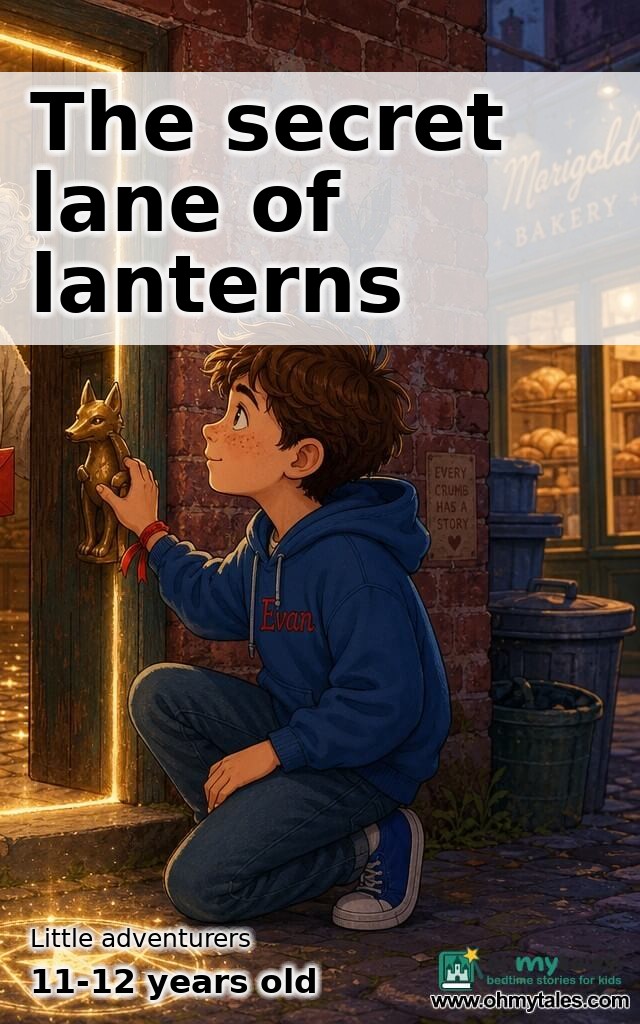
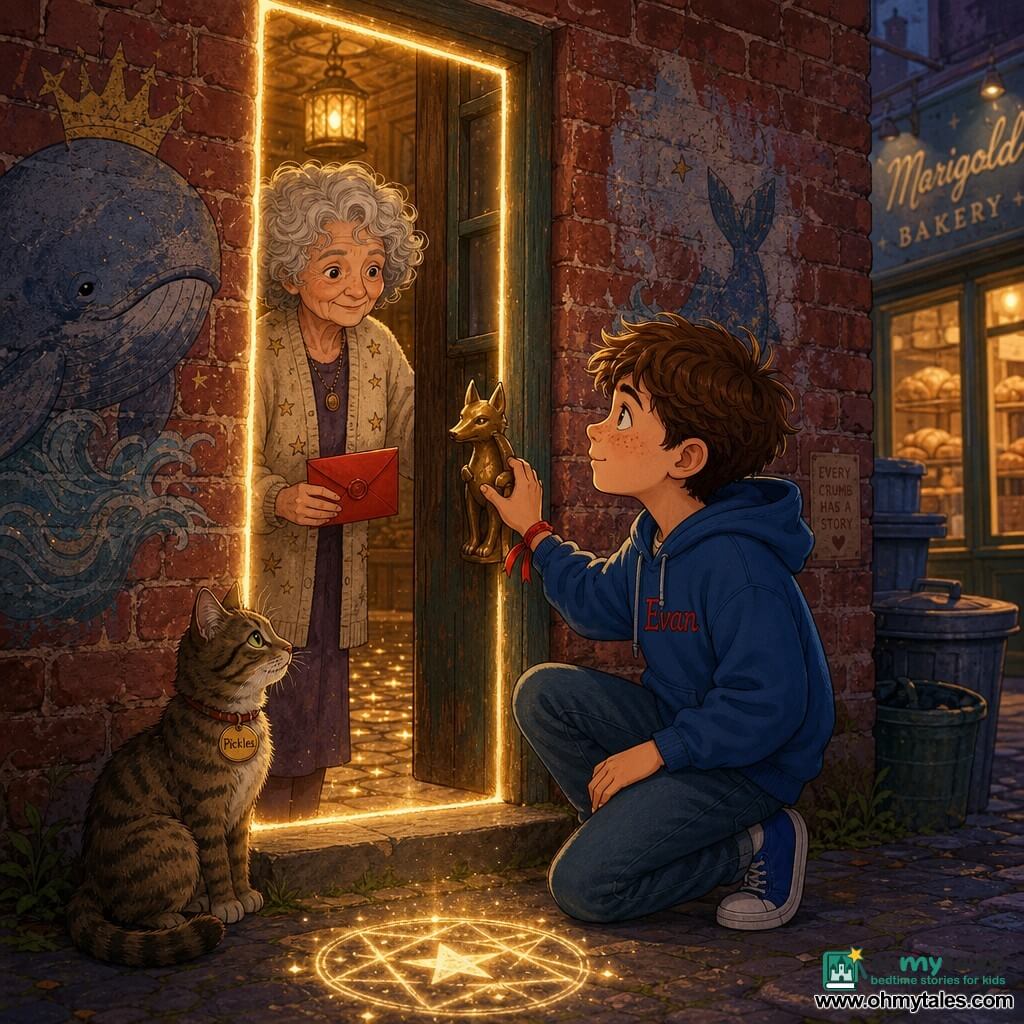
Instead, it was a blank brick wall behind a bakery, with three trash bins and a fading mural of a whale wearing a crown.
Leo stood there, hands on hips. “Alright. Which one of you is the secret?”
Pickles, unfortunately, was not here to offer her expert opinion.
Leo took out the chalk and drew the circle-star on the ground.
It lit up and floated—actually floated—up the wall, stopping at a spot between two bricks that looked… ordinary.
Leo reached out. His fingers touched cool brick.
He knocked anyway.
Tap. Tap. Tap.
For a moment, nothing happened.
Then the bricks sighed.
Yes. The wall sighed, like someone tired of pretending.
A thin line appeared, glowing softly, outlining a door shape. A doorknob formed, made of light.
Leo grabbed it.
The moment he turned the knob, the smell of bread vanished. Cool air brushed his face, carrying the scent of candle wax and night air.
The door swung open into a narrow lane lit by hanging lanterns. Real lanterns, swaying gently. The stones under Leo's feet shimmered, like they'd been sprinkled with sugar.
He stepped through.
The door clicked shut behind him.
Leo turned fast.
The brick wall was gone. Only the lane remained, stretching ahead like a secret being shared.
Windows lined the lane, glowing with warm light. A black cat sat on a doorstep, its tail curled neatly. It blinked at Leo as if he were late.
Number plaques hung beside doors: 2, 6, 9…
Leo's card said: 14 Lantern Lane.
He walked. The lanterns above hummed softly, like they were remembering a song.
At number 14, the door was painted a deep green. A brass knocker shaped like a fox held a ring in its mouth.
Leo raised his hand. His courage felt like the toy astronaut in his pocket: small, but solid.
He knocked.
The fox ring clinked gently.
A pause.
Then locks clicked—one, two, three—like careful footsteps.
The door opened.
An elderly woman stood there, short and upright, with silver curls and a cardigan covered in tiny embroidered stars. Her eyes were bright, like she'd been waiting for exactly this moment.
“You're Leo,” she said.
Leo blinked. “Yes, ma'am.”
She smiled. “And you brought it yourself. Good. Come in quickly. The lane doesn't like doors open too long.”
Leo stepped inside.
The room was cozy and cluttered, but in a comforting way. Shelves held jars of buttons, folded maps, and lanterns in every shape—round, square, moon-shaped, even one shaped like a fish.
Mrs. Winter closed the door and turned to Leo.
“Do you have the message?” she asked softly.
Leo patted his pocket.
Then he paused.
“What is it?” he asked. “And why can't I use a phone?”
Mrs. Winter's smile grew a little sad. “Phones are loud in the wrong way. They echo. This message needs a human hand. A human choice.”
Leo nodded slowly. “Okay.”
He pulled out the card and held it out.
Mrs. Winter didn't take it yet. She studied Leo's face like she was reading a weather forecast.
“You look tired,” she said.
“I'm… kind of thrilled and terrified at the same time,” Leo admitted.
“That's an honest mix.” She finally took the card. “Now, let's see what the city decided to whisper today.”
Chapter 6: The Message and the Match
Mrs. Winter broke the wax seal with her thumb. The wax didn't crumble; it softened like it had been waiting to be touched.
Inside the envelope (because yes, there was an envelope inside the envelope—this day was clearly committed to being strange) was a thin sheet of paper.
Mrs. Winter read silently.
As she read, her eyes shone more and more, like lantern light getting stronger.
When she finished, she let out a small laugh—warm and relieved.
“It worked,” she said.
Leo leaned forward. “What worked?”
Mrs. Winter folded the paper carefully and placed it in a wooden box on the table. The box had the same circle-star symbol carved into it.
Then she looked at Leo, serious now.
“The message was from my brother,” she said. “He's been traveling for years. He promised he'd come home when the city felt safe again. He needed to know if people still helped each other when no one was watching.”
Leo's cheeks warmed. “So… this was a test?”
“A question,” Mrs. Winter corrected gently. “Tests try to trap you. Questions invite you to choose.”
Leo thought about the chalk, the drain, Milo, the umbrellas. The toy astronaut in his pocket.
He swallowed. “Did I choose right?”
Mrs. Winter reached out and tapped the ribbon on his wrist. “You did. You carried something for someone else. You walked quietly. You didn't hand the message away. Those are all choices.”
Leo exhaled. “Good. Because I did not want to be yelled at by a billboard soda bottle again.”
Mrs. Winter laughed, a bright sound like a bell. “Oh, they can be very dramatic.”
She opened a drawer and pulled out a small matchbox. It was painted with tiny lanterns. She set it in Leo's palm.
“What's this?” Leo asked.
“A Lantern Match,” she said. “If you ever feel lost—truly lost—strike one. It won't start a fire. It will start a path.”
Leo turned the matchbox over. On the bottom were the words:
FOR RETURN TRIPS ONLY.
He looked up. “Return trips?”
Mrs. Winter tilted her head. “Adventures rarely end in one day. They pause. Like a book you close to sleep.”
Leo smiled, feeling something settle inside him, steady and proud.
Then the ribbon on his wrist tugged gently, like a tiny hand pulling.
“Oh!” Leo said. “I promised to return something.”
Mrs. Winter nodded approvingly. “Go. Deliver the small thing, too. Generosity is a lantern. It keeps glowing when you share it.”
Leo slipped the matchbox into his pocket next to the chalk. He stood.
“Thank you,” he said.
Mrs. Winter opened the door. The lantern-lit lane waited, quiet and kind.
As Leo stepped out, she called after him, “Leo?”
He turned.
Her eyes crinkled at the corners. “Come back when you're curious again. Lantern Lane likes curious children.”
Leo nodded. “I will.”
And he meant it.
Chapter 7: The Lost Astronaut
Finding Birch Avenue was easy. The city was back to looking normal, but Leo noticed the small clues now: a corner that seemed to wink, a gust of wind that nudged him right instead of left.
The ribbon tugged again as he turned onto Birch.
It wasn't a strong pull. Just steady, like a compass with feelings.
Near a small apartment building, a little boy sat on the steps, shoulders slumped. He looked about six. His mom stood nearby, talking to a neighbor with worry in her voice.
The boy stared at the sidewalk like it had personally offended him.
Leo approached slowly, holding the toy astronaut out in his open palm like it was a peace offering.
“Hi,” Leo said. “Is this… yours?”
The boy's head snapped up.
His eyes widened. “Captain Zoom!”
He grabbed the astronaut so gently it made Leo's throat tighten. Like the toy was fragile in a way plastic shouldn't be.
“I lost him,” the boy whispered. “I thought he fell into the… the street monster.”
Leo crouched. “The storm drain?”
The boy nodded solemnly. “It eats stuff.”
Leo thought about the whispering pages under the drain and decided not to argue. “Well, Captain Zoom is tough. He made it back.”
The boy hugged the astronaut to his chest. The tightness in his face loosened, like a knot untying.
His mom noticed and hurried over. “Oh! Where did you find that?”
Leo scratched the back of his neck. “Uh… he was on an adventure.”
The mom smiled, relief pouring out of her like sunlight. “Thank you. Really.”
Leo shrugged, trying to act like this happened every day. “No problem.”
But inside, something bright flickered—like a lantern being lit.
As Leo walked away, the ribbon on his wrist relaxed. The knot felt lighter, like it was satisfied.
Leo checked the time and started jogging home.
He still had to show up for lunch, pretend he'd returned a book, and maybe locate his other sock.
But now, in his pocket, he carried chalk that could glow, a matchbox for return trips, and the memory of a secret lane full of lanterns.
And the city, for the first time, felt less like it was listening to catch him…
…and more like it was listening to cheer him on.
On the next corner, Leo glanced back, half-expecting to see an umbrella bridge or a door made of light.
He saw only ordinary street and sky.
Still, he smiled.
Because he knew where to knock.
And he knew he'd be back soon.
Come back with him next time.