Chapter 1 — The Pebble Mission
On Saturday morning, Milo's house felt too quiet. The kind of quiet that makes your feet look for trouble.
He was eleven, small for his age, and fast in a way that made his mom say, “Please don't sprint indoors like a startled rabbit.”
Milo stood at the kitchen window with a bowl of cereal that had gone soggy. Outside, the sky was bright. The neighborhood path behind their building curved toward the old community garden, then disappeared into a strip of trees.
He had walked that path a hundred times. Still, it always seemed to change. A new puddle. A fallen branch. A slippery patch of mud that tried to steal your shoes.
On the table lay a note from Mrs. Dalloway, the garden coordinator. She wrote in neat, bossy letters:
MILO — If you can, please mark the safest route to the garden today. The kids' group comes tomorrow. Use pebbles. Keep it simple. Thank you.
Milo read it twice. Mark the route. Like a secret trail in a jungle, except the jungle was a normal path with someone's lost sock on it.
His little sister, Nora, wandered in, hugging a stuffed cat with one ear chewed flat.
“What are you staring at?” she asked.
“A mission,” Milo said.
Nora's eyes widened. “Is it dangerous?”
“Only if you're a pebble,” Milo said. “I'm going to make a pebble road. So people don't get lost.”
Nora leaned closer to the note. “Can I come?”
Milo imagined tomorrow's kids. Some would rush. Some would whine. Some would wander off chasing a butterfly and never return until lunch. The route had to be obvious. It had to be safe.
He breathed in. He wanted to do it right. On his own.
“Not today,” he said gently. “But you can help me pick pebbles.”
That earned him a serious nod, like she was being promoted to Assistant Pebble Manager.
They filled an old backpack with stones from the yard—smooth gray ones, bright white ones, and one that looked like a tiny potato.
Milo held up the potato-stone.
Nora giggled. “It's you.”
“It is not,” Milo said, but he put it in anyway.
He slung on the backpack. It clinked like a pocket full of tiny drums. At the door, his mom called, “Stay where I can call you!”
Milo saluted with two fingers. “Yes, Captain Mom.”
He stepped outside, and the everyday world clicked into a different gear. The air smelled like cut grass and sun-warmed sidewalk. A sparrow hopped near the curb as if it had an appointment.
Milo tightened his straps. His mission was simple.
Mark a route of pebbles.
Simple things, he had learned, could still surprise you.
Chapter 2 — The First Markers
Behind the building, the path began between two hedges. Milo knelt and placed the first three pebbles in a neat arrow shape.
He sat back. They looked… tiny.
“Okay,” he told himself. “We need a pattern. Something that says: This way, humans.”
He decided on clusters of five stones every few steps, like little constellations on the ground. If someone missed one, they would find the next. If the path turned, he'd make a bigger cluster.
Milo walked, counted, and dropped pebbles. Five. Five. Five.
The backpack got lighter. His confidence got heavier, in a good way.
At the corner where the path split—one way toward the garden, the other toward the busy road—he made a bold sign: a circle of white stones with a single dark stone pointing left.
He smiled. “That's practically professional.”
A dog barked behind a fence. Milo jumped, then laughed at himself.
“Nice try,” he told the dog. “I'm not quitting because you have opinions.”
As he went on, the trees thickened. Their leaves flickered in the breeze like they were whispering to each other. The path narrowed. A puddle sprawled across it, wide and brown, with a slick shine.
Milo crouched and poked it with a stick. The stick sank like it was being swallowed.
“Great,” he muttered. “Mud soup.”
He could mark a detour, but the sides were prickly with nettles. People would avoid nettles like they were tiny green villains.
Milo took a slow breath. Curiosity, he reminded himself, was just courage wearing a thinking cap.
He scanned the ground. A line of flat stones lay half-buried near the puddle's edge, like stepping-stones someone had forgotten.
He tested one with his shoe. It held.
“Hello,” he said to the stones. “You and I are now a bridge.”
He arranged his spare pebbles to lead people to the stepping-stones, then across, then back to the path. He made the clusters extra big.
Five became eight. Eight became ten.
“Even sleepy adults can't miss that,” he said.
A sudden gust shook the trees. A shower of leaves pattered down. One leaf landed on his nose and made him sneeze.
“Bless me,” Milo said, because no one else was there.
He continued, feeling a little like an explorer. The garden was still ahead, but already the ordinary path had turned into a puzzle he could solve.
Then, around the next bend, he found the obstacle that didn't care about puzzles.
A fallen tree lay across the trail.
It wasn't huge, but it was big enough to block the way, branches tangled like a giant's messy hair.
Milo stopped. His backpack clinked softly, as if the pebbles were nervous.
He swallowed. “All right,” he told the tree. “What's your plan here?”
The tree, of course, had no answer.
So Milo had to make one.
Chapter 3 — The Tree That Wouldn't Move
Milo tried the obvious first. He pushed the trunk with both hands. It didn't budge.
He tried the less obvious. He shoved with his shoulder like a tiny bulldozer. The tree stayed smugly put.
He stepped back and wiped his forehead. “Okay. You win at being heavy.”
The branches were thick, with sharp little stubs where twigs had snapped. Going over it would mean climbing, and tomorrow the kids would be wearing sneakers that slipped and confidence that vanished fast.
Going under was possible, but low. Someone would crawl through and come out with a leaf stuck to their face. Funny, yes. Safe, maybe not.
Milo searched for another route. The ground off the path was uneven and dotted with roots. There were also nettles again, waiting like they had been hired.
He set his backpack down and paced. His brain felt like it was sorting through a drawer full of random objects: string, marbles, old receipts.
Then he remembered something his granddad said while fixing a wobbly chair: “If you can't move the problem, move the path.”
Milo looked at the tree, then at the land beside it. A narrow strip of clear ground slipped between two bushes. It was tight, but it existed.
He crouched and inspected it. No nettles. No big holes. Just a few roots and one rock that looked like it was pouting.
He grinned. “New path, coming up.”
He used a fallen branch like a broom to sweep away crunchy sticks. He rolled the pouting rock aside. He tested the strip by walking it twice, carefully, like he was checking ice.
Then he began marking.
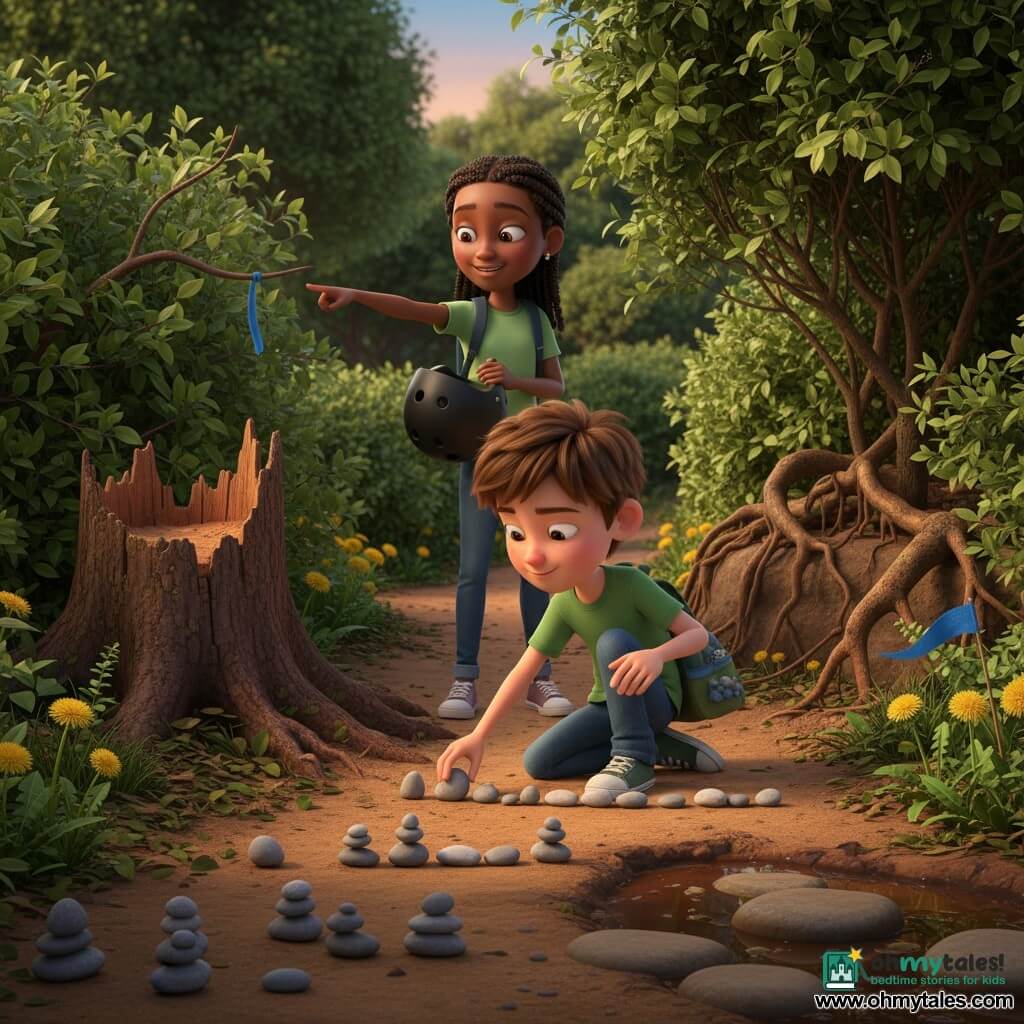
He placed pebbles in a strong line that curved off the main trail, threaded through the bushes, and returned to the path on the other side of the tree. At the entry and exit points, he made huge clusters—little pebble fireworks.
He stood back and examined his work.
It looked like a secret passage.
He felt proud. Also itchy, because one bush had slapped him.
“Don't get dramatic,” he told the bush. “You're part of the solution now.”
As he lifted his backpack again, a voice called, “Milo?”
He spun.
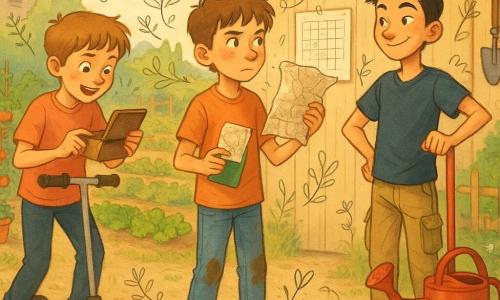
It was Jada from his building, wearing a bike helmet and pushing her scooter. She was twelve, taller than him, and always carried a notebook like she might write down the world's mistakes.
“What are you doing?” she asked.
Milo hesitated. This was his mission. His responsibility. But missions didn't have to be lonely.
“I'm marking the safe route to the community garden,” he said. “With pebbles. There's a group coming tomorrow.”
Jada's eyes followed the stones. “That's… actually smart. Like trail markers.”
“Thanks,” Milo said, trying not to look too pleased.
She pointed at the fallen tree. “Did you move it?”
“I moved the path,” Milo said.
Jada nodded slowly, impressed in a way that made her look like a judge giving a high score. “Need help?”
Milo thought of Mrs. Dalloway's note. Keep it simple. He thought of tomorrow's kids. He thought of the backpack, still heavy enough to thump.
“Yeah,” he said. “But we have rules. No messing around near the road. And we don't step on anything that stings.”
Jada raised a hand. “I swear on my scooter.”
They walked on together, the pebbles clicking softly as Milo dropped them, and Jada scouting ahead like a captain on a ship that traveled on dirt.
The path felt less scary with someone beside him. Not because he couldn't do it alone, but because teamwork made the courage last longer.
Chapter 4 — The Vanishing Trail
The trees opened near the garden fence, and sunlight splashed across the ground. Milo could already smell the garden—warm soil, mint, and something sharp like onions.
They were almost there when Jada stopped so suddenly Milo nearly walked into her helmet.
“Uh,” she said. “Problem.”
Ahead, the path dipped into a low area. It usually held a shallow stream after rain, but today it looked like someone had dumped a whole bucket of chocolate milk into it.
The usual stepping-stones were gone. Washed away. Only swirls of muddy water remained, with a few sticks drifting like tiny rafts.
Milo's stomach tightened. Tomorrow, kids would see this and either panic or run straight into it like it was a fun experiment.
He looked around. “Is there another way?”
Jada pointed to the right. “There's a narrow plank bridge. I've seen it. But it's… kind of hidden.”
Milo followed her gaze. Sure enough, half-covered by weeds, there was a wooden plank laid across the narrowest part. It looked old but steady. The problem was getting people to find it.
Milo opened his backpack and stared at the pebbles. He didn't have unlimited stones. He had to be clever with what he had.
Jada crouched near the mud and lifted a stick. “We could make arrows in the dirt.”
“They'll wash away,” Milo said.
She tapped her notebook against her knee, thinking. “What about height? Markers that aren't on the ground.”
Milo looked up. A low branch stretched over the path. Another branch leaned toward the hidden plank. He had string? No. Tape? No.
But he had something else: his brain, and a pocket full of ordinary stuff.
He patted his pockets. He found a small roll of bright blue thread from a craft kit Nora had shoved at him last week. He'd meant to return it. He never had.
He held it up like a treasure. “Nora's thread.”
Jada's eyebrows rose. “You carry thread?”
“It's a long story,” Milo said. “And it's embarrassing.”
“Perfect,” Jada said. “Use it.”
Milo tied a short length of thread to the low branch near the muddy dip. It fluttered in the breeze like a tiny flag. Then he tied another to the branch pointing toward the hidden plank. He added a third near the plank itself.
From a distance, the flags made a clear, bright trail above the ground.
Milo placed pebbles too, but fewer. A line that guided your feet while the flags guided your eyes.
He tested it by walking away and returning. The route was obvious now, like the path was winking at you.
Jada grinned. “Not bad, Pebble Captain.”
Milo laughed. “Don't say that. It sounds like a superhero who fights gravel.”
They crossed the plank carefully. The wood creaked, but it held.
On the other side, Milo exhaled. He hadn't noticed he was holding his breath.
The garden gate came into view, painted green and peeling. On it was a sign: COMMUNITY GARDEN — PLEASE SHUT THE GATE (THE RABBITS CAN READ).
Milo nudged Jada. “Do you think the rabbits really can read?”
Jada deadpanned. “Only the serious ones.”
They pushed through the gate. Inside, the garden was a small world of its own. Tomato plants leaned on stakes. Sunflowers turned their heads like curious giants. A scarecrow wore a scarf that looked suspiciously like someone's lost sweater.
Milo felt the warm pride of arriving. But he also knew the mission wasn't finished.
A marked route was only as good as the proof that it worked.
He needed a map.
Chapter 5 — The Map Maker's Test
Mrs. Dalloway wasn't there, but her shed was, with a padlock shaped like a grumpy face. Milo didn't need to go inside.
He sat at a picnic table. Jada sat opposite him and flipped open her notebook.
“I can draw,” she said, as if she was confessing a secret talent.
Milo pulled a folded sheet of paper from his pocket—math homework on one side, blank space on the other. “We can use this.”
“Classic,” Jada said. “Saving the world with homework.”
Milo began sketching the path from memory, but the turns tangled in his mind. The fallen tree detour. The muddy dip and the hidden plank. The pebble clusters. The blue thread flags. It was more complicated than it had seemed while walking.
Jada leaned over his paper. “Let's do it properly. We'll walk it backward and check every marker. Like a test run.”
Milo nodded. Autonomy didn't mean refusing help. It meant steering your own choices, and choosing help when it made you stronger.
They left the garden and followed Milo's pebbles back toward home.
At first, it worked perfectly. The big clusters shouted TURN HERE without using any words. The path through the bushes around the fallen tree felt like a secret corridor they owned.
Then they reached the muddy dip.
One of the blue thread flags was gone.
Milo stared at the branch. Only a frayed end remained.
“Something took it,” he said.
Jada pointed to a nearby bush. A scrap of blue thread clung to a twig, like a tiny surrender flag.
Milo frowned. “A bird?”
“Or a squirrel,” Jada said. “They love stealing things just to feel powerful.”
Milo imagined a squirrel wearing the blue thread like a belt. He almost laughed, but worry pressed in.
If one flag disappeared overnight, tomorrow's kids might miss the plank bridge. They could step into the mud. They could slip. They could panic.
Milo's throat went tight. He had promised himself he'd make it safe.
He looked at the remaining thread roll. Not much left.
Jada said quietly, “We can fix it. Use something they can't steal so easily.”
Milo scanned the ground again. He saw small stones, of course. He saw sticks. He saw a long, pale piece of bark that had peeled off a tree.
Then he saw it: a trail of dandelions near the edge, their yellow heads bright as tiny suns.
An idea popped like a lightbulb.
“Dandelion posts,” Milo said.
Jada blinked. “What?”
Milo ran to the dandelions and carefully picked a few, stems long. He stuck them upright in the soft ground beside the pebbles, like little signposts. He made a line leading toward the hidden plank.
Then he added a new pebble pattern: two tight clusters close together meant “pay attention.” He placed them before the dip, then again near the plank.
Jada watched, impressed again. “Double code. Visual and pattern.”
Milo stood back. The yellow flowers were cheerful and obvious. A squirrel might steal one, but there were plenty. And if they wilted, the pebble pattern would still speak.
Milo felt his shoulders loosen. Resilience wasn't a loud feeling. It was a quiet decision to try again.
They walked the rest of the way back, checking markers, adjusting a few, and making sure the route never drifted too close to the road.
At the split in the path, Milo reinforced his stone circle arrow. He added the potato-stone at the tip, because it made him smile.
Jada pointed at it. “Is that a potato?”
“It's a landmark,” Milo said with dignity.
When they reached the hedge near Milo's building, the last cluster of five pebbles waited like a friendly wave.
Milo looked at the whole route behind them, even though he couldn't see all of it at once. He could feel it in his mind, connected like dots.
Now he had to put it on paper.
Chapter 6 — The Copied Map
Back at Milo's kitchen table, Nora hovered like a curious bee.
“Did you fight anything?” she asked.
“A tree,” Milo said. “And mud.”
Nora gasped. “Did you win?”
“I moved the path,” Milo said again, and Nora looked satisfied, as if this was the correct heroic answer.
Jada spread her notebook open. Milo smoothed his homework-paper map and started fresh, using a pencil sharpened to a fierce point.
He drew the hedge start, the path, the split, the big stone circle arrow. He marked the fallen tree with an X and drew the detour like a loop around it. He added small dots for pebble clusters and a special symbol—two dots side by side—for the “pay attention” pattern.
For the muddy dip, he drew a wavy brown line and a little plank bridge. Beside it he drew tiny dandelions, like stars.
Jada leaned in. “Add distances. Like: ten steps to the next marker.”
Milo nodded. He added simple notes: “Five-pebble clusters every few steps.” “Big cluster at turns.” “Avoid nettles.” “Use stepping-stones if dry.” “Use plank bridge if wet.”
Nora tugged Milo's sleeve. “Can I draw a rabbit that can read?”
Milo looked at Jada. Jada shrugged, solemn. “For accuracy.”
So Nora drew a small rabbit near the garden gate, holding a tiny book. It looked proud.
When the map was done, Milo stared at it. It was clear. It was practical. It was also kind of wonderful, like a secret made visible.
But Mrs. Dalloway's note echoed in his head. The kids' group comes tomorrow.
One map wasn't enough.
Milo opened a drawer and found a stack of plain paper. He placed one sheet beside the finished map.
“I'm going to copy it,” he said.
Jada nodded. “Smart. Backups.”
Milo copied the map once, slowly, carefully. Then again, faster. He kept the key symbols the same each time. He made sure the potato-stone landmark stayed, because every good map needed something that made you grin.
By the third copy, his hand ached, but it was a good ache. Like he had built something real.
He slid the original map into a plastic folder. He stacked the copied maps neatly.
His mom walked in and paused at the sight: two kids, papers everywhere, a rabbit drawing, and a trail plan detailed enough for a small expedition.
She raised an eyebrow. “So. How was your ‘walk'?”
Milo sat a little straighter. “Productive.”
Jada stood up. “Route is marked. Obstacles solved. Maps created.”
Milo's mom looked at the copied maps. Her expression softened. “I like the part where you planned for tomorrow instead of just hoping.”
Milo felt warm. That was the part he was proudest of too.
Later, when Jada left, Milo carried the folder to his room. He placed it on his desk like it was a treasure chest.
Outside, the evening light turned the sidewalks golden. Somewhere, a dog barked again, probably still sharing its opinions.
Milo lay on his bed, tired in the best way. He had taken something ordinary—a path he'd walked a hundred times—and turned it into an adventure with signs, codes, and kindness.
Tomorrow, kids would follow his pebbles and his patterns. They would reach the garden without getting lost or stuck. They would feel brave, even if they didn't know why.
And Milo would know.
Because he had done the mission.
He had marked the route of pebbles.
And he had ended with a map—copied, ready, and shared.