Chapter 1: The Ordinary Hallway
Twelve-year-old Milo liked routines. He liked the click of the apartment door, the smell of toast, the steady hum of the elevator. Routines were like handrails for the day.
But Milo also liked being ready.
He had a small notebook in his backpack. On the cover, in thick black marker, it said: “SAFETY STUFF I SHOULD KNOW.”
Today, during breakfast, Milo tapped the notebook with his spoon. “Mom,” he said, trying to sound casual, “what's the most important safety thing to learn?”
His mom took a careful sip of tea. “Depends. Crossing streets safely. Knowing your address. Calling for help.”
Milo nodded. “What about… like, the big stuff?”
“The big stuff?” She raised an eyebrow. “Such as dragons?”
Milo grinned. “Like if someone is choking.”
His mom's smile faded into something softer. “That's a very good thing to want to learn,” she said. “We can ask at the community center. They sometimes have first-aid classes.”
Milo's chest warmed with pride. Then his little sister Lila slid in like a comet and stole his last piece of toast.
“Lila!” Milo protested.
“I am saving you from carbohydrates,” Lila declared, chewing loudly.
“You are nine,” Milo said. “You don't even know what that word means.”
“I saw it on a cereal box,” she said, and struck a heroic pose with crumbs on her chin.
Milo sighed, but he was smiling. Ordinary morning. Ordinary hallway. Ordinary backpack.
And then, in the elevator mirror, Milo noticed something odd.
A shiny sticker had been stuck on the corner of the mirror. It showed a tiny lighthouse with a beam of light, and beneath it, in neat letters, it said: KEEP YOUR EYES OPEN.
Milo stared at it.
Lila squinted. “It's telling you to stop daydreaming,” she said.
Milo reached out and peeled the sticker. It came off easily, as if it had been waiting for him. On the back was a simple map drawn in blue ink.
It was a map of their building.
And someone had drawn a dotted path leading to the basement.
Milo's heart beat faster, not with fear exactly, but with that sharp sparkle of curiosity that made the world feel bigger. He slid the map into his notebook.
“Come on,” he told Lila, “we're going to school.”
“Are we going to the basement first?” Lila asked, eyes shining.
“We are absolutely not,” Milo said quickly.
He paused.
Then he added, “Not right now.”
The elevator dinged. The doors slid open.
Milo stepped out, feeling the day tilt, just a little, as if the ordinary hallway had become the edge of a cliff.
Chapter 2: The Basement Door
After school, Milo tried to act normal. He did his homework. He fed their grumpy goldfish, Captain Blub. He listened to Lila explain—at length—how she would train squirrels to deliver messages.
But the map kept tugging at him like a loose thread.
When Mom started a video call with Aunt Nia, Milo whispered to Lila, “Basement. Five minutes. Quiet feet.”
Lila's grin was immediate and dangerous. “Adventure feet,” she whispered back.
They slipped out. The hallway lights flickered like sleepy eyes. Milo held his notebook open, following the dotted path: down the back stairs, past the recycling bins, turn left at the old vending machine that never worked.
The basement smelled of dust and warm pipes. Everything echoed. Their footsteps sounded like they belonged to someone braver.
At the end of the corridor stood a door Milo had never cared about before. It was painted gray, with a sign that said: STORAGE — STAFF ONLY.
And right beneath the sign, someone had stuck another lighthouse sticker.
Milo swallowed. “Okay,” he murmured. “We look. We don't touch. If anything seems weird, we leave.”
Lila saluted. “Captain Milo, leader of cautious explorers.”
Milo tried the handle. It was locked.
Lila leaned in. “Maybe it opens with a secret word,” she said. “Like ‘carbohydrate.'”
Milo snorted. Then he noticed something: a small metal plate beside the doorframe, half hidden behind a pipe. It had a tiny slot, like something for sliding a card through.
Milo flipped the map. In the corner, there was a drawing of a hand holding a library card.
He blinked. “No way.”
He pulled his library card from his wallet. It was scratched and bent at one corner, like it had lived a busy life in his pockets.
He slid it through the slot.
There was a soft click.
Lila's mouth fell open. “You just… library-carded the door.”
Milo pushed it open slowly.
Inside was not storage. Not exactly.
It was a narrow room with shelves. But on the shelves were not boxes. There were objects, each sitting under a little label written in careful handwriting: “Compass That Points to People,” “Umbrella That Only Works Indoors,” “Whistle That Calls Lost Things.”
In the center of the room, on a table, lay a first-aid kit. Bright red. Neat. Real.
And beside it, a note.
Milo picked it up with two fingers, as if it might bite.
WELCOME, VIGILANT ONE.
IF YOU WANT TO LEARN A SAFETY GESTURE, FOLLOW THE LIGHT.
BRING A FRIEND. OPEN MINDS OPEN DOORS.
Lila whispered, “That is either the coolest thing ever… or the beginning of a horror movie.”
Milo laughed, but it came out a bit thin. “No horror movies,” he said firmly. “Just… weird basement libraries.”
He looked at the shelves again. The objects felt like jokes that had become solid.
And yet the first-aid kit sat there like a promise.
Milo's courage didn't roar. It didn't explode. It simply stood up inside him, shaky but determined.
He tucked the note into his notebook. “We're doing this,” he said.
Lila bounced. “Yes! Do we get capes?”
“No capes,” Milo said. Then he added, “Maybe… small ones.”
As he closed the door behind them, a lighthouse sticker on the inside beam caught the light from the corridor. It gleamed, bright as a wink.
Chapter 3: The Light Trail
The next lighthouse sticker appeared on the stairwell railing on the way up. Then another on the lobby bulletin board, hidden behind a flyer for “Yoga for Tired Knees.”
Milo began noticing things he had ignored for years: the squeaky step on the third floor, the smell of cinnamon from Mrs. Patel's apartment, the way the afternoon sun made the lobby tiles look like a river of pale gold.
The dotted path on the map led outside.
Milo and Lila waited until Mom finished her call, then asked permission to go to the community center courtyard.
“Stay where I can reach you,” Mom called. “And no climbing on anything you can't explain later.”
Lila muttered, “So… no dragons.”
They crossed the street carefully, Milo holding up a hand at the curb like he was stopping invisible traffic. It made Lila giggle, but Milo didn't mind. Being careful was not embarrassing. It was smart.
At the community center, another sticker sat on the water fountain: the tiny lighthouse, the beam pointing toward the side garden where nobody went except the janitor and determined pigeons.
They followed.
Behind a row of tall bushes was a small door Milo had never noticed. It was painted green and had a simple sign: MAINTENANCE.
Lila stared at it. “You're going to swipe your library card again, aren't you.”
Milo shrugged. “It worked once.”
He slid the card through a slot hidden under the handle.
Click.
“I am naming your library card ‘The Key of Knowledge,'” Lila announced.
The door opened into a narrow passageway that smelled of soil and old paint. A string of tiny lights ran along the ceiling like a trail of stars someone forgot to take down.
Milo walked slowly. He kept his shoulders relaxed, his ears open. Vigilant, not panicked. He remembered something Mom said once: “Fear is like a smoke alarm. It's useful. It's not meant to scream forever.”
At the end of the passage, the lights widened into a small room with a circle of folding chairs.
In one chair sat a woman with silver-streaked hair and bright eyes. She wore a community center badge that read: MRS. SATO — SAFETY & FIRST AID.
She looked up, as if she'd been expecting them for weeks. “Milo,” she said.
Milo froze. “How do you know my name?”
Mrs. Sato tapped the notebook in Milo's hands. “You wrote it on the cover,” she said gently. “Also, you have the face of someone who reads signs.”
Lila whispered loudly, “He reads them like they're treasure maps.”
Mrs. Sato's smile widened. “Excellent. Then you're in the right place.”
Milo held his notebook tighter. “Did you… put those stickers?”
Mrs. Sato leaned back. “Not all of them,” she said. “This building has… helpers. People who like turning the everyday into something you remember.”
Lila's eyes grew huge. “Like… secret librarians?”
“Like neighbors,” Mrs. Sato corrected, warm but firm. “Curious ones. Kind ones. Ones who want you to be safe and brave at the same time.”
Milo took a slow breath. “I want to learn what to do if someone is choking,” he said. “A safety gesture. Something that actually helps.”
Mrs. Sato nodded, serious now. “That's not a trick. That's real. And you can learn it.”
She stood and clapped her hands once. “First,” she said, “we talk. Because knowledge without wisdom is like a flashlight with no batteries.”
Lila raised a hand. “Can wisdom have stickers?”
Mrs. Sato laughed. “Sometimes.”
Milo felt something loosen inside him. The room wasn't magical in a sparkly way. It was magical in a practical way. Like a place where courage could be taught.
Chapter 4: The Signal and the Squeeze
Mrs. Sato placed a laminated poster on an easel. It showed a person holding their throat.
“This,” she said, tapping the image, “is the universal choking sign. Hands to the throat. It means: I can't breathe. I need help.”
Milo copied the gesture carefully. Hands to his throat. Clear. Simple.
Lila did it too, but added dramatic eyes and a slow fall to the floor.
“Lila,” Milo warned.
Mrs. Sato held up a hand. “Humor is allowed,” she said, “as long as we keep it respectful. Emergencies are serious, but learning can still be human.”
Lila sat up straight. “Yes, ma'am.”
Mrs. Sato continued. “If someone is choking, you must act fast. But you must also act smart. First, you ask: ‘Are you choking?' If they can cough or speak, encourage coughing. If they can't breathe, then you get help.”
Milo's pencil scratched across his notebook. He wrote in big letters: ASK. CHECK. GET HELP.
Mrs. Sato pointed to a phone icon on the poster. “You call emergency services. You tell them where you are. You stay calm. And if you are trained and it is safe, you can do back blows and abdominal thrusts. But only if you know how. We practice with a training vest and clear rules.”
Milo swallowed. The idea of pressing hard on someone's stomach sounded scary. Like he might hurt them.
Mrs. Sato must have seen his face. “Being afraid of doing it wrong means you care,” she said. “That's good. Resilience is not pretending you're fearless. It's learning anyway.”
She brought out a training vest and placed it on a mannequin. “Watch,” she said. “Five firm back blows between the shoulder blades. Then abdominal thrusts: stand behind, arms around the waist, fist above the belly button, quick inward and upward motion.”
Milo's hands tingled. He watched every move like it was a dance with strict steps.
Then Mrs. Sato offered him the vest. “Your turn,” she said.
Milo stepped forward. He could hear the buzz of the ceiling lights. He could smell the faint soap scent on the vest. He could feel Lila's eyes on him.
His heart thumped.
He did the back blows, counting softly. “One. Two. Three. Four. Five.”
“Good,” Mrs. Sato said.
Milo positioned his fist where she showed him. He hesitated.
Lila whispered, “You've got this. Captain Cautious.”
Milo almost smiled. He tightened his focus. He practiced the motion, quick and careful, not wild.
“Excellent,” Mrs. Sato said. “And you always stop when the object comes out, or the person can breathe.”
Milo released a breath he hadn't realized he was holding.
Mrs. Sato sat back down. “Now,” she said, “we talk about openness. Because you won't always know the person. They might be older, younger, from somewhere else, speaking another language. Safety doesn't belong to one type of person. It belongs to all of us.”
Milo nodded slowly. He thought about Mr. Nguyen downstairs who always smelled like garlic and laughed like a drum. Mrs. Patel with her cinnamon. Aunt Nia with her loud stories and big hugs. Different people, same need to breathe.
Mrs. Sato handed Milo a small lighthouse sticker. “For your notebook,” she said. “Not a secret one. A reminder.”
Milo stuck it on the inside cover. KEEP YOUR EYES OPEN.
Lila leaned over. “Can I have one?”
Mrs. Sato gave her a sticker too. Lila placed it on her shirt like a medal.
“I am officially a certified helper,” Lila announced.
Mrs. Sato chuckled. “You are officially a student,” she corrected.
Milo wrote the last line in his notebook with neat care: HANDS TO THROAT = CHOKING. CALL FOR HELP.
He felt taller. Not because he had grown. Because he had learned something that mattered.
Chapter 5: The Snack That Fought Back
The adventure could have ended there. A hidden room, a learned skill, a sticker on a notebook.
But life liked surprises.
On the way home, Milo and Lila stopped at the small corner shop. The bell jingled as they entered, and the smell of mixed candy and warm bread wrapped around them.
Behind the counter stood Mr. Kofi, who always wore colorful socks and told jokes that sometimes made no sense.
“Ah, my favorite explorers!” he said. “Today's special is: one joke for free with every purchase.”
Lila slapped a coin on the counter. “Two gummy worms and the best joke you've got.”
Mr. Kofi leaned in, very serious. “Why did the banana go to the doctor?”
Milo guessed, “Because it wasn't peeling well?”
Mr. Kofi pointed at him like Milo had won a prize. “Exactly! You are too powerful.”
They all laughed. Milo bought a granola bar, the kind with nuts and dried fruit, because he was trying to eat like someone who might one day have to run from dragons.
Outside, they sat on a bench near the community center steps. Lila tore open her gummy worms with her teeth like a pirate. Milo bit into the granola bar.
It was crunchy. Sweet. Ordinary.
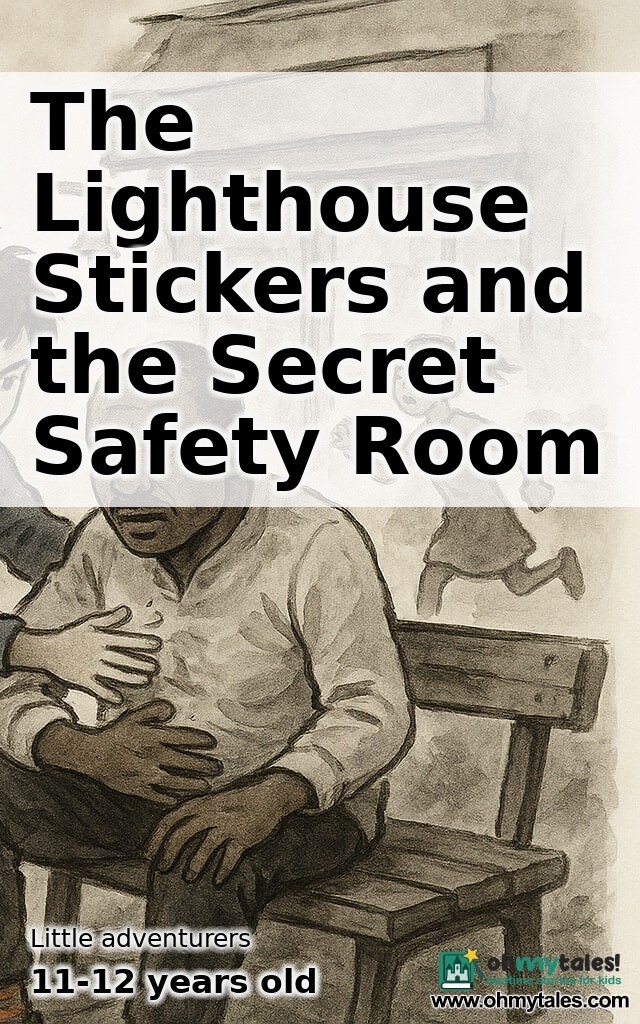
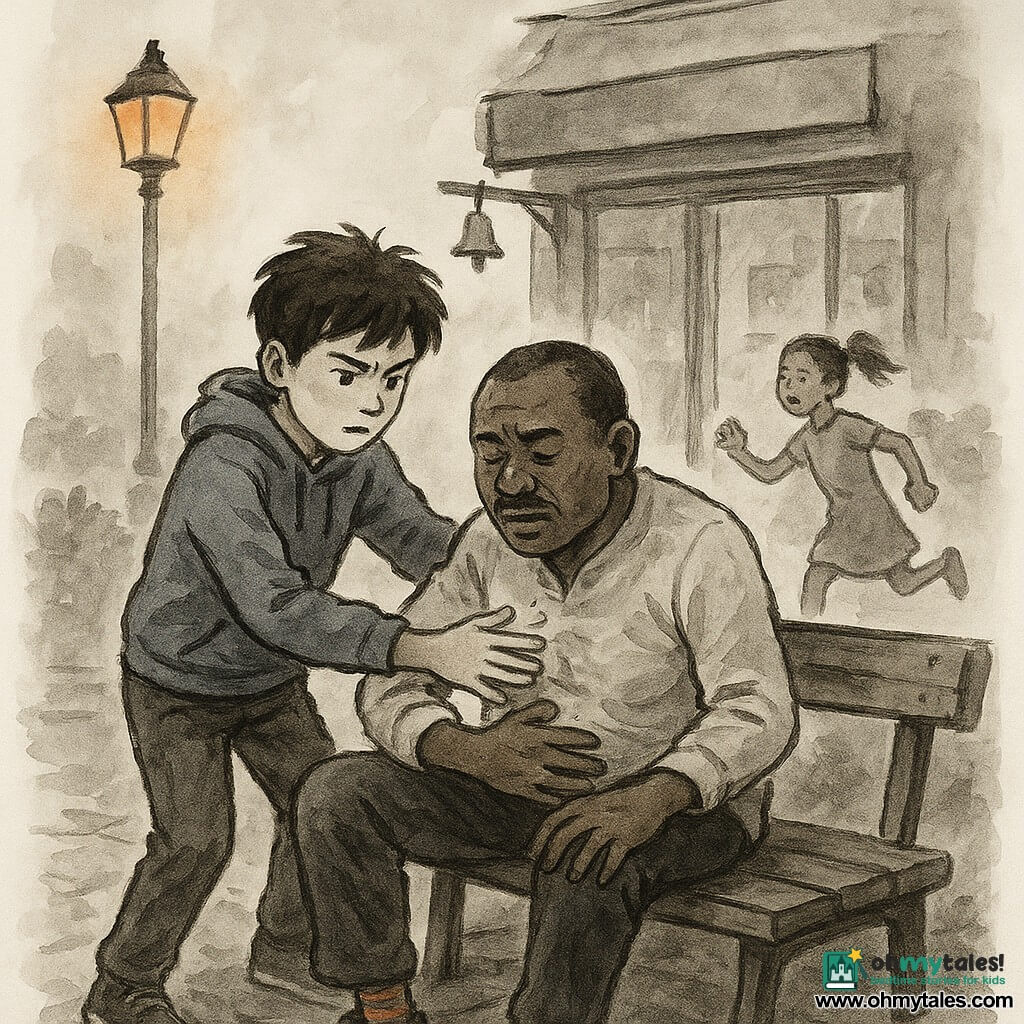
Then Mr. Kofi came out carrying a small box of deliveries. He waved and popped something into his mouth—maybe a mint. He was still smiling when his expression changed.
His hand flew to his throat.
Both hands. The choking sign.
For a second, Milo's brain went blank, like a page wiped clean. The world narrowed to one detail: Mr. Kofi's wide eyes.
Then Milo's notebook voice kicked in: ASK. CHECK. GET HELP.
Milo stood up so fast his knees knocked the bench. “Mr. Kofi!” he said, loud and clear. “Are you choking?”
Mr. Kofi nodded sharply. He couldn't speak.
Milo turned to Lila. His voice shook, but it didn't break. “Go inside. Get help. Tell them to call emergency services. Now.”
Lila didn't argue. She sprinted, ponytail flying like a banner.
Milo moved closer to Mr. Kofi. He remembered Mrs. Sato's calm hands. “Okay,” Milo said, forcing his voice steady. “I'm going to help. I'm right here.”
Mr. Kofi bent forward slightly, coughing, but nothing came out. His face was turning red.
Milo glanced around. Two adults were nearby, but they were staring like their brains had also turned into blank pages.
Milo didn't wait for the blank to fill.
He positioned Mr. Kofi leaning forward and delivered five firm back blows between the shoulder blades, counting under his breath. “One. Two. Three. Four. Five.”
On the fifth, Mr. Kofi made a harsh sound, but still no breath.
Milo stepped behind him. His hands trembled. He thought, I don't want to hurt him.
Then he thought, I don't want him to die.
He placed his fist correctly, above the belly button, just like Mrs. Sato taught. He pulled inward and upward with a quick motion.
Once.
Twice.
On the third thrust, Mr. Kofi jerked, and a small white mint shot out onto the pavement like a tiny comet.
Mr. Kofi sucked in air, loud and ragged. Then he coughed and coughed again, the kind that sounds like life returning.
Milo stumbled back, dizzy with relief. His hands were shaking like they had their own weather.
Mr. Kofi leaned on the bench, breathing. “You—” he rasped. “You saved—”
“Just breathe,” Milo said, voice wobbly. “Just keep breathing.”
Lila burst out of the shop with the cashier and another customer. “Help is coming!” she shouted, then saw Mr. Kofi breathing and froze. “Milo… did you—”
Milo nodded, speechless.
The adults nearby snapped out of their staring. One offered water. Another called out that the ambulance was on the way anyway, just to be safe.
Mr. Kofi took small sips. His eyes shone, not with tears exactly, but with something close.
“You are… very brave,” he said.
Milo swallowed. “I was scared,” he admitted.
Mr. Kofi's smile was shaky but real. “Bravery is not a lack of fear,” he said, surprising Milo with the same idea. “It is moving with fear in your pocket.”
Lila grabbed Milo's hand. She squeezed it hard, like she was anchoring him to the ground.
When the paramedics arrived, they checked Mr. Kofi and praised Milo for getting help and acting quickly. Milo answered their questions clearly. He gave their address. He described what happened. His voice steadied as he spoke.
The world widened again. The sky looked the same. The bench looked the same.
But Milo didn't feel the same.
He felt like an ordinary kid who had just done something extraordinary with ordinary knowledge.
Chapter 6: The Hand-Wave Home
That evening, Milo sat at the kitchen table with his notebook open. He wrote everything down while it was fresh: the choking sign, the steps, the importance of calling for help, the way his fear tried to freeze him.
Mom read quietly over his shoulder. Her hand rested on his back, warm and firm.
“You did exactly what you should,” she said.
Milo stared at the lighthouse sticker inside the cover. “I didn't think it would happen so fast,” he said.
Mom nodded. “It usually doesn't send a calendar invite.”
Lila climbed onto her chair and cleared her throat like she was about to give a speech. “I would like to announce,” she said, “that I, too, was brave. I ran like a gazelle.”
Milo raised an eyebrow. “You don't know what a gazelle is.”
“I saw it on a nature documentary,” Lila said, offended. “It has drama.”
Mom laughed softly. The sound filled the room like lamplight.
After dinner, Milo walked with Mom and Lila to the corner shop. Mr. Kofi was sitting outside, wrapped in a light jacket, sipping tea. He looked tired, but he smiled when he saw them.
“Milo!” he called.
Milo's cheeks warmed. He stepped closer. “Hi,” he said. “How are you feeling?”
“Like I have learned to respect mints,” Mr. Kofi said, then added more seriously, “Thank you. You kept your head. That is rare.”
Milo shrugged, awkward. “Mrs. Sato taught me.”
“Then I will thank her too,” Mr. Kofi said. He held out a small paper bag. “For you and your sister. Free gummy worms. And for you,” he added, handing Milo a small flashlight shaped like a lighthouse, “a thing that reminds you: light is useful. But so are people.”
Milo took it carefully. “Thank you,” he said.
A couple walking by glanced over. Milo noticed their different accents, their different clothes, the way they smiled politely. He found himself thinking what Mrs. Sato said: safety belongs to all of us.
Milo turned to Lila. “Next time,” he said, “we learn another skill. Maybe CPR.”
Lila's eyes went wide. “Next time,” she said, “we get capes.”
“No capes,” Milo said automatically.
Mr. Kofi lifted a finger. “Small ones,” he suggested, grinning.
Milo laughed, and the laugh felt easy.
They stayed a few minutes, talking about school and socks and how mints could be sneaky. Then Mom said it was time to go home.
Milo stood on the sidewalk. He looked at Mr. Kofi, alive and breathing and joking again.
He raised his hand.
And he waved.