Chapter 1: The Suitcase That Rattled
Maya's suitcase made a soft rattle-rattle as she walked down the hallway of Maple Street Library. It wasn't full of clothes. It was full of paper, pencils, erasers, and a little box of inks that clicked like tiny teeth.
The librarian, Mrs. Bell, whispered, “You're early. The children's corner is ready.”
Maya smiled. “Art likes a quiet start.”
She set up at a small table near a window. Outside, the evening looked like a blue blanket being pulled over the town. Inside, the lamps glowed warm and yellow, like friendly moons.
Maya opened her sketchbook. The first page was blank and brave. She took a pencil and drew a light rectangle.
“A box,” she murmured. “The first panel.”
A boy returning books stopped to stare. He had a green hoodie and a curious face.
“Are you drawing a comic?” he asked.
Maya nodded. “A silent one.”
“No words?” His eyebrows bounced.
“No words,” Maya said. “But still a story.”
He leaned closer. “How can it be a story without talking?”
Maya tapped her pencil on the paper. “That's the artist's job. To make pictures that speak quietly. Like when you see someone smile and you understand they're happy, even if they don't say it.”
The boy looked impressed, then a little worried. “What if you mess up?”
Maya chuckled softly. “Then I erase. Or I turn the mistake into something new. Artists make lots of mistakes. We just don't always call them that.”
Mrs. Bell drifted by and whispered, “The after-school group will arrive soon.”
Maya watched the empty chairs and imagined them filled with wiggling knees and listening eyes. She drew another rectangle beside the first. Then another. Three panels, like three windows.
Her silent comic was about a small lost kitten finding its way home—because everyone liked a story that ends safely.
Maya's pencil moved lightly, like a skating bird on ice. She sketched the kitten's round head in panel one. Two wide eyes. A tiny nose. A tail shaped like a question mark.
“Hello,” she whispered to it. “Let's see where you go.”
Chapter 2: The First Line and the First Lesson
The children arrived in a gust of noise: shoes squeaking, backpacks thumping, laughter popping like bubbles. Maya stood and waved.
“Hi,” she said. “I'm Maya. I draw comics.”
A girl with braids asked, “Like superheroes?”
“Sometimes,” Maya said. “Today, we're making a comic with no words at all.”
A boy made a dramatic face. “So… it's a mime comic?”
The kids giggled.
“Exactly,” Maya said. “But on paper.”
She held up her sketchbook so they could see the first panels. “This is called a page. And these are panels. Panels are like little moments trapped inside boxes.”
The kids leaned in. Maya liked that. Not because she wanted to be famous, but because she wanted them to feel welcome near art, the way you feel welcome near a campfire.
She pointed to the first panel. “Here's the kitten. What do you notice?”
“It's scared,” said one child.
“How do you know?” Maya asked.
“Big eyes,” the child answered. “And the tail looks like it's asking something.”
Maya nodded. “Artists use shapes to show feelings. Big eyes can mean surprise or worry. A tail can be a question.”
She drew panel two: the kitten standing on a sidewalk, tiny against tall buildings. Panel three: a pair of feet walking past, not noticing.
A girl frowned. “That's sad.”
Maya kept her voice gentle. “It is a little. But sad moments are part of stories. And part of making art is being honest, even when it's small honesty.”
Then her pencil made a line she didn't mean to make—an accidental scratch right across the sidewalk.
The kids went quiet.
Maya blinked at the mark. For a second, her cheeks warmed. Even after years of drawing, mistakes could still feel like stepping in a puddle with socks on.
She took her eraser and tried. The line faded but didn't vanish. A pale scar stayed.
The boy in the green hoodie—the one from earlier—whispered, “Uh-oh.”
Maya breathed out slowly. “Not uh-oh,” she said. “Uh-hmm.”
She picked up the pencil again and turned the pale line into a crack in the sidewalk. Then she added a tiny sprout pushing up from it, brave and green.
“A crack,” she said, “can become a place where something grows.”
The children's faces relaxed.
“So you didn't ruin it,” the braided girl said.
Maya smiled. “I almost did. Then I remembered: art isn't about being perfect. It's about noticing what you can do next.”
She let them each draw one small panel idea on scrap paper: a face showing a feeling, an object that tells a story, a simple action. They drew crooked smiles, flapping capes, and one very funny pancake that looked like it was crying syrup.
Maya laughed with them. “See? No competition. Just sharing. Your page doesn't need to look like mine. It needs to look like you.”
Chapter 3: A Quiet Adventure in Six Boxes
When the group left, the library became hushed again. The clock ticked like a patient little drum. Maya returned to her comic page.
She had planned six panels in a row—simple and clear, like stepping-stones.
Panel four: the kitten hears a sound. Maya drew the kitten's ears perked up, and its head tilted. No words, but you could almost hear the “huh?” in the angle of its whiskers.
Panel five: the kitten follows a trail of something familiar—little fish-shaped crackers scattered on the ground.
Maya paused. Fish crackers? She smiled to herself. That came from the snack bag she'd seen a child carrying. Artists borrowed from life all the time, like bees borrowing pollen.
Panel six: a door with a welcome mat and a window glowing like honey. The kitten sits on the mat, looking up.
Maya leaned back and studied the page. “Does it make sense?” she asked the quiet room.
Mrs. Bell answered from behind the shelves, as if she'd been waiting. “It looks like the kitten is thinking very hard.”
Maya laughed softly. “Maybe it's thinking, ‘Is this home?'”
Mrs. Bell stepped closer. “How do you show that without words?”
Maya tapped the last panel. “Body language. The kitten's shoulders—well, kitten shoulders—are raised a little. The tail is still a question. And the light in the window makes the door feel safe.”
Mrs. Bell nodded. “You make it look easy.”
Maya shook her head. “It isn't. I just practice. And I mess up a lot where nobody sees.”
Mrs. Bell looked at the page again. “That seems humble.”
Maya felt her throat tighten in a good way. “Art is bigger than me. I'm only the hands today.”
She inked the kitten carefully. Ink was less forgiving than pencil. It felt like walking on a narrow beam: exciting, but you had to pay attention.
Her hand trembled slightly. A dot of ink landed near the kitten's eye.
Maya froze.
Then she laughed under her breath. “Hello, tiny dot.”
She turned the dot into a small shining tear, just at the corner of the kitten's eye—sad, but also hopeful.
“Now it feels more real,” Mrs. Bell said quietly.
Maya nodded. “Stories are allowed to be tender.”
Outside, the night deepened. Maya's lamp made a small circle of light, and inside it, her page looked like its own little world.
Chapter 4: The Missing Panel
Maya carried her sketchbook home in her arms, like it was a sleeping cat. Her apartment was small but cozy. Her desk sat by a plant that leaned toward the window as if trying to see the moon.
She made tea and set out her tools: ruler, pencil, eraser, inks, and a clean sheet of paper for the final version.
Her silent comic needed one more thing. The kitten had reached a door, but home wasn't only a place. Home was a feeling.
Maya drew six panels again, fresh and neat. She copied the best parts from the library sketch, but not exactly. Artists copied their own work all the time, but they also listened for improvements.
When she got to the last panel, she hesitated.
“What happens next?” she whispered.
She imagined a hand opening the door. Too easy. She imagined a person swooping in like a hero. Too loud.
Then she remembered the kids' faces when she turned a mistake into a sprout. They liked the small brave moment. The quiet win.
Maya drew the last panel like this: the door opens just a crack. A warm light spills out. In the light, you see a shadow of someone kneeling down. Not a full person, not a dramatic pose—just a gentle shape.
The kitten's tail straightens. Not a question anymore. A happy exclamation.
Maya added a small detail on the welcome mat: a little bowl with the same fish-shaped crackers.
She leaned back, satisfied.
But something felt missing. She stared until her eyes watered. Then she saw it: the spaces between the panels were too tight. The page felt crowded, like a room where you can't stretch your arms.
So she did the hard thing. She redrew the borders, giving each moment more breathing room.
It took time. It wasn't flashy. It was the kind of work nobody clapped for.
Her wrist ached. Her tea went cold. Still, Maya kept going.
She thought about what she wished someone had told her when she was nine: that art wasn't a race. That you didn't need permission. That a simple pencil could be a key.
When she finished, the page looked calm. The kitten's journey had room to be understood.
Maya packed the final page into a folder, careful not to smudge the ink. She wrote her name small in the corner, not like a shout, more like a quiet signature on a gift.
Chapter 5: The Night Before the Readers
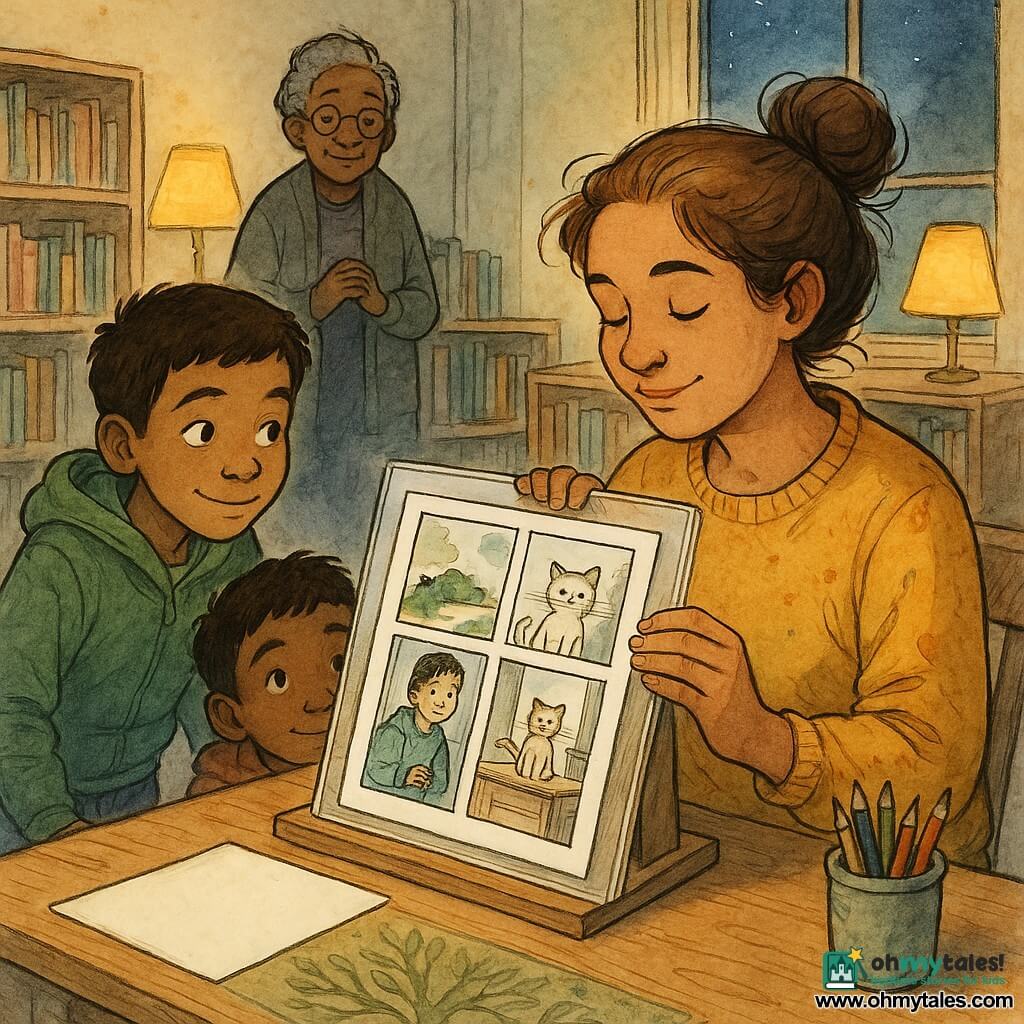
The next evening, Maya returned to the library. Mrs. Bell had prepared a small display stand near the children's corner.
Maya slid the silent comic page into a clear sleeve and set it on the stand. Underneath, Mrs. Bell placed a blank sheet and a cup of pencils.
“What's this for?” Maya asked.
“So children can make their own silent panel,” Mrs. Bell said. “If they want.”
Maya felt a warm swell in her chest. “That's perfect.”
A few kids wandered in, drawn by the page like moths to lamplight. The boy in the green hoodie was there again.
He studied the panels closely. “I get it,” he said. “The kitten doesn't say anything, but I can tell what it's thinking.”
Maya crouched beside him. “You're reading with your eyes and your heart.”
He pointed to the sprout in the sidewalk. “That's from the mistake, right?”
Maya nodded, a little embarrassed. “Yes.”
“That's my favorite part,” he said. “Because it means you don't have to be perfect to make something good.”
Maya swallowed. “Exactly.”
A younger child asked, “How do you become an artist?”
Maya considered her answer carefully, like choosing the right color.
“You become an artist by making art,” she said. “You try. You notice. You learn. You share. And you stay kind—to others and to yourself.”
The child looked serious. “Even if it's messy?”
“Especially if it's messy,” Maya said. “Messy means you're exploring.”
Later, when the library grew quiet again, Maya stood alone in front of the display. Her page sat there, peaceful and ready.
She imagined tomorrow's children. Some would rush past. Some would stop. One might smile at the kitten. One might point at the tear. Another might draw their own panel on the blank sheet—maybe a pancake crying syrup, maybe a superhero, maybe something brand new.
Maya placed a hand lightly on the edge of the stand, as if tucking the comic in for the night.
“Go on,” she whispered to the silent panels. “Do your quiet talking.”
As she walked out under the sleepy stars, she didn't feel like a famous artist or a perfect one. She felt like a helper—someone who left a small trail of pictures for others to follow.
And thinking of the next children who would discover her work, Maya's eyes softened with a gentle, grateful emotion, warm as the library lights behind her.