Chapter 1: The Paint-Splattered Morning
The sun peeked gently through the dusty window of Leo's small art studio. Leo stretched, his curly brown hair sticking out in all directions, and gazed at the jumble of brushes, pencils, and colorful tubes waiting for him on his desk. It was a new day, and Leo felt a tingling of excitement. He loved making art, but what he loved even more was sharing his creations with others.
Today, Leo had a special plan. The school nearby was holding a “Creative Day,” and he had been invited to show the children his studio. He wanted to show them how art could help express feelings—happy, sad, or even just a little bit silly.
Leo hummed as he packed his bag. He chose a sketchbook, a box of colored pencils, a set of watercolor paints, and a small lump of clay that felt cool and soft in his hand. He carefully rolled up a canvas with a half-finished painting—a swirling sea with jumping dolphins and flying birds. Finally, he tucked in a handful of paintbrushes, each with bristles shaped like tiny fans.
Just as he turned to leave, his cat, Picasso, leapt onto the table, scattering pencils everywhere. Leo laughed and scooped Picasso into his arms. “Not today, little artist! You have to guard the studio while I'm gone.”
With a smile, Leo set out, his bag of art materials bouncing against his hip, ready for the day ahead.
Chapter 2: A Rainbow of Questions
The classroom was buzzing when Leo arrived. Children clustered around him, their eyes wide as they saw his colourful bag and big, friendly smile. Miss Parker, the teacher, clapped her hands for quiet.
“Everyone, this is Mr. Leo. He's an artist, and he's come to show us the magic of making art!”
Leo set out his materials on a big wooden table. The children leaned in, curious.
“Do you paint every day?” asked a boy with freckles.
“Almost,” Leo replied. “Sometimes I use pencils or charcoal. Other days, I use paint or even clay. It depends how I feel or what I want to say.”
A girl with glasses pointed to the tubes of paint. “What are those made of? Are they like the ones we use for craft?”
Leo grinned. “Great question! These are called acrylic paints. They're made of color powder mixed with a gluey liquid. When you paint, the color sticks to the paper or canvas. Watercolors, like these,”—he shook a small box—“are different. They mix with water to make soft, flowing colors, like puddles after rain.”
Another child, shy and quiet, touched the lump of clay. “Is it like playdough?”
“It's a bit like playdough, but artists' clay can be shaped and carved, then baked hard like a stone,” Leo explained. “I use it when I want to make something I can hold, like a tiny animal or a bowl.”
The children oohed and aahed, their hands itching to try everything. Leo's heart felt warm. He remembered how he'd felt as a child, amazed by all the ways to create.
Chapter 3: The Art of Feelings
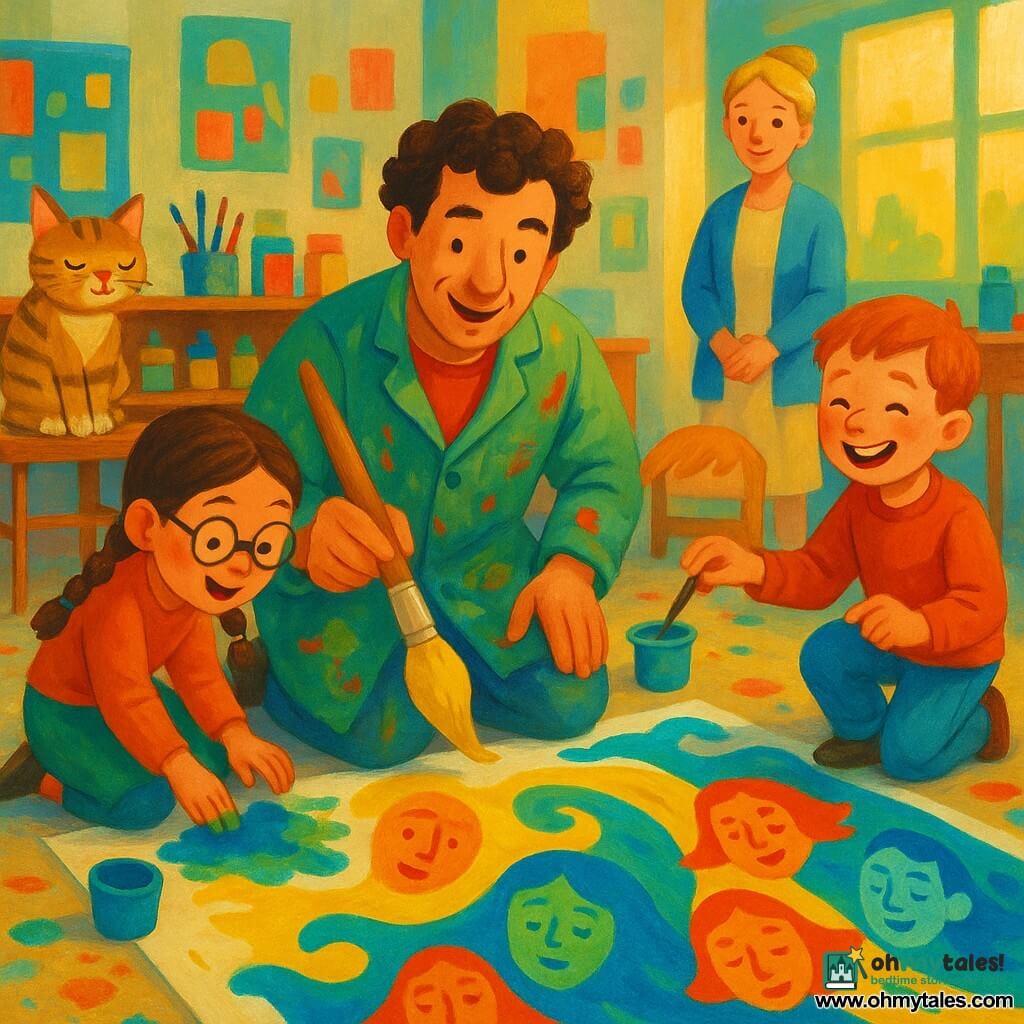
Leo wanted the children to see that art wasn't just about making pretty pictures. He found a big piece of paper and laid it on the floor.
“Let's make a feelings mural together,” he said. “Art can show how we feel inside. If you're excited, you might use bright yellow. If you're sad, maybe a gentle blue. If you're angry—what color would that be?”
“Red!” called out one boy.
Leo nodded. “Exactly! Let's use colors, shapes, and lines to show different feelings.”
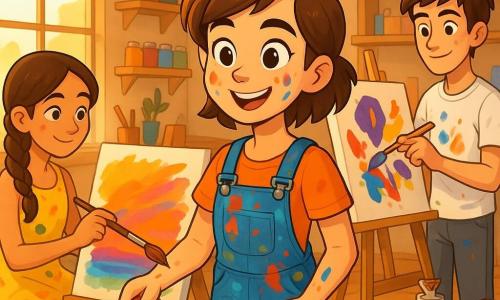
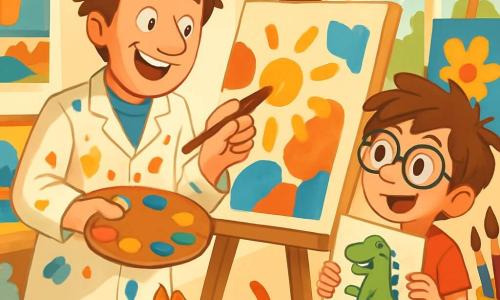
The children grabbed brushes and pencils, dipping them into colors and swirling them onto the paper. Some painted zigzags and swirls, others drew big smiley faces or wobbly shapes. Leo moved around, helping them blend colors or showing how to press harder or softer for different effects.
One girl looked frustrated. “My green won't stay inside the lines,” she said.
Leo smiled. “That's okay. Art isn't about being perfect. Sometimes, the best surprises happen when things don't go as planned. Look—your green mixed with the blue, and it made a new shade! Art is full of happy accidents.”
As the mural grew, laughter filled the room. Some children even started painting with their fingers, making funny patterns. Leo felt a bubble of happiness. He saw how each child's art was different, just like their feelings.
Chapter 4: The Great Atelier Tour
After the mural, Leo invited the children to his studio. They walked through the quiet street, chattering and guessing what they'd see.
Inside the studio, the children gazed around in wonder. Canvases leaned against the walls, some painted with bright colors, others with mysterious shadows. Jars of brushes stood like flower bouquets. Shelves were stacked with sketchbooks, bits of wood, small sculptures, and even a box of shiny buttons.
“Is this where you work every day?” asked a boy, spinning slowly to take it all in.
“Yes,” said Leo. “This is my special place. Here, I can try new things, make mistakes, and start again if I need to.”
A girl pointed to a table covered in colored pencils and scraps of paper. “Do artists use lots of different materials?”
“They do,” Leo replied. “Sometimes I mix things together—like gluing paper on a painting, or scratching the surface with a stick to make textures. If you look closely at this painting,” he said, showing them his seascape, “you'll see I used both brushes and a sponge. The sponge made the foamy waves.”
Another child found a little sculpture of a cat. “Did you make this, too?”
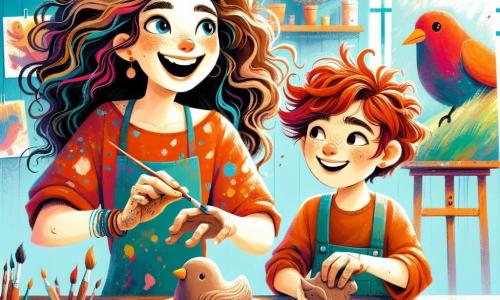
“I did. I used clay, then painted it. Sometimes, when I don't know what to make, I just play with the materials. Art can come from play.”
The children explored, touching the brushes gently, flipping through sketchbooks, and asking a hundred questions. Leo answered every one, happy to share his world.
Chapter 5: Making Magic Together
Leo set up a table with big sheets of paper and a pile of art supplies. “Now, it's your turn,” he said. “Let's create something together.”
The children split into groups. Some decided to draw a giant forest, others a city full of towering buildings. One group wanted to make animals out of clay. Leo moved from table to table, offering tips and encouragement.
He showed one group how to blend colors to make new shades. He helped another roll clay into coils to build a snake. He reminded everyone that it was okay to get messy, to try again, to laugh if things didn't work out the first time.
As they worked, the room filled with the soft sounds of pencils scratching and brushes swishing. Sometimes, someone would giggle, or let out a surprised “Wow!” when two colors mixed just right.
When the timer rang, the children stepped back. The tables were covered in bright forests, wild animals, and swirling colors. The clay animals looked a bit wobbly, but everyone agreed they were wonderful.
Miss Parker clapped her hands. “Look what you made—together! Art is even more fun when we share and create as a team.”
Leo nodded, feeling proud. “That's the magic of art. It brings people together and lets us show who we are.”
Chapter 6: A Place to Call Home
As the sun dipped low, the children said their goodbyes and left, their hands full of drawings and tiny clay creations. Leo walked slowly back to his studio, his bag now almost empty but his heart full.
He opened the door and felt the familiar smell of paint and paper. Picasso purred and wound around his legs. Leo looked around at his colorful, messy, wonderful studio.
He saw the corner by the window, where sunlight fell onto his big worktable. He saw his old, splattered apron hanging on a hook. He saw brushes, pencils, paints, and all the things that helped him share his feelings and ideas.
Leo set his bag down, tidied the table, and sat for a moment, listening to the quiet. He thought of the children, their laughter, and their bright, eager faces.
He smiled, feeling peaceful and proud. He looked at his messy corner and whispered, “This is home.”
And in that cozy corner, surrounded by colors and dreams, Leo knew that art would always be his way to bring joy, to himself and to everyone around him.