Chapter 1: The Soft-Echo Room
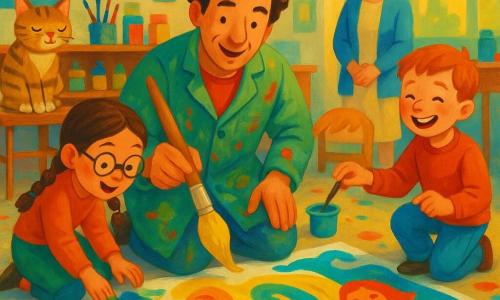
Theo Bright unlocked a low blue door and the children hummed behind him. The room smelled like warm paper and damp paint. Light bounced off a row of hanging lamps that winked like sleepy stars. Theo smiled. He was young and calm. His hair looked like a brush stroke. He waved them in.
“Welcome to the Soft-Echo Room,” he said. “This is where things try out their voices.”
The group sat on soft rugs. Theo showed them tools: tiny brushes, thick rollers, strings, tape, a stack of old cardboard, and a tray of soft clay. “Art isn't only painting,” he said. “It's listening. It's trying. It's looking after what we make.”
A girl named Mina touched the clay. “Is it magic?” she asked.
“Partly,” Theo said. “But mostly it's patience and care.” He tapped a small bell. The sound stretched and came back like a warm blanket. “Every sound, every mark, every light matters.”
Chapter 2: The Plan and the Problem
Theo explained the big idea. They would prepare a short show for the school. It would be gentle—walking images, tiny sounds, and lights that blinked like slow heartbeats. Each child would help create one thing.
They divided tasks. Luis tended the clay creatures. Mina painted moving leaves. Sara wove threads for curtains. Theo fixed the lights and drew plans on the floor with chalk.
They worked for an hour. The room filled with soft noises: brushes, whispers, and the scratching of pencils. Theo moved between them. He showed how to mix blue until it felt like the inside of a cloud. He taught how to press a brush lightly, like petting a cat. He wiped a tear from a spilled pot of ink and laughed. “Mistakes are marks, too. We learn from them.”
Just as they were about to test the first scene, a loud pop echoed. One lamp went out. The wires had frayed. Darkness sighed across the room like a blanket.
“No!” whispered Luis.
Theo crouched by the lamp. “We need to be careful,” he said. He felt the fragile filament like a tiny spine. It was easy to panic. He breathed in slowly. “Art is patient,” he told them, “and so are we.”
Chapter 3: Fixing and Learning
Theo brought a small kit and taught the children to problem-solve. He showed how to unplug the lamp, how to check a wire, how to make a safe repair. The children watched closely. Theo spoke simply. “First, notice. Then, consider. Then, try.”
Mina held the flashlight. “What if it breaks again?” she asked.
“Then we try another way,” Theo said. “The show can shine even with a different light.”
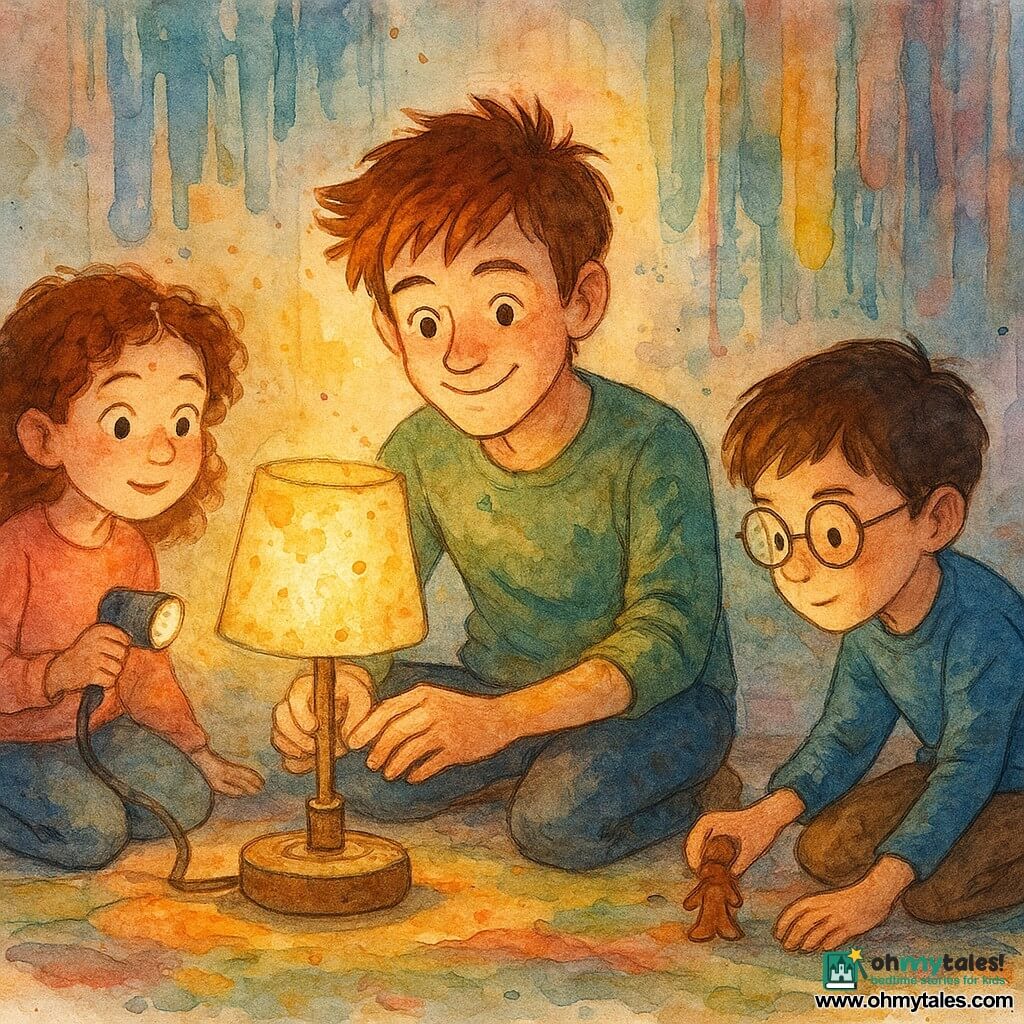
They taped the wires carefully. They fashioned a shade from cardboard and silver foil. Luis suggested using a jar with twinkling stickers. Sara added threads that reflected the beam. Together they built a new fixture that looked like a small moon on a stick.
They tested the light. It was soft and warm. It made the clay creatures look like they were breathing. The children clapped, not loud, but like tiny drums. Theo felt proud, but he kept his voice gentle. “Well done. You were patient and kind to your tools.”
Chapter 4: The Dress Rehearsal
Rehearsal day felt like a quiet festival. The children set the stage: a patchwork of rugs, a cardboard tree, a line of painted pebbles as a path. Theo taught them how to move slowly so the lights could follow. “Art asks for attention,” he said. “It asks us to listen and to wait.”
They practiced cues. Mina pulled a thread and leaves fluttered. Luis rolled a clay creature along the pebble path. Sara adjusted the curtain. Theo stood by the lamps and nodded.
Then a new problem arrived. A sudden drip from the roof landed on the painted leaves. The children froze. The leaf's paint blurred into soft streaks.
“How sad,” Sara whispered.
Theo wiped the water with a towel. He breathed out. “It's a chance,” he said. “Sometimes rain gives us a surprise.”
The children gathered the wet leaves and pressed them flat to dry. They liked the new streaks. Mina pointed. “It looks like a river now.” They rearranged the scene. The dripping made a new idea. The show felt more honest because of it.
Chapter 5: The Night of the Small Show
Parents came in like gentle visitors. They sat on cushions and looked curious. The Soft-Echo Room glowed. Theo walked them through, softly. He did not perform alone. He let the children lead, one by one.
“Watch,” he whispered to the crowd. “This is the work of patient hands.”
The show began. Mina's leaves fluttered into a pretend breeze. Luis's clay creature stopped by the shining jar and nodded. Sara's thread curtain shivered. The new lamp cast a soft halo. The audience listened to the tiny bell that began and ended the piece. No one shouted. No one rushed. Smiles grew slow and wide.
After the final bell, the room filled with quiet clapping. A father wiped his eyes. A teacher hugged each child. Theo knelt and looked at each maker. “You made it gentle and true,” he said.
Chapter 6: Afterglow and Gifts
Later, Theo and the children packed up. They labeled boxes with neat handwriting. They kept a small clay creature for the school shelf. They left the patched lamp standing by the window like a little moon.
“Will we do another show?” Mina asked.
Theo smiled. “Of course. Art keeps asking us to try. It likes when we care.”
The children walked home under street lamps that blinked like distant stage lights. Theo carried the last box. He felt tired and happy. He knew art was not a prize to win. It was a path of trying, fixing, and sharing. The children grew a little braver that night. They learned that mistakes could turn into surprises. They learned to wait and to be gentle.
At home, Theo hung a tiny note on his studio door: Be patient. Be kind. Keep trying. He turned off the lamps and listened. The room held the soft echoes of a good evening. He drifted to sleep thinking of the next small light to make blink.