Chapter One — The Quiet Kingdom
In a kingdom of soft hills and singing streams stood a library like a small moon. It sat by a stone bridge that arched over a clear ford. Trees made a green road to its door. The library's windows were like eyes that watched the sky. Inside, books slept on shelves like little ships.
Prince Emil lived in a pale castle near the bridge. He wore a cloak the color of warm bread. Emil was kind and curious. He bowed to every gardener and spoke gently to every cat. But he had a wish that surprised everyone. He wanted, very quietly, to close the library.
"Close the library?" asked the baker one morning, flour on his hands. "Why, Prince?"
Emil looked at a page of maps. He saw roads that led to brave mountains and deep forests. "Books keep us inside," he said. "I want the kingdom to learn by going out. I want children to run across fords and see the world with their own eyes."
His voice was soft. His eyes were sincere. The people loved Emil for his care. Yet the library was alive. The librarian, old Lady Mira, had hair like white reeds. She kept maps of the stars and poems that smelled like lavender. She listened when birds forgot their songs.
"I will not close the doors," she said gently. "But I will show you why books are bridges too."
Emil nodded. He loved bridges. He liked stone under his feet. He agreed to a walk by the river first. The librarian put a small key in his palm. The key was a promise, shining like a pebble.
Chapter Two — A Walk and a Question
They walked along the avenue of trees. Leaves made soft music. Children chased one another on the road. They leaped over puddles like tiny horses. Emil watched them. He saw a child fall and a friend help her up. He saw a boy find a lost hat and give it back with a bow.
"Books keep us warm when it is cold," Lady Mira said. "They keep the past so we do not lose it. They are like lanterns that light the road in fog."
"But lanterns also hide the stars," Emil replied. He gazed up at the sky. Thin clouds sailed like white ships.
They came to the stone bridge. Underneath, water hummed over round stones. A heron stood very still, tall as a tower. Emil knelt and watched the river. He thought of closing the library, of children running free, of stories shoved like coins into pockets.
"Could we learn without books?" Emil asked softly.
"Perhaps," said Lady Mira. "But sometimes books teach hands how to mend a sail or eyes how to read a map. They hold recipes for bread and songs for lullabies. They are friends that do not sleep."
Emil turned the key in his hand. It was warm from the sun. He pressed it to his heart as if feeling two roads in one palm.
A sudden wind moved the trees. A page flew from the librarian's satchel. It rose like a white bird and landed in the ford. Emil waded in to fetch it. The page had a poem. It pictured a child who crossed a bridge, not alone, but with a book tucked under her arm.
"See?" said Lady Mira. "Books travel with us. They do not keep us inside. They teach us to walk safely, to ask for help, to be brave."
Emil looked at the poem. He smiled. Yet the wish still lived inside him like a small lantern. He loved people learning by doing. He wanted children to feel the mud between their toes and know the taste of apple trees.
Chapter Three — The Little Storm
That afternoon, clouds bowed low. A little storm came to the kingdom. Rain drummed on roofs like tiny drums. The river swelled and ran fast. A path by the trees turned into a ribbon of water. A family returning from market found the road broken by a fallen branch. A small child named Lila clutched a basket of bread. Her shoes were muddy. She looked frightened.
Emil saw them from the bridge. He felt his cloak like a flag. He ran down the road. He helped the family lift their cart past the ford and under a tilted branch. He gave Lila his hand.
"Hold tight," he said. His voice was steady. He showed them where stones made a safe step. He guided them like one would guide a small boat through a swift river.
After the rain, the sky smiled. The family waved. Lila hugged Emil's knee and whispered, "When I read with my father, the rain is like a drum and the prints are like secrets. Books help me find my way."
Emil felt a warmth blossom in his chest. He saw that books were not walls. They were wings and maps and lanterns. That night he sat beneath the library's window. Moonlight painted the books silver. He opened the door and listened.
From the shelves came a quiet kind of music: whispers of old kings who once fixed bridges, of bakers who saved seeds, of sailors who mended sails. The books told of mistakes and how people learned from them. They showed how to be brave and how to say sorry. Emil thought of the key in his pocket. He thought of the children on the road. He folded his hands and made a promise like a small stone.
"I will keep the library open," he whispered. "I will also teach by walking with them. I will show the roads and mend the bridges. I will hold both lantern and map."
Chapter Four — The Gift of Stars
Days turned like pages. Emil began to go between the library and the roads. Each morning he read with children beneath the trees. He read aloud of faraway seas and small recipes for honey cakes. The words rolled over the children like sun. Each afternoon he led journeys across fords and over bridges. He taught how to watch the river and how to help a friend.
Some nights, he and Lady Mira would sit and mend torn pages. "A book that is loved," she said, "keeps giving." Emil learned to sew the seams of both books and friendships. He learned that responsibility was like tending a garden: it needed water and time.
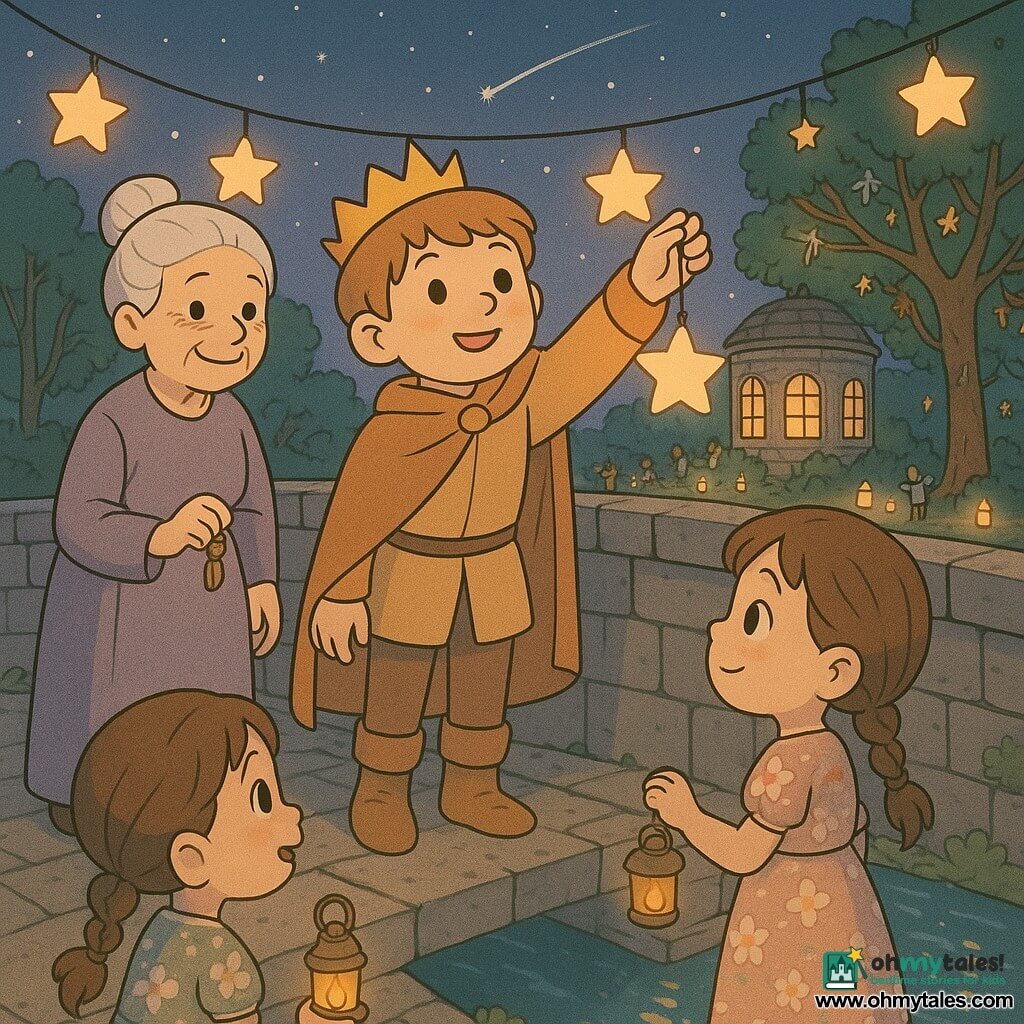
One evening, when the air smelled of wild thyme, the kingdom prepared for the Festival of Lanterns. The bridge was draped with ribbons. Children hung paper stars on the trees. The library's windows glowed like warm bread. Emil stood on the bridge and looked up.
"Prince Emil," called a little voice. It was Lila, holding a tiny lantern. "Will you help us light our stars?"
Emil reached out. He lifted each star gently, like catching a bird. He placed them on the string. Lady Mira lit a candle, then another, and the lanterns blinked awake. The ribbon road looked like a smile.
As the lanterns rose, a silver line crossed the sky. A star fell, swift and bright, like a tear of light. It painted the river with a silver stripe. The whole kingdom held its breath.
"It is a wish," whispered Lady Mira. "A moment when the sky listens."
Emil closed his eyes. He thought of the library's door and the road by the trees. He wished for a kingdom that learned with both feet and heart. He wished for children who knew how to care for books and for each other.
The star blinked once, like wink from a friend, and then sailed on. The people cheered. The children hugged their lanterns. Lila's eyes were round as moons.
Emil felt a quiet joy. He had kept his promise. He had not closed the library, but had opened wider paths. He had shown others how to be responsible. He had sewn together reading and doing, like two ribbons braided into one.
Later, as the bridge settled and the river hummed a soft lullaby, Emil put the key back in Lady Mira's hand. "Keep the door open," he said with a smile. "And I will keep the path swept."
Lady Mira touched his sleeve with a smile like warm bread. "You have become a true prince," she said. "You care for both stones and stories."
Emil watched the last lantern fade into the night. Above, the stars shone steady. Far away, a little comet wrote a thin white trail. It looked like a promise, like a kindly finger pointing toward tomorrow.
The kingdom slept. The library waited, full of whispers. The bridges and the roads rested. Responsibility lived in gentle acts: in helping a friend, in mending a page, in lighting a lantern. And for a very long time, whenever a child crossed the stone bridge or read beneath a tree, they remembered the night a star fell and the prince who learned to hold both book and road.