Part One: The Hall of Silent Harps
In the Kingdom of Larkspur, even the air seemed to listen.
The castle stood on a hill like a patient swan, white and proud, watching over valleys where mist curled like sleeping ribbons. Inside, there was a hall that visitors remembered most. It was long and bright, with tall windows and banners that moved softly, as if they were breathing.
And along both walls stood harps—dozens and dozens of them.
They were beautiful, with golden frames and carved roses, but they did not sing. Their strings were tuned, neat, and shining, yet quiet as snow.
People called it the Hall of Silent Harps.
Princess Elowen walked there each morning. She was not the kind of princess who waited for luck to knock on the door. She liked maps and small plans. She liked puzzles and careful steps. Her nurse used to say, “Your mind is a little lantern, Elowen. It finds paths.”
But lately, Princess Elowen had a wish tucked inside her like a secret letter.
She wanted to learn a name.
Not just any name. A true name.
For weeks, she had heard it in her dreams—almost. It was like hearing a song through a closed window. She would wake up with her hands open and her heart full, sure she had been close to a word that mattered.
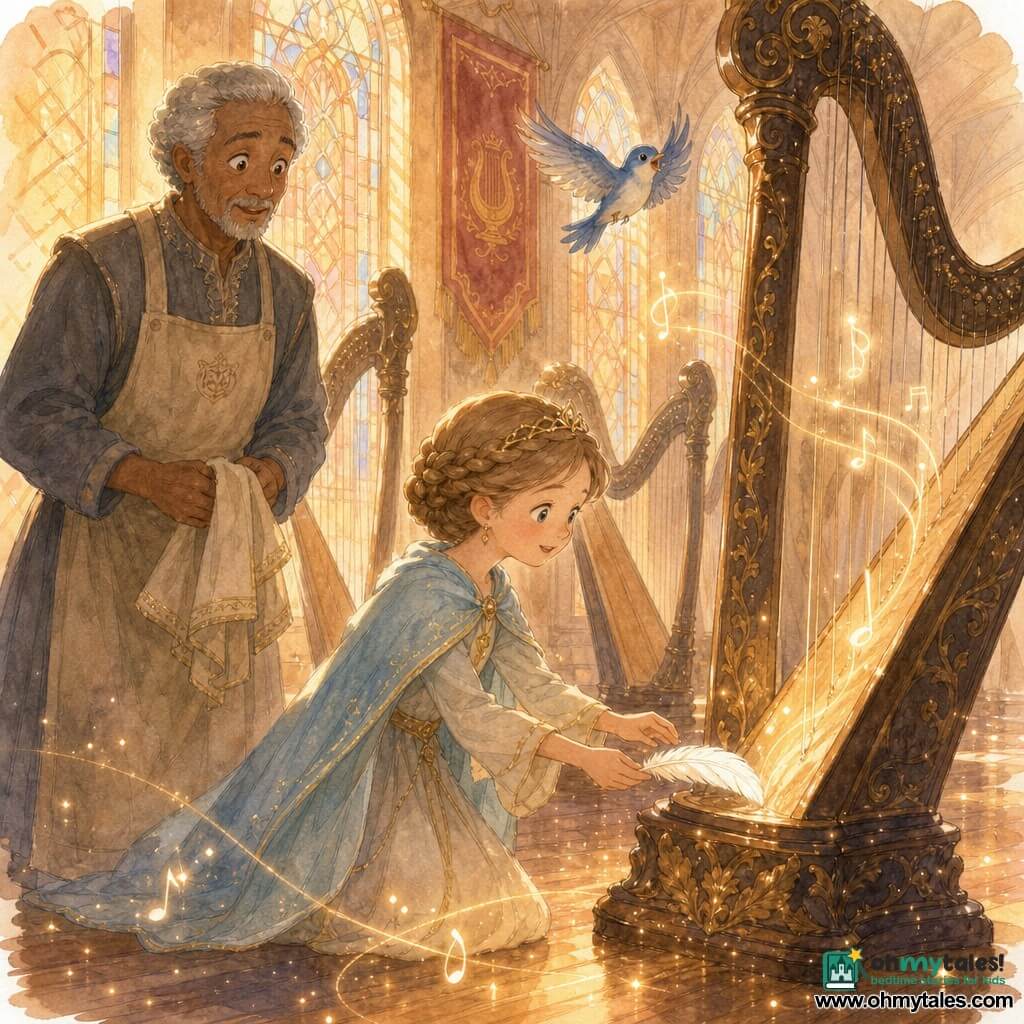
One morning, she paused beside the oldest harp of all. Its wood was darker, like honey in shadow. Its strings shimmered faintly, as if moonlight had been braided into them.
The princess leaned closer. “Why are you silent?” she whispered.
No answer came, of course. Yet the quiet felt thick, as if the hall were holding its breath.
An old steward was polishing the floor nearby. His cloth moved in circles, and each circle looked like a small, careful moon.
“The harps were not always silent,” he said gently, without looking up.
Princess Elowen turned. “Then what happened?”
The steward's eyes were kind and tired. “Long ago, our kingdom lost a name,” he said. “A name that belonged to the music itself. Without it, the harps are like birds who forget their sky.”
“A name can do that?” Elowen asked.
“A true name can,” he replied. “Names are keys. Some open doors. Some open hearts. This one opened song.”
Elowen's wish stirred like a kitten waking.
“Where is the name now?” she asked.
The steward placed his cloth in his pocket. “If we knew, Highness, the harps would already be singing.”
Princess Elowen looked down the long hall. The harps stood still, proud and quiet, like a royal guard made of wood and gold.
She felt something brave and tender rise inside her.
“Then I will find it,” she said.
She did not shout. She did not stomp. She spoke as if she were promising the hall itself.
That day, she went to the castle library, where the books smelled of dust and dried flowers. She unrolled maps that showed rivers like silver threads and forests like green blankets. She asked the court musicians, the gardeners, the cooks, the guards—anyone who might know a hint.
Some people shrugged. Some smiled kindly as if she were playing at adventure. But Princess Elowen did not mind. Perseverance, she believed, was a small drum. It did not roar. It simply kept beating.
At last she found a thin book with a faded cover: The Tales of Tuned Things.
Inside, in curly ink, she read about a place beyond the castle walls—a valley where strings were tuned by the wind, and where songs were born like baby stars.
It was called the Country of Tuned Strings.
And at the bottom of the page, someone had written a note, as if for her:
Seek the name where music begins,
where silence is not empty, but waiting.
Princess Elowen closed the book. Her plan clicked into place like a puzzle piece.
At sunrise, she packed a small satchel: bread, cheese, an apple, a ribbon for luck, and a notebook for clues. She took no crown, only a simple cloak the color of morning. She told her parents she would return before three sunsets.
The king and queen were worried, but they knew their daughter's heart was steady.
“Be wise,” said the king.
“Be kind,” said the queen, tying the ribbon around Elowen's wrist.
“I will be both,” Elowen promised.
And she stepped out of the castle, into a world that waited like a page ready for a story.
Part Two: The Country of Tuned Strings
The road from Larkspur Castle dipped and turned through fields where daisies nodded and sheep chewed in slow, thoughtful circles. Birds followed Princess Elowen for a while, hopping from fence to fence, as if curious about her quiet purpose.
By noon, the land began to change.
The trees grew taller and closer together, their leaves whispering like gossiping silk. And in that forest, Elowen heard something strange: a faint twang, like someone gently plucking an invisible string.
She stopped. The sound came again—twang—then a softer one, like a sigh.
Between two oaks, she saw it.
A bridge made of strings.
Not ropes. Not wood. Real strings—thin, shining lines stretched across a narrow stream. They trembled with every breeze. When Elowen stepped closer, the wind combed through them, and the bridge gave a tiny, sweet note, like a harp clearing its throat.
She swallowed. “So the stories were true.”
A small sign hung from a branch, painted in neat letters:
Step lightly. Listen closely.
Princess Elowen tested the first string with her boot. It held firm, strong as a promise.
She crossed slowly, arms out, careful and calm. Each step made a note. Not loud—just gentle, like a lullaby being built one brick at a time.
Halfway across, a gust of wind swirled through the trees. The strings quivered and sang out all at once, a bright splash of sound.
Elowen wobbled.
Her heart jumped, but she did not panic. She took a breath, found her balance, and lowered her steps. She remembered her nurse's words: a lantern mind finds paths.
“I can do this,” she murmured.
She reached the far side, cheeks warm with pride. Behind her, the stream ran on, sparkling as if it enjoyed the music.
Beyond the bridge, the forest opened into a wide valley. It was the Country of Tuned Strings.
Everywhere, strings stretched between poles and trees, between stones and tall posts, between little towers and old stumps. Some were thick as a finger. Some were thin as spider silk. They hummed softly, like a meadow full of bees.
And there were harps there too—smaller ones, hanging from branches like fruit. They did not play by themselves, yet the wind often brushed them, waking tiny notes that drifted away like soap bubbles.
Princess Elowen walked through the valley with careful wonder. It felt like walking inside a song that had not decided its words yet.
Soon she met someone sitting on a rock near a cluster of silver strings. It was a young harp-maker, with a cap pulled low and hands dusted with wood shavings. Their eyes were sharp and bright, like someone who notices small things.
They looked up. “Hello, traveler.”
“I am Princess Elowen of Larkspur,” she said politely. She hesitated, then added, “I have come to learn a name.”
The harp-maker's eyebrows rose. “A name? For a person?”
“For music,” Elowen said. “For the harps in my castle. They are silent. I heard the kingdom lost a true name long ago.”
The harp-maker's face softened. “Ah,” they said, as if she had spoken of a missing star. “You seek the Name of First Song.”
Elowen's stomach fluttered. “Do you know it?”
“I know how to search,” the harp-maker replied. “But it is not hiding under a stone. It is not written on a scroll. A true name is shy. It comes when you prove you will hold it gently.”
Princess Elowen nodded. That made sense. Some things did not like to be grabbed.
“How do I prove that?” she asked.
The harp-maker stood and pointed toward the center of the valley, where a circle of tall posts rose like quiet guardians. Between them, the strings were stretched very tight, gleaming like frozen sunlight.
“That is the Tuning Circle,” they said. “If you can pass through it without making the strings scream, the valley will trust you. Then the name may come nearer.”
Elowen looked at the circle. The space between the strings was narrow. It would be easy to bump them. Easy to rush and tangle.
A small twist of fear pinched her, but she smoothed it down like a wrinkle in cloth.
“I will try,” she said.
She stepped into the circle.
At first, it was like walking through tall grass—only the grass was shining and singing. The strings were everywhere, crossing and crisscrossing like a spider's careful work.
Elowen moved slowly. She lifted her feet high. She turned her shoulders sideways. She planned each step.
Then she heard a buzzing above.
A little blue bird had flown into the circle and gotten stuck between two strings. It fluttered, chirping sharply. The strings trembled. The whole circle seemed ready to ring out in a loud, angry noise.
Elowen froze.
If the strings screamed, she would fail. The valley would not trust her. The name would drift farther away.
But the bird's tiny feet were caught, and its eyes were round with fear.
Princess Elowen made her choice as quietly as a snowfall.
She eased closer, slower than ever. She held her breath so her chest would not bump the strings. With two careful fingers, she lifted the string just enough for the bird to slip free.
The bird tumbled into her palm, warm and shaking.
“It's all right,” she whispered.
The bird blinked. Then, with a quick kiss of wings, it flew out of the circle and into the open sky.
The strings stopped trembling.
In the sudden calm, the air itself seemed to smile.
Elowen continued, even more careful now, and step by step she reached the center of the circle. There, on a flat stone, lay a single white feather. It was long and bright, and it shimmered softly, like it had borrowed light from the moon.
The harp-maker's voice carried from outside the circle. “Take it. It is a token of trust.”
Elowen picked up the feather. The moment it touched her hand, she heard something—not a full word, not yet. More like a beginning. A first syllable slipping out of silence.
She closed her eyes.
The sound was gentle, like a baby's first laugh.
Still, it was not complete.
The harp-maker met her when she stepped out. “You did well,” they said. “You chose kindness over speed. That is how names come closer.”
Elowen held up the feather. “I heard a part.”
“Good,” said the harp-maker. “Now you must carry it home. The rest of the name belongs to the Hall of Silent Harps. It will bloom there.”
Princess Elowen thanked them with a bow. Then she turned toward the road back to her castle, the feather tucked safely in her notebook like a star pressed between pages.
As she walked, the valley's strings hummed behind her. It sounded like encouragement.
Part Three: The Name That Woke the Harps
The journey home felt shorter, as if the path itself were helping. Princess Elowen crossed the string-bridge again, stepping with the same gentle care. The forest whispered. The fields opened like friendly arms.
By the time the second sunset painted the sky peach and gold, she saw the castle on its hill.
It looked the same—tall and proud—yet Elowen felt different inside. She felt steadier, like a tree that has learned it can stand through wind.
She hurried through the gates and down the familiar corridors until she reached the Hall of Silent Harps.
The long windows were dim now, holding the last light of day. The harps lined the walls, quiet as ever.
But when Elowen stepped in, the air changed.
It was as if the hall recognized her satchel, her tired shoes, her brave little feather.
The steward looked up from his polishing. “You returned,” he said.
“I did,” Elowen replied. Her voice was soft, but it carried. “And I brought trust.”
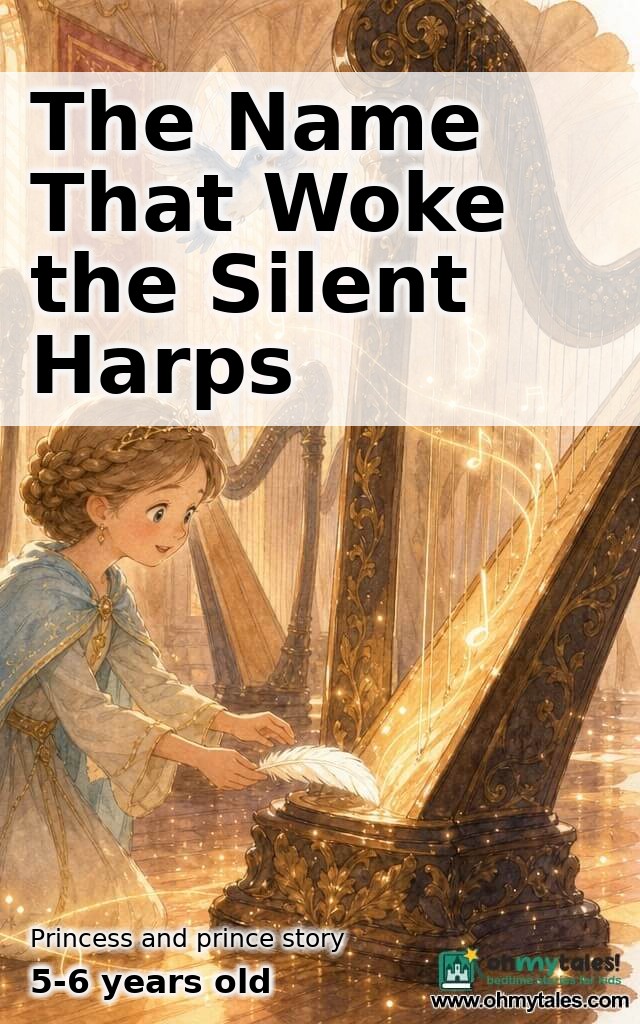
She walked to the oldest harp, the dark honey one, and opened her notebook. Carefully, she took out the white feather and laid it on the harp's base.
Nothing happened at first.
Elowen's heart fluttered, uncertain.
Then a breeze slipped in through the window crack—just a small breath of evening. It touched the feather. The feather lifted and drifted upward, brushing one string.
A single note rang out.
It was quiet, but it was real. It was like the first star appearing before the others.
Elowen's eyes widened. “Hello,” she whispered, as if greeting a shy friend.
The harp's string trembled again. Another note answered, a little brighter.
The steward stopped polishing. His mouth fell open.
Elowen stood very still. She listened the way you listen to someone who is trying hard to speak.
In the gentle ringing, the half-syllable she had heard in the valley returned. It floated in her mind like a boat on calm water. And now, in this hall, it found its other half.
The true name came together.
It did not arrive like thunder. It arrived like sunrise.
Elowen spoke it softly, as one would speak to a sleeping child.
“Serenvale,” she said.
At that word, the oldest harp sang—a clear, sweet chord that made the windows tremble with joy. Then the next harp answered, and the next, until the hall filled with music, warm and glowing.
The silent harps were silent no more.
The sound rose and spun through the air like ribbons of light. It danced along the banners. It curled around the pillars. It touched the steward's cheeks and made tears shine there.
More people came running—musicians, guards, cooks, the king and queen. They gathered at the doorway, amazed, as if watching winter turn into spring.
Princess Elowen stood in the center, small beneath the tall windows, but bright as a candle in a grand chapel.
The king's eyes were wide with wonder. The queen pressed a hand to her heart.
Elowen turned to them. “The name was not lost forever,” she said. “It was waiting for someone to treat it gently.”
Her father stepped forward. “You found it with courage,” he said.
“With patience,” her mother added.
Elowen nodded. “I almost hurried,” she admitted. “But then I helped a bird. And the valley trusted me.”
As if it heard her, a blue bird flitted in through the high window and landed on the top of a harp. It chirped once, sweet and proud, then tilted its head as if listening to its own story.
The music softened, becoming calmer, like a blanket being smoothed.
And then, as the last light of sunset faded, something else began to happen.
The floor of the hall—its old wooden parquet—started to glitter.
At first it looked like a dusting of gold. Then the sparkles grew clearer, like tiny stars had slipped down to rest in the wood's shining pattern. Each plank gleamed along its lines, and the whole floor seemed to ripple with gentle light.
People gasped. Someone laughed softly.
Princess Elowen looked down, astonished. The parquet shimmered beneath her feet as if the hall itself were smiling.
The steward whispered, “The hall remembers. The music has woken the magic.”
Elowen bent and touched the floor with her fingertips. It was warm, as if it had been holding sunshine inside all along.
In that glittering, she understood something important.
A true name was not just a word you grabbed like a toy from a shelf. It was a promise you earned. It was a door that opened when you knocked again and again, kindly and bravely, even when it would be easier to stop.
She stood up, feeling tall in her own skin.
The harps continued their gentle song, filling the castle with calm courage. Outside, the kingdom's night lamps began to glow, one by one, like friendly eyes.
Princess Elowen smiled.
She had wanted to learn a name, and she had.
But she had learned something else too: that perseverance is a quiet kind of royalty. It does not shout. It does not push. It keeps going, step by step, until silence turns into music.
And in the Hall of Silent Harps, on a parquet that sparkled like starlight, the kingdom listened—and felt hope sing again.