Chapter One: The Quiet Knight
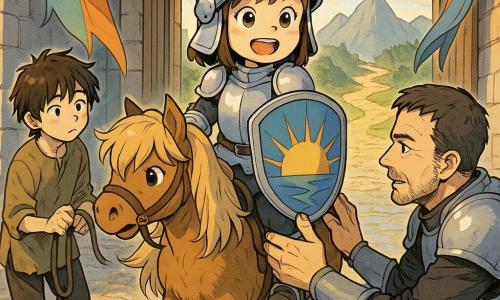
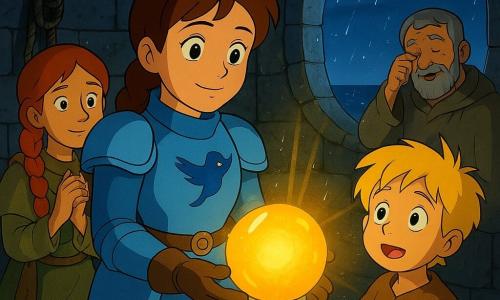
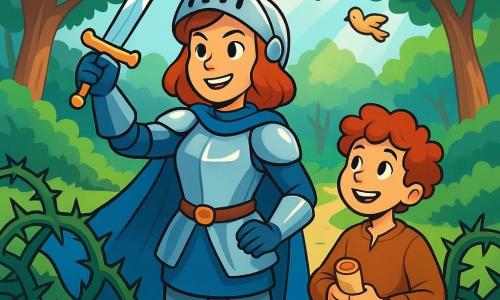
Sir Rowan was a very young knight. He was still smaller than the horses, and his helmet made a soft clink when he walked. He spoke quietly, smiled often, and loved to listen to the wind in the castle flags. More than jousts or loud cheers, Rowan dreamed of making something beautiful for everyone: a bright parade through the village on the day the old bell would ring for spring.
"I want our parade to be kind," he told his teacher, Master Lysa. "I want everyone to feel welcome."
Master Lysa patted his shoulder. "A knight with a gentle heart is brave in a different way. If you prepare it with care, it will be a parade to remember."
Rowan began to plan. He drew banners with stars, flowers, and strong trees. He asked the blacksmith for little silver horns. He learned songs for the march. He visited the baker, the shepherd, the potter, and the fisherfolk, and he asked them to join. Everyone smiled and promised to come. Rowan felt steady and calm, like a lake at dawn.
On the edge of the village lived friends he wanted to include: Mina the mud-pot maker who painted bright swirls, Tomas the flute-player who had traveled from a far hill, and Alin, a shy apprentice who wore a turban with a tiny patch of blue. Some knights teased Rowan. "Parades are for loud heroes," they said. Rowan simply bowed and kept working.
Chapter Two: The Missing Banner
Three nights before the parade, a windstorm rattled the castle. In the morning, a shout rose from the great hall. The castle's Memory Banner—the long cloth that told the stories of past brave deeds—was missing. It had been kept safe for generations and was meant to lead the parade. Without it, the feast felt less whole.
"Who would take our Memory Banner?" asked Sir Brom, a blunt knight.
Rowan felt his stomach twist. He loved the banner because it held pictures of knights and villagers who had helped each other long ago. He did not shout or blame. He knelt and touched the floor, thinking.
"Let us search together," Master Lysa said. "Courage is not only in fighting. It is in finding answers."
Rowan led a small group: Mina, Tomas, Alin, and two gentle knights who had once laughed but now looked sorry. They followed footprints through the mud, into the orchard, across the stream, and up a lane lined with lavender. The trail ended at the old willow.
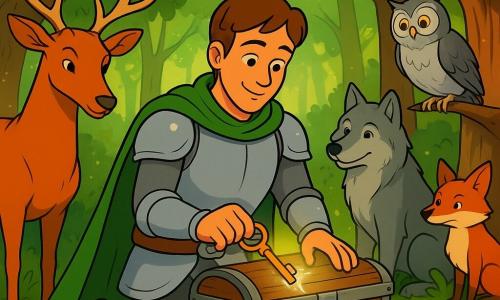
Under that willow sat a little fox, blinking, and beside the fox on a root was the Memory Banner, wrapped in soft leaves. A small child from the village stood nearby, cheeks red from running.
Rowan knelt. "Why did you take the banner?" he asked in his calm voice.
The child fidgeted. "I wanted to see the pictures. My sister told me stories, but we do not have big things like that. I thought I could hide it and look."
Mina knelt too and offered a muddy cookie. "We will share the stories with you," she said. "No one should be afraid to ask."
They brought the banner back. Rowan did not scold the child. He asked the villagers to join in a telling under the willow that night. They sat on blankets, and Rowan pointed to the figures on the cloth, explaining each gentle deed. People listened. The child hugged the banner and promised to help carry it in the parade. Rowan felt the warm kind of bravery that grows when people understand each other.
Chapter Three: The Bridge of Voices
The day before the parade, a wooden footbridge that crossed the river creaked and gave way. It was old and many people used it to reach the market. Now it was broken. The smith could mend it, but heavy timbers were needed and the river was high.
People began to worry. "If we cannot cross, the bells will ring but the parade will stop," someone fretted.
Rowan looked at the river and then at his friends. He remembered a story on the Memory Banner where people from different lands had joined to build a shelter. "We can build a new bridge," he said softly. "We only need hands and ideas."
Some knights were sure they alone could throw a rope across and carry the goods. But Rowan knew that if they listened to different people, they might find a better way. He called Mina, who shaped clay, Alin with his patch of blue, Tomas who had walked many paths, and the fisherfolk who knew the river's moods.
"We can braid long ropes," suggested the fisher, "and plant a strong tree in the middle to hold a plank."
Alin pointed to stones and said, "If we put stones here, the water will slow and the logs will sit steady."
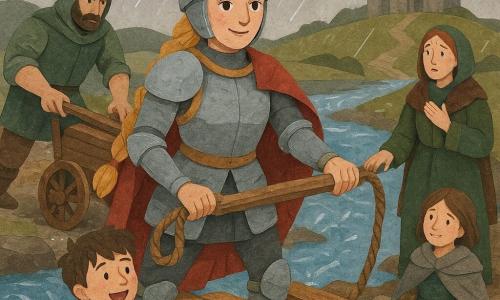
They worked together. The knights lifted, the village women tied ropes, the children fetched nails. Rowan kept the plan calm, telling jokes to make the work light. "Hold the plank steady, and I will sing," he said, and he hummed a tune so the ropes moved like dancers.
By sunset a sturdy bridge arched the river, new and bright. It did not look like any single person's work; it had colors from Mina's clay, a carved post by Tomas, and a blue patch tied by Alin. Everyone stepped onto it, proud. Sir Brom, who had doubted the gentle plan, looked at Rowan and said, "You taught us to listen. A brave knight, indeed."
Rowan smiled. "We built it together," he said. "That is the bravest part."
Chapter Four: The Day of the Parade
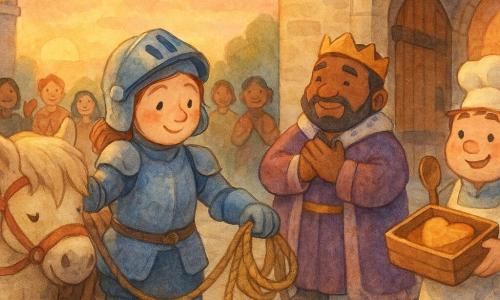
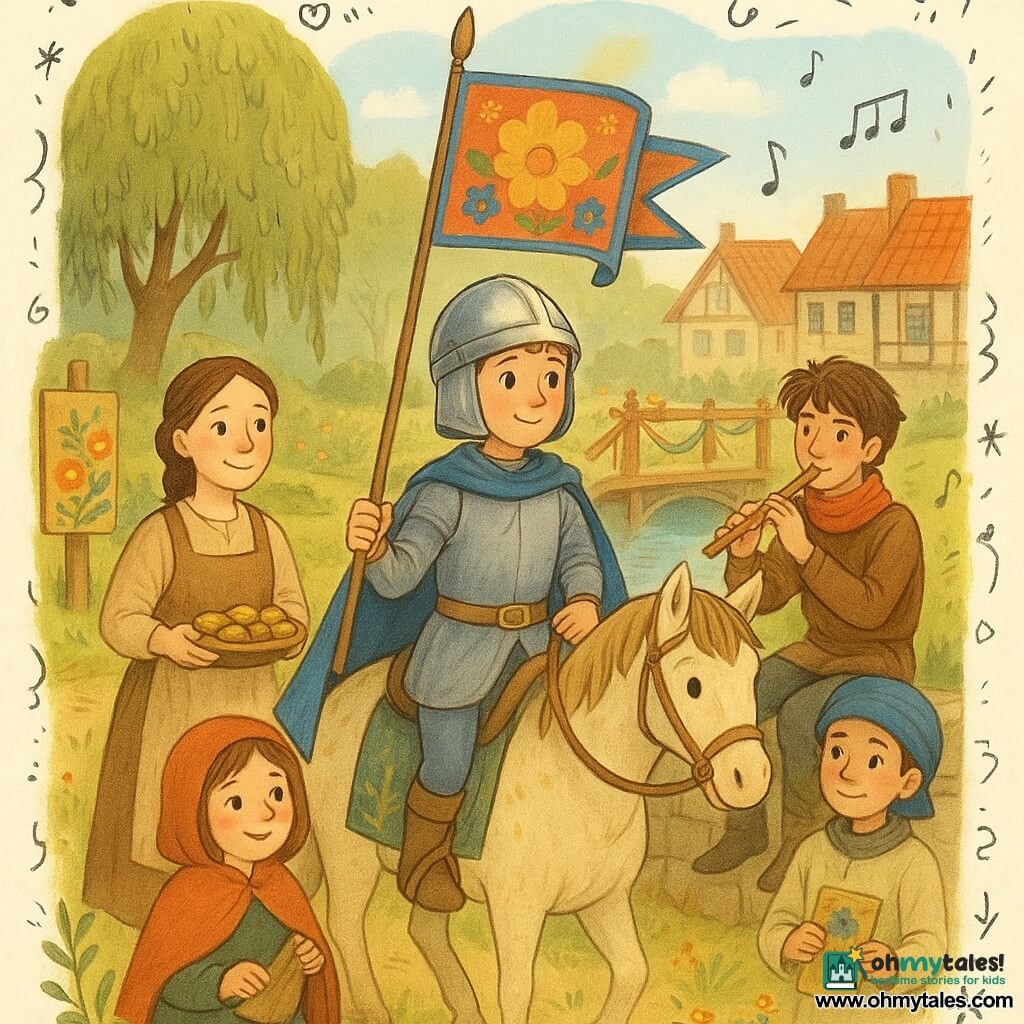
At last the morning came. The castle bell rang, clear and long. People lined the road. Children clapped. The Memory Banner led, carried by the little child from the willow and by Rowan's friends. Rowan rode a calm palfrey draped in cloth painted with trees. His small shield shone like a moon.
As they moved, each group showed their craft. The bakers rolled out trays of star-shaped biscuits. Mina and her helpers wore muddy aprons with painted swirls. The fisherfolk sang soft boat songs. Tomas played his flute, and the sound bounced between white houses like bright birds.
Some knights rode with shiny lances, but they kept their helmets low so the crowd could see their smiles. Rowan rode slowly, waving, meeting every face. He stopped when he saw Alin bow to a visiting caravan. The caravan came from a land with tall hats and bright scarves. At first, a few villagers had looked uneasy, but Rowan lifted his hand and invited them.
"Join our march," he said. "Bring your colors."
They joined, and their flags made the parade richer. Old concerns melted like frost in the sun. The villagers clapped for the caravan's music. Rowan felt proud and light. The parade became a gathering of many voices, not one loud voice.
When the march ended in the green field by the river, Master Lysa stood and said, "Today we remember. We remember how courage can be kind. We remember how listening builds bridges."
Chapter Five: A Chant of Memory
As the day closed, everyone gathered around the great oak. Rowan climbed a low stone and looked at the faces lit by lanterns. He took a breath and started a melody that he had learned from the stars in the banner. The tune was simple and steady, like a heartbeat.
"Sing with me," Rowan invited. "A chant of memory."
At first a few voices joined, then more. Mina's laugh became a high note, Tomas's flute wove through, the caravan's drums marked a gentle step, and even Sir Brom's voice rose like a slow drum. The Memory Banner hung behind them, soft as old cloth, for all to see.
They sang of small brave deeds: the child who returned the lost lamb, the farmer who shared grain in winter, the fisher who taught a child to row, the knight who fixed a wobbly bridge. They sang of listening, of building, of making room for new friends. The words were simple and stretched like light across the field.
When the song ended, the crowd held a quiet moment. Rowan felt a warm light in his chest. "We will remember," he said softly. "Every small help, every open ear. This is how we stay brave together."
The little child from the willow stepped forward and placed a tiny flower on the Memory Banner. "So we never forget," the child said.
People smiled and nodded. They felt safe and proud. They had sung their memories and stored them like seeds in their hearts.
Rowan found his teacher's hand in the crowd. Master Lysa squeezed it. "Today you led with courage that listens," she whispered.
Rowan looked at the faces around him—some were different, some were like him, all were brave in their own ways. He thought of the bridge, the banner, the parade, and the chant. His heart was calm and full.
That night, as the lanterns dimmed and the castle quieted, the people would hum the chant to sleep and remember the brave little knight who taught them to make a parade of kindness. They would carry the Memory Banner high and tell stories to children for years to come, and the chant of memory would travel like wind through the village, reminding everyone that tolerance, courage, and listening are the greatest acts of all.